Inspiration
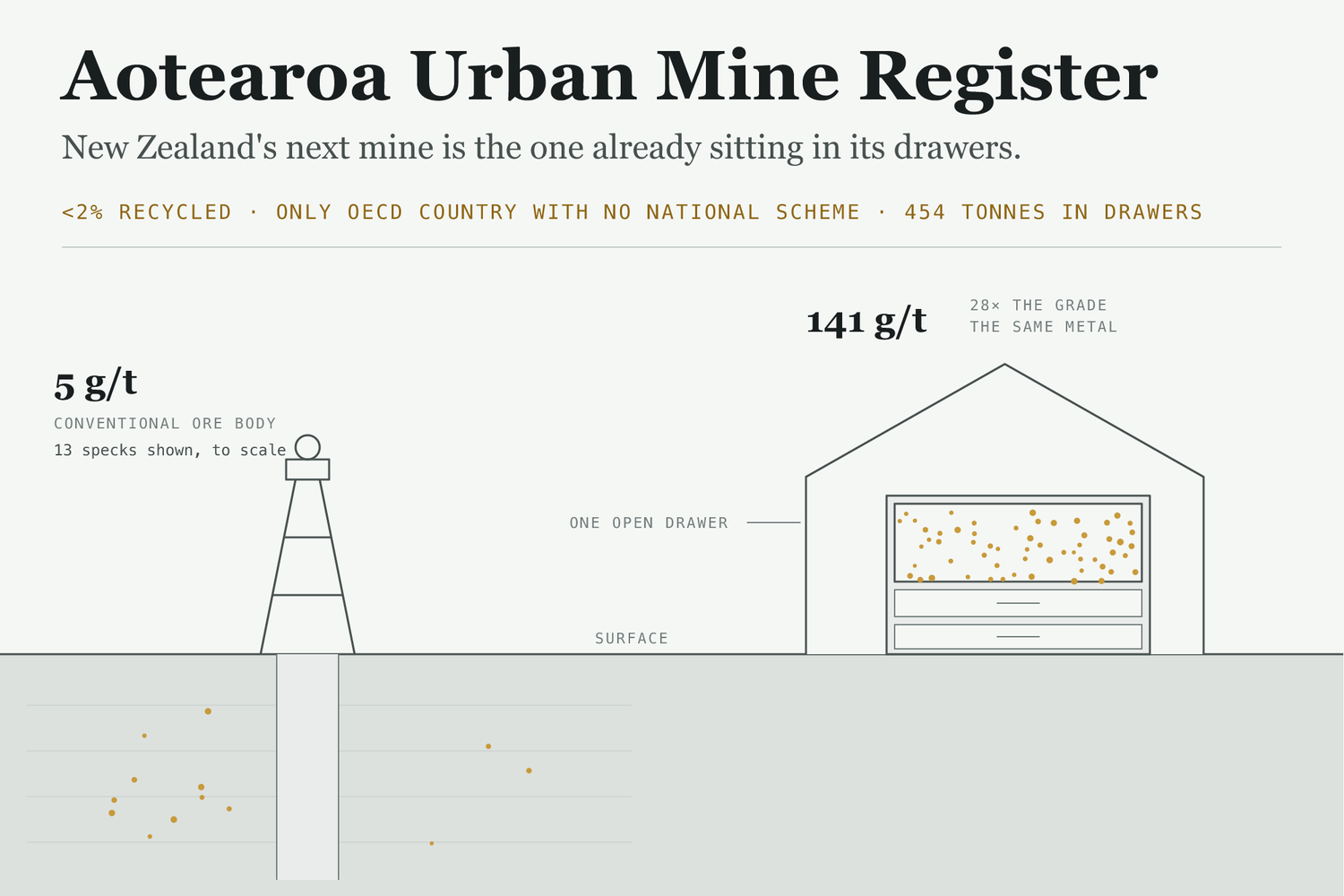
New Zealand is the only country in the OECD without a regulated national e-waste scheme. It recycles under 2% of the roughly 80,000–99,000 tonnes it generates a year, landfills about 97,000 tonnes of it, and exports what little it recovers — 19,000 tonnes in 2020, 98% of it to South Korea — before buying the refined metal back at a premium.
What made me want to work on this was not the scale of the failure but its shape. Electrical and electronic products were declared a priority product under the Waste Minimisation Act in July 2020. TechCollect NZ was funded to design a regulated stewardship scheme and delivered its final reports in mid-2023. The design has been finished and waiting for government endorsement for three years.
So the usual explanations don't apply. The intent exists. The design exists. The technology to shred, separate and refine electronics has existed for decades. I wanted to understand what was actually missing.
What it does
The Aotearoa Urban Mine Register is a proposal that reframes New Zealand's hoarded household electronics as an undeveloped mineral deposit, and applies the reporting and financing machinery the country already uses for mineral reserves.
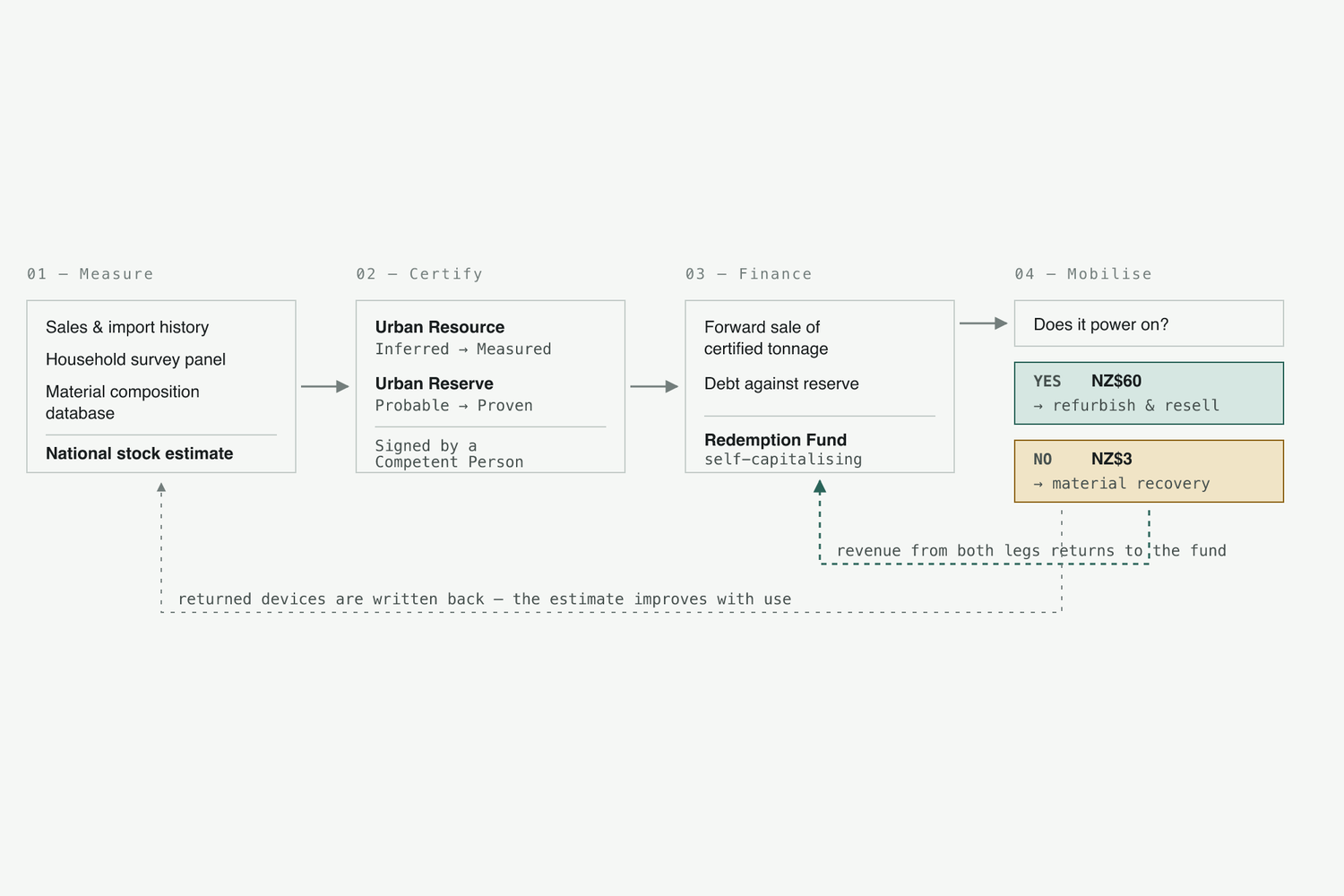
It works in four moves:
Measure the national household stock of devices and its recoverable material content, from import and retail sales history, a household survey panel, and a device-model → material composition database.
Certify that stock under an urban-mining adaptation of the JORC Code — the Australasian Code for Reporting of Mineral Resources and Ore Reserves, which has been incorporated into New Zealand Stock Exchange listing rules since 1992. JORC's Resource/Reserve split and its Inferred → Indicated → Measured confidence ladder transfer to a household device stock almost without modification, including the Competent Person requirement that makes a reserve statement someone's personal professional responsibility.
Finance against the certified reserve, through a forward sale of a fraction of the certified tonnage and debt raised against the reserve statement — both ordinary instruments in conventional mining. What has been missing is not the instrument but a certified reserve to apply it to.
Mobilise the stock by paying households directly for returned devices, at a price steeply differentiated by whether the device still powers on.
The core problem it solves is one nobody currently working on New Zealand e-waste appears to be addressing. The designed scheme is user-pays: a fee added to the price of a new device funds that device's eventual recovery. That is sound for material entering the market from the day the scheme starts, and it has one unavoidable consequence — every device already in a New Zealand home is permanently outside it. No fee was ever paid on it. The scheme has no funds attached to it and no claim over it.
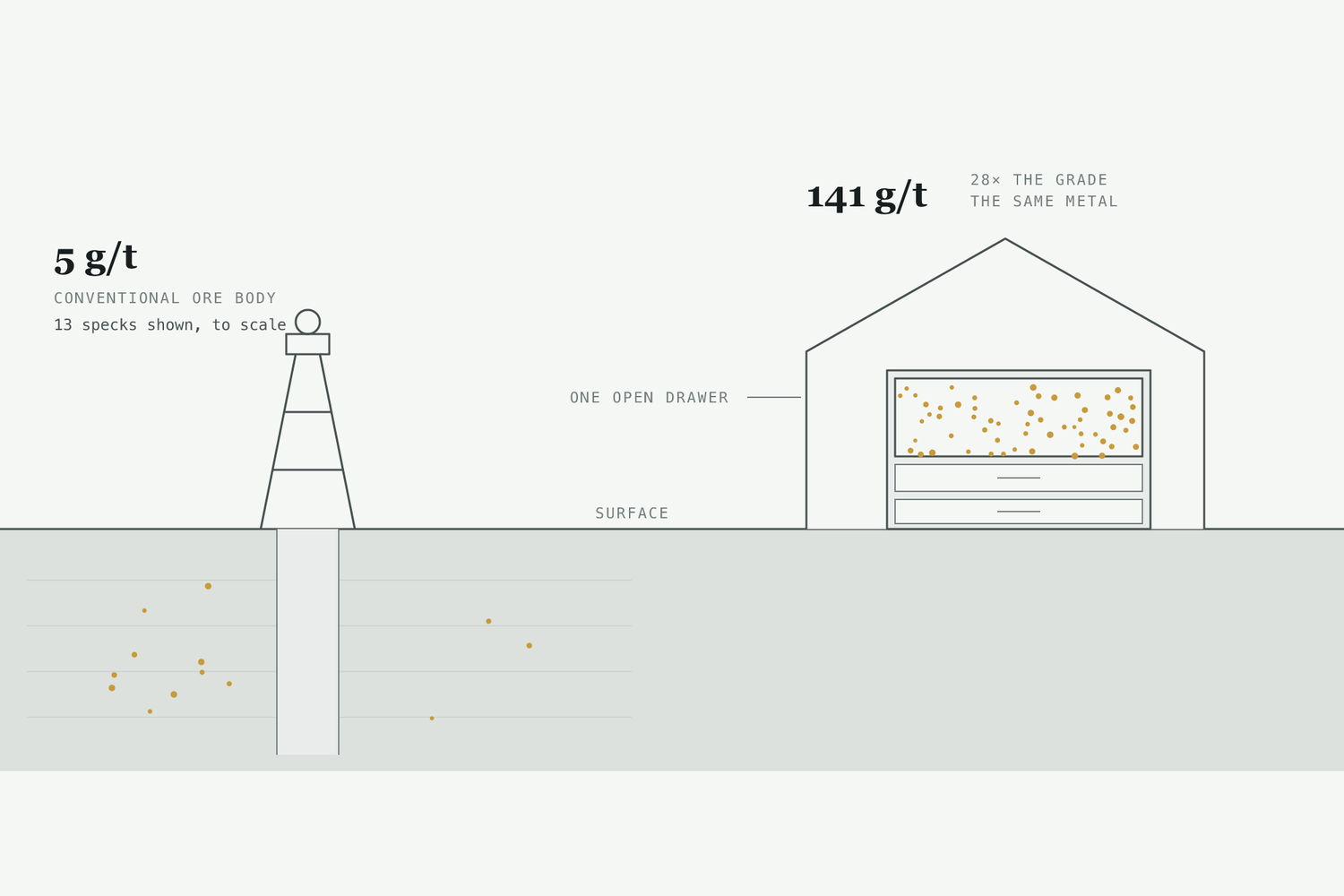
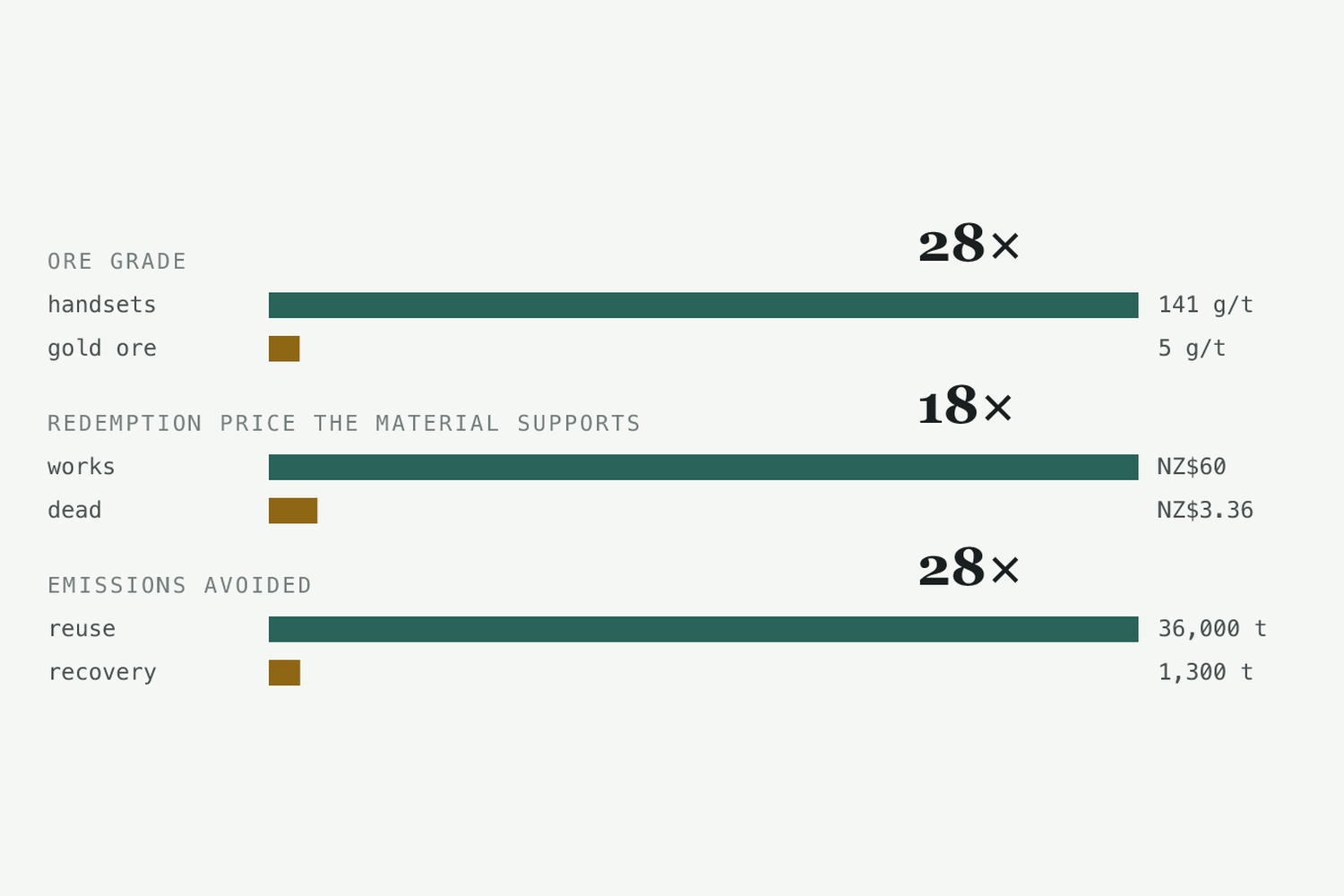
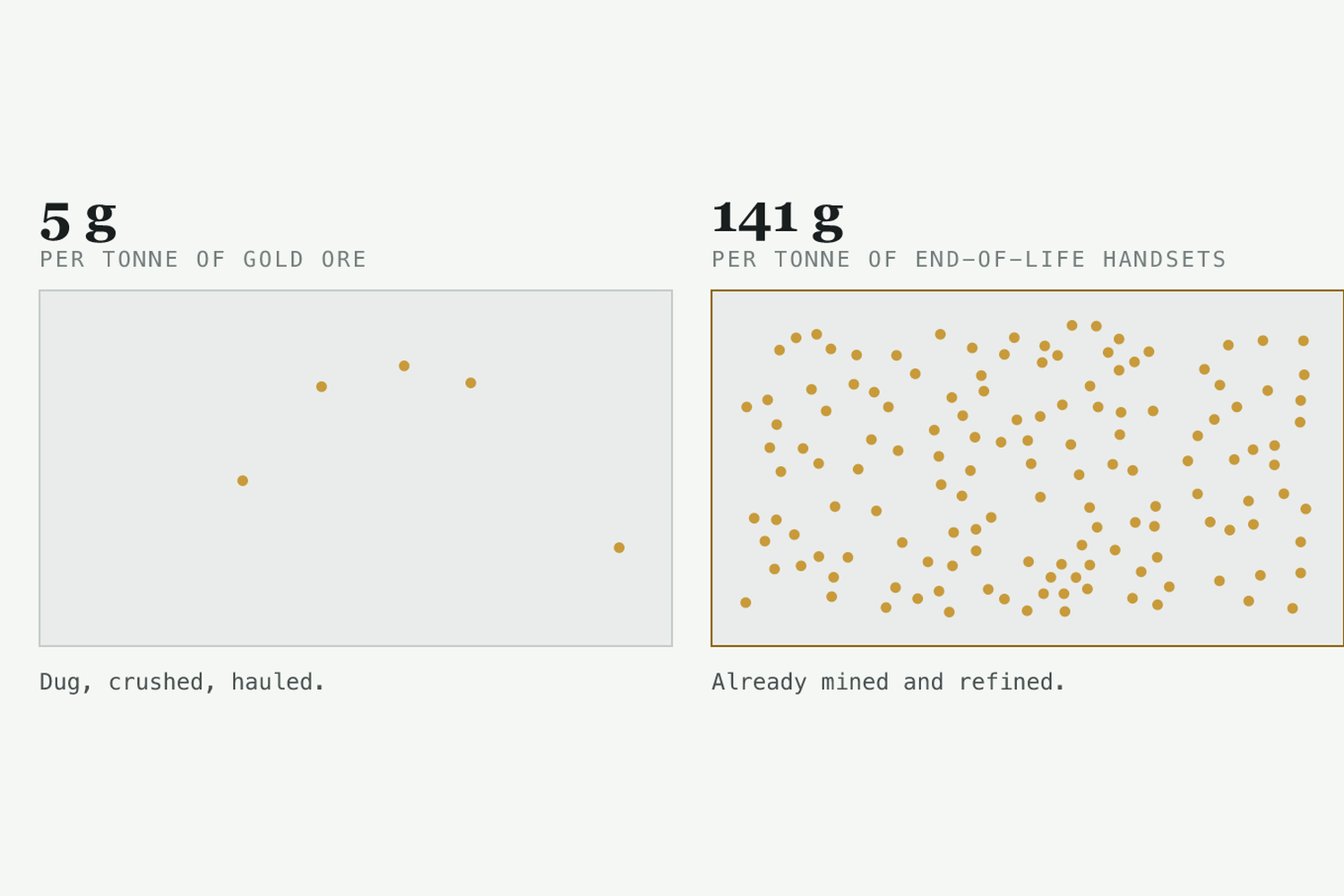
That matters because of which devices those are. Hoarded phones and laptops are not a random slice of the waste stream; they are the richest part of it. A tonne of end-of-life handsets carries roughly 141 grams of gold, against typical gold ore at about 5 grams per tonne.
How we built it
There was no code to write — this is a policy and market-design proposal — so the work was research, then arithmetic, then a lot of revision when the arithmetic disagreed with the design.
I started from New Zealand's primary sources: the Ministry for the Environment's waste work programme and its live Basel Convention consultation, TechCollect NZ's scheme design, Stats NZ census and population figures, and the RNZ reporting on why New Zealand exports unrefined e-scrap. For the international comparators I used the JORC Code itself, AusIMM's standards documentation, UNDP's urban-mining material, Material Focus and SellCell household hoarding surveys, and August 2026 LME and spot commodity prices.
Then I assayed the stock the way you would assay an orebody: 1.78 million households × 1.5 hoarded handsets × 170 g = 454 tonnes of material, at a conservative 141 g/t gold grade = 64 kg of contained gold, worth US$8.31 M at US$129.83/g, plus US$0.65 M of copper — US$8.96 M in total, with silver, palladium, cobalt, aluminium and rare earths deliberately excluded so the figure stays conservative.
Then I did the whole thing again in Wolfram Language, independently, to check it — including taking the troy-ounce-to-gram conversion from Wolfram's own unit system instead of a constant I'd typed in. Both derivations agree to the cent. Wolfram also solved the redemption model symbolically across the full range of its weakest assumption, which produced the sharpest number in the submission (below).
Everything is published with its inputs visible so it can be checked and disputed. The deliverables are a five-section document, five figures, and a web version designed to read like a geological reserve statement rather than a sustainability brochure — greywacke greys, with brass and verdigris as the two accent colours, because gold and copper are the two metals in the assay. The illustrations are generated by a seeded scatter script, so the 141 gold specks in the drawer are actually 141 specks, not a suggestion of "lots".
Challenges we ran into
The arithmetic broke the design, and that turned out to be the most valuable thing that happened.
The original plan was straightforward: certify the reserve, borrow against it, pay households for their old devices. Then I divided the material value by the number of devices.
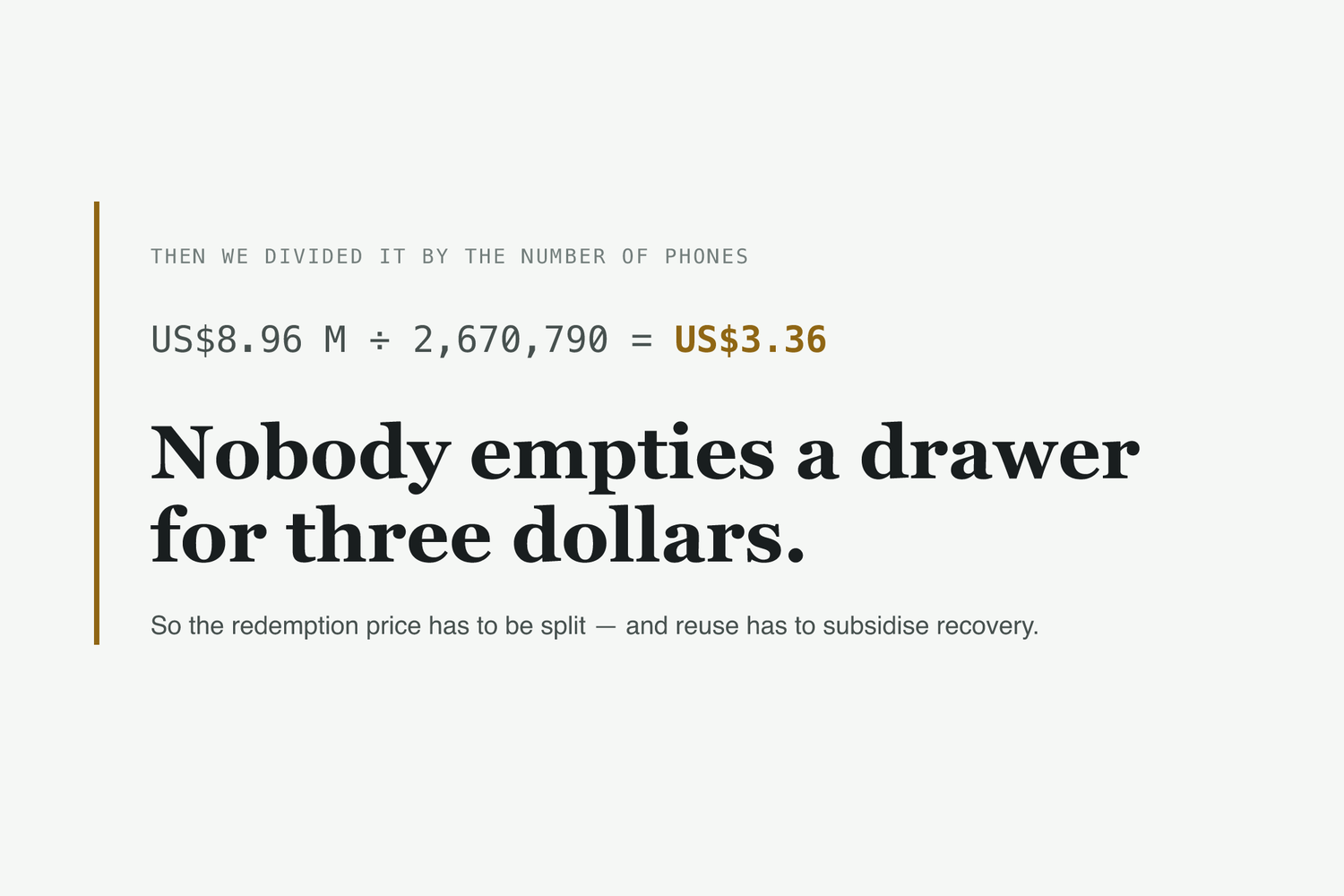
US$8.96 M ÷ 2,670,790 devices = US$3.36 per device
After processing, consolidation and freight, that supports a redemption ceiling of about NZ$3.36 per phone. Nobody empties a drawer for three dollars. The scheme, as designed, could not pay enough to mobilise the very stock it existed to mobilise.
I think this is the actual reason every pure-recycling scheme fails to reach household hoards, and it is not something better collection logistics can fix. Material recovery cannot generate a payment large enough to change a household's behaviour. The number is simply too small.
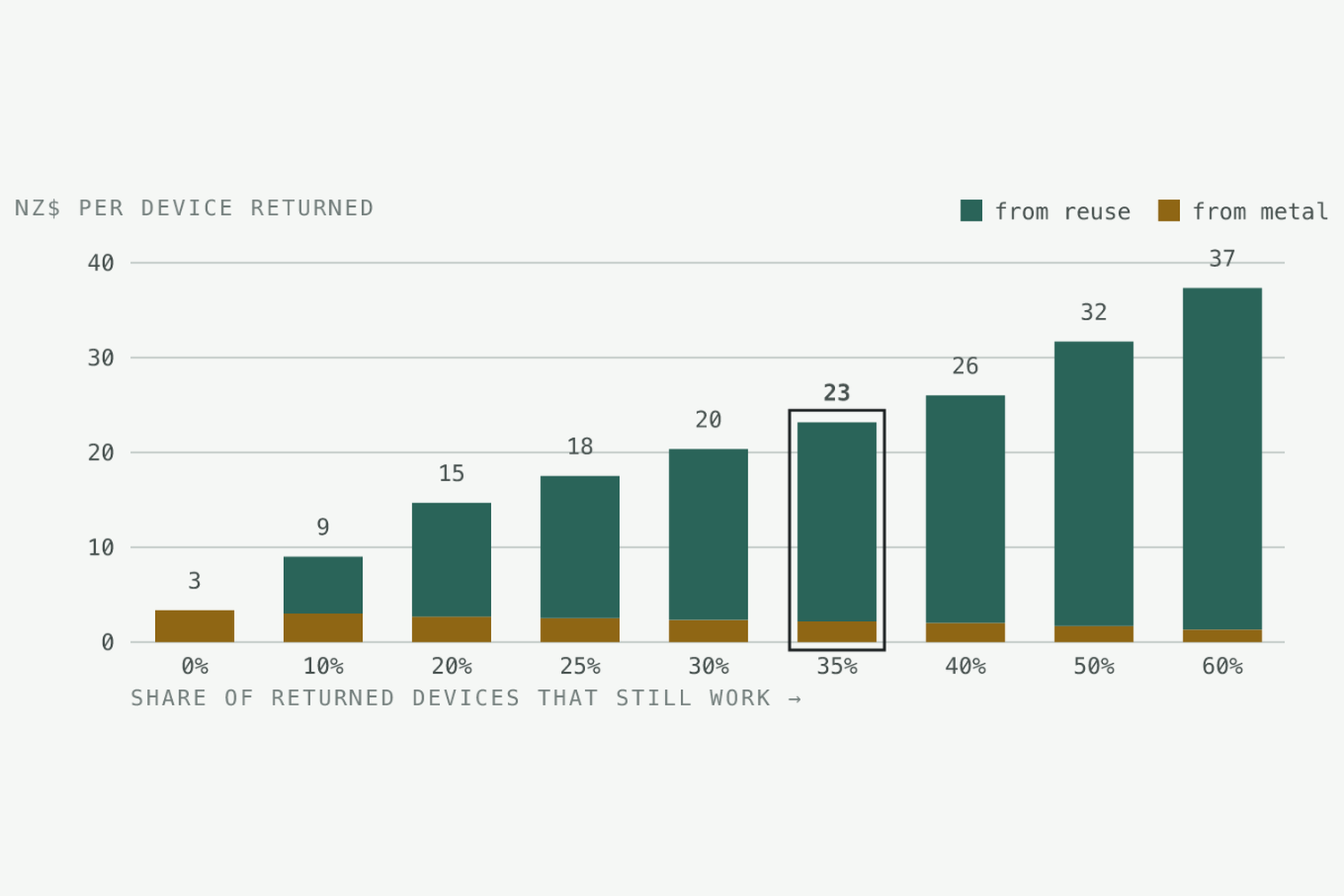
The fix came from the reuse side. A working second-hand handset sells in New Zealand for NZ$80–250; net of refurbishment, testing and data sanitisation, about NZ$60 — roughly eighteen times the material value. So the redemption price has to be split: a floor price for dead devices, a much higher price for working ones, with the reuse leg subsidising the recovery leg.
Differentiated pricing stopped being a refinement and became the mechanism that makes the whole thing solvent.
The second challenge was resisting the obvious idea. My first concept was a component-level reuse scoring index. Half a day of research found eReuse.org doing open-source component-level traceability, the French repairability index and its EU EPREL successor doing published reuse scoring, commercial ITAD software doing grading and routing, and the EU Digital Product Passport mandating structured material and dismantling data from February 2027. It was already built, four times over. Throwing it out was the right call and it cost me most of a day.
Accomplishments that we're proud of
Finding a mapping that is genuinely exact rather than merely evocative. I expected "treat e-waste like a mine" to be a nice metaphor that fell apart under scrutiny. Instead JORC's structure fits a household device stock almost line for line — Resource versus Reserve, the Inferred/Indicated/Measured confidence ladder, the Modifying Factors, the Competent Person — and JORC has had legal force in New Zealand through NZX listing rules since 1992. The proposal borrows a standard the country's own regulators already trust rather than inventing one nobody has reason to believe.
Turning the weakest assumption into a falsifiable target. The 35% refurbishable share is the one input with no New Zealand data behind it, and the whole scheme rests on it. Rather than assert it and move on, I solved the redemption model across its entire range in Wolfram. The result: at 35% the reserve supports an average redemption of NZ$23.18 per device — but paying NZ$25 would require a 38.2% share, which is more than I assumed. Publishing the number that undercuts my own assumption is, I think, the most useful thing in the document. It gives a regional trial something specific to disprove.
Getting two independent calculations to agree. The economic ceiling says pay more for the working device, because reuse supports an 18× higher redemption price. The carbon analysis says pay more for the working device, because the reuse leg avoids roughly 36,000 tonnes of CO₂e against about 1,300 tonnes for material recovery — 28× greater. Those are unrelated calculations arriving at the same instruction, and that coincidence is what makes reuse-first pricing defensible rather than just appealing.
Publishing the limitations properly. A reserve statement that doesn't declare its own confidence level isn't a reserve statement, so the proposal names its load-bearing uncertainties explicitly — the stock estimate is Inferred until surveyed, and the 35% refurbishable share is the input the whole thing hinges on.
What we learned
The bottleneck in circular economy work is almost never the technology. The sorting, separation and refining technology has existed for decades. What is missing is a mechanism that makes recovery pay for itself without waiting on an appropriation.
Stationary material behaves nothing like moving material. Collection logistics is the right frame for waste already in the stream. It is the wrong frame for a drawer. A 2006 New Zealand survey found 85% of people willing to carry items to a neighbourhood collection point, and the recycling rate is still under 2% twenty years later. Willingness was never the constraint. A drawer is not an access problem, and it needs a price rather than a bin.
Reuse and recycling are not neighbours on a spectrum — they are different businesses by an order of magnitude. Eighteen times the value, twenty-eight times the carbon benefit. Treating them as adjacent rungs of the same ladder obscures how much of the available benefit sits on one rung.
Do the arithmetic before committing to the design. The US$3.36 figure would have been just as true if I had found it after writing the proposal instead of before. It would simply have been fatal instead of useful.
What's next for Aotearoa Urban Mine Register
The immediate next step is the one the proposal itself calls for: replacing the Inferred stock estimate with a Measured one. The 1.5 handsets per household assumption is drawn from UK, US and European survey data, and a New Zealand household survey panel would move the estimate up the JORC confidence ladder and make the reserve statement signable.
Beyond that: extending the model past handsets to laptops, tablets and small appliances, where the material composition database has to do considerably more work; testing redemption price elasticity in a single region before committing to a national figure; and putting the JORC-UM classification framework in front of AusIMM and the Ministry for the Environment, since a standard nobody adopts is just a document.
The mechanism is not New Zealand-specific. New Zealand is simply the clearest case, because it is the OECD's outlier and because its stalled scheme makes the blind spot visible. Any jurisdiction funding e-waste recovery through an advance fee has the same legacy stock problem, and does not yet know it.
Built With
- carbon-accounting
- circular-economy
- css
- data-analysis
- e-waste
- html
- jorc
- lifecycle-assessment
- market-design
- mineral-economics
- new-zealand
- policy-design
- product-stewardship
- research
- resource-recovery
- sensitivity-analysis
- sustainability
- svg
- urban-mining
- wolfram-technologies

Log in or sign up for Devpost to join the conversation.