Inspiration
The inspiration for Welcome Anywhere came from personal experiences and stories of friends who struggled during relocations—whether for work, education, or family reasons. Existing city guides and relocation tools were either too generic or overly complex. We wanted to create something that feels like a helpful local friend: simple, personalized, and genuinely supportive from day one.
What it does
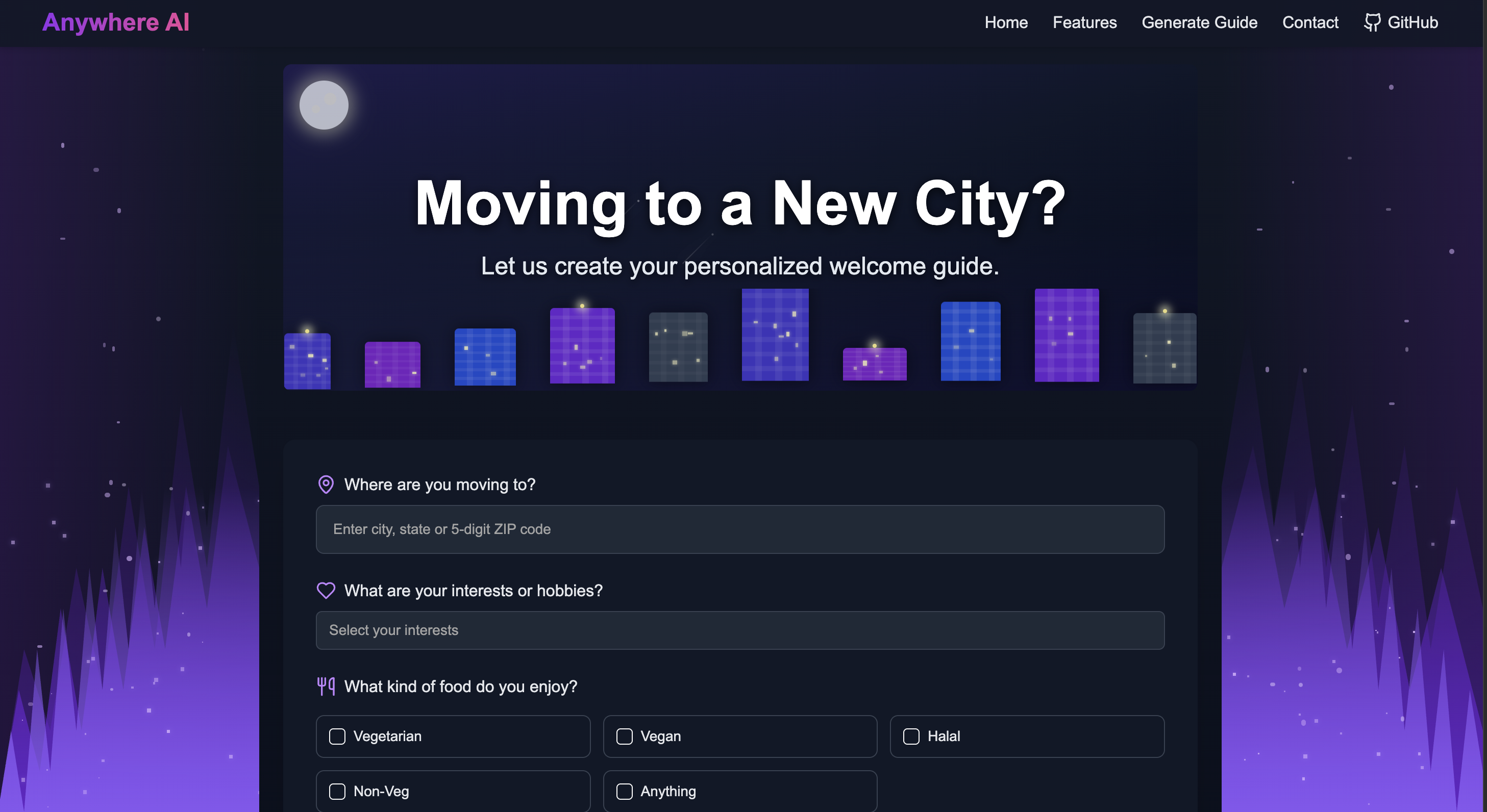
Welcome Anywhere is an AI-powered city guide designed specifically for newcomers. It takes user input—like location, interests, dietary needs, job field, and more—and instantly generates a personalized guide that includes: 1)Tailored housing suggestions based on budget and lifestyle 2)Job opportunities matched to your professional background 3)Local events and activities that align with your interests 4)Food and restaurant recommendations based on dietary preferences 5)Language learning resources for non-native speakers 6)Community services and support tailored to your relocation needs All of this happens in real time, without requiring a login or navigating a chatbot. Users simply fill out a form, hit "Generate My Guide," and receive an interactive, easy-to-explore personal relocation roadmap.
How we built it
We built Welcome Anywhere with a Next.js 14 frontend, styled using Tailwind CSS and shadcn/ui. We used React Hook Form with Zod for robust and user-friendly form validation. The AI recommendation system is powered by custom models that process user inputs and fetch localized, context-aware results across housing, food, jobs, events, and more. Every result is rendered in a clear, interactive UI designed for accessibility and responsiveness
Challenges we ran into
While building Welcome Anywhere, we faced several challenges:
1)Balancing Personalization with Simplicity: We had to ensure recommendations were relevant and specific, but also concise and easy to read. Crafting AI prompts that struck this balance took multiple iterations.
2)Data Aggregation: Reliable, city-specific data is often scattered or limited. We had to design fallback mechanisms and graceful degradation for cities with sparse data.
3)Form UX and Validation: Designing a form that was user-friendly but also robust took effort. We used Zod and React Hook Form, but aligning schema validation with dynamic fields introduced edge cases.
4)Mobile Optimization: Since many users access relocation tools on the go, ensuring a seamless mobile experience was critical. This required multiple layout refinements and testing.
5)Content Rendering: Displaying AI-generated content across tabs without causing layout shifts or performance lag involved some complex state handling and component restructuring.
Accomplishments that we're proud of
Built a fully functional MVP in record time with a clean UI and seamless UX.
Achieved real-time AI personalization across six critical areas without overwhelming the user.
Created a no-login, frictionless experience that lowers the barrier to entry for all users.
Designed with inclusivity in mind, offering support for non-native speakers, dietary needs, and various community support resources.
Successfully integrated modern technologies like Next.js 14, Tailwind CSS, and custom AI models to create a cohesive, scalable product.
Received positive feedback from early testers who found it genuinely useful and emotionally reassuring during simulated relocation scenarios.
What we learned
Empathy is essential in product design—understanding real-life relocation pain points helped us make better technical and UX decisions.
AI is only as good as the inputs and prompts—we iterated extensively to optimize prompt design for relevance, diversity, and tone.
Simplicity beats complexity—users appreciated the direct form and instant guide generation far more than chatbot-style interactions.
Clean architecture and modular design made it easy to test, iterate, and deploy features without breaking others.
Cross-device responsiveness matters—designing for mobile-first ensured our app was accessible anytime, anywhere.
What's next for Anywhere-AI
Real-time updates: Incorporating live data feeds for jobs, housing, and events to keep guides current.
Native mobile apps: Building iOS and Android versions for improved accessibility and offline use.
Multilingual support: Translating the interface and guides into multiple languages to serve a broader audience.
Local insights: Allowing community members to contribute tips, favorite spots, and verified resources.
Service integrations: Partnering with housing platforms, job boards, and local services for deeper recommendation quality.
Accessibility upgrades: Enhancing navigation and readability for users with disabilities.
Optional user profiles: Letting users save and revisit their guides while still prioritizing privacy and ease of use.
Built With
- 14
- ai
- api
- cloudflare
- css
- custom
- db
- form
- github
- googleplaceai
- hook
- mapbox
- mapboxai
- models
- mongodb
- next.js
- node.js
- openai
- orm
- performance
- places
- prisma
- react
- routes)
- security
- shadcn/ui
- supabase
- tailwind
- typescript
- vercel
- zod
- zustand

Log in or sign up for Devpost to join the conversation.