-
-
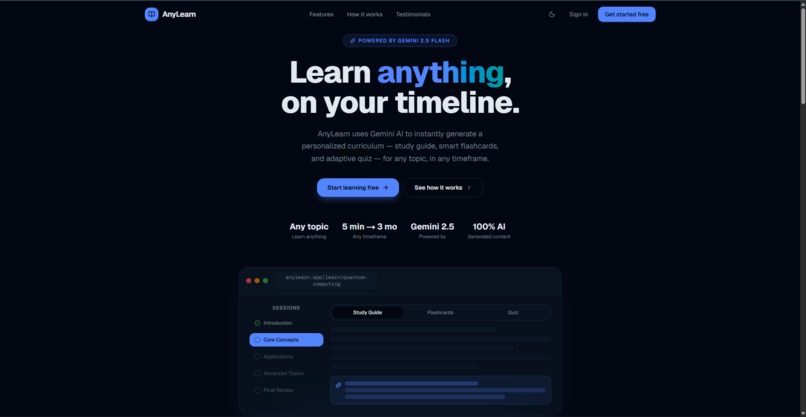
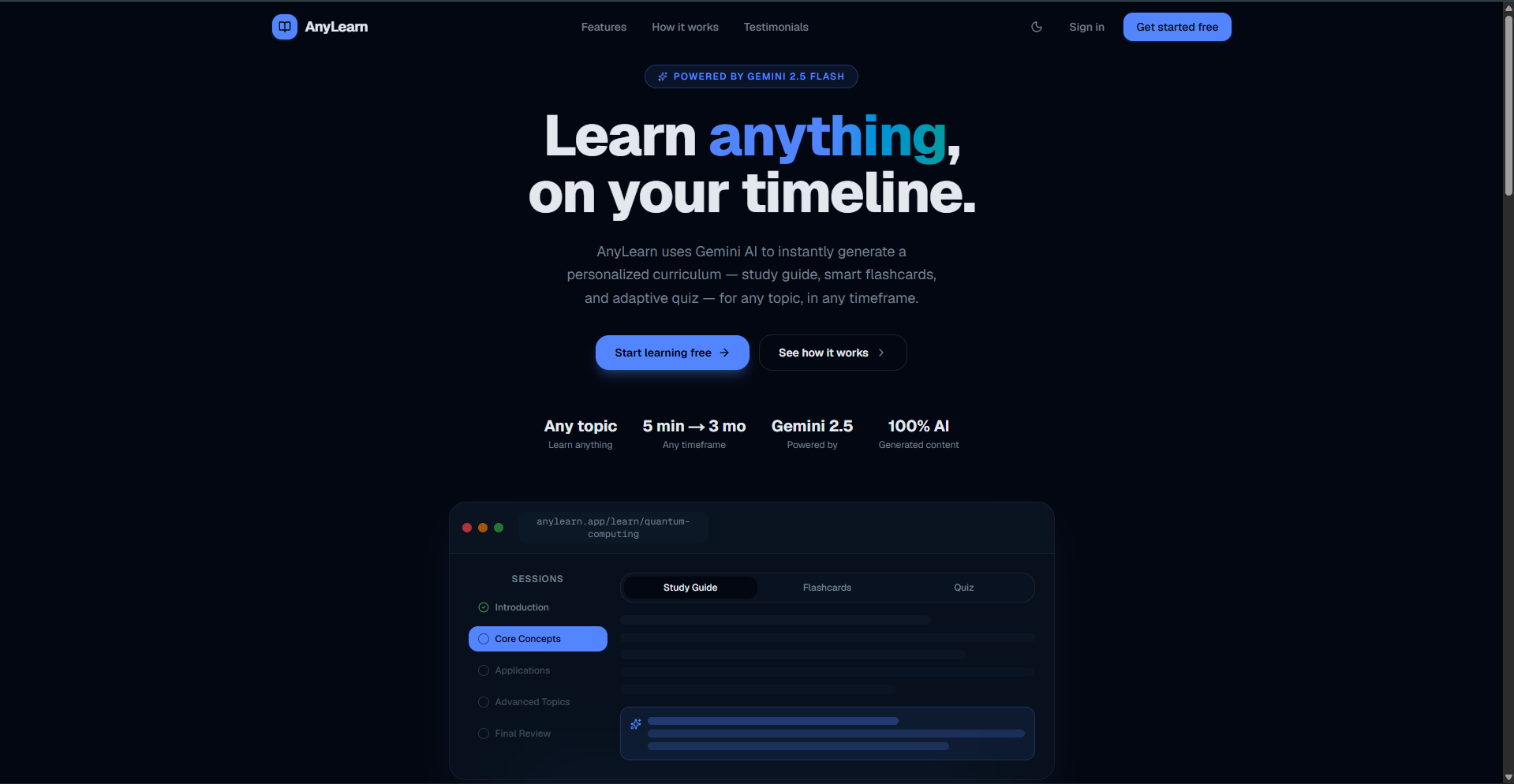
homepage in dark theme
-
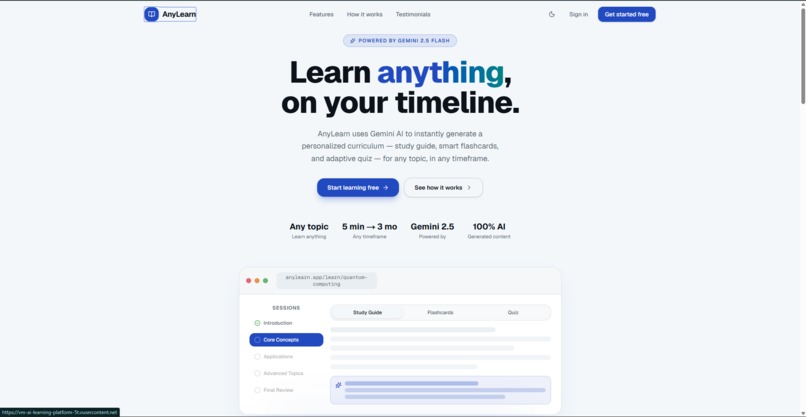
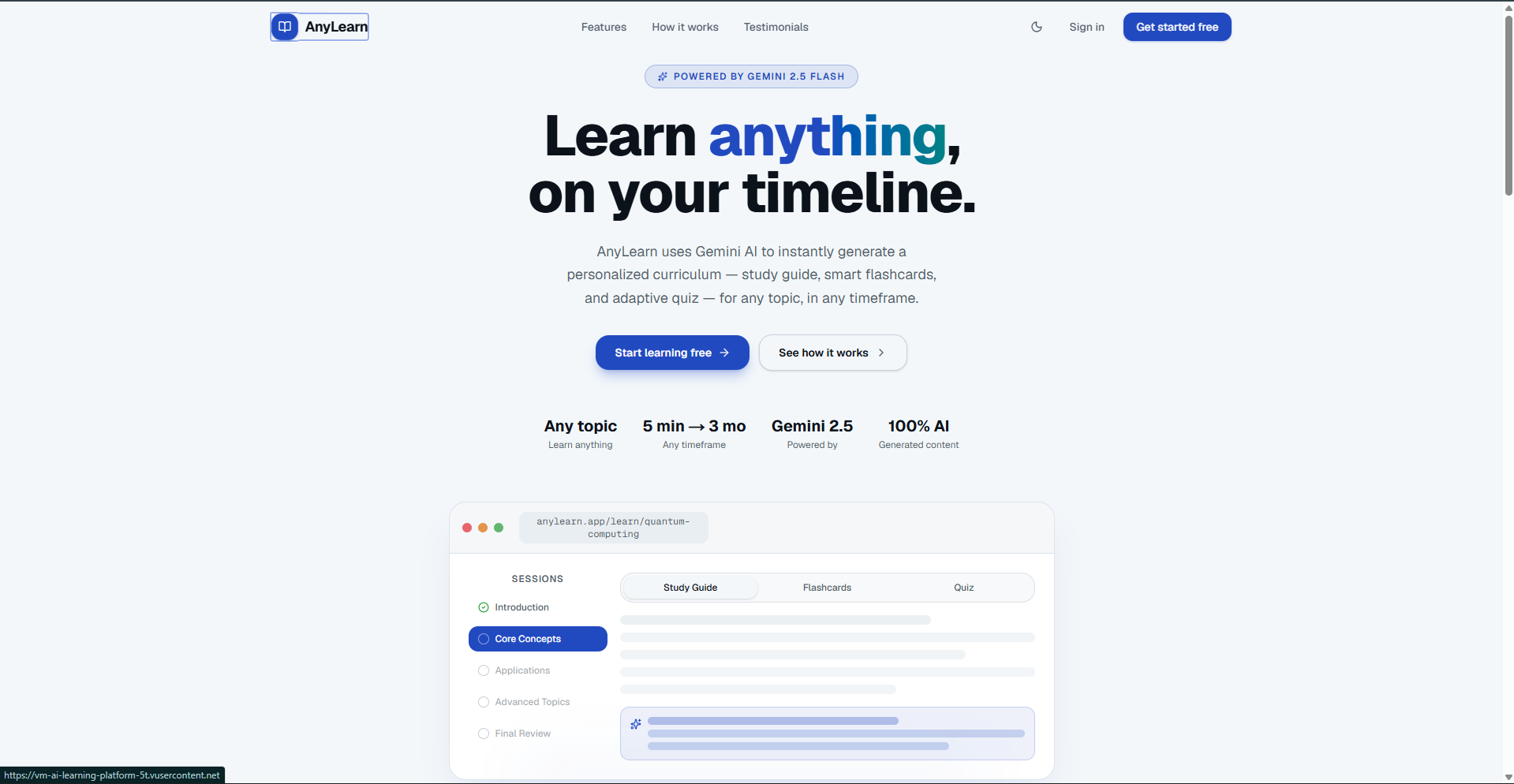
homepage in light theme
-
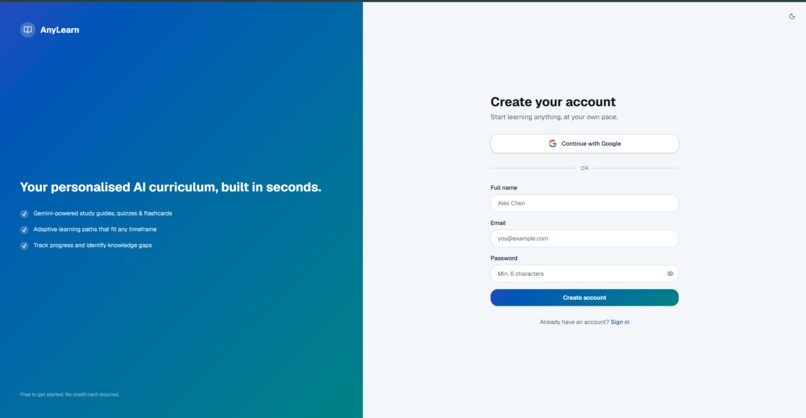
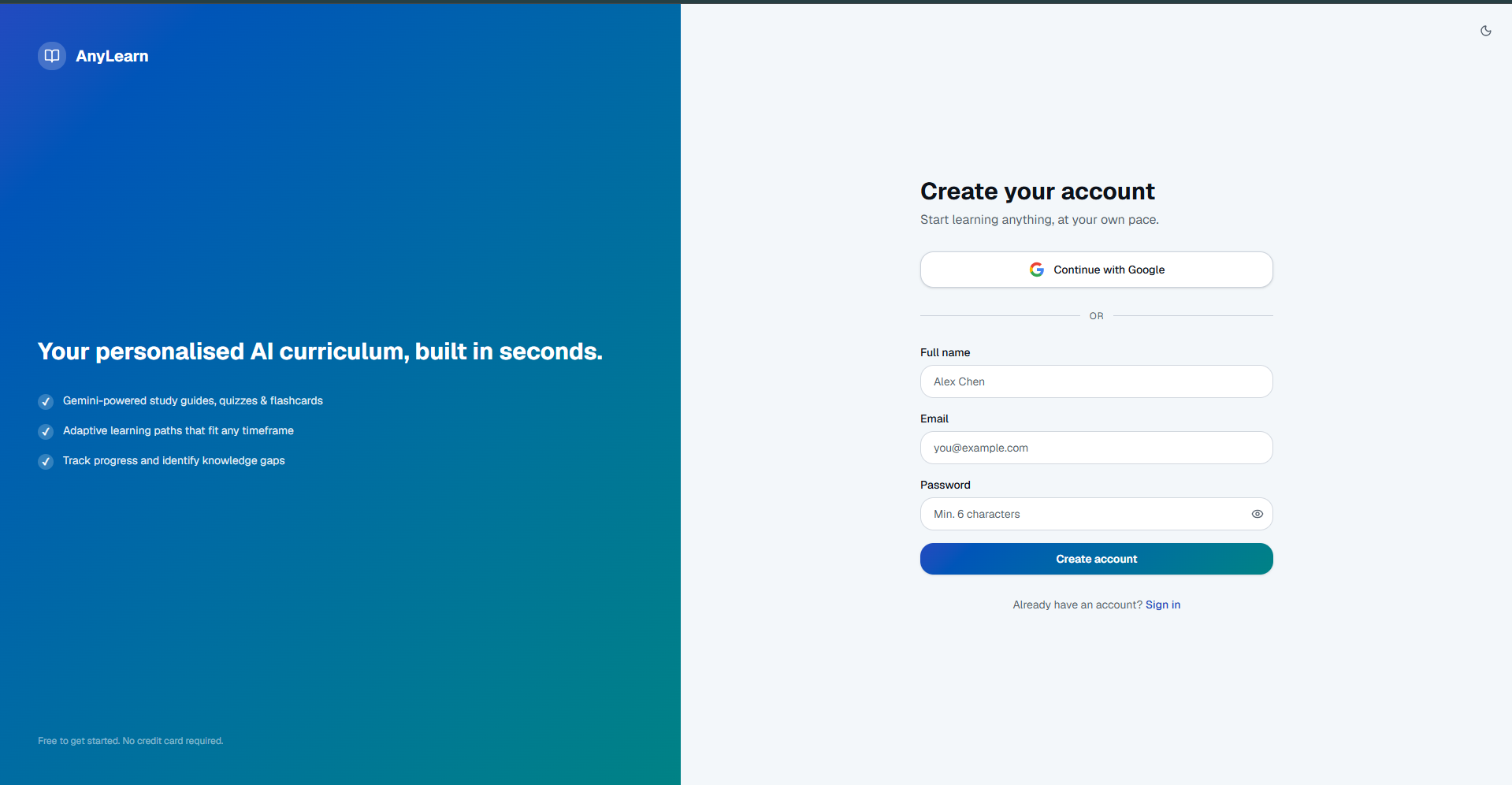
signup page in light theme
-
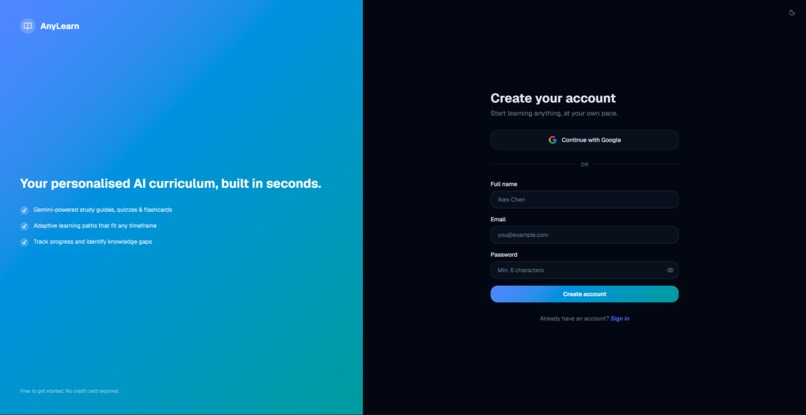
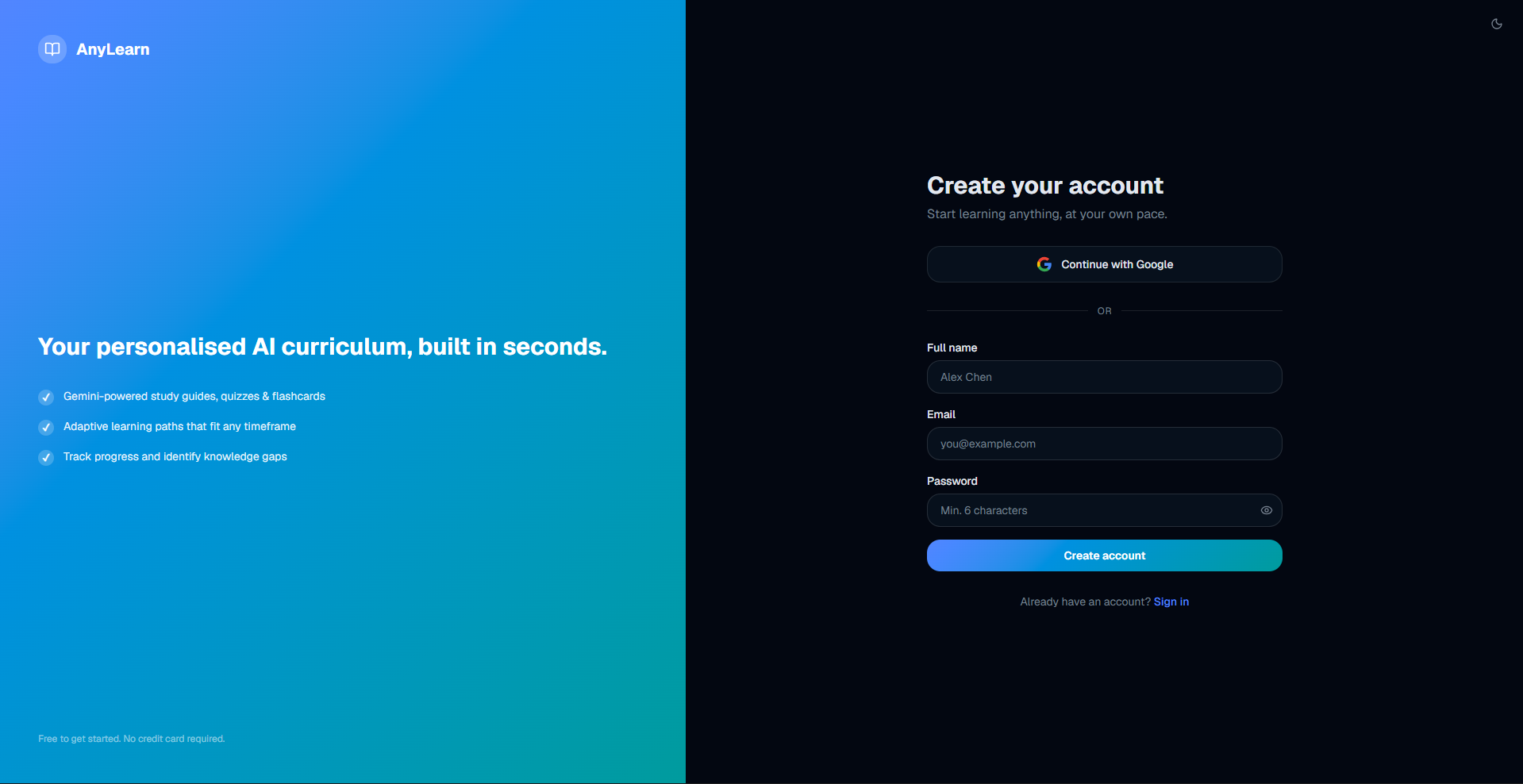
signup page in dark theme
Inspiration
Every time I wanted to learn something new — a programming language for a weekend project, music theory before a trip, the basics of investing — I hit the same wall. Courses are built for a fixed pace and a fixed syllabus, not for my topic and my timeline. I'd spend more time assembling a study plan than actually studying.
So I asked a simple question: what if an AI could generate a complete, structured curriculum for literally any topic, scaled to exactly how much time I have — five minutes or three months? That question became AnyLearn.
What it does
AnyLearn turns any topic into a personalized learning path:
- AI-generated curriculum — Gemini 2.5 Flash builds a full plan tailored to your topic, goal type, and available time.
- Structured sessions — Material is broken into progressive sessions (Foundations → Core Concepts → Applied Skills → Advanced Topics → Mastery Review) that unlock as you advance.
- Three learning modes per session:
- A multi-section study guide with key takeaways
- Smart flashcards with 3D flip animations and per-card mastery tracking
- An adaptive 5-question quiz, freshly generated every time — never the same quiz twice
- Progress analytics — streaks, quiz scores, and learning velocity across every topic.
How we built it
The app is a Next.js 16 (App Router) + React 19 + TypeScript application styled with Tailwind CSS v4 and animated with Framer Motion.
- AI layer — All educational content is generated through the Vercel AI SDK using
generateObject, with Gemini 2.5 Flash as the model. Every output is constrained by a Zod schema, so quizzes, flashcards, and study guides always come back as valid, strongly-typed JSON rather than free-form text. - Auth — Firebase Authentication handles sign-up and login, with a session cookie bridging the client to server-side API routes.
- Database — User profiles, learning sessions, and quiz results are persisted in Amazon Aurora DSQL (Postgres) accessed via the
pgpool. Connections are authenticated with short-lived IAM tokens from@aws-sdk/dsql-signer, using Vercel OIDC (awsCredentialsProvider) so there are no long-lived AWS keys. - API routes handle AI generation, auth/session/onboarding, session CRUD, and quiz result storage.
- Deployed on Vercel.
Schema-constrained generation is the core idea. For example, every quiz must satisfy:
$$\text{questions} = 5, \quad \text{options per question} = 4, \quad 0 \le \text{correct} \le 3$$
which guarantees the UI never has to defend against malformed AI output.
Challenges we ran into
- Reliable structured output — Early free-text prompts produced inconsistent shapes. Moving to
generateObjectwith strict Zod schemas (exact counts, bounded indices) made AI responses safe to render directly. - Keyless cloud auth — Wiring Aurora DSQL's IAM token signing to Vercel's OIDC provider so the serverless functions authenticate without storing AWS secrets took careful configuration.
- Connection management on serverless — Using a pooled
pgclient withattachDatabasePoolto keep DSQL connections healthy across function invocations. - Tuning prompts per session — Getting content difficulty to scale appropriately with both the session number and the chosen timeframe.
What we learned
- Pairing an LLM with a schema validator turns "creative but unpredictable" generation into a dependable backend primitive.
- OIDC-based, keyless access to cloud databases is a real, practical security upgrade over static credentials.
- Good structure around an AI — sessions, gating, analytics — matters as much as the model itself for an actual learning experience.
What's next for AnyLearn
- Spaced-repetition scheduling for flashcards
- Multi-modal content (diagrams, generated illustrations)
- Shareable learning paths and collaborative study
- Voice-based quiz mode
Built With
- amazon-aurora-dsql
- firebase
- firebase-auth
- framer-motion
- gemini-2.5-flash
- google-gemini
- next.js
- node.js
- postgresql
- react
- tailwind-css
- typescript
- vercel
- vercel-ai-sdk
- vercel-oidc
- zod

Log in or sign up for Devpost to join the conversation.