-
-
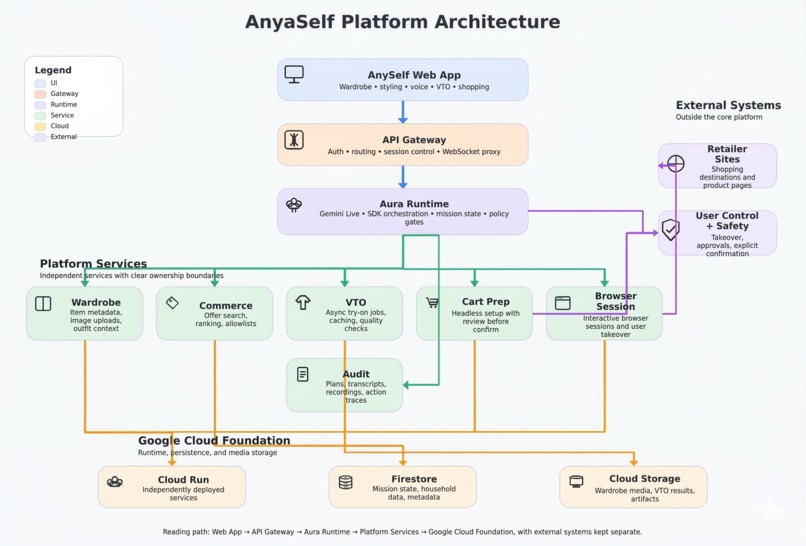
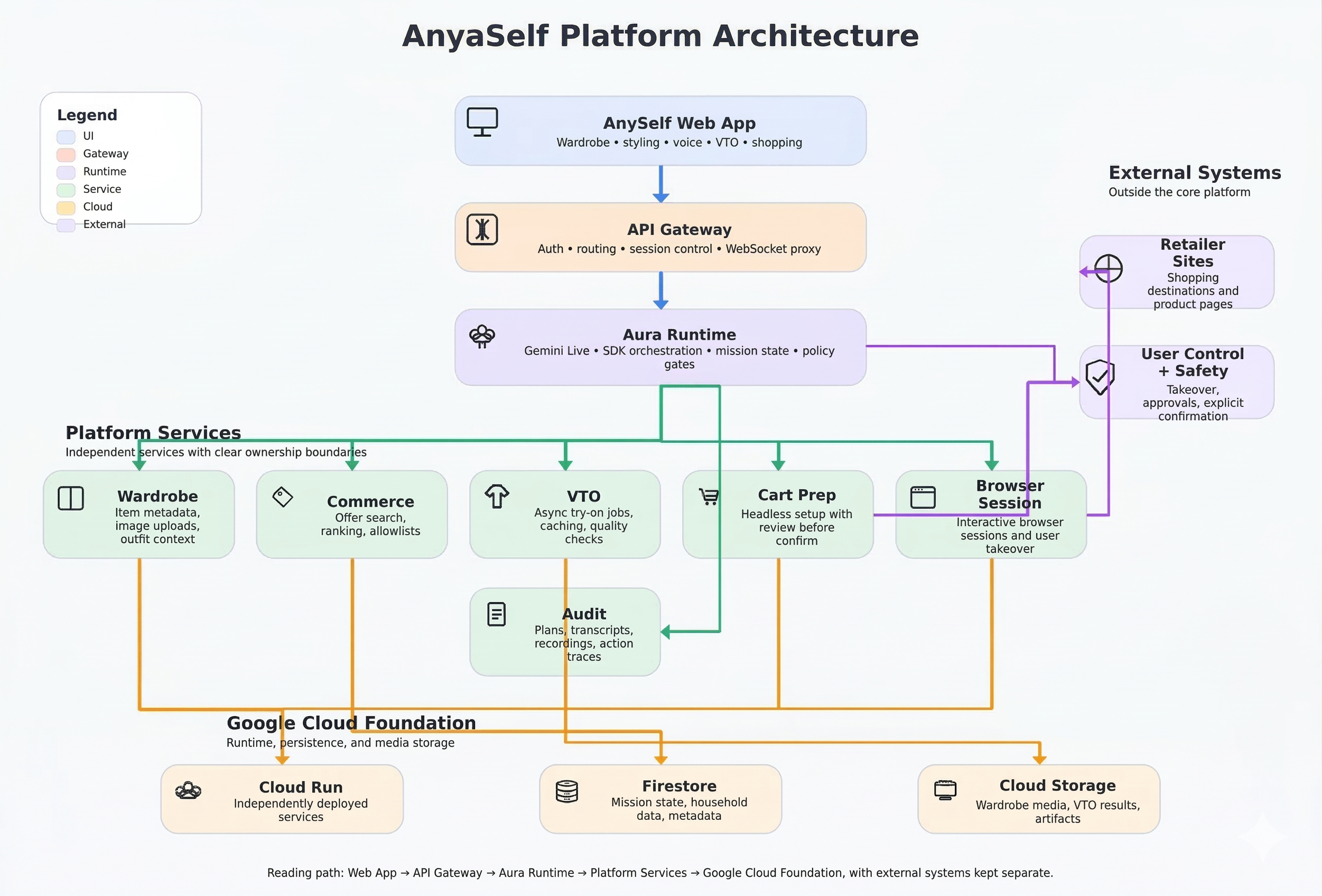
Anyaself platform architecture
-

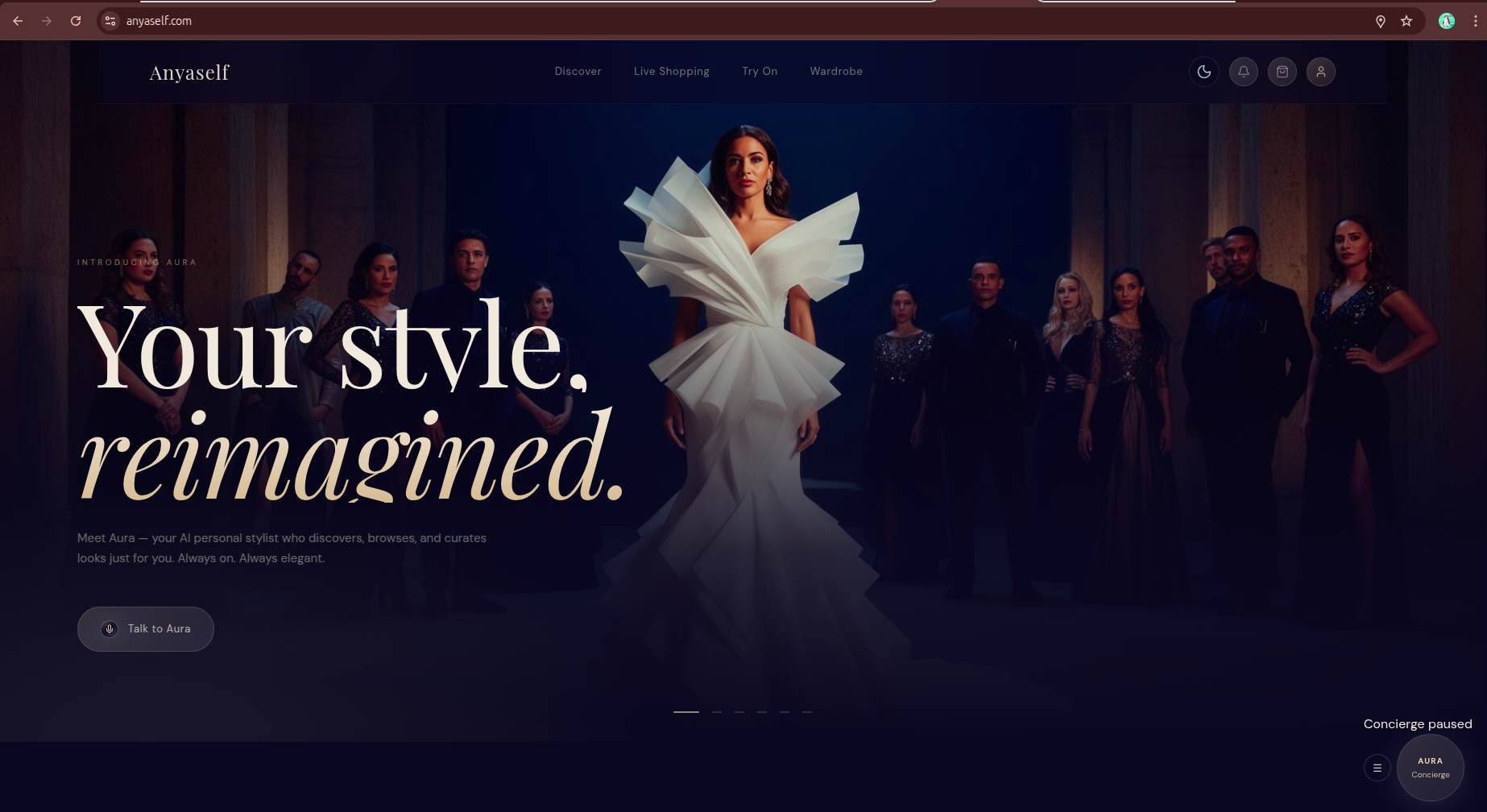
Anyaself home
-
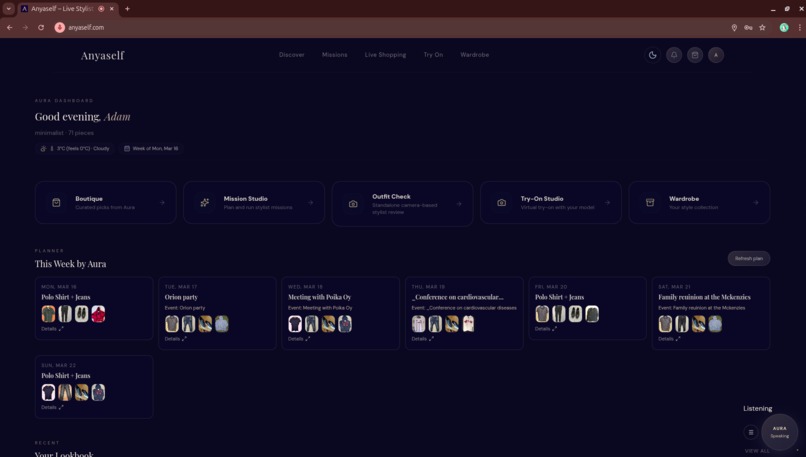
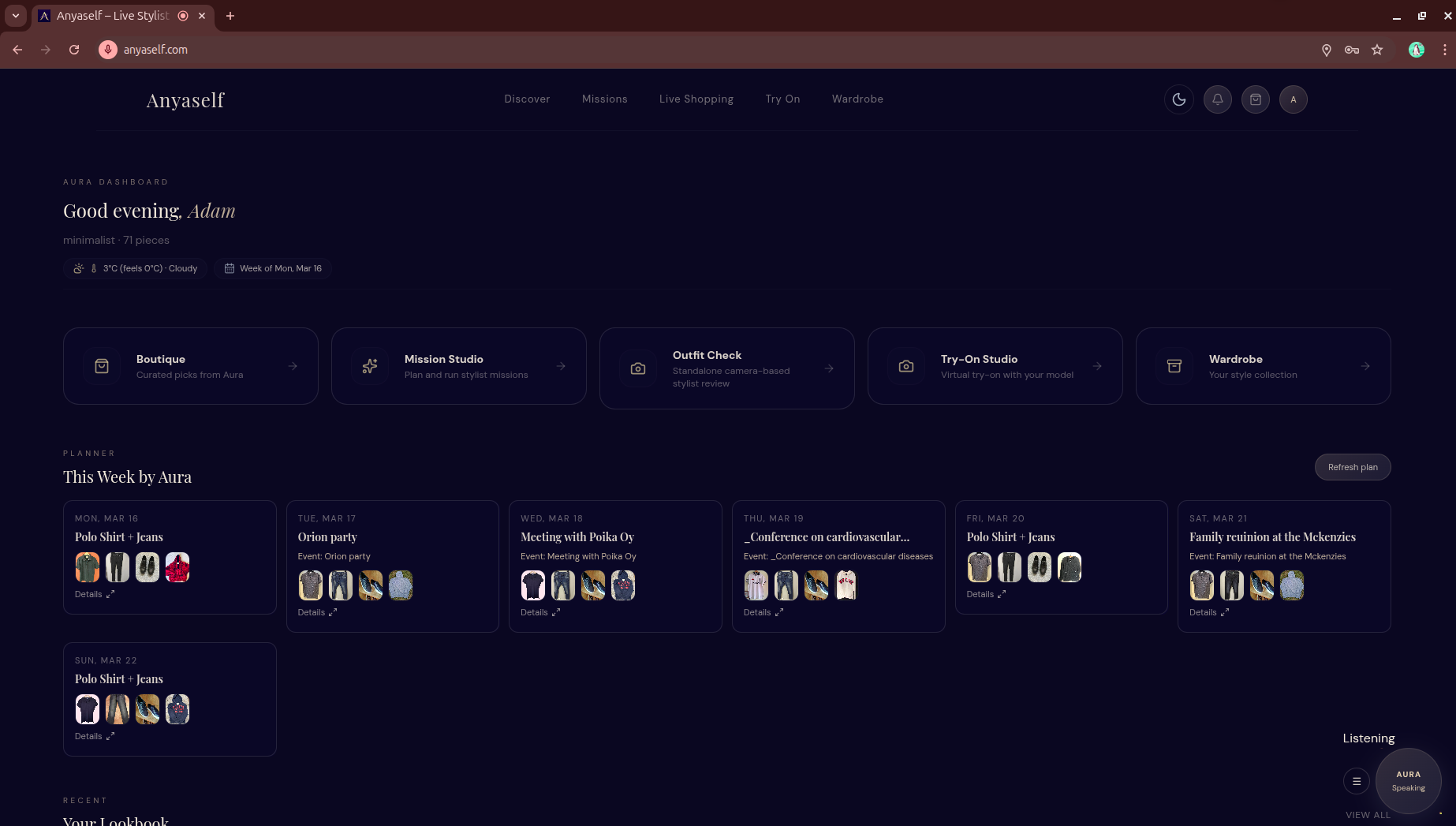
Aura's weekly plan
-
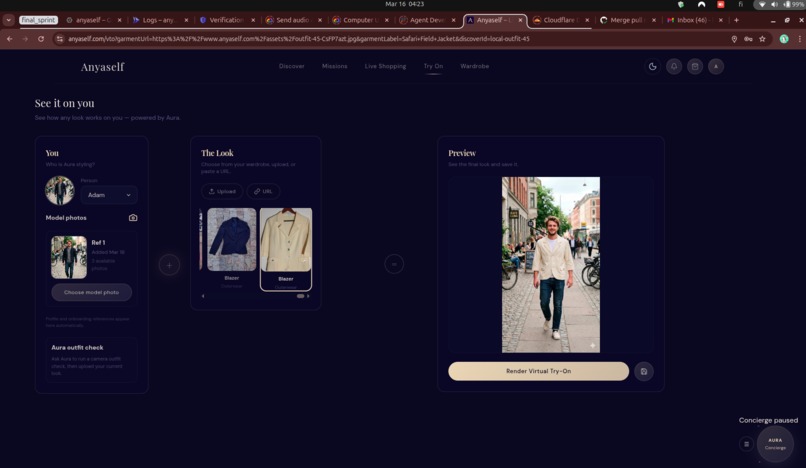
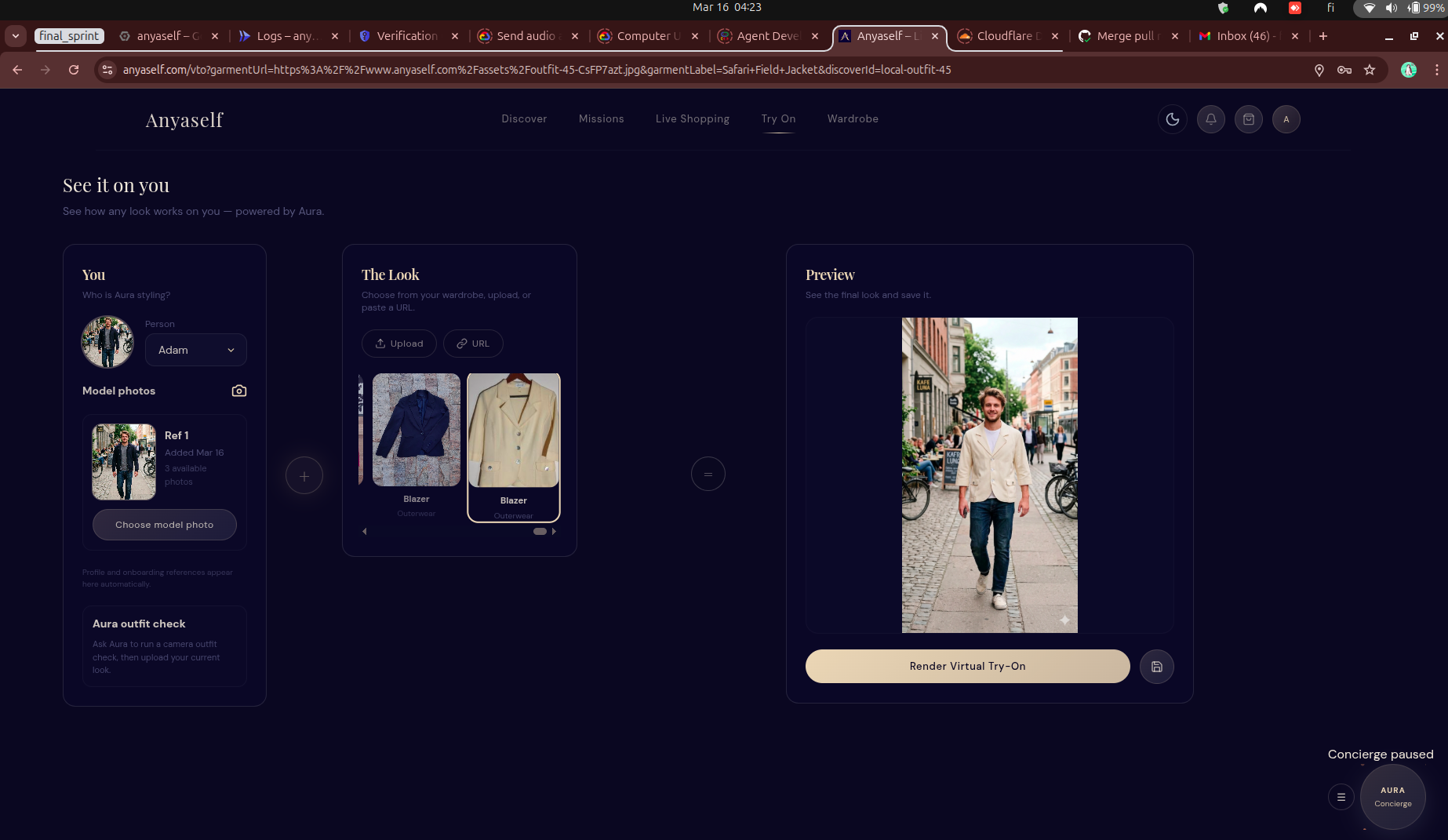
Try on with Aura
-
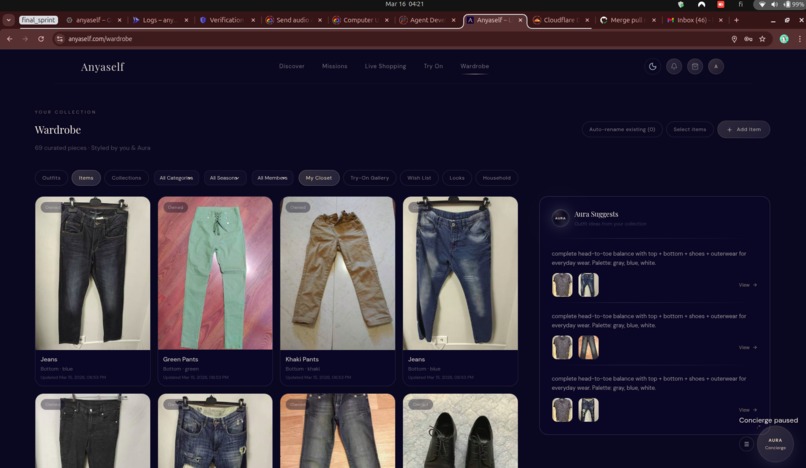
Aura's suggestions
-

All audit and logs
-
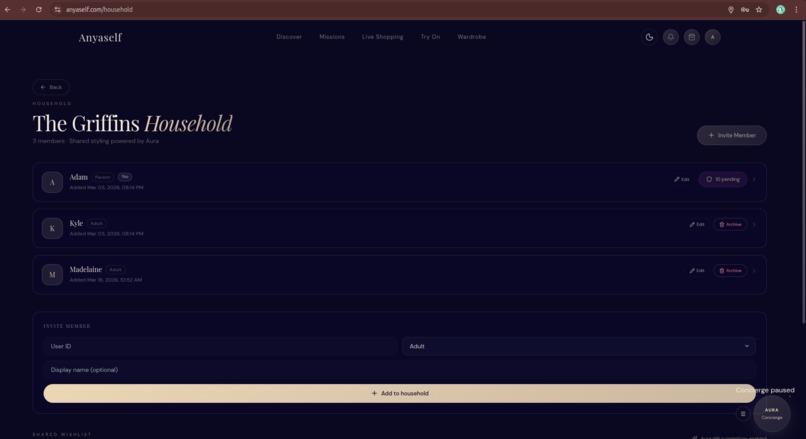
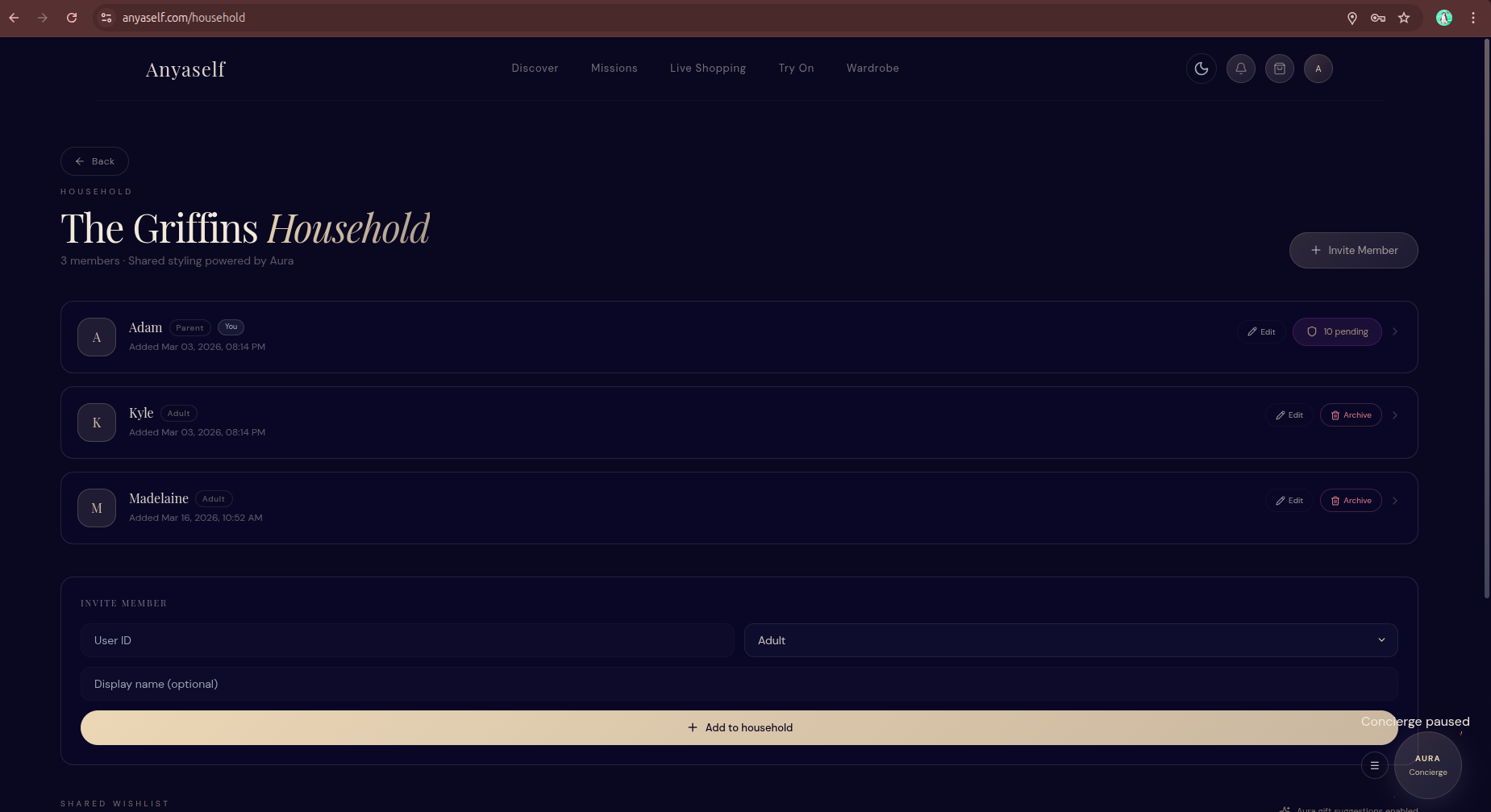
Household

Anyaself — Your AI Stylist Platform, for Everyone
Anyaself is a fashion intelligence platform for wardrobe management, personalized styling, and agentic shopping—powered by Aura, your AI stylist.
Inspiration
Every morning, billions of people stand in front of their closets and ask the same question: "What should I wear?"
It sounds trivial. It isn't. What we wear shapes how we're perceived, how we feel, and how we move through the world. Fashion is one of the few things every human being shares—across cultures, abilities, ages, and identities. A teenager in Lagos getting ready for school and a wheelchair user in Berlin preparing for a job interview are both navigating the same deeply personal decision: how do I present myself today?
Yet the tools we have are broken. Fashion apps show us what influencers wear, not what we should wear. Styling services cost hundreds of dollars an hour. And online shopping—the place where most of us actually buy clothes—is a lonely, overwhelming maze of tabs, size charts, and checkout flows designed to extract, not to help.
We asked: what if everyone had access to a personal stylist who could see your wardrobe, understand your taste, speak with you naturally, and even shop for you—without ever making you feel like you needed to be a certain size, gender, or income bracket to deserve that help?
That's Anyaself. And at its heart is Aura—a multimodal AI stylist powered by the Gemini Live API who doesn't just chat. She sees, listens, speaks, and acts.
What it does
Anyaself is a full-stack fashion intelligence platform centered around Aura, a live voice-powered AI stylist built on the Gemini Live API. Here's what a real user session looks like:
🗣️ Talk to Aura, Naturally
Open Anyaself, tap the microphone, and start a conversation. Aura is a real-time voice agent—she understands interruptions, asks clarifying questions, and maintains conversational memory throughout a mission. She speaks like a stylist, not a chatbot.
"Aura, I have a wedding next month. Something elegant but not too formal—and I don't want to repeat what I wore to Sarah's party."
👁️ She Sees Your Wardrobe
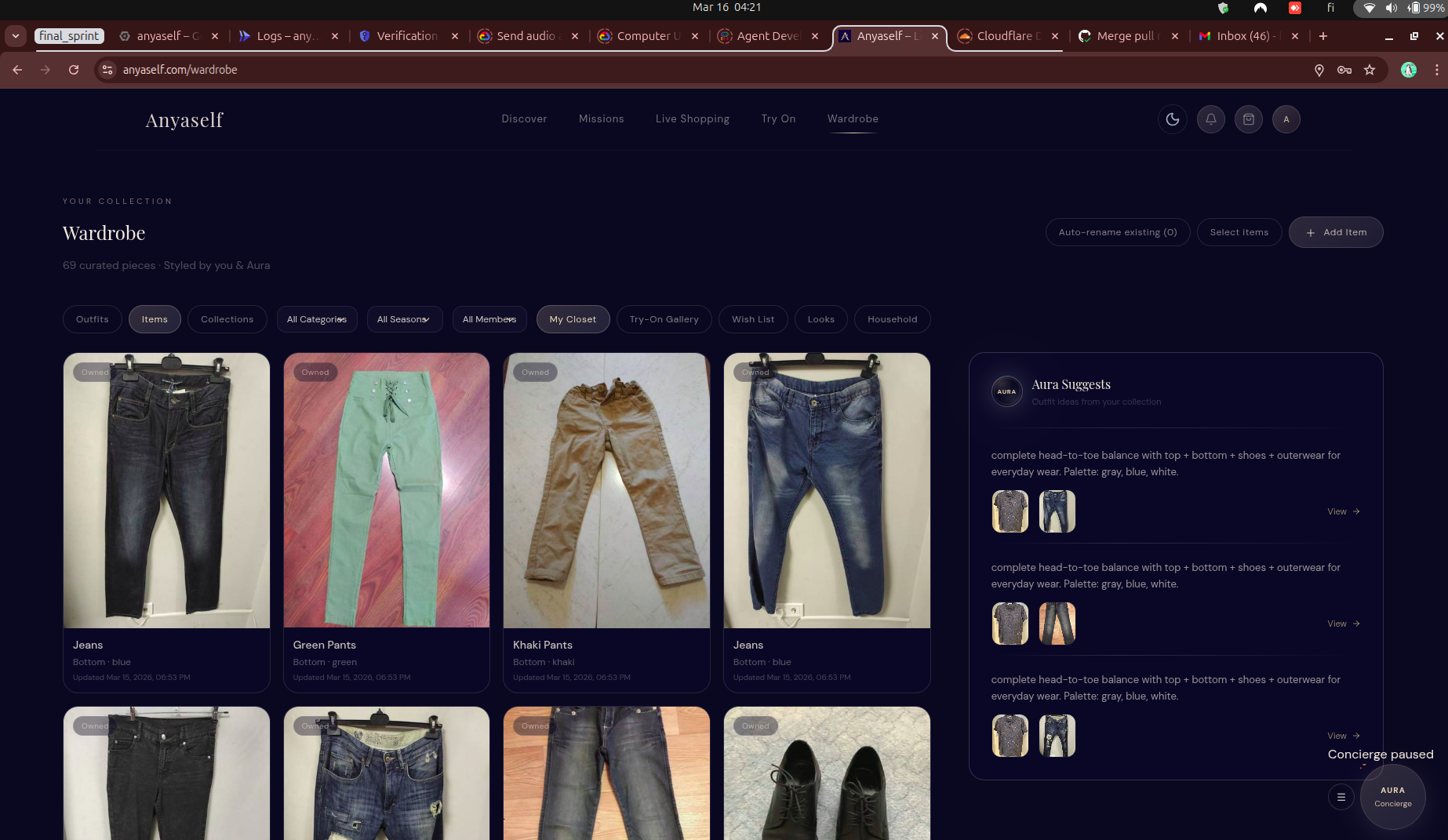
Users photograph their clothes and upload them to a digital wardrobe. Aura knows what you own. She reasons over your items using embeddings and visual understanding—matching colors, occasions, seasons, and style profiles—to suggest outfits from pieces you already have, before recommending anything new.
👗 Virtual Try-On
Found something you like? Anyaself's VTO (Virtual Try-On) pipeline lets you see garments on your photo, using Vertex AI inference. Results render asynchronously, are cached for instant recall, and include quality scores so we never show you a misleading preview.
🛒 "Buy For Me" — Agentic Shopping
This is where Anyaself truly breaks the text-box paradigm. When Aura finds the right item, she doesn't hand you a link and walk away. She offers two modes:
- Cart Prep (headless): Aura opens an ephemeral browser, navigates to the retailer, selects your size and color, and prepares the cart—all automatically. She records every step and gives you a summary + cart link to review before you confirm.
- Show Me (interactive via Hyperbeam): You watch Aura navigate the retailer's site in real-time through an embedded browser. You can take over at any moment—type, click, scroll—and hand control back. The human is always in the loop.
No purchase is ever finalized without explicit user confirmation. This isn't just a UX decision—it's enforced at the server level through coded policy gates, not prompt instructions.
👨👩👧👦 Family Spaces (Households)
Anyaself supports multi-member households with roles: parents/guardians can approve purchases, children can browse and request. A parent can say: "Aura, find school-appropriate sneakers for my daughter under $60"—and the workflow includes parental approval before anything is bought.
📋 Mission Plans & Audit Trails
Everything Aura does is documented. Every mission produces a structured plan, a transcript, step-by-step recordings, and an audit log. Users can review exactly what happened, especially for headless runs. This is accountability by design, not afterthought.
How we built it
Architecture: 8 Microservices on Google Cloud
Anyaself runs as a monorepo with 8 independent Python microservices, containerized with Docker, and deployed on Google Cloud Run:
| Service | Role |
|---|---|
| API Gateway | Auth (JWT), routing, rate limiting, Gemini Live API voice WebSocket proxy |
| Orchestrator | Vertex AI Agent + ADK mission runner, tool-calling engine |
| Wardrobe | Item CRUD, image uploads to GCS, embeddings, metadata |
| Commerce | Normalized product offers, catalog search, domain allowlisting |
| VTO | Virtual try-on inference pipeline, job queue, caching |
| Headless Cart Prep | Playwright-based ephemeral browser automation |
| Hyperbeam Bridge | Interactive browser sessions, agent ↔ DOM event channel |
| Artifacts & Audit | Mission plans, transcripts, recordings, append-only audit logs |
Gemini at the Core
- Gemini Live API (
gemini-2.0-flash-live-001) powers Aura's real-time voice: natural speech, interruption handling, context-aware conversation. The API Gateway proxies WebSocket connections with authenticated session tokens and per-user rate limiting. - Vertex AI Agent Engine + ADK runs the Orchestrator's mission state machine (
PLANNED → RUNNING → NEEDS_USER → DONE). The agent calls tools across all microservices—wardrobe queries, commerce search, VTO jobs, cart prep, Hyperbeam sessions—with strict JSON Schema contracts. - Gemini multimodal reasoning drives outfit suggestions, image understanding for wardrobe items, and the Hyperbeam UI navigation agent (interpreting live DOM snapshots and screenshots).
Frontend
A React + Vite web client with a premium design system (Cormorant Garamond + Inter typography, warm gold accent palette, dark/light mode). Features include the Boutique discovery feed, VTO viewer, voice UI, mission progress tracking, request/approval flows, and Hyperbeam embed.
Google Cloud Services Used
- Cloud Run — all 8 microservices
- Cloud Storage (GCS) — wardrobe images, VTO results, recordings
- Vertex AI — Agent Engine, Gemini models, VTO inference
- Gemini Live API — real-time voice interaction
- Firebase — client auth
- Firestore — household data, wardrobe metadata
Challenges we ran into
1. Making voice feel alive, not turn-based. Early versions of Aura felt like a phone tree. The Gemini Live API gave us real-time streaming, but building an experience where users could interrupt naturally—mid-sentence, mid-thought—while the agent maintained mission context required careful WebSocket state management, session token lifecycles, and graceful reconnection logic.
2. Agentic shopping is adversarial terrain.
Retailer websites fight automation. We hit bot detection, CAPTCHA walls, dynamic popups, and login gates. Our headless cart prep service needed typed error handling (BLOCKED_BOT_DETECTED, SIZE_UNAVAILABLE, POPUP_OVERLAY_UNRESOLVED) and hard safety limits (120-second timeout, domain allowlisting, no payment data entry—ever).
3. Earning trust with autonomous actions. Giving an AI agent the ability to add items to a shopping cart is inherently high-stakes. We spent significant effort building server-side policy gates—coded in Python, not in prompts—that physically prevent the agent from completing purchases without explicit user confirmation. Prompt injection from untrusted web content cannot bypass these gates.
4. Building for families, not just individuals. Most fashion apps assume a single user. We designed Anyaself for households: parents, children, guardians, each with distinct permissions. The data model, API authorization, and approval flows all enforce this at the server level, with audit logging for every sensitive action.
5. VTO quality is unforgiving. Users have zero tolerance for try-on results that look "off." We implemented quality scoring (0–1), automatic fallback when scores drop below threshold, and careful caching keyed to (person photo, garment image, pose variant) to avoid re-rendering.
Accomplishments that we're proud of
The "Show Me" moment. Watching a user say "Aura, buy that dress for me"—and then seeing Aura open a live browser, navigate to the site, select the right size, and pause at checkout for confirmation—while the user watches and can intervene at any moment. That loop—agent acts, human oversees, either can take control—is the interaction paradigm we think defines the next generation of AI.
An architecture that takes responsibility seriously. Every mission produces a reviewable plan. Every action is logged. Every purchase requires confirmation. In a world where AI agents are gaining autonomy, we chose to build one that's accountable by design.
Inclusivity embedded in the product, not bolted on. The household system means a visually impaired parent can ask Aura to find clothes for their child using only voice. A non-English speaker can describe what they want in natural conversation. A budget-conscious family can set price caps and Aura respects them. Fashion intelligence shouldn't be a luxury—it should be a utility.
8 microservices, one coherent experience. What the user sees is a clean, warm, premium interface. What runs underneath is a distributed system with independent services, strict contracts, JWT-based auth, event-driven coordination, and infrastructure-as-code deployment. The complexity serves the simplicity.
What we learned
Multimodal isn't a feature—it's a philosophy. When Aura can hear you, see your clothes, reason about your style, navigate a website, and speak back to you—all in one mission—the boundaries between "voice app" and "shopping app" and "wardrobe app" dissolve. The Gemini Live API enabled us to think about user interaction as a continuous, multimodal flow rather than a sequence of isolated inputs and outputs.
Trust is the product. For an agent that handles purchases and children's data, the technical question is never "can we do this?" but "should we, and can we prove we did it safely?" Server-side policy gates, typed audit logs, and mandatory confirmation flows are the features users will never see—but they're the ones that matter most.
Fashion is deeply human. We started building a "wardrobe management tool" and ended up building something closer to a companion. The moment we heard a tester say "Aura remembered I don't like yellow"—that was the moment we understood what personalized AI actually means. It means remembering the small things.
What's next for Anyaself
- Native mobile apps (iOS/Android) with offline wardrobe browsing and voice-first interaction
- Expanded VTO with full-body pose estimation, multi-garment composition, and accessory layering
- Merchant partnerships for verified sizing data, real-time inventory, and streamlined checkout
- Style profiles that travel — Aura learns your preferences over time and adapts across seasons, occasions, and life changes
- Accessibility-first features — enhanced screen reader support, voice-only workflows, and adaptive sizing guidance for people with disabilities
- Community styling — share outfits, vote on looks, contribute to a collective style intelligence that benefits everyone
We believe the future of fashion isn't about algorithms telling people what to wear. It's about an AI companion who understands your world—your closet, your family, your budget, your body, your confidence—and helps you show up as the version of yourself you want to be.
That's Aura. That's Anyaself.
Built with ❤️ using the Gemini Live API, Vertex AI Agent Engine, Google Cloud Run, and the belief that everyone deserves a great stylist.
#GeminiLiveAgentChallenge
Disclaimer All visual assets included in this project submission are either AI-generated images and videos created for illustrative purposes only, with no direct link to or representation of any real individual or images sourced from Unsplash and used in accordance with Unsplash licensing terms, with attribution provided where applicable.
Built With
- fastapi
- gemini
- geminiliveapi
- google-calendar
- pydantic
- python
- typescript
- zod

Log in or sign up for Devpost to join the conversation.