-
-
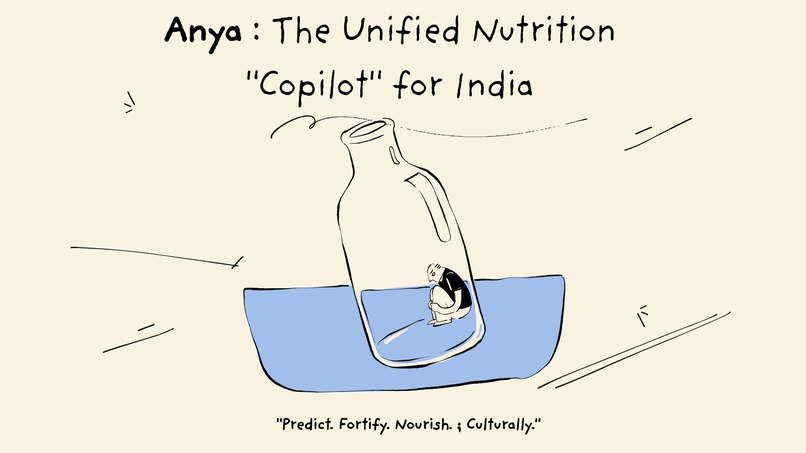
Project-Theme-image
-
-
-
-
-
-
Inspiration
India produces enough food to feed its entire population — yet 35.5% of children under 5 are stunted and 57% of women are anemic. We don't have a food crisis. We have a nutrition intelligence failure.
When we analyzed NFHS-5 data across India's 640+ districts, we found something striking:
In Alirajpur, Madhya Pradesh, 79% of children are anemic — just 800km from Mumbai. These crises are predictable and preventable, but India's nutrition response is always too late, too generic, and culturally disconnected.
The data to solve this already exists — health surveys, food prices, weather patterns, PDS records — but it sits in silos, never connected, never predictive.
So we asked:
What if one platform could predict which deficiencies will spike where, generate precision fortification strategies, and create culturally appropriate meal plans families will actually eat — all within their budget?
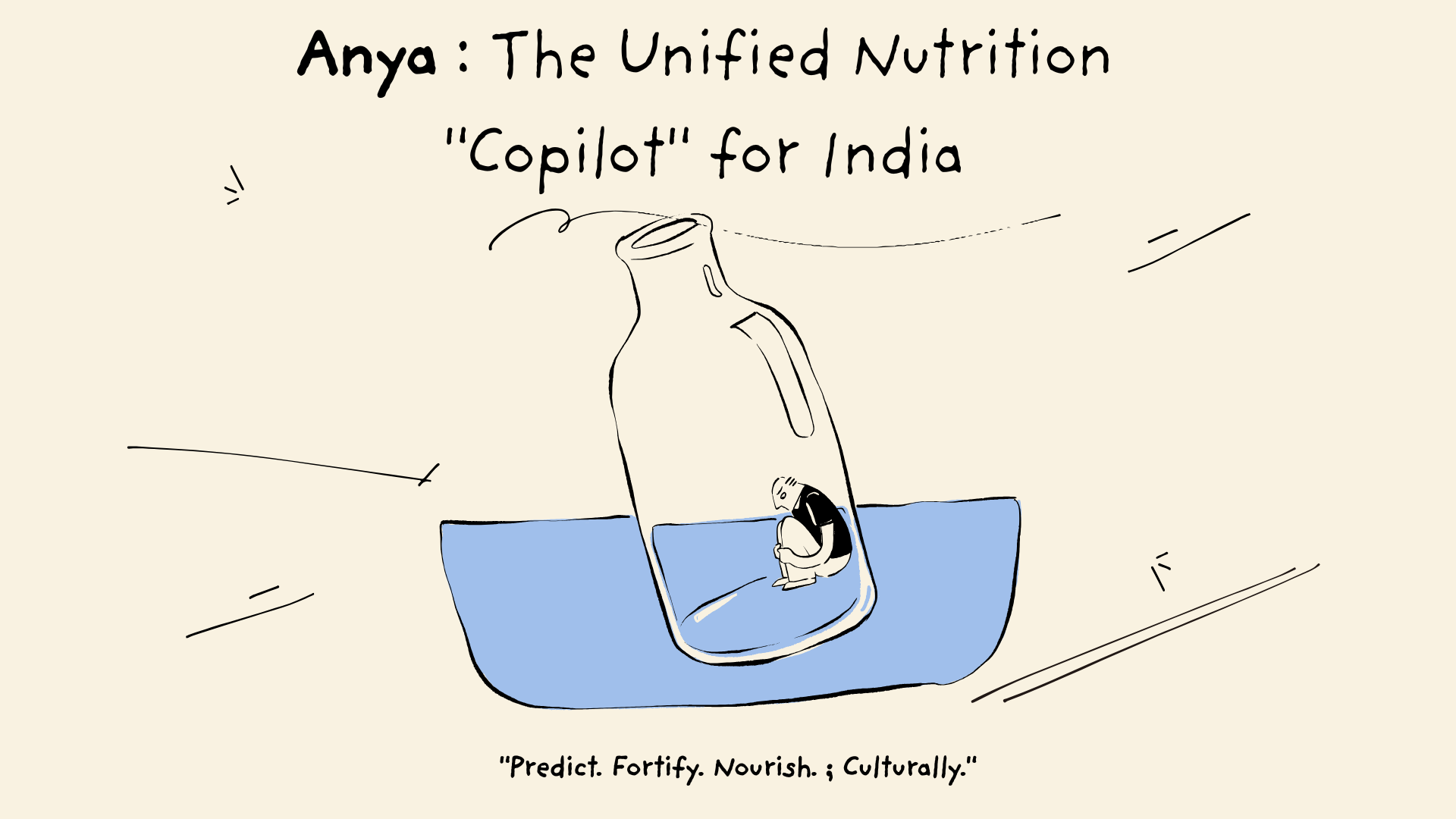
That became Anya — meaning "grace" in Sanskrit. Because every child deserves adequate nutrition, regardless of which district they were born in.
What It Does
Anya is an end-to-end AI-powered nutrition intelligence platform built specifically for India. It operates as a three-stage pipeline:
| Stage | Purpose | Key Output |
|---|---|---|
| PREDICT | Identify who is at risk | Per-district, per-micronutrient risk scores |
| FORTIFY | Determine what nutrients are needed | Cost-optimized fortification strategies |
| NOURISH | Deliver meals people will actually eat | 7-day culturally aware meal plans |
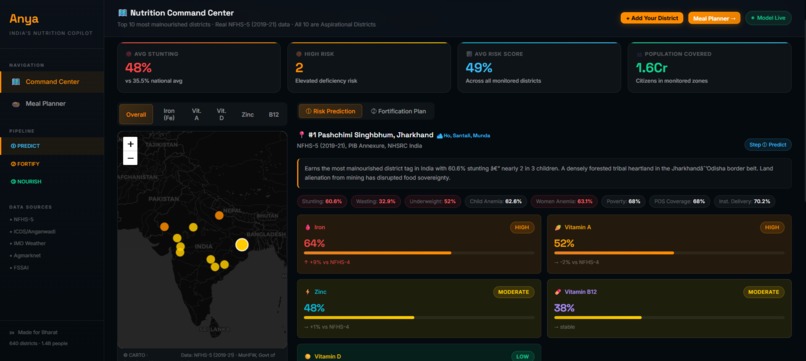
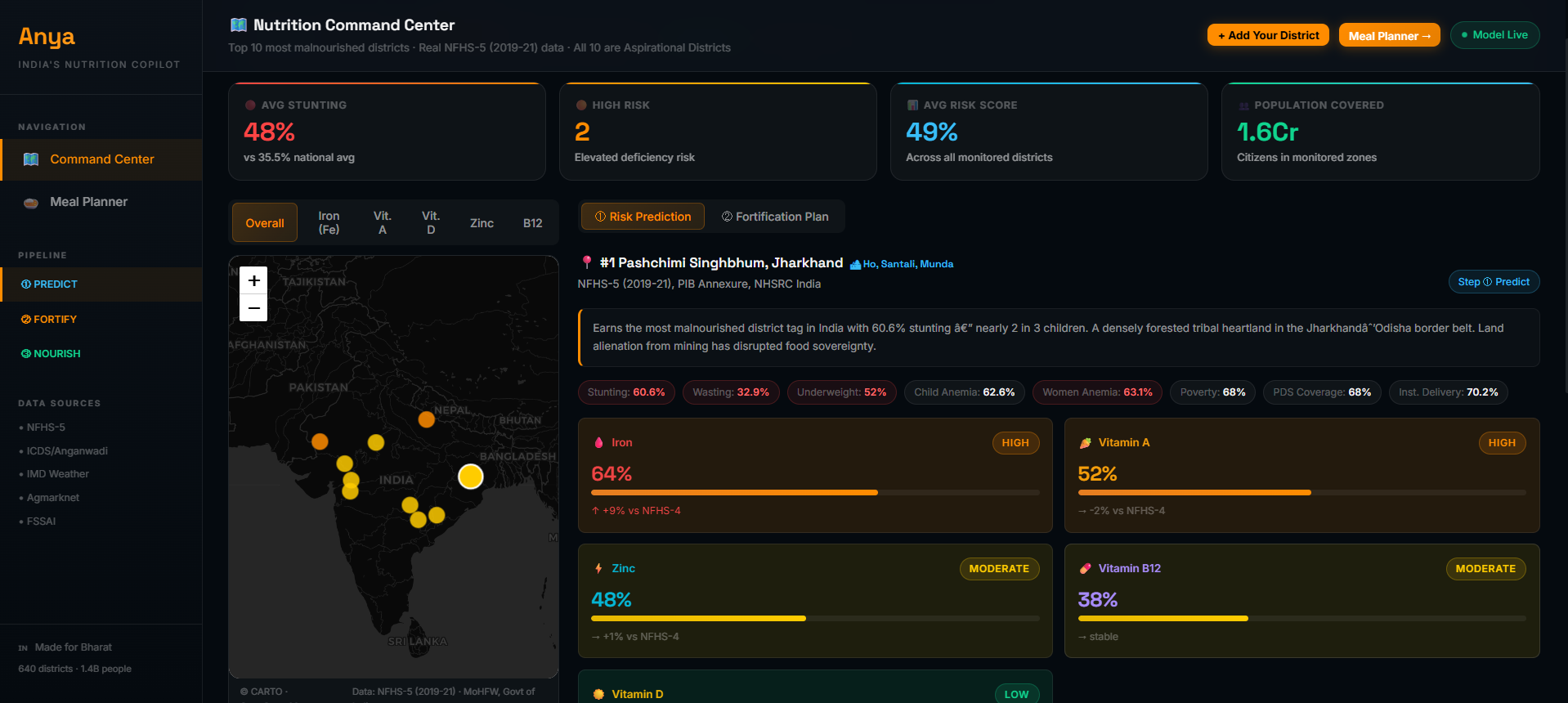
Stage 1 — PREDICT: Who Is At Risk?
- Fuses data from NFHS-5, Agmarknet food prices, IMD weather, and PDS records
- Generates per-district risk scores for Iron, Vitamin A, Zinc, B12, and Vitamin D
- Flags emerging hotspots before crises escalate
- Covers India's top 10 most malnourished aspirational districts with real data for 1.6 crore citizens
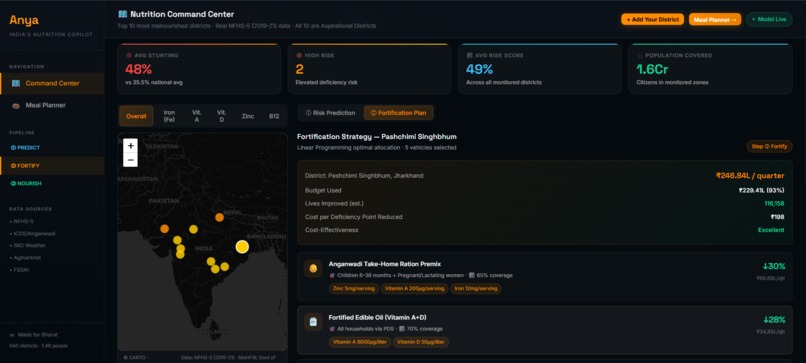
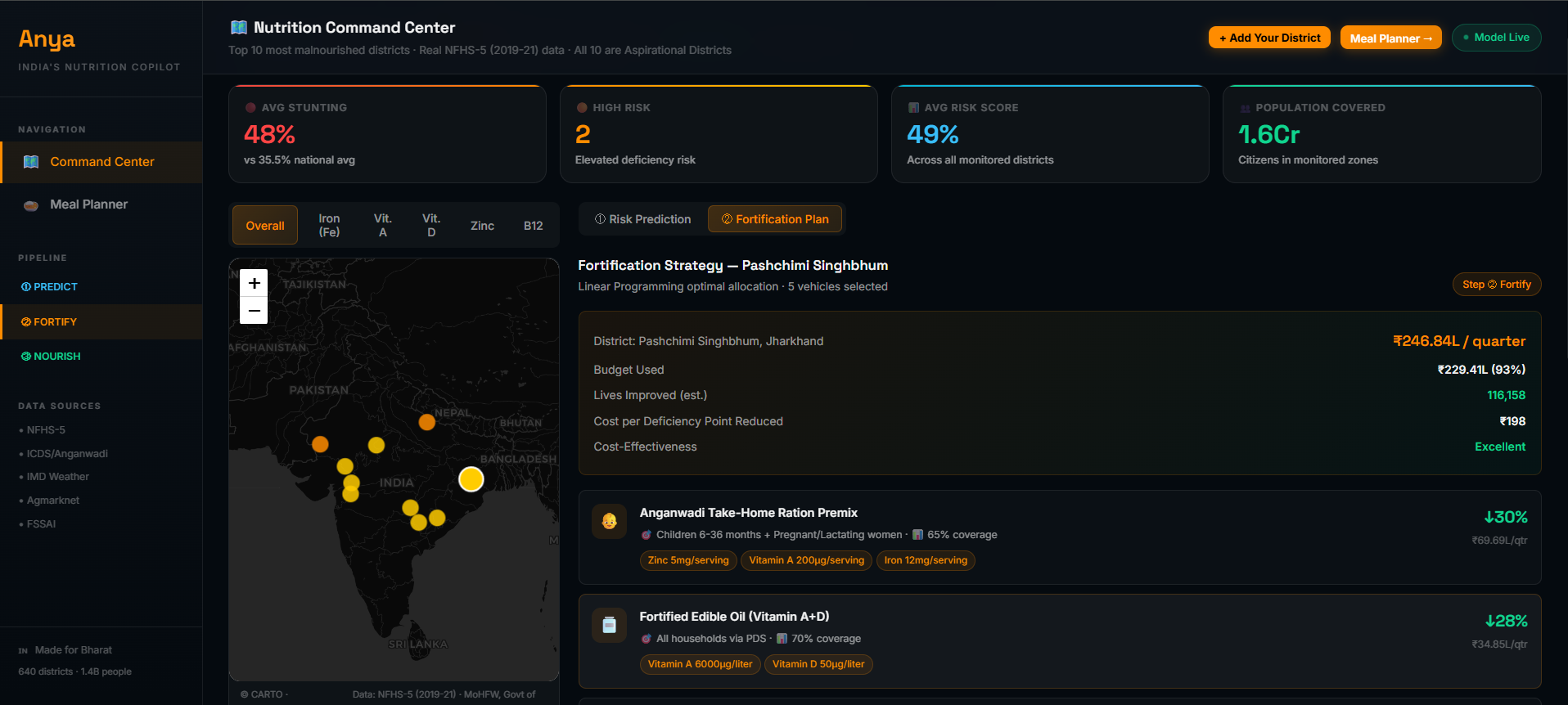
Stage 2 — FORTIFY: What Nutrients Are Needed?
- Generates cost-optimized fortification strategies per district using linear programming
- Recommends the right fortification vehicle based on deficiency profile:
| Vehicle | Use Case |
|---|---|
| PDS Rice | Iron and B12 fortification in rice-consuming states |
| Edible Oil | Vitamin A and D delivery via cooking medium |
| Double-Fortified Salt | Iron and iodine through universal salt consumption |
| Mid-Day Meal Flour | Zinc and iron for school-age children |
- Incorporates bioavailability science — e.g., pairing iron with Vitamin C, separating iron and calcium across meals
- Projects 3-month outcomes with estimated reduction in anemia, VAD, and zinc deficiency
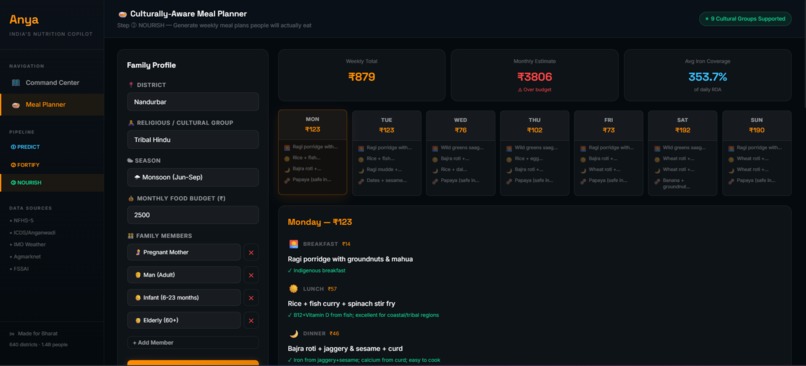
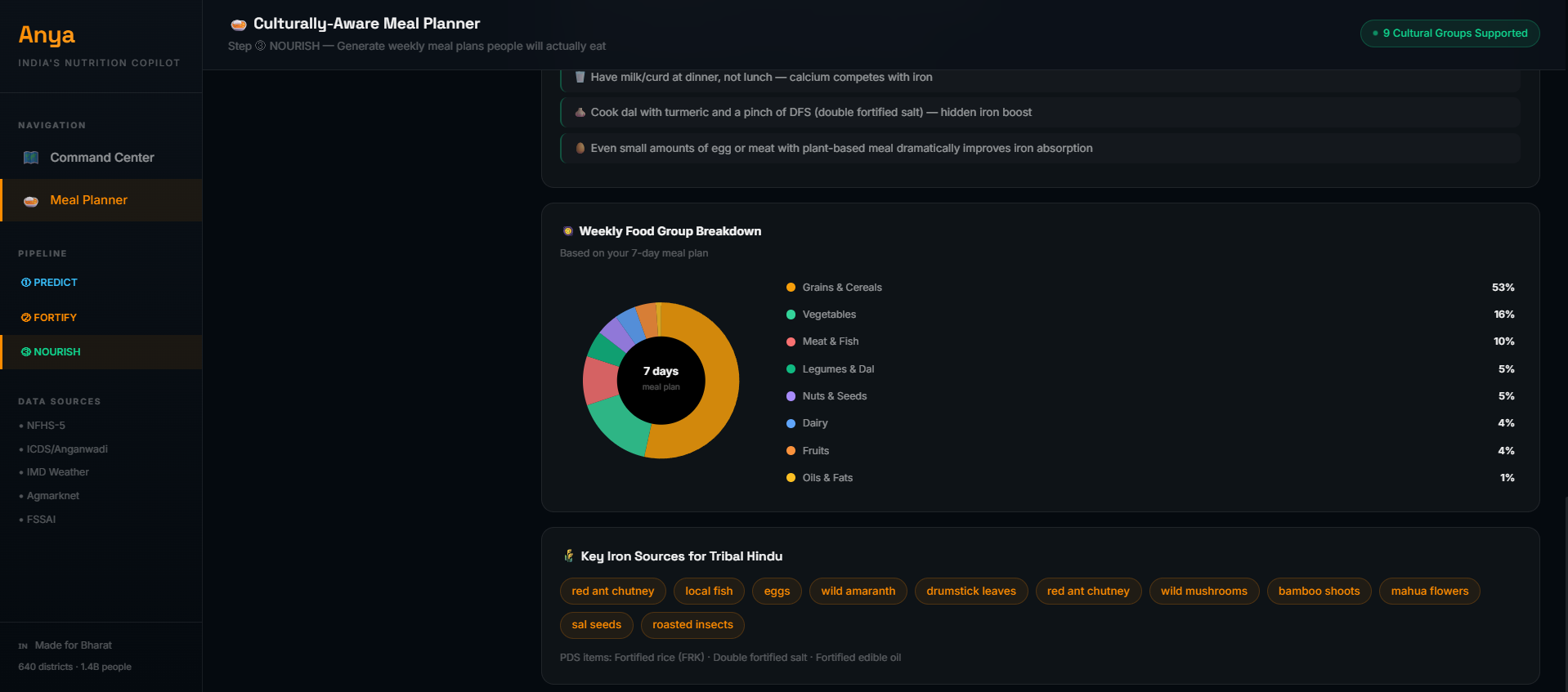
Stage 3 — NOURISH: Meals People Will Actually Eat
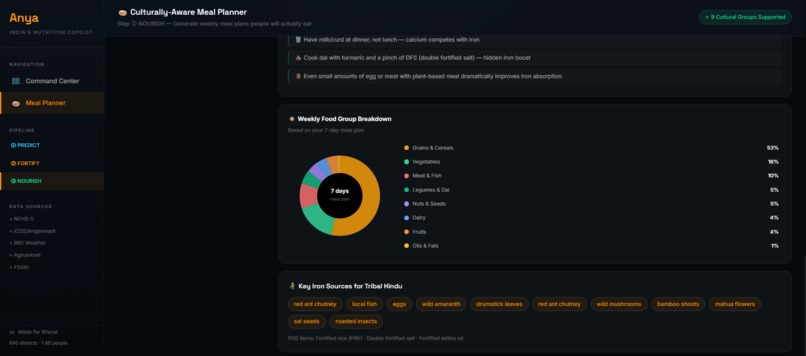
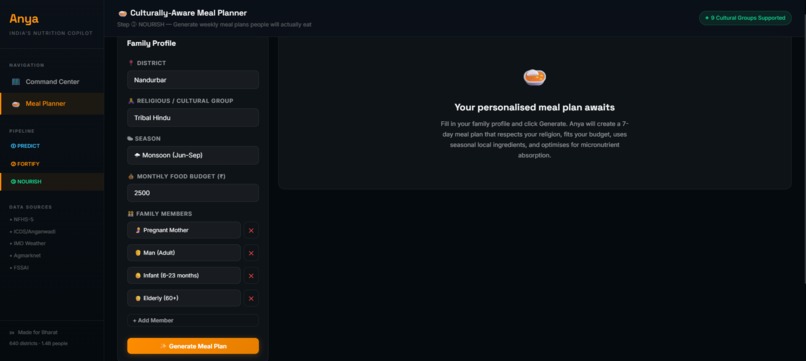
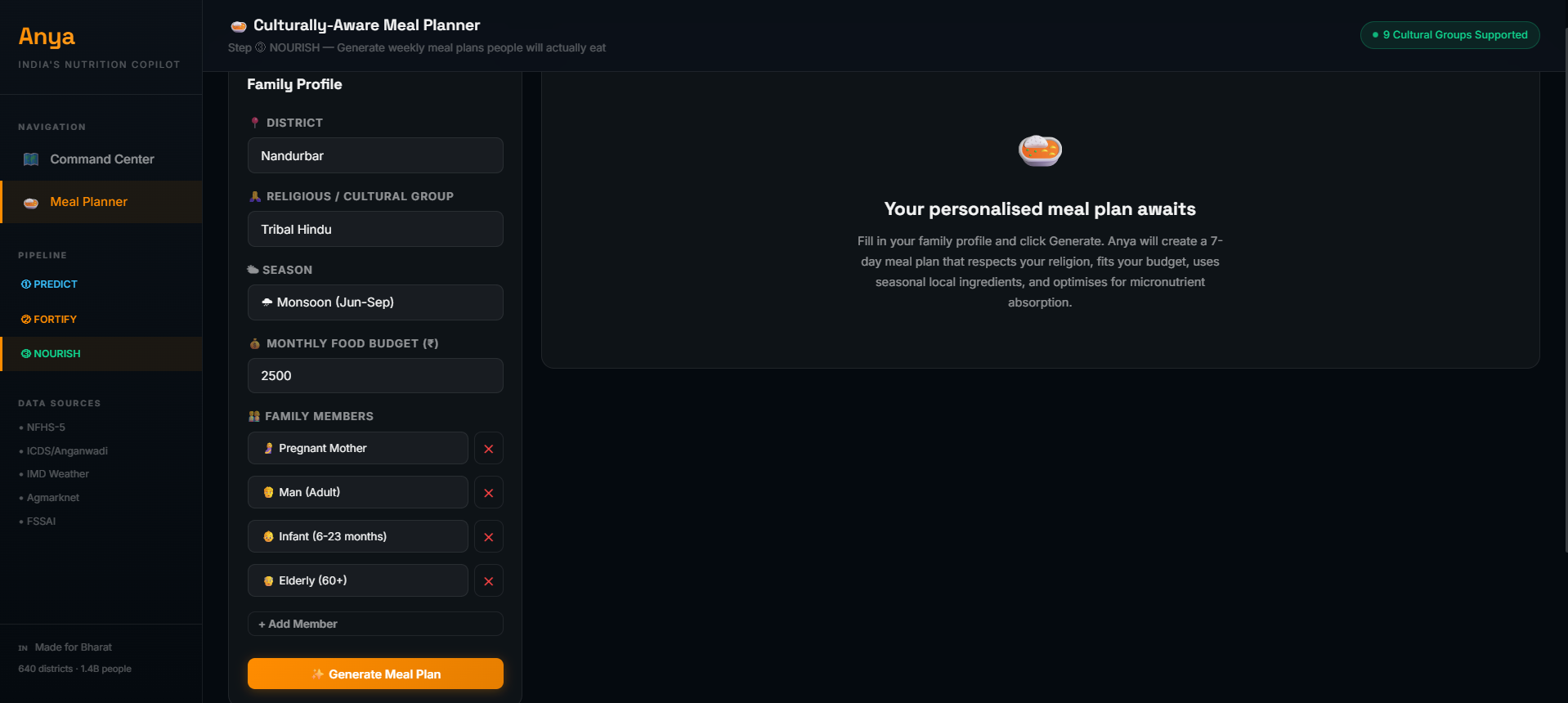
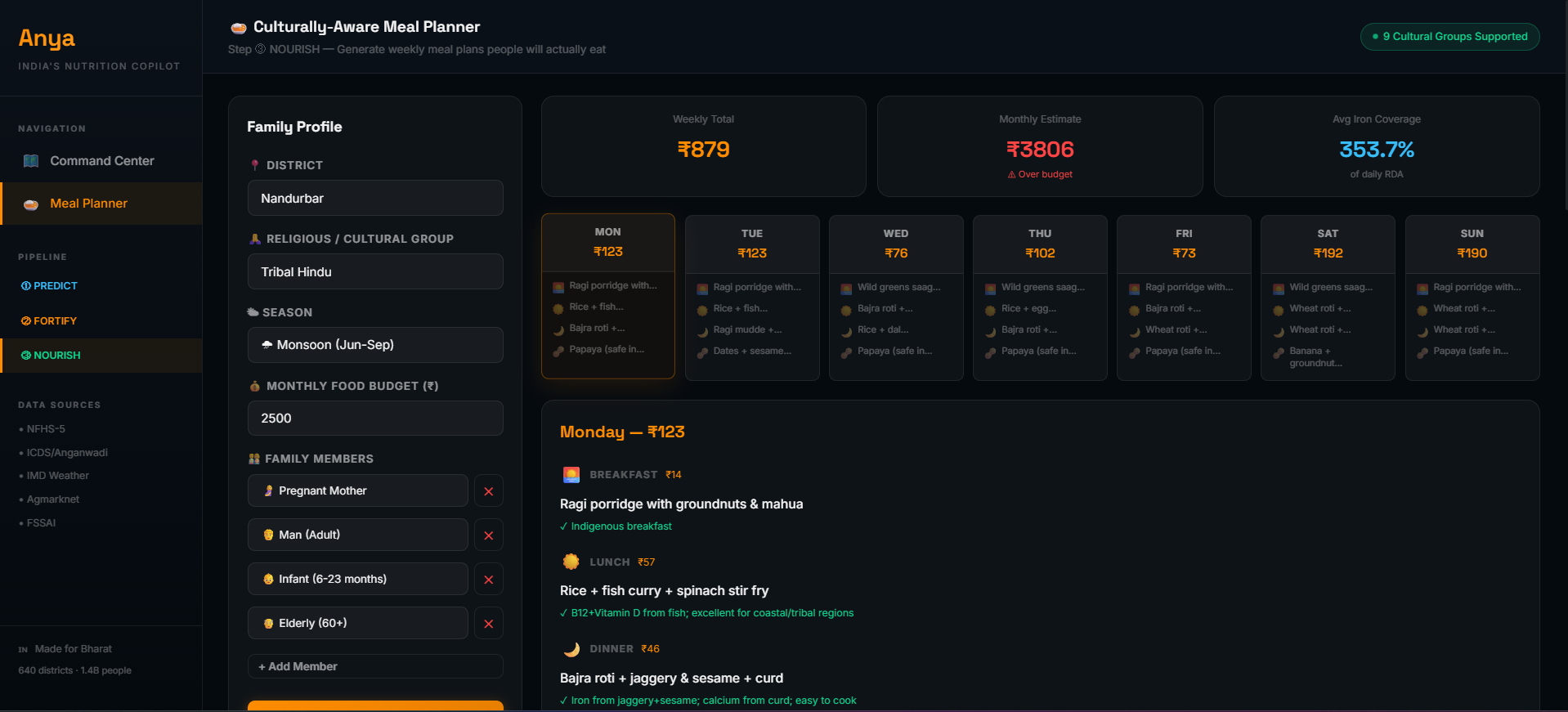
Generates 7-day culturally aware meal plans based on:
| Parameter | Details |
|---|---|
| Cultural Group | 9 groups supported (Tribal Hindu, Muslim, Jain, Sikh, and more) |
| Season | Adjusted for local and seasonal food availability |
| Budget | As low as Rs. 2,500 per month |
| Family Composition | Pregnant mothers, infants, elderly, lactating women |
Key capabilities:
- Uses only locally available, affordable ingredients including indigenous superfoods (ragi, moringa, drumstick leaves, wild amaranth)
- Displays per-meal cost, nutrient coverage, and bioavailability guidance
- Includes weekly food group breakdown and key nutrient sources specific to each cultural group
Our model calculates it costs just Rs. 847 per person to shift them out of nutritional risk through this pipeline.
How We Built It
Architecture
| Layer | Technology |
|---|---|
| Frontend | React.js, Mapbox (India district heatmaps), D3.js (charts and visualizations) |
| Backend | Python, FastAPI |
| Risk Prediction | XGBoost trained on real NFHS-5 district-level data fused with food price indices, seasonal features, and poverty indicators |
| Fortification Optimizer | Linear programming via PuLP and SciPy — maximizes deficiency reduction per rupee spent, subject to FSSAI safety limits and bioavailability constraints |
| Meal Generator | Constraint satisfaction engine combining ICMR Food Composition Tables, WHO/ICMR RDA values, cultural dietary rules (9 groups), local market pricing, and PDS entitlement data |
| Database | PostgreSQL |
Data Sources
| Source | What It Provides |
|---|---|
| NFHS-5 | District-level stunting, wasting, anemia rates |
| Agmarknet | Real-time food prices at mandi (market) level |
| IMD | Weather and seasonal data |
| FSSAI | Fortification standards and safety limits |
| ICMR | Dietary guidelines and food composition tables |
| Soil Health Card Portal | Regional agricultural data |
Everything runs on real government open data — no synthetic or mock datasets.
Challenges We Ran Into
Modeling Indian Food Complexity
A single dish like "dal" varies in ingredients, nutrition, and cost across every state. Building the cultural rules database for 9 religious/cultural groups — with accurate dietary restrictions, pregnancy taboos, and fasting calendars — was the most demanding non-technical challenge.
Data Inconsistency Across Government Sources
NFHS-5 operates at district-level granularity while Agmarknet food prices are reported at mandi (market) level. Reconciling these geographic mismatches required careful spatial mapping and interpolation.
Bioavailability Modeling
Iron absorption varies 3 to 10 times depending on what else is present in the meal. Building the nutrient interaction matrix and enforcing it during meal generation was scientifically demanding:
$$ \text{Absorbed Iron} = \text{Dietary Iron} \times \text{Bioavailability Factor} $$
Where the bioavailability factor ranges from \( 0.03 \) to \( 0.30 \) depending on meal composition (presence of Vitamin C enhancers, absence of calcium and phytate inhibitors).
Multi-Constraint Budget Optimization
Generating a meal plan that simultaneously meets all of the following constraints required solving a complex optimization problem in real-time:
| Constraint | Description |
|---|---|
| Nutritional Adequacy | Must meet ICMR/WHO RDA targets for all micronutrients |
| Cultural Compliance | Must respect dietary rules for the family's cultural group |
| Local Availability | Must use only ingredients available in the district and season |
| Budget Limit | Must fit within Rs. 2,500/month for the entire family |
| Bioavailability | Must account for nutrient interaction effects across meals |
Incomplete District Data
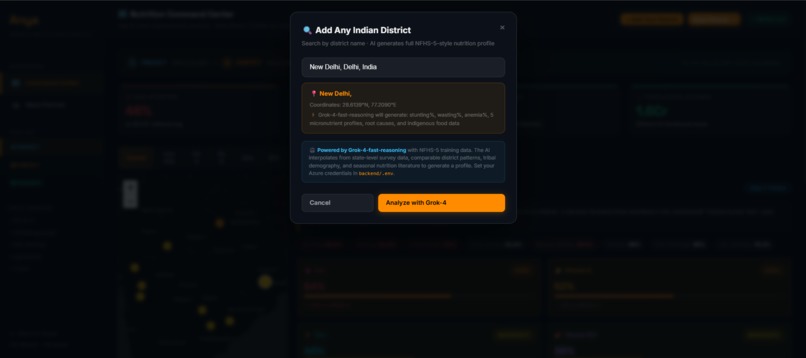
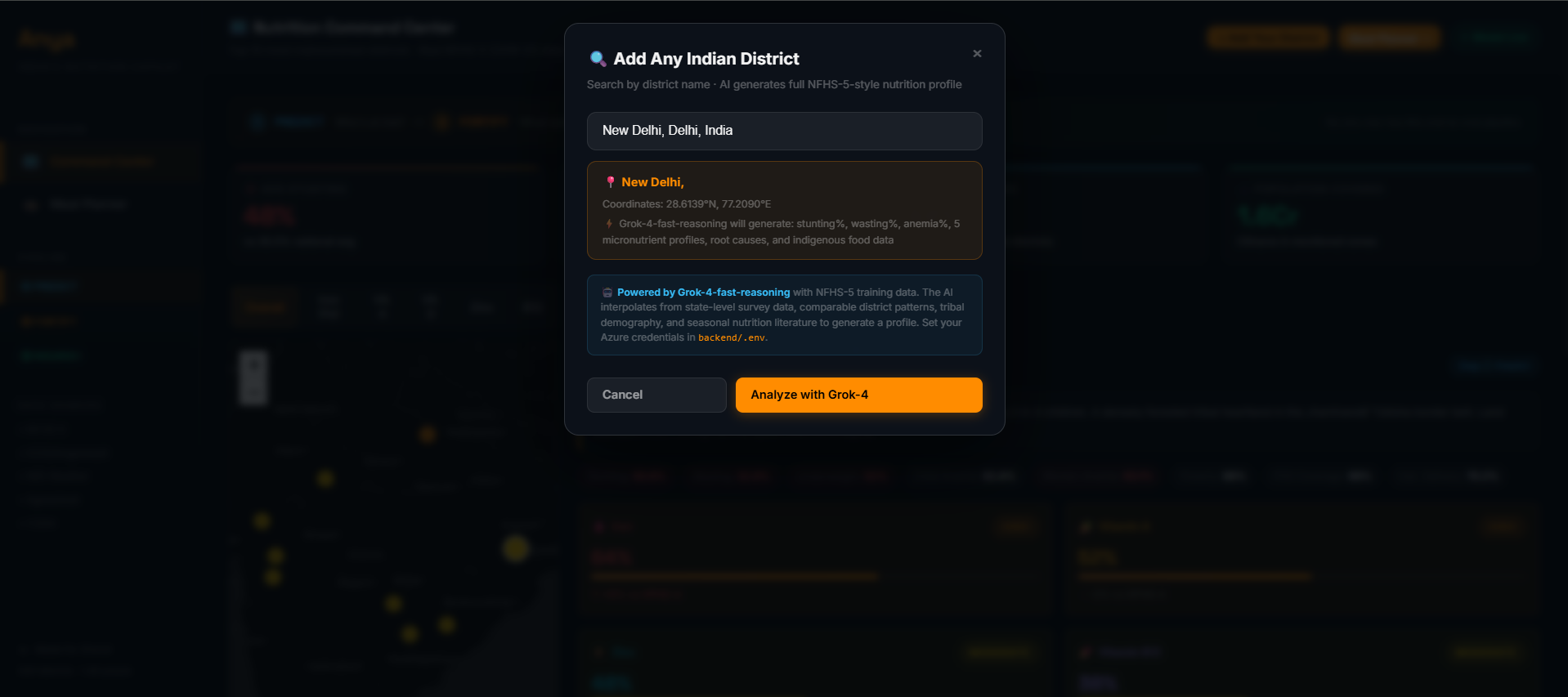
Certain districts had gaps in NFHS-5 coverage. We built fallback estimation logic using neighboring district interpolation and state-level averages weighted by demographic similarity.
What We Learned
Malnutrition in India is not a food problem — it is a data, delivery, and cultural sensitivity problem. The food exists. The government programs exist. What is missing is the intelligence layer connecting prediction to action.
Cultural context is non-negotiable. A nutrition solution that ignores caste, religion, regional food habits, and pregnancy taboos will fail in India, regardless of its technical sophistication.
Indigenous foods are nutritional powerhouses. Red ant chutney (iron-rich), ragi (calcium and iron), moringa (Vitamin A), wild amaranth — these traditional foods outperform expensive supplements but have been systematically overlooked by modern nutrition programs.
Bioavailability matters as much as quantity. A person can consume adequate iron on paper but absorb almost none if it is paired with inhibitors. This invisible factor is a major driver of India's anemia crisis.
Government open data is a goldmine. NFHS-5, Agmarknet, Soil Health Cards, IMD — the infrastructure for intelligent nutrition planning already exists. It simply needs to be connected and operationalized.
What's Next for Anya
| Milestone | Description |
|---|---|
| Full India Coverage | Expand to all 640+ districts with complete NFHS-5 integration and real-time Agmarknet price feeds |
| POSHAN Tracker Integration | Connect with the government's existing Anganwadi monitoring platform to reach 1.4 million frontline workers |
| Anganwadi Mobile Application | Offline-first architecture, voice-based UI in 12+ Indian languages, camera-based MUAC measurement for instant child screening |
| Nandurbar Pilot | Deploy across 50 Anganwadi centers serving approximately 2,000 children in partnership with the district ICDS office |
| WhatsApp-Based Delivery | Send personalized weekly meal plans to mothers via voice messages in their local language |
| Dynamic Price Adjustment | Automatically substitute affordable alternatives when local ingredient prices spike |
| Open Source Release | Release the full platform so other countries facing similar malnutrition challenges can adapt Anya to their context |
Social Impact Statement
Anya directly addresses UN Sustainable Development Goal 2 (Zero Hunger) and SDG 3 (Good Health and Well-Being) by targeting the systemic gaps in India's nutrition delivery infrastructure.
The scale of the problem:
| Indicator | Statistic | Source |
|---|---|---|
| Children under 5 who are stunted | 35.5% | NFHS-5 |
| Women aged 15–49 who are anemic | 57.0% | NFHS-5 |
| Children under 5 who are wasted | 19.3% | NFHS-5 |
| Annual economic loss due to malnutrition | 4% of GDP (~\$68 billion) | World Bank |
How Anya creates impact:
- Predictive intervention, not reactive response. By identifying districts at risk before a crisis peaks, Anya enables targeted resource allocation — reducing waste and improving outcomes.
- Cost efficiency at scale. At Rs. 847 per person, Anya's pipeline is significantly more affordable than clinical supplementation programs, making it viable for government deployment across millions of beneficiaries.
- Cultural inclusion. By respecting the dietary rules, food preferences, and indigenous knowledge of 9 distinct cultural groups, Anya ensures that nutrition plans are adopted rather than ignored — addressing the single largest failure point of existing programs.
- Empowering frontline workers. Integration with POSHAN Tracker and a planned mobile application will put actionable, district-specific intelligence directly in the hands of 1.4 million Anganwadi workers — the backbone of India's nutrition delivery system.
- Bridging the data gap. Anya demonstrates that India's existing open government data (NFHS-5, Agmarknet, IMD, FSSAI) can be unified into a coherent intelligence layer — creating a replicable model for data-driven public health intervention.
Projected impact of a single district pilot (Nandurbar, Maharashtra):
| Metric | Baseline | Projected After 6 Months |
|---|---|---|
| Child anemia prevalence | 74.8% | 58–62% |
| Dietary diversity score | 3.2 / 9 | 5.5–6.0 / 9 |
| Monthly nutrition cost per family | Rs. 3,200 | Rs. 2,500 |
| Families receiving culturally appropriate plans | 0% | 100% of pilot group |
Anya does not propose a new food program. It proposes the missing intelligence layer that makes India's existing programs — PDS, ICDS, Mid-Day Meal Scheme — work as they were intended to. The food is there. The workers are there. The data is there. Anya connects them.


Log in or sign up for Devpost to join the conversation.