Inspiration
India produces enough food to feed every one of its 1.4 billion people. And yet, 35.5% of children under five are stunted, and 57% of women are anemic. This isn't a food crisis. It's a nutrition intelligence failure.
When we mapped NFHS-5 data across India's 640+ districts, one number stopped us cold: in Alirajpur, Madhya Pradesh, 79% of children are anemic — just 800 kilometers from Mumbai. Not in a famine zone. Not in a war. In a country with surplus grain, functional health infrastructure, and decades of welfare schemes.
The crises are predictable. The interventions exist. But India's nutrition response has always been too late, too generic, and too disconnected from how people actually eat.
The frustrating part? The data to fix this already exists — health surveys, food prices, weather patterns, PDS records. It just sits in silos, never connected, never used to look ahead.
We built Anya to change that. One platform that predicts which deficiencies will spike, in which districts, before they do — and responds with precision fortification strategies and culturally grounded meal plans that families can afford and will actually cook.
Anya means "grace" in Sanskrit. Because where a child is born should never determine whether they get to grow.
What It Does
Anya is an end-to-end AI-powered nutrition intelligence platform built specifically for India. It operates as a three-stage pipeline: Predict → Fortify → Nourish.
PREDICT — Who's at risk?
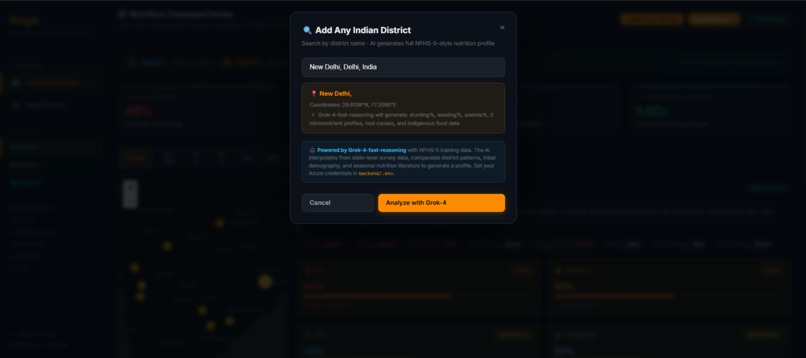
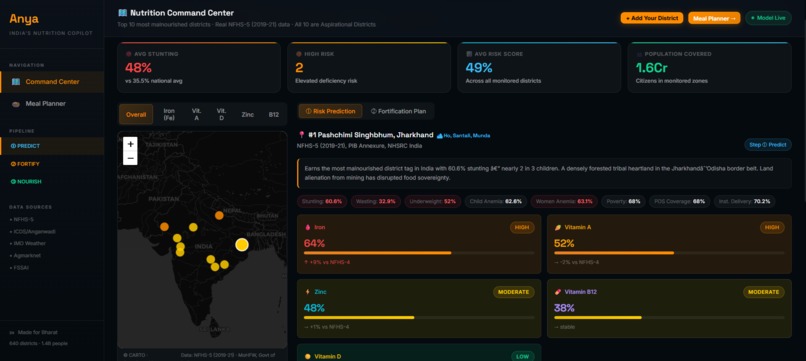
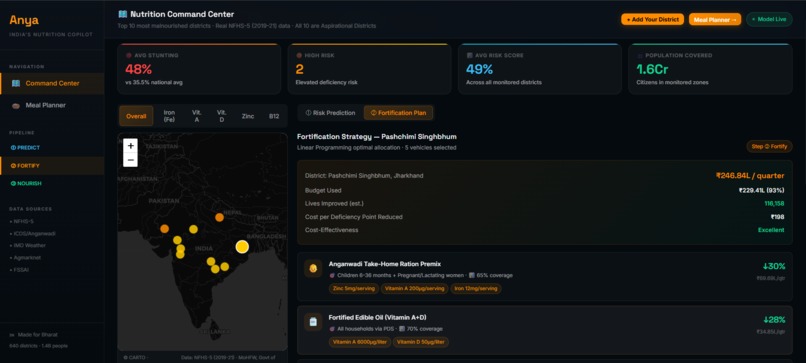
Anya fuses data from NFHS-5, Agmarknet food prices, IMD weather patterns, and PDS records to generate per-district, per-micronutrient risk scores across Iron, Vitamin A, Zinc, B12, and Vitamin D. Rather than reacting to crises after they appear in surveys, it flags emerging hotspots before they escalate. In its current form, Anya covers India's 10 most malnourished aspirational districts with real data for 1.6 crore citizens.
FORTIFY — What nutrients are needed, and how?
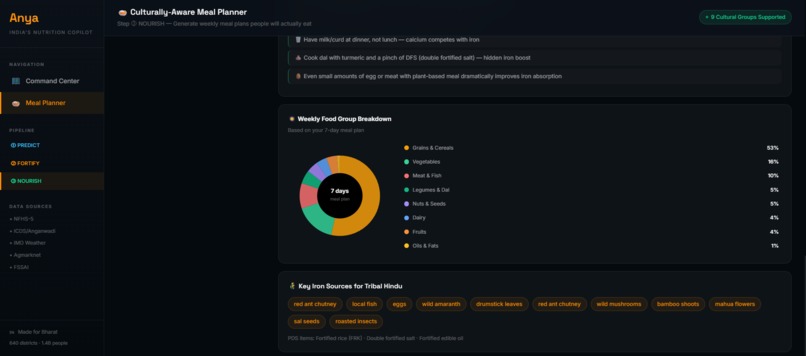
Anya generates cost-optimized fortification strategies per district using linear programming. It recommends the right fortification vehicle — PDS rice, edible oil, double-fortified salt, or mid-day meal flour — based on each district's specific deficiency profile. Critically, it incorporates bioavailability science: pairing iron with Vitamin C sources, separating iron and calcium across meals. It then projects 3-month outcomes with estimated reductions in anemia, VAD, and zinc deficiency.
NOURISH — Meals people will actually eat
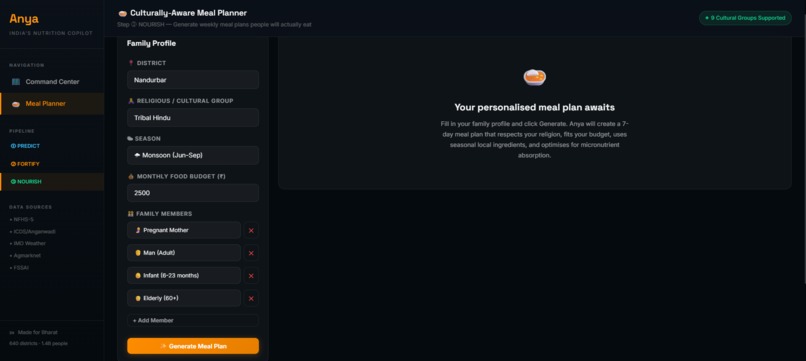
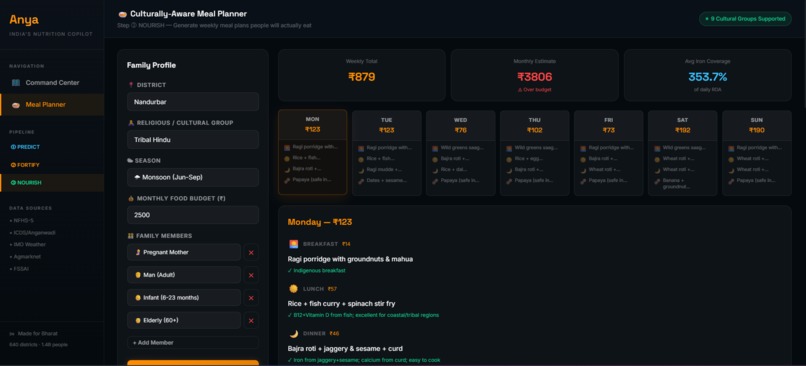
Anya generates 7-day culturally aware meal plans for families based on:
- District, religion, and cultural group (9 groups supported: Tribal Hindu, Muslim, Jain, Sikh, and more)
- Season and local food availability
- Monthly budget (as low as ₹2,500)
- Family composition (pregnant mothers, infants, elderly)
It uses only locally available, affordable ingredients — including indigenous superfoods like ragi, moringa, drumstick leaves, and wild amaranth — and shows per-meal cost, nutrient coverage, and bioavailability tips for each plan.
Our model calculates it costs just ₹847 per person to shift someone out of nutritional risk through this pipeline.
How We Built It
Frontend: React.js with a dark-themed command center dashboard, Mapbox for India district heatmaps, and D3.js for charts and visualizations.
Backend: Python with FastAPI serving the prediction, fortification, and meal generation engines.
Risk Prediction: An XGBoost model trained on real NFHS-5 district-level data (stunting, wasting, anemia rates), fused with Agmarknet food price indices, IMD seasonal features, and poverty indicators. No synthetic or mock datasets — everything runs on real government open data.
Fortification Optimizer: A linear programming engine (PuLP/SciPy) that maximizes deficiency reduction per rupee spent, subject to FSSAI safety limits and nutrient bioavailability interaction constraints.
Meal Generator: A constraint satisfaction engine combining the Indian Food Composition Tables (ICMR), WHO/ICMR RDA values, a cultural dietary rules database covering 9 groups, local market pricing, and PDS entitlement data.
Data Sources: NFHS-5, Agmarknet, IMD, FSSAI fortification standards, ICMR Dietary Guidelines, Soil Health Card Portal.
Challenges We Ran Into
Modeling the complexity of Indian food. A single dish like "dal" varies in ingredients, nutrition, and cost across every state. Building the cultural rules database for 9 religious and cultural groups — with accurate dietary restrictions, pregnancy taboos, and fasting calendars — was the hardest non-technical challenge we faced.
Data inconsistency across government sources. NFHS-5 has district-level data, but Agmarknet food prices are at the mandi (market) level. Reconciling these geographic granularities required careful mapping and fallback estimation logic for districts with incomplete data.
Bioavailability modeling. Iron absorption varies 3–10x depending on what else is in the meal. Building the full nutrient interaction matrix — iron + Vitamin C enhances absorption; iron + calcium suppresses it — and enforcing these constraints in real-time meal generation was both scientifically demanding and computationally intensive.
Multi-constraint real-time optimization. Generating a meal plan that simultaneously meets nutrition targets, respects cultural rules, uses only locally available ingredients, and fits a ₹2,500/month budget is a hard combinatorial problem. Making it run in real time required significant optimization of our constraint solver.
Accomplishments That We're Proud Of
We're proud that Anya runs entirely on real government open data — not a single synthetic record. Every risk score, every fortification recommendation, every meal plan is grounded in actual NFHS-5 survey data, live Agmarknet prices, and ICMR nutritional tables.
We're proud of the cultural depth. Nine distinct dietary profiles, pregnancy taboos, fasting calendars, and indigenous ingredient databases — built because a nutrition platform that ignores how people actually live and eat will always fail, no matter how technically impressive it is.
We're proud of the ₹847 figure. That's not a guess — it's the output of our linear programming optimizer, and it reframes malnutrition from an intractable crisis into a solvable, costed intervention.
And we're proud that Anya surfaces indigenous superfoods — ragi, moringa, red ant chutney, wild amaranth — that have been systematically overlooked by mainstream nutrition programs despite being nutritionally superior and locally available.
What We Learned
Malnutrition in India is not a food problem. It's a data, delivery, and cultural sensitivity problem. The food exists. The government programs exist. What's missing is the intelligence layer connecting prediction to action.
Cultural context is non-negotiable. A nutrition solution that ignores caste, religion, regional food habits, and pregnancy taboos will fail in India — no matter how technically sound it is. Nutrition science without cultural science is incomplete.
Indigenous foods are nutritional powerhouses. Ragi, moringa, drumstick leaves, wild amaranth — these traditional foods often outperform expensive supplements but have been systematically overlooked. The answer was always in the local ecosystem.
Bioavailability matters as much as quantity. You can eat enough iron on paper and absorb almost none if it's paired with the wrong foods. This invisible factor is a major — and chronically underappreciated — driver of India's anemia crisis.
Government open data is a goldmine. NFHS-5, Agmarknet, Soil Health Cards, IMD — the infrastructure for intelligent nutrition planning already exists. It just needs to be connected.
What's Next for Anya
Scale to all 640+ districts with full NFHS-5 coverage and real-time Agmarknet price feeds.
Integrate with POSHAN Tracker — the government's existing Anganwadi monitoring platform — so Anya's predictions and meal plans reach India's 1.4 million Anganwadi workers directly within infrastructure they already use.
Build an Anganwadi worker mobile app with offline-first architecture, voice-based UI in 12+ Indian languages, and camera-based MUAC (mid-upper arm circumference) measurement for instant child malnutrition screening at the last mile.
Pilot in Nandurbar, Maharashtra — partner with the district ICDS office to deploy Anya's fortification strategy and meal plans across 50 Anganwadi centers serving approximately 2,000 children.
WhatsApp-based meal plan delivery — send personalized weekly meal plans to mothers via voice messages in their local language, reaching the 500 million Indians already on WhatsApp with zero new infrastructure.
Real-time food price integration — dynamically adjust meal plans when local ingredient prices spike, automatically substituting affordable alternatives so nutrition targets hold even during inflation.
Open-source the platform so other countries facing similar malnutrition challenges can adapt Anya to their own food systems, cultural contexts, and government data infrastructure.


Log in or sign up for Devpost to join the conversation.