Inspiration
As someone who’s watched friends and family struggle with unmanaged anxiety—panic attacks in public, crippling social fear, overwhelming exam stress—I knew there had to be a better way than scattered coping strategies. Drawing on clinical psychology research (including the validated GAD-7 assessment) and real-world anxiety management practices, I set out to build a tool that delivers immediate relief and long-term growth—something accessible, no clinical jargon, just calm, actionable support.
What it does
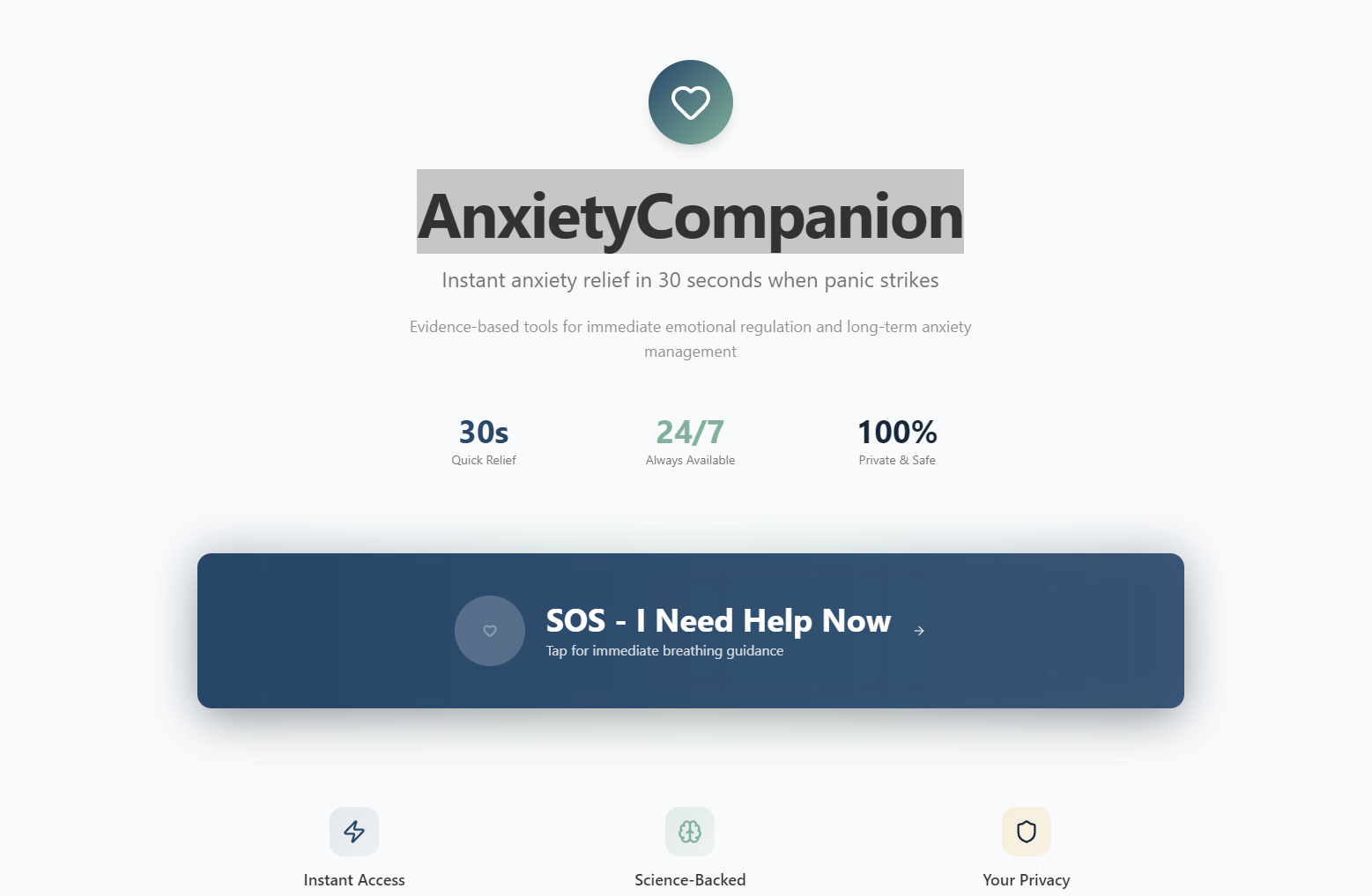
AnxietyCompanion is an all-in-one anxiety management app. It hits two core needs: instant relief (via SOS Mode’s guided breathing for panic attacks, or the 5-4-3-2-1 grounding exercise) and long-term self-awareness (GAD-7 severity assessments, mood/journal tracking, and a structured social anxiety exposure program). Free features cover emergency use, while premium unlocks deep trend analysis and full therapy tools—all with local data storage to protect privacy.
How we built it
I started by mapping clinical guidelines (GAD-7 scoring, exposure therapy frameworks) to user-friendly flows, designing the UI in Figma to prioritize calm colors and intuitive navigation (no extra clicks for SOS Mode). I built the core app with React Native/Expo for cross-platform access, used SQLite for local journal/assessment storage, and integrated Chart.js for trend visualizations. Firebase handled encrypted backup for premium users, and I tested with real anxiety sufferers to refine pacing (e.g., self-paced grounding exercises).
Challenges we ran into
The biggest hurdle was balancing clinical accuracy with approachability—avoiding overly technical language while ensuring GAD-7 scoring was 100% precise. I also struggled with limiting free features without alienating users: the goal was to offer meaningful emergency support (unlimited SOS Mode) while incentivizing premium for long-term tools. Testing with users revealed the need to simplify journal entry fields (fewer tags, faster input) for moments of high anxiety.
Accomplishments that we're proud of
We built a tool that’s both clinically valid and emotionally safe—users report SOS Mode helps them exit panic attacks faster, and the social anxiety challenge hierarchy has helped many take small, sustainable steps toward less avoidance. We also nailed privacy: no mandatory accounts, all sensitive data stored locally, and zero third-party sharing—something users consistently highlight as a top win.
What we learned
I learned that mental health tools live or die by empathy, not just functionality. Users don’t want “one-size-fits-all” solutions—they need control (e.g., self-paced exercises, editable journal entries) and reassurance (calm design, clear progress tracking). I also deepened my understanding of clinical assessment frameworks and how to translate them into code without losing accuracy.
What's next for this project
First, expand the social anxiety program to include more personalized challenge hierarchies based on user triggers (e.g., work vs. school social stress). Next, add customizable breathing exercise parameters (premium feature) and integrate mild AI-driven trigger pattern analysis (using locally processed data only). Finally, roll out a caregiver view (with user consent) to help loved ones support progress—all while keeping the app ad-free and focused on accessibility.

Log in or sign up for Devpost to join the conversation.