-
-
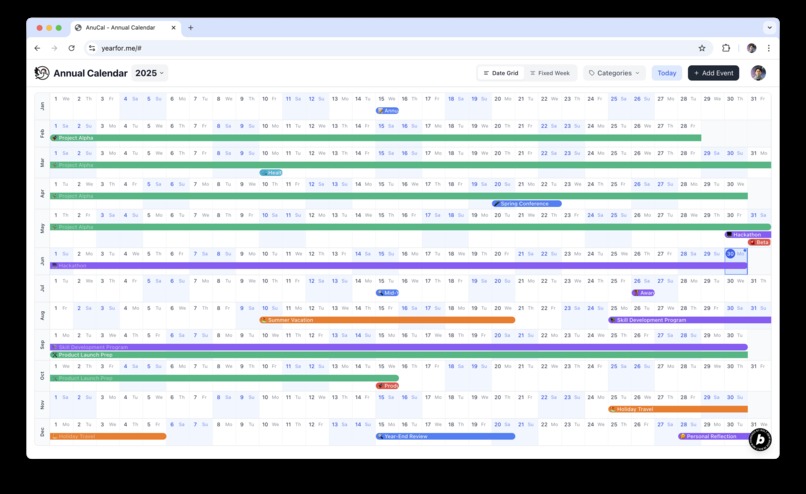
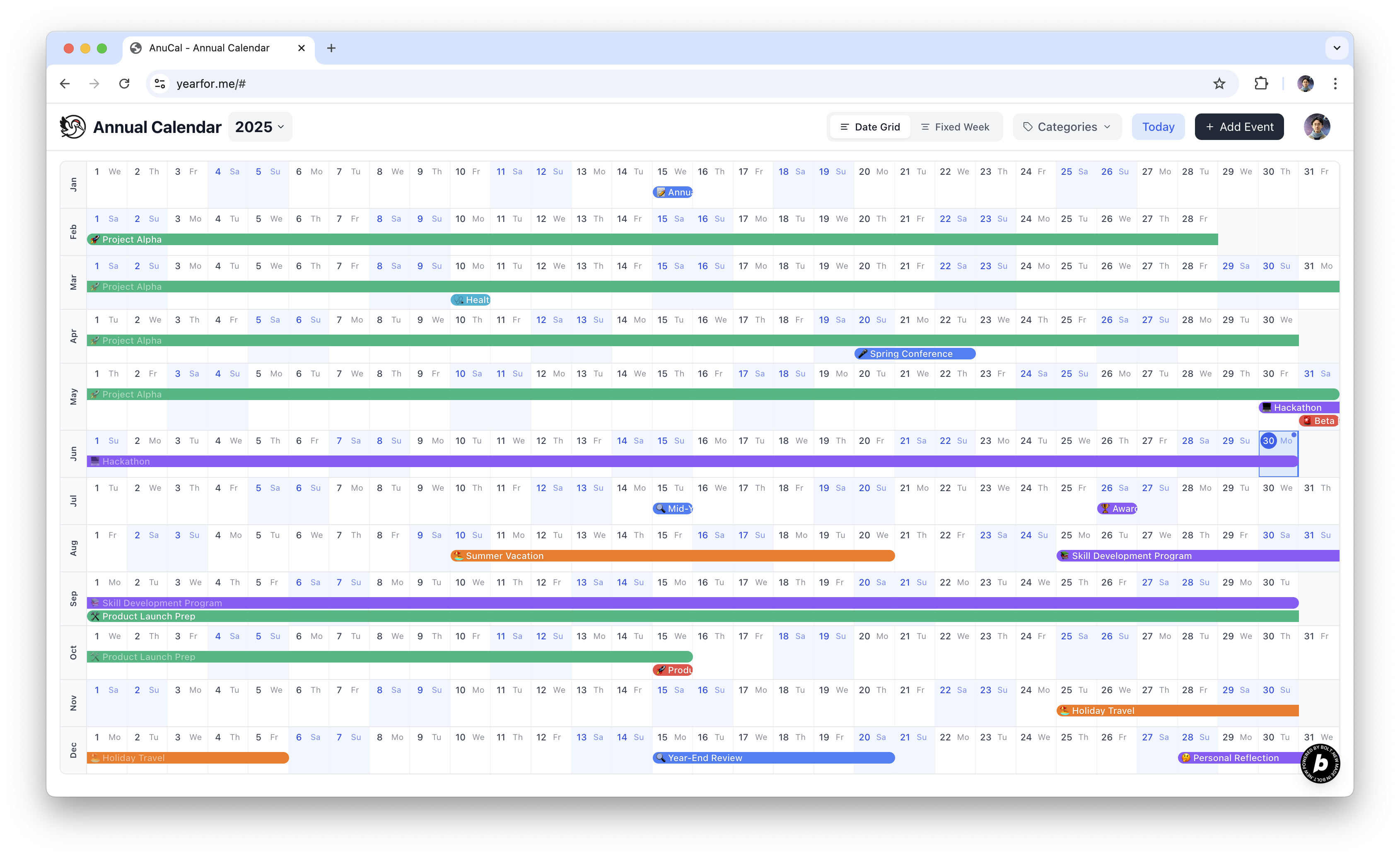
Date Grid Layout
-
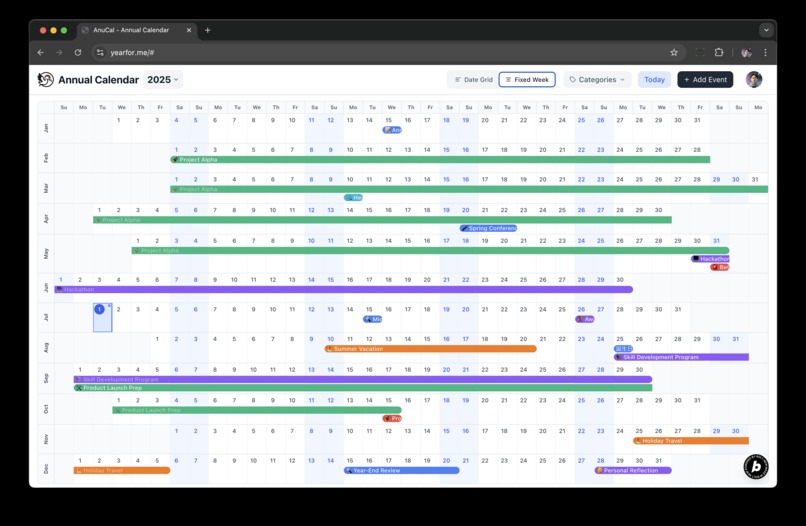
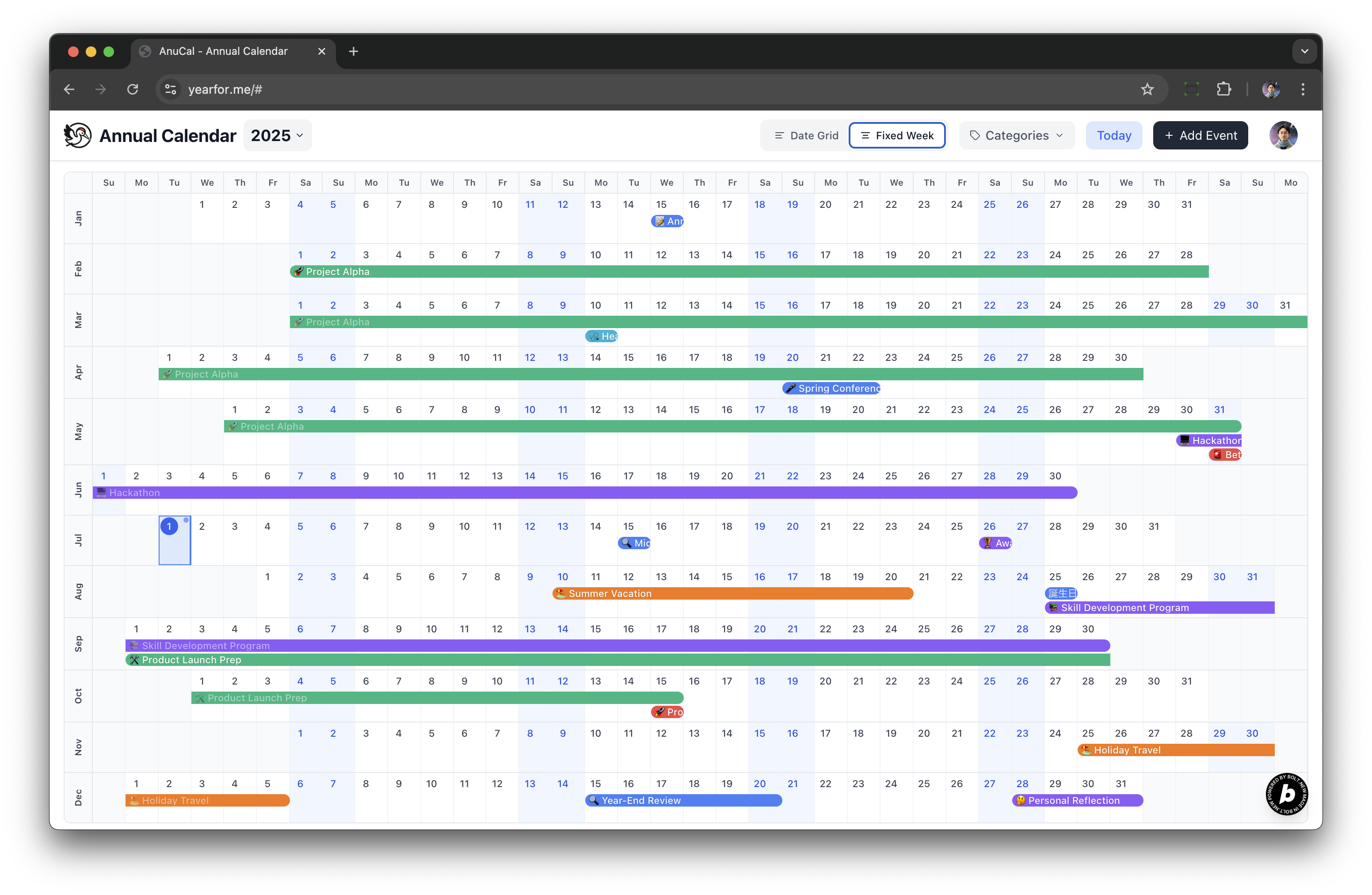
Fixed Week Layout
-
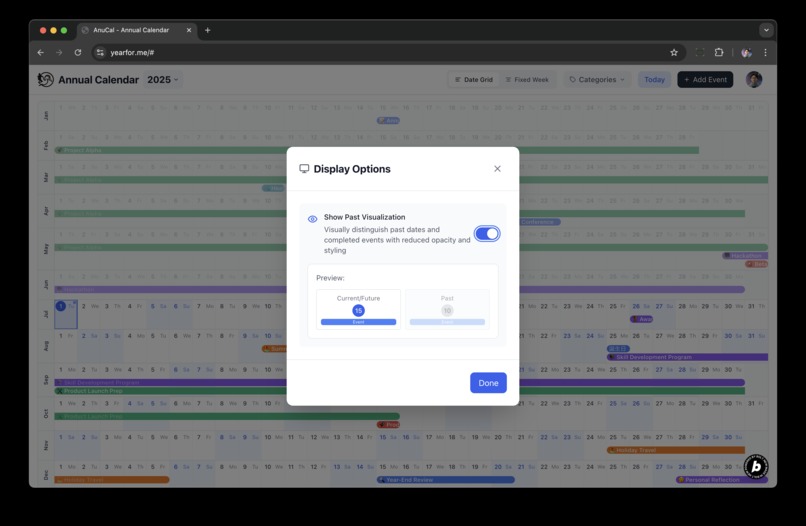
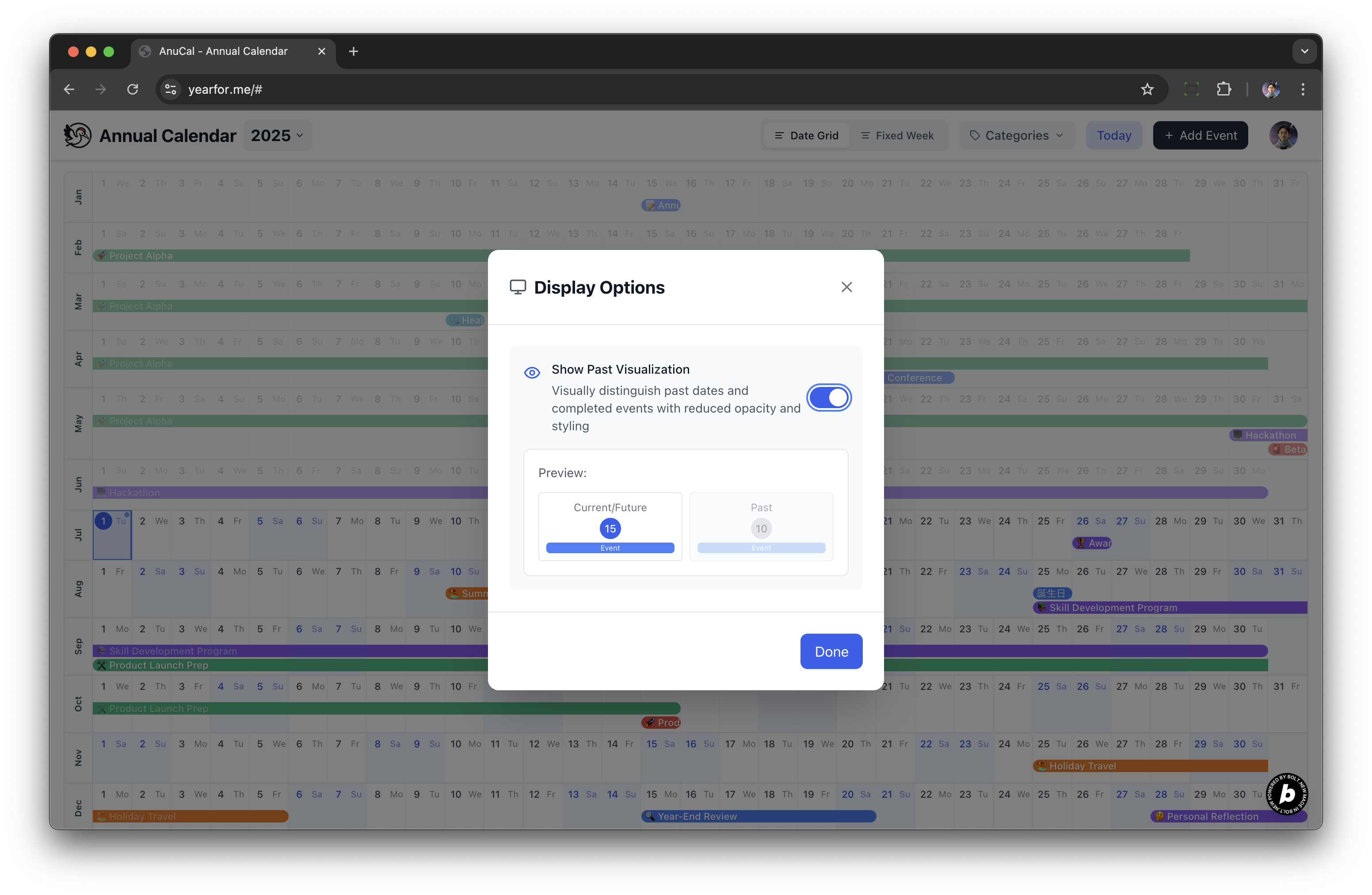
Past Visualization
-
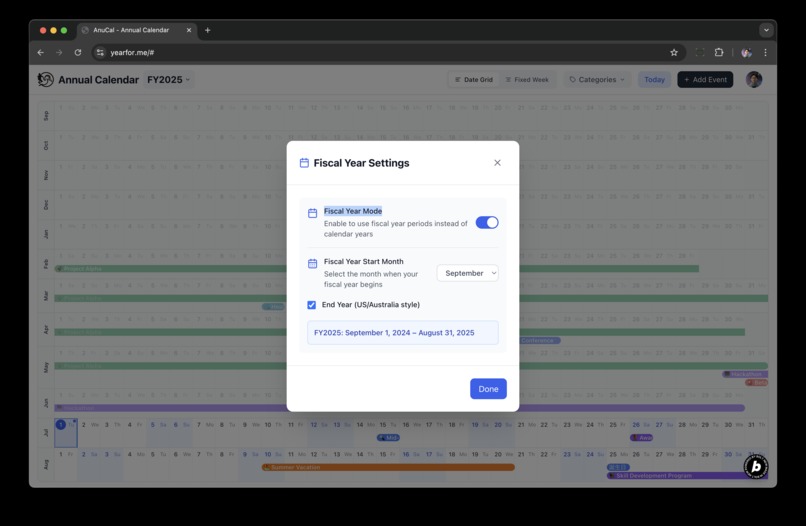
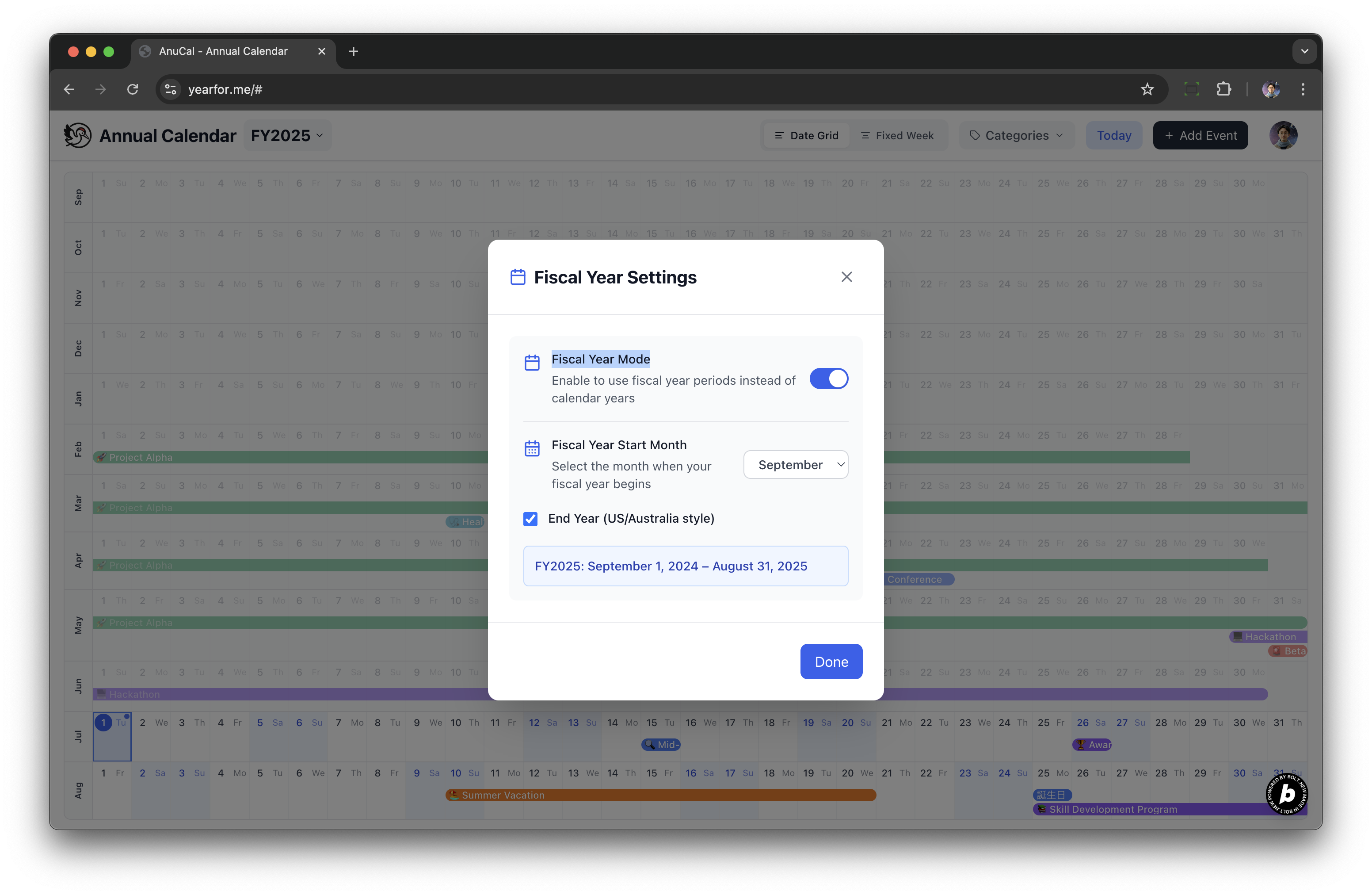
Fiscal Year Mode
-
Logo
🌟 The Inspiration Moment
The journey to AnuCal began with an encounter with Nick Milo's eye-opening video "The Most Useful Calendar View in 2025 That No One Told You About." Having spent years obsessing over digitizing everything and navigating through iCal, Google Calendar, and Asana's timeline views, his message resonated with me instantly.
Despite having access to sophisticated digital tools, I had fallen into what Nick called "the small thinking trap." While most digital calendars excel at weekly views, monthly views, and project-specific Gantt charts, they all share a common flaw: they force you to think small. I realized that constantly using weekly views had fundamentally changed my approach to life. I had lost the ability to dream big, to envision future adventures, and to plan meaningful experiences beyond the immediate scope.
Ironically, while trying to optimize productivity with digital tools, I was unconsciously constraining my own imagination. I wanted digital convenience but without the cognitive limitations. Yet none of the existing solutions felt complete.
When Nick's video ended with a passionate call for developers and designers to create innovative solutions in this space, a simple realization emerged: Why hasn't anyone built this? A few days later, when I discovered the Bolt.new hackathon with its attractive prize structure, the answer became clear—I should try building it myself.
🚀 The Building Journey
What started as a "let's see what happens" experiment quickly evolved into an engrossing endeavor. My development approach was refreshingly different from traditional product development cycles:
Tools and Timeline:
- Tech Stack: React (thanks to Bolt.new's smart suggestions)
- Development Period: 3 intensive weeks
- Process: Claude for requirement gathering → Bolt.new for implementation
- Team Size: Solo development
Workflow Revolution: Instead of the typical lengthy planning phase, I adopted what should be called an "AI-accelerated iteration" approach. Inspired by Nick Milo's video, I organized the requirements for an annual calendar and then proceeded with implementation on Bolt.new. This "build while thinking" approach felt revolutionary—when something didn't work, I could immediately pivot and try new directions without losing momentum.
The most exhilarating moments were during multi-turn conversations with AI, watching my vision materialize with each layered prompt. Each iteration brought me closer to the ideal, creating an addictive feedback loop between creativity and implementation.
🛠️ Challenges and Breakthroughs
Technical Hurdles: The biggest technical challenge was the dreaded "Could not find project" error in Bolt.new's WebContainer environment. When this barrier threatened to hinder progress, I pivoted by downloading the project data and switching to Windsurf, consulting multiple AI assistants to navigate through the complexity.
Design Complexity: Calendar layouts are surprisingly fragile, with small changes cascading into visual chaos, requiring meticulous attention to responsive design principles. The challenge wasn't just making it work, but making a year's worth of data both comprehensive and visually digestible.
Deployment Drama: Bug fixes during deployment became a recurring theme. While I eventually resolved the critical issues, the deployment process was noticeably more error-prone than local development, a pattern that continues today.
Resource Juggling: Running multiple projects simultaneously created interesting dynamics. Switching focus to other endeavors while AnuCal was being processed on Bolt.new created a challenging yet surprisingly enjoyable parallel development workflow.
🎯 What I Learned
This project fundamentally changed my understanding of modern product development. The traditional "plan thoroughly, then execute" methodology gave way to "build quickly, iterate constantly." AI tools have dramatically lowered the barrier to experimentation, making "let's try it" not just more feasible than theoretical planning, but a superior approach.
Key Insight: In the age of AI-assisted development, the cost of trying new approaches has plummeted. Failed experiments that once represented days of wasted effort now function as quick learning opportunities, enabling a more exploratory and creative development process.
📈 Current Status and Future Vision
Current State: AnuCal now exists as a functional MVP, beautifully fulfilling its core promise: viewing an entire year in a single, comprehensive display. I'm transitioning from builder to user, preparing to integrate AnuCal into my daily planning workflow to validate its real-world impact.
Next Steps: The immediate priority is Google Calendar integration, which will bridge the gap between AnuCal's macro-level planning and the micro-level scheduling that existing tools excel at.
Personal Impact: I expect AnuCal to restore something I didn't realize I had lost—the joy of temporal thinking. The ability to casually browse future possibilities, reminisce about past experiences, and maintain a healthy relationship with the flow of time. This isn't just about productivity; it's about rediscovering the pleasure of thinking beyond the immediate.
This project represents something beyond a calendar tool—it's a philosophical statement about how we should relate to time, planning, and the scope of our ambitions. Sometimes the most innovative solutions come from recognizing what we've unconsciously surrendered in our pursuit of efficiency.
Built With
- bolt
- supabase
- vercel


Log in or sign up for Devpost to join the conversation.