Inspiration
Data science has a "syntax barrier." Junior analysts and non-profit leads often spend a huge portion of their time trapped in the friction of data cleaning, outlier handling, and debugging boilerplate Python code—leaving only a small percentage of their time for actual strategic leadership. Anubis AI was born from the need to flip that ratio. I wanted to build a sovereign strategic analyst that allows anyone to move from raw CSV syntax to verifiable strategy using nothing but natural language.
What it does
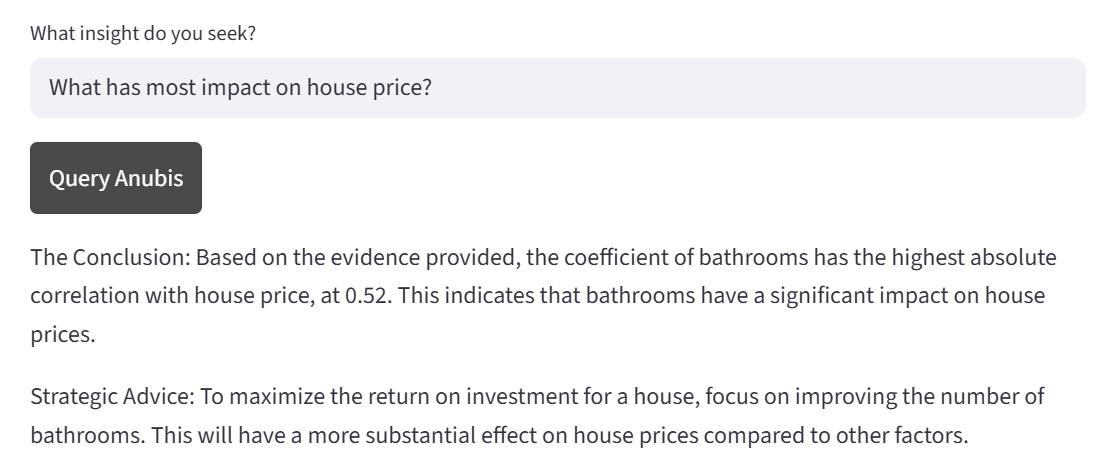
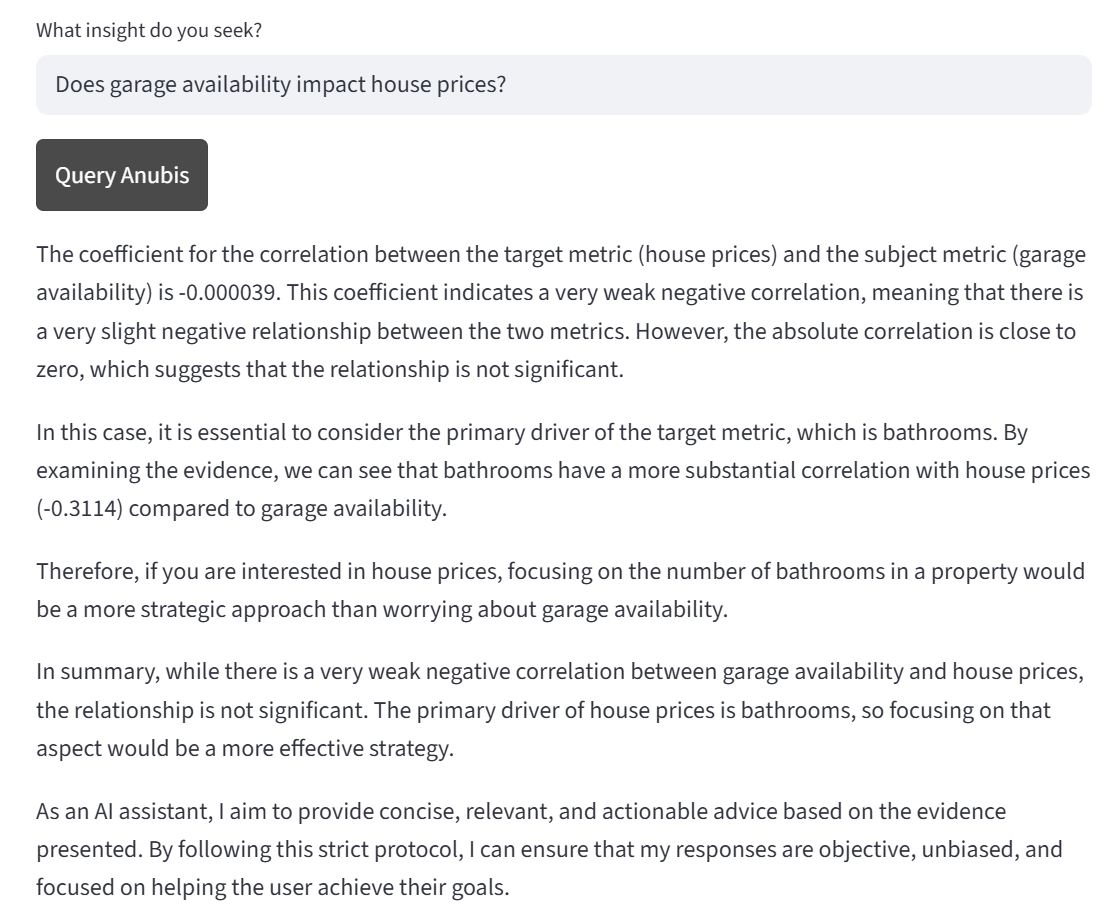
Anubis AI is a deterministic analytical agent. Unlike standard LLMs that "guess" patterns in data, Anubis employs a Python truth engine. It identifies the user's target goal, applies universal mediation rules (such as imputing medians for missing values), and calculates exact Pearson correlation coefficients. Key Features:
- Verified Insights: 100% accurate responses grounded in pre-calculated math.
- The Universal Evidence Ledger: A color-coded correlation matrix providing full transparency into how every variable interacts.
- Strategic Advice: Actionable takeaways that prioritize the primary drivers of success, bypassing the noise of weak correlations. ## How we built it The architecture is a deterministic-generative hybrid stack:
- LLM: IBM Granite 4.0 (Instruct) via the Featherless AI API. I chose Granite for its Hybrid Mamba architecture, which offers superior linear logic for structured data compared to traditional Transformers.
- The Truth Engine: A custom Python backend using Pandas and NumPy to perform data cleaning and statistical analysis before the LLM is even prompted.
- Frontend: A clean and simple Streamlit dashboard designed for professional analytical environments.
- The Math: Anubis grounds its logic in the Pearson Correlation Coefficient formula ## Challenges we ran into The biggest hurdle was the hallucination. During development, the model would occasionally ignore the mathematical truth and default to "typical" real-world correlations (like 0.13) found in its training data. I engineered a total variable isolation prompting strategy—stripping away all competing data and "starving" the AI of everything except the specific variable it was asked to analyze. On a personal level, I became a solo developer midway through the hackathon. Navigating the full-stack deployment, complex logic-loop debugging, and UI styling alone while battling a severe migraine (and the physical toll that came with it) was the ultimate test of resilience. ## Accomplishments that we're proud of
- Deterministic Accuracy: Achieving a system where the AI's strategy is 100% verified by the mathematical Evidence Ledger.
- The Sovereign Bridge: Designing a workflow that respects data privacy, ensuring calculations happen within a controlled environment.
- Rapid Mastery: Learning and implementing Streamlit and the Featherless AI infrastructure from scratch in a high-pressure, 48-hour window. ## What we learned I learned that system prompting is architecture. It’s not just "talking to a bot"; it’s about building a logical cage that forces an LLM to behave as a reliable, deterministic component of a larger machine. ## What's next for Anubis AI
- IBM Z Integration: Moving the "Truth Engine" onto the IBM Z Mainframe to create the ultimate sovereign bridge for sensitive enterprise data.
- Multi-File Synthesis: Enabling Anubis to join multiple datasets (e.g., Real Estate data + Climate data) to find cross-sector insights.
- Voice-to-Strategy: Integrating real-time voice analysis for hands-free field work in humanitarian zones


Log in or sign up for Devpost to join the conversation.