-
-
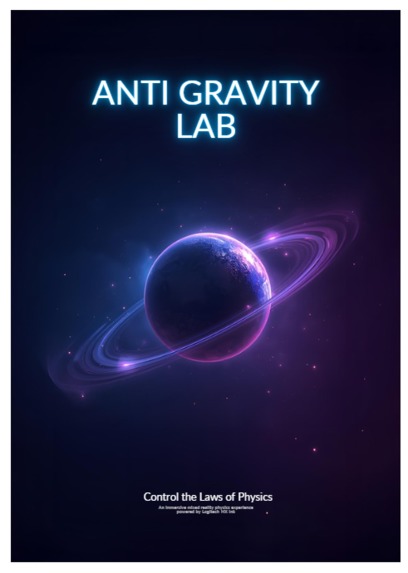
Anti Gravity Lab
Inspiration
Physics is powerful, but for most students and creators, it exists only in textbooks and equations. Concepts like gravity, orbital mechanics, and spacetime curvature are difficult to truly visualize and experience. We asked a simple question: What if you could control gravity in your own room? With the precision of Logitech MX Ink and the immersive potential of Mixed Reality on Meta Quest, we saw an opportunity to transform abstract physics into something interactive, intuitive, and unforgettable. AntiGravity Lab was inspired by the idea of turning learning into an experience — where users don’t just study gravity, they manipulate it.
What it does
AntiGravity Lab is a Mixed Reality physics simulation platform powered by Logitech MX Ink. Users can: Draw planets in mid-air using the stylus Adjust mass and gravitational strength with pressure gestures Create orbiting systems dynamically Generate black holes and observe spacetime distortion Activate Anti-Gravity Mode to experience zero-gravity environments View real-time gravity vectors and force visualizations The application transforms any room into an interactive physics sandbox where users can explore, experiment, and understand gravitational mechanics in an intuitive 3D space. It bridges education, creativity, and immersive technology.
How we built it
AntiGravity Lab was built using a modern immersive development stack: React + Vite for fast development and modular architecture Three.js and @react-three/fiber for 3D rendering @react-three/drei for optimized helpers and controls Framer Motion for cinematic UI animations Tailwind CSS for a clean futuristic interface Structured architecture prepared for WebXR / Meta Quest integration We designed a physics-driven 3D simulation engine that dynamically generates celestial bodies, orbit paths, and gravity fields.
The UI was crafted to feel premium, minimal, and futuristic — blending holographic design principles with immersive spatial interaction.
Challenges we ran into
One of the biggest challenges was balancing realism with performance. Simulating gravity in real time while maintaining smooth frame rates required optimizing object counts and animation loops. Another challenge was designing intuitive stylus interactions that felt natural in mixed reality. Translating pressure, drag, and motion into meaningful physics changes required careful mapping of input logic. We also focused heavily on avoiding UI clutter, ensuring that educational overlays enhanced the experience rather than distracting from immersion.
Accomplishments that we're proud of
Successfully transforming a complex physics concept into an interactive mixed reality experience Creating a cinematic, immersive 3D simulation environment Designing a scalable architecture ready for Meta Quest deployment Delivering a hackathon-ready prototype that blends education and innovation Crafting a visually striking experience that stands out from traditional MR apps Most importantly, we built something that feels powerful — where users genuinely feel like they are controlling the universe.
What we learned
Through building AntiGravity Lab, we learned: Mixed Reality is most impactful when it makes abstract concepts tangible Precision input devices like MX Ink unlock entirely new interaction possibilities Clean UX design is critical in immersive environments Performance optimization is essential in real-time 3D simulations The future of education lies in experiential interaction, not passive observation This project reinforced how immersive technology can redefine learning and creativity.
What's next for AntiGravity Lab
We plan to expand AntiGravity Lab with: Full Meta Quest WebXR deployment Collaborative multiplayer physics labs Advanced astrophysics modules STEM classroom integration tools AI-assisted gravity prediction and scenario generation Gamified physics challenges and mission-based learning Our long-term vision is to make AntiGravity Lab a next-generation educational platform that transforms how physics is taught and experienced globally.

Log in or sign up for Devpost to join the conversation.