
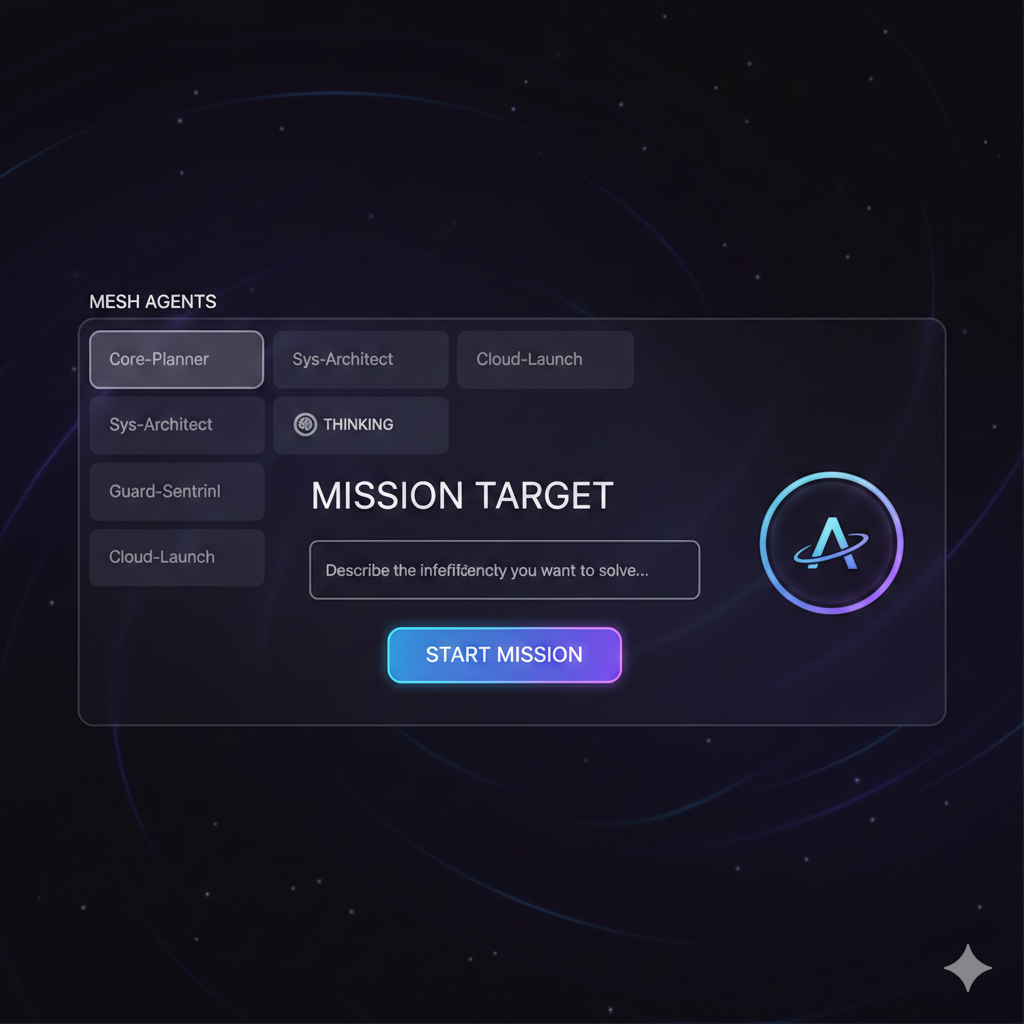
The inspiration for Project ANTIGRAVITY stemmed from the growing friction between human intent and digital execution. In a world of "distributed AI agents," I noticed a persistent inefficiency: the "touch-time" required for a human to bridge the gap between identifying a problem and deploying a solution. I wanted to build a system that felt weightless—hence the name—where software doesn't just assist but independently "detects real-world inefficiencies and independently builds digital solutions". What I Learned During development, I learned that true autonomy requires more than just intelligence—it requires a "Synaptic Archive". By implementing a feedback loop where users can rate and comment on mission results, the system creates a history of performance that informs future iterations. I also gained deep insights into the physics of AI-driven development: reducing the "mass" of a project (the manual steps) directly increases its "acceleration" toward production. Challenges Faced The primary challenge was managing Quota Locks and resource exhaustion. High-fidelity agents like these require significant computational overhead. To solve this, I implemented a strict cooldown mechanism:$$T_{total} = \sum_{i=1}^{n} (t_{processing, i} + t_{stabilization, i})$$Where $n$ represents the number of agents and $t_{stabilization}$ is the 60-second gap enforced to prevent "faults" and ensure "Ultra Safe-Mode" operation. Balancing this "Extreme Stabilization" while maintaining a seamless "Zero-Touch" user experience was the ultimate technical hurdle.
Antigravity
Defying the friction of manual development.
Updates

Leave feedback in the comments!
Log in or sign up for Devpost to join the conversation.