
Inspiration
Every party has the same ten minutes. Someone says "shall we play something", and the group ends up on a website from 2014, squinting at a pop-up, arguing about the rules. I wanted one app a group can pass round a sofa: open it, pick a game, first card in seconds. No accounts, no ads, no setup.
What it does
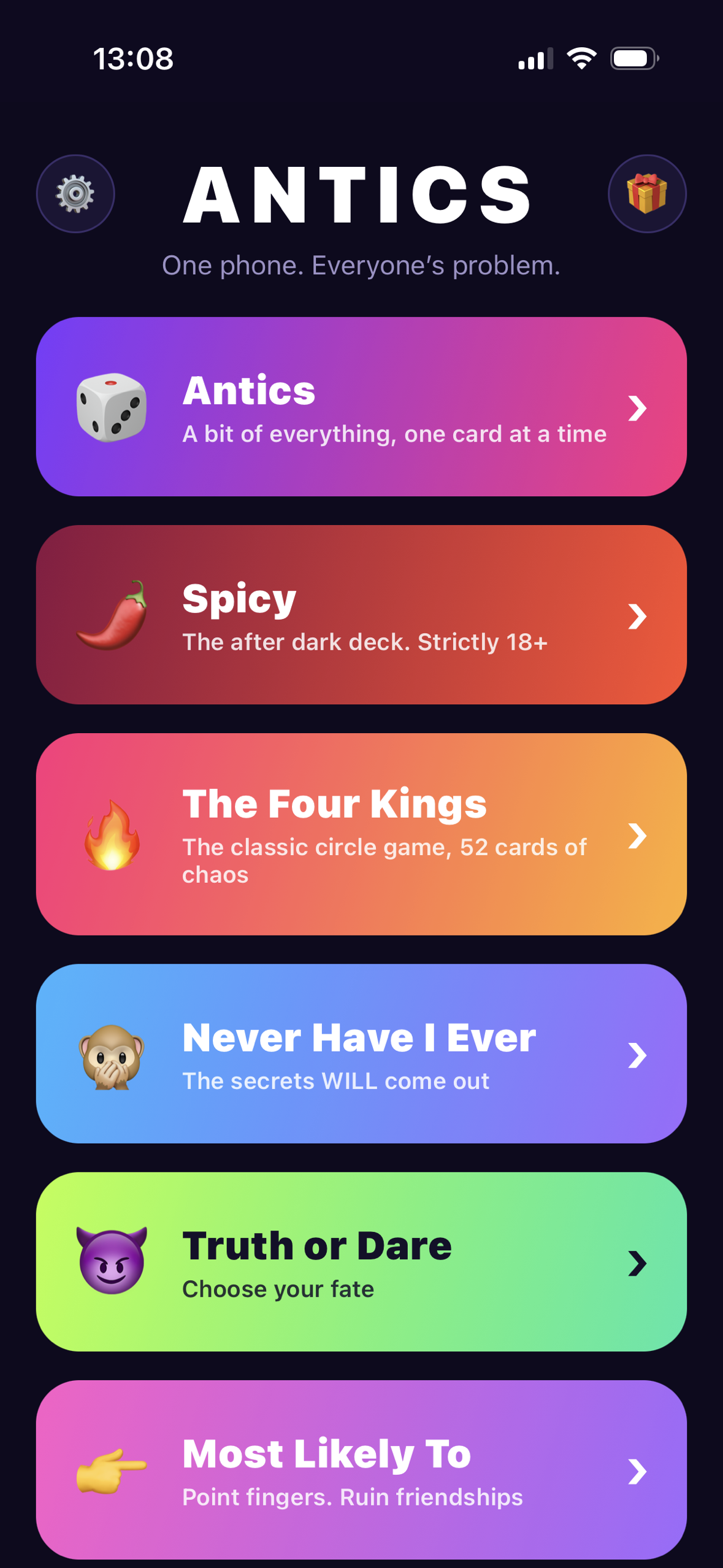
Antics is a pass-the-phone party game collection for iPhone and Android. One screen of games:
- Antics mode, a mixed feed of statements, targeted cards, rules that persist for a few cards with countdown chips, challenges and votes.
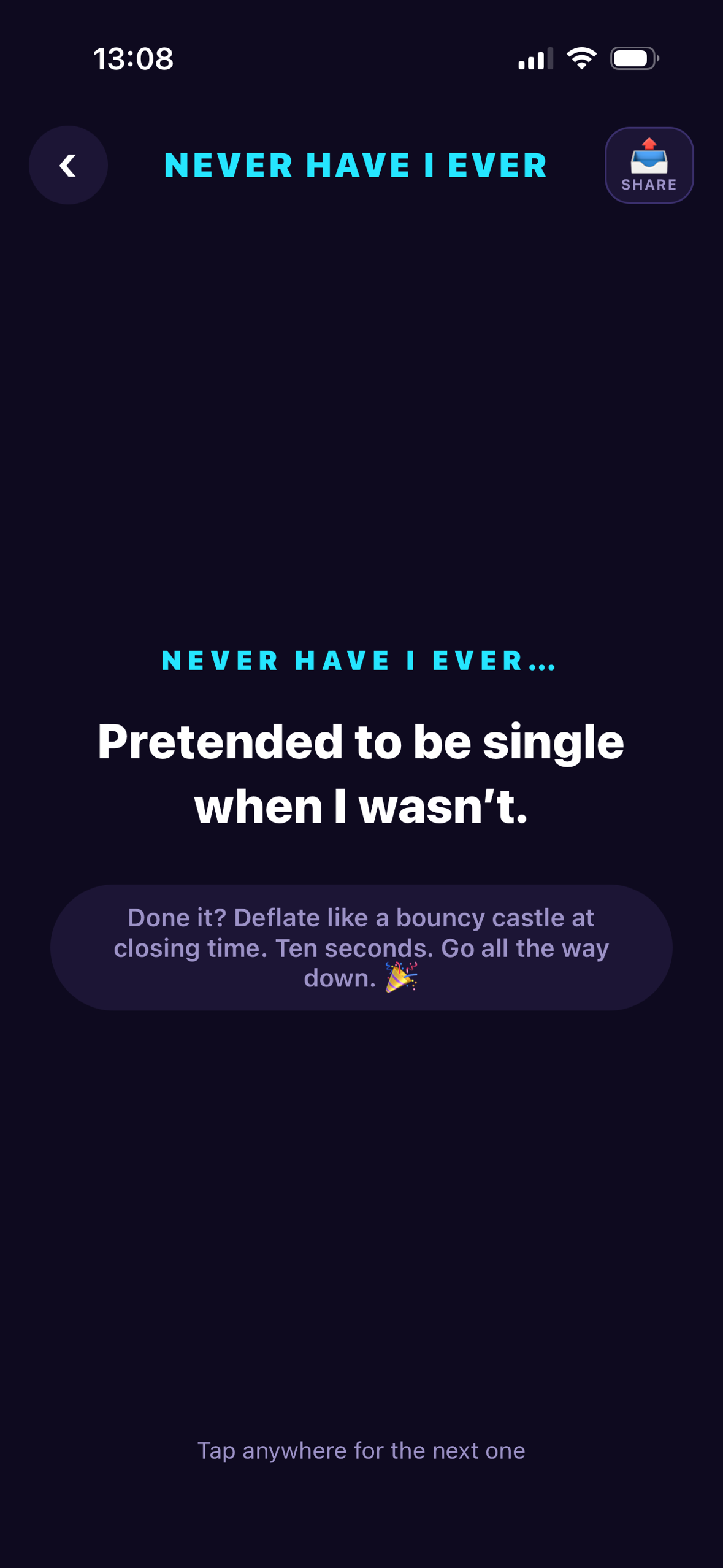
- Never Have I Ever, Most Likely To, Would You Rather, Truth or Dare and What Are The Odds, each with its own deck.
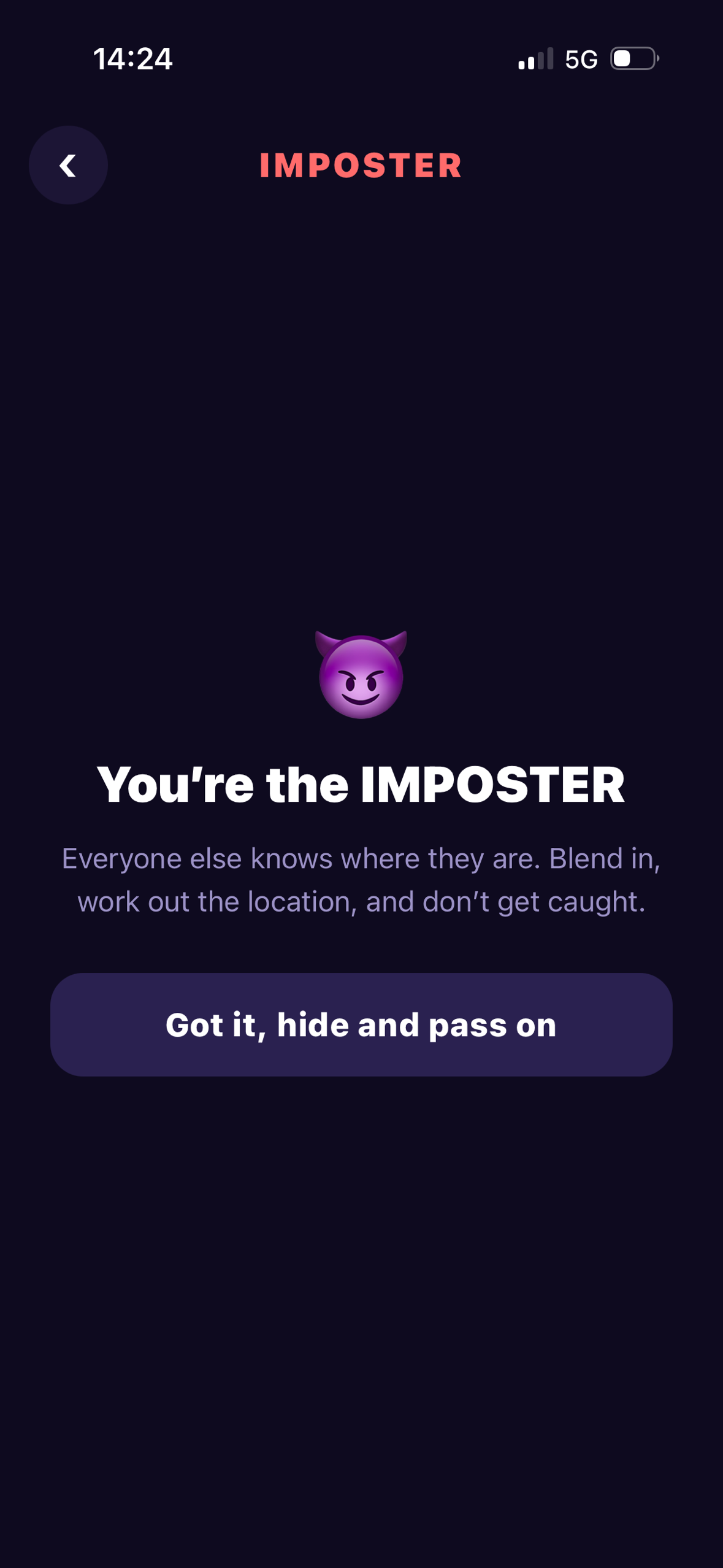
- Imposter, the bluffing word game, with an Easy and Hard tier for the imposter's hint.
- The Four Kings, the 52-card circle game with the rules built in.
Cards inject player names, remember what each device has already seen so a deck never repeats a card until it is exhausted, and can be shared as a branded image card straight into a group chat. Gameplay runs fully offline, which matters on bad venue wifi. It ships in eleven languages, picked from Settings: English, Spanish for Latin America and for Spain, Portuguese for Brazil and for Portugal, German, French, Italian, Dutch, Polish and Czech.
Every core game deals a free hand. Imposter and The Four Kings are completely free. New subscribers get their first week free, and premium unlocks the full decks, thousands of cards and growing, through a single RevenueCat entitlement.
How we built it
React Native with Expo SDK 54, TypeScript, EAS builds. RevenueCat (react-native-purchases) runs every purchase against one entitlement, premium. Supabase edge functions power our own event sink and the promoter link tracking. Local notifications, not push, for a weekly game-night reminder that rotates Thursday, Friday and Saturday so the data can settle which evening wins. Built by a first-time developer with Claude Code, which is how nine App Store releases shipped in six weeks.
The operation behind the app is automated as heavily as the app. A scheduled Apple Search Ads optimiser adjusts bids against a cost-per-install bar and keeps its own ledger. A daily owner brief lands every morning with downloads, ratings, spend and revenue pulled from App Store Connect, RevenueCat and our own event sink. The street team runs on scripts: personal QR codes, Apple offer codes, weekly promoter emails and a payrun that pays from Apple's redemption reports against a ledger, never from memory. Releases go through a stager that creates the App Store Connect version, attaches the pinned build and refuses to submit if the notes break a gate we learned from a rejection. Content lands through per-game card-writing skills, a mirror gate that keeps all eleven language files index-aligned with English, and a lint pass that enforces the house rules on every commit. Even App Store review replies are drafted weekly and posted only on a numbered confirm.
Challenges we ran into
- App Review. Seven submissions, six rejections across four guidelines, 44 days from first submission to first clean approval. The original concept fell foul of the guidelines and had to be rebuilt around physical and verbal forfeits, which turned out to be a better product. Later, our in-app referral code field was ruled a purchase mechanism outside in-app purchase, so it came out within 48 hours and the free-week mechanic moved to Apple offer codes instead.
- Our first pricing model did not convert, so we rebuilt it mid-contest. The original headline product was a 48 Hour Pass, a consumable whose clock started on the first card drawn rather than at checkout, so someone could buy on the walk to a party and lose nothing. RevenueCat recorded the purchase and our own activation logic managed the window. It was a nice piece of engineering that the market did not want: across roughly 500 downloads, 3 subscribed. We replaced the whole ladder with a one week free trial, which meant a new weekly product, a new paywall, and holding the old tier in RevenueCat as a fallback we can switch on remotely.
- Growth with a tiny budget. A party game is bought by the person holding the phone at the party, so we built a street team: promoters with personal QR codes that unlock a free week via offer codes, paid per redemption from Apple's own reports.
Accomplishments that we're proud of
Live in 166 App Store territories and on Google Play within six weeks of first approval, now in eleven languages. Rated 4.8 on the UK App Store. App Store downloads went from 192 in our first four weeks to 695 by 26 September. Parties played hit 113 in the week to 19 September; the week to 28 September ran 67, at a median of 25 cards each. Nearly 9 in 10 cards are read out rather than flicked past.
What we learned
Ship the earliest usable version and let real parties tell you what is wrong. The free deck is the trial, so it has to be the best-of, not the first N. A monetisation model you are proud of is still wrong if nobody buys it, and the cost of finding out is one release. Measurement breaks more often than products do, so keep your own event sink.
What's next for Antics
A multi-device Imposter room. An in-game card that invites the room to install, and a lobby that puts names first, both built and in the next release. Bigger core decks every week, each card vetoed by hand before it ships.
Built With
- claude-code
- expo.io
- react-native
- revenuecat
- sentry
- supabase
- typescript


Log in or sign up for Devpost to join the conversation.