-
-
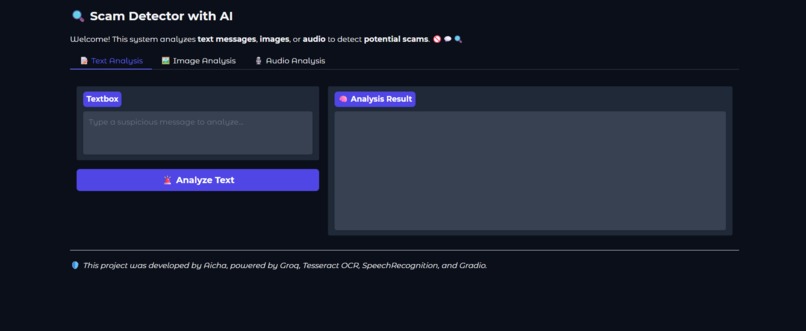
interface of our web app

Inspiration
The rise of sophisticated scams across digital platforms, from phishing texts to fraudulent voicemails, inspired me to create an accessible tool to protect users. As someone passionate about AI and cybersecurity, I wanted to empower individuals to identify scams swiftly and confidently. My goal was to build a solution that bridges advanced AI with user-friendly design, making scam detection inclusive and practical for everyone.
What it does
The Scam Detector is an AI-powered tool that identifies potential scams in text messages, images, and audio files. Users can input text, upload images containing text, or submit WAV audio files through a user-friendly Gradio interface. The system processes these inputs as follows:
Text Analysis: Directly analyzes user-entered text using Groq’s Llama-3.3-70B model to classify it as a scam or not, providing reasons and a confidence score. Image Analysis: Extracts French text from images using Tesseract OCR, then analyzes it for scam indicators via Groq’s API. Audio Analysis: Transcribes WAV audio files using Google’s Speech-to-Text API and evaluates the transcribed text for scams. Results are presented in a clear, structured format, empowering users to make informed decisions about suspicious communications. The tool enhances cybersecurity by offering multi-modal scam detection with high accuracy and accessibility.
How we built it
The project is built in Python, leveraging: Groq API: For real-time scam analysis with structured outputs (scam/no scam, reasons, confidence scores). Tesseract OCR: To extract French text from images, with checks for language data availability. SpeechRecognition: To transcribe WAV audio files using Google’s API. Gradio: To create a sleek, tab-based interface for text, image, and audio analysis. The system processes inputs, extracts or transcribes text, and feeds it to Groq’s model for scam detection, delivering results in a clear, user-friendly format.
Challenges we ran into
Dependency Management: Ensuring Tesseract’s fra.traineddata was correctly configured was tricky, requiring precise path handling. Audio Processing: Handling variable audio quality and ensuring WAV format compatibility posed issues, resolved through robust error checks. API Integration: Managing rate limits and errors from Groq’s API required careful exception handling. User Experience: Designing an intuitive Gradio interface while maintaining functionality across modalities was a balancing act.
Accomplishments that we're proud of
We’re thrilled with the milestones achieved in developing the Scam Detector project: Multi-Modal Integration: Successfully combined text, image, and audio analysis into a single tool, leveraging Groq’s Llama-3.3-70B, Tesseract OCR, and SpeechRecognition for robust scam detection across diverse inputs. User-Friendly Interface: Built an intuitive Gradio interface with a soft theme, featuring distinct tabs for text, image, and audio analysis, making scam detection accessible to non-technical users. Accurate Scam Detection: Achieved reliable scam classification with structured outputs, including clear reasoning and confidence scores, enhancing user trust and decision-making. Robust Error Handling: Implemented comprehensive error management for Tesseract’s language data, audio file formats, and API interactions, ensuring a smooth user experience. French Language Support: Enabled seamless processing of French text in images and audio, catering to a specific linguistic audience with Tesseract’s fra.traineddata. Real-World Impact: Created a practical cybersecurity tool that empowers users to identify scams in real-time, addressing a pressing need in today’s digital landscape.
What we learned
Developing this project deepened my understanding of integrating multiple AI technologies. I gained hands-on experience with: Natural Language Processing: Using Groq’s Llama-3.3-70B model to analyze and classify text for scam detection. OCR and Audio Processing: Implementing Tesseract OCR for image text extraction and SpeechRecognition for audio transcription. UI Development: Creating an intuitive interface with Gradio to enhance user accessibility. Error Handling: Managing dependencies and file paths, especially for Tesseract and audio inputs. I also learned to balance technical complexity with usability, ensuring the system is both powerful and approachable.
What's next for Anti-scam and Misinformation detection
To elevate Scam Detector’s fight against scams and misinformation, we plan to: Add Languages: Support more languages for OCR and audio to reach global users. Real-Time Analysis: Use Grok’s DeepSearch to check web and X posts for emerging scams. Misinformation Detection: Add fact-checking to catch misleading content. Mobile App: Build an app with voice mode for easy, on-the-go scam detection. Smarter AI: Train on larger datasets for better accuracy. User Feedback: Let users submit content to improve detection over time.

Log in or sign up for Devpost to join the conversation.