Inspiration
Online shopping is designed to convince us to buy. We wanted to flip the role of the salesperson: instead of an AI trying to sell you something, what if it worked for you? This inspired us to create an AI that questions whether a purchase is actually worth making.
What it does
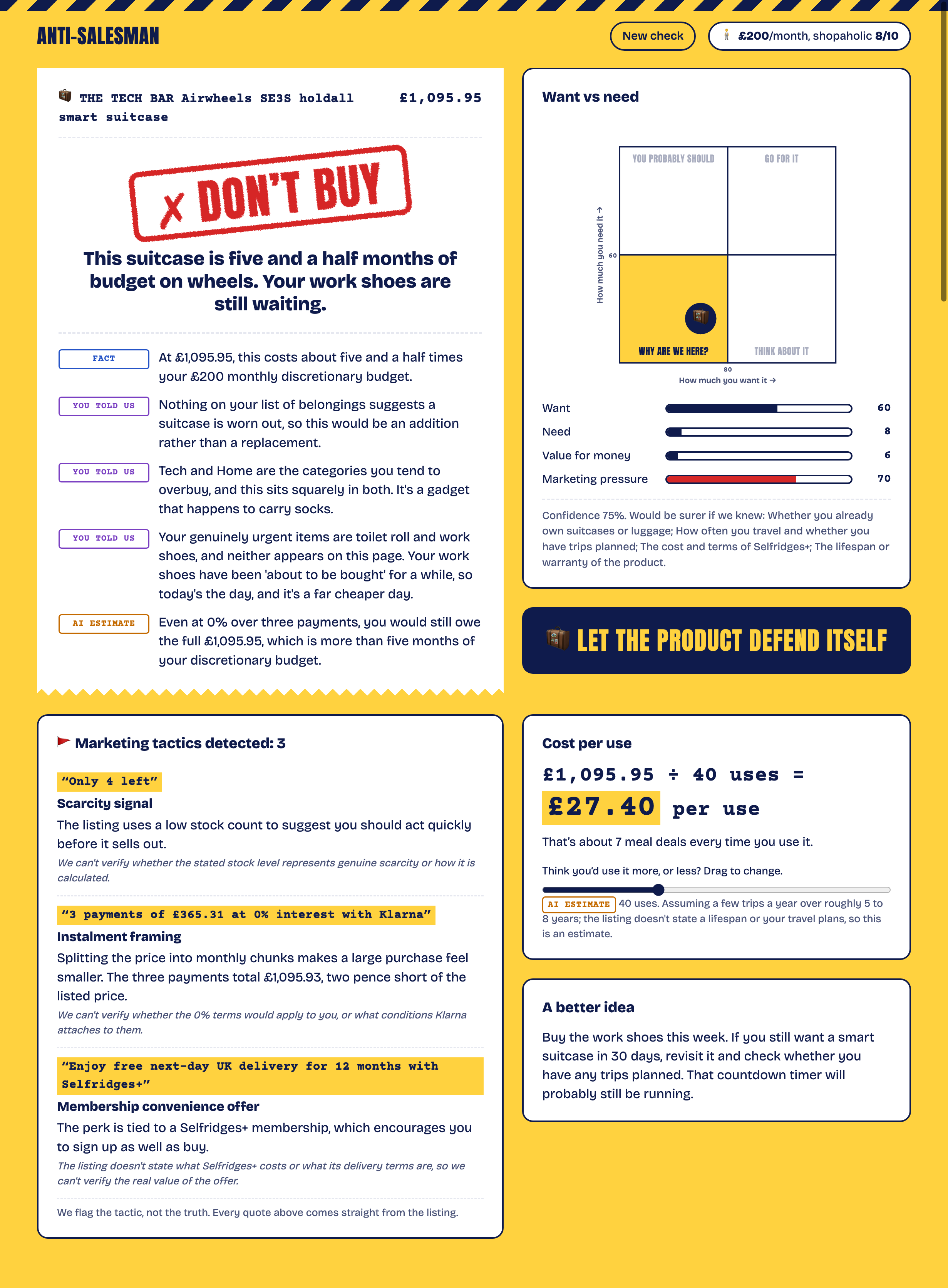
Anti-Salesman analyses products based on your needs, budget, habits and what you already own. It gives you a BUY, THINK, or DON'T BUY verdict, explains why, identifies marketing tactics such as scarcity and urgency, calculates cost-per-use, and even lets the product defend itself in an AI-powered debate.
Importantly, it isn't simply anti-shopping, it can tell you to buy something when you genuinely need it.
How we built it
We built Anti-Salesman as a lightweight web application using HTML, CSS and JavaScript, with Claude providing the AI reasoning. We use structured AI outputs to power the different parts of the interface, while calculations such as cost-per-use are handled directly by the application.
We focused on creating a polished, interactive experience that could demonstrate the concept quickly rather than building unnecessary infrastructure.
Challenges we ran into
Our biggest challenge was balancing AI creativity with reliability. We wanted Anti-Salesman to be funny and opinionated without inventing facts or presenting AI estimates as certain.
We also had to work within a very short hackathon timeframe, so we had to prioritise the features that best demonstrated the core idea and make the demo reliable.
Accomplishments that we're proud of
We're particularly proud of the "Let the product defend itself" feature. It turns the shopping experience into a humorous debate between the product and the AI, making the flipped concept immediately visible.
We're also proud that Anti-Salesman doesn't blindly say "don't buy". Seeing it confidently recommend a necessary purchase demonstrates that the system is genuinely trying to make the right decision for the shopper, rather than simply discouraging spending.
What we learned
We learned that good AI products aren't just about the model. The way AI outputs are structured, presented and constrained is just as important.
We also learned the importance of designing around a clear core interaction. With limited time, focusing on one memorable experience was much more effective than trying to build a huge number of features.
What's next for Anti-Salesman
The next step would be to bring Anti-Salesman directly into the shopping experience, allowing it to analyse products while users browse and intervene before they click "Buy".
We'd also like to improve product research, provide stronger evidence for claims, learn from users' purchasing patterns, and make the AI increasingly personalised to each shopper.
