-
-
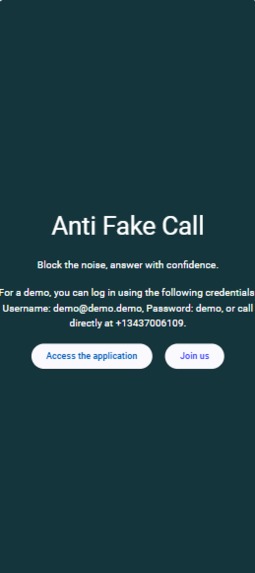
"Anti Fake Call" App (Splash Screen)
Inspiration
Phone scams cost consumers over 8 billion dollars a year, and people of color are twice as likely to be scammed. 'Anti Fake Call' solves this problem by giving you a virtual phone number and using AI to screen calls. If it’s legitimate, you get notified; if it’s a scam, we block it instantly. Stay protected with 'Anti Fake Call'.
The project was inspired by the growing rise in phone scams and the increasingly sophisticated methods being employed, particularly with voice imitation technologies driven by large language models (LLMs). A personal incident also played a significant role— a close acquaintance became a victim of such a scam, which led to a substantial financial loss for several of their contacts.
What it does
'Anti Fake Call' gives you a virtual phone number that you can use as your "public" phone number; it then uses AI to screen incoming calls to that virtual phone number. If it’s legitimate, the call gets forwarded to your "private" number i.e your real number (the current demo version only notifies you); if it’s a scam, we block it instantly.
How we built it
The detection/verification process is powered by OpenAI GPT-4 for conversation analysis and Twilio API for call proxy, streaming and notifications. Additionally, we used OpenAI's Whisper for accurate transcription of voice calls. The App is built with Angular for the frontend and Django as the API server framework. The entire system was containerized with Docker for seamless scalability and deployment, ensuring robustness and flexibility across different environments.
Challenges we ran into
The primary challenge was integrating to build the system analyze conversations in real-time. This required streaming calls, while ensuring the accuracy of the conversation transcription and analysis, which involved a lot of API integration and a few hacks.
Accomplishments that we're proud of
We're particularly proud of successfully building everything in about a week. It was challenging to design the system for this to work and with more time we'll definitely make it even more effortless for everyone to have a personalized "calls concierge".
What we learned
Through this project, we gained deep insights into telecommunication APIs and how to effectively integrate calls streaming for real-time use. We also learned about the challenges of fraud detection, the intricacies of LLM-driven voice imitation, and how to build scalable, containerized applications.
What's next for Anti FakeCall
The nexts steps for Anti FakeCall are:
- To develop a solution that provide users with protection with or without a virtual phone number implying a greater flexibility and control over their communications.
- Additionally, we aim to continue expanding the system’s AI capabilities to improve detection accuracy including simulated voice interactions to trap scammers and prevent further fraudulent communications.
- We also have ideas to make the user experience snappier and more straightforward.
- Exploring partnerships with telecom providers remains an interesting option to make the system more accessible and offer protection on a larger scale.


Log in or sign up for Devpost to join the conversation.