-
-
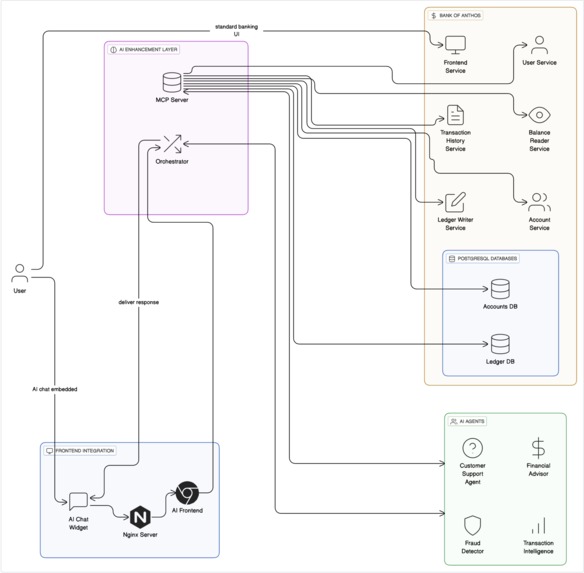
Architecture Diagram

Inspiration
Banking has become increasingly digital, but most applications still focus on transactions rather than insights. We saw an opportunity to transform Bank of Anthos from a standard banking platform into an intelligent financial partner. Our vision was to create AI agents that could understand customer needs, provide personalized guidance, enhance security, and extract meaningful patterns from financial data—all without modifying the core application. This approach demonstrates how existing microservice architectures can be enhanced with AI capabilities, creating smarter applications that better serve users.
What it does
AnthoSage adds an intelligent layer to Bank of Anthos through four specialized AI agents:
Customer Support Agent: Answers questions about accounts, transactions, and banking features. It guides users through common banking tasks and troubleshoots issues.
Financial Advisor: Analyzes account activity to provide personalized financial recommendations, savings opportunities, and budgeting advice.
Fraud Detector: Monitors transactions in real-time to identify suspicious patterns and potential security threats, alerting users to possible fraudulent activity.
Transaction Intelligence: Analyzes spending habits, categorizes expenses, and identifies trends to give users insights about their financial behavior.
These agents work together through an orchestration system, presenting a unified interface to users through a chat widget seamlessly integrated into the Bank of Anthos UI.
How we built it
Our solution architecture consists of several key components:
Agent Framework: We built four specialized agents using Google's Agent Development Kit (ADK), each powered by Gemini models and focusing on specific banking functions.
MCP Server: We implemented a Model Context Protocol server that acts as a bridge between the AI agents and Bank of Anthos APIs, allowing agents to retrieve real-time banking data.
Orchestrator: We developed an agent orchestrator that routes user queries to the appropriate specialist agent and coordinates multi-agent responses.
Middleware: We created authentication middleware that securely allows agents to access Bank of Anthos APIs while respecting user permissions.
Frontend Integration: We built a JavaScript widget that injects our AI interface into the existing Bank of Anthos UI, creating a seamless user experience.
All components were containerized and deployed on Google Kubernetes Engine (GKE), with careful attention to security, scalability, and resilience.
Challenges we ran into
Building AnthoSage presented several significant challenges:
Auth System Integration: Bank of Anthos uses JWT authentication, requiring us to develop a sophisticated proxy system for our agents to securely access user data.
Context Management: Banking conversations need substantial context from transaction history and account details. We developed a context compression system that prioritizes relevant information while staying within model context limits.
Agent Specialization vs. Collaboration: Balancing agent specialization with effective collaboration required careful design of communication protocols and responsibility boundaries.
Responsible AI: Ensuring agents provided accurate financial information without making promises or giving inappropriate advice required extensive prompt engineering and testing.
Kubernetes Networking: Configuring service discovery and network policies for secure inter-agent communication required deep knowledge of Kubernetes networking.
Accomplishments that we're proud of
Zero Core Code Modification: We enhanced Bank of Anthos with advanced AI capabilities without changing a single line of the original application code.
Multi-Agent Collaboration: We successfully implemented a system where specialized agents work together to provide comprehensive responses.
Seamless UI Integration: Our chat widget blends naturally with the existing Bank of Anthos interface, creating a cohesive user experience.
Real-Time Financial Intelligence: The system analyzes transactions as they occur, providing immediate insights and security alerts.
Scalable Architecture: Our deployment on GKE allows the system to scale efficiently as user demand grows.
What we learned
This project provided valuable insights across multiple domains:
Agent Architecture: We learned how to effectively balance specialization and collaboration in multi-agent systems.
Context Optimization: We discovered techniques for compressing and prioritizing information for large language models in data-intensive applications.
GKE Deployment: We gained experience deploying complex, interconnected services on Kubernetes while maintaining security and performance.
Prompt Engineering: We developed strategies for crafting effective prompts that generate helpful, accurate responses for financial use cases.
API Integration: We learned how to create flexible middleware that can adapt to existing API authentication schemes.
What's next for AnthoSage: AI-Powered Banking Agents
We have ambitious plans to expand AnthoSage's capabilities:
Agent Personalization: Training agents to adapt to individual user communication styles and preferences.
Proactive Insights: Moving beyond reactive responses to proactively identify opportunities and concerns in users' financial data.
Multi-Modal Interaction: Adding support for image processing to handle documents, receipts, and financial statements.
Financial Education: Developing learning paths that help users improve their financial literacy based on their specific situations.
API Expansion: Creating a developer-friendly API that allows third-party services to integrate with our AI banking agents.
Enhanced Analytics: Building advanced analytics that provide deeper insights into spending patterns and financial health.
By continuing to develop AnthoSage, we aim to create an AI banking assistant that not only answers questions but helps users achieve their financial goals and improve their relationship with money.
Built With
- docker
- fastapi
- gemini-ai-models
- gke
- google's-adk
- javascript
- jwt-authentication
- kubernetes
- mcp
- nginx
- python


Log in or sign up for Devpost to join the conversation.