-
-
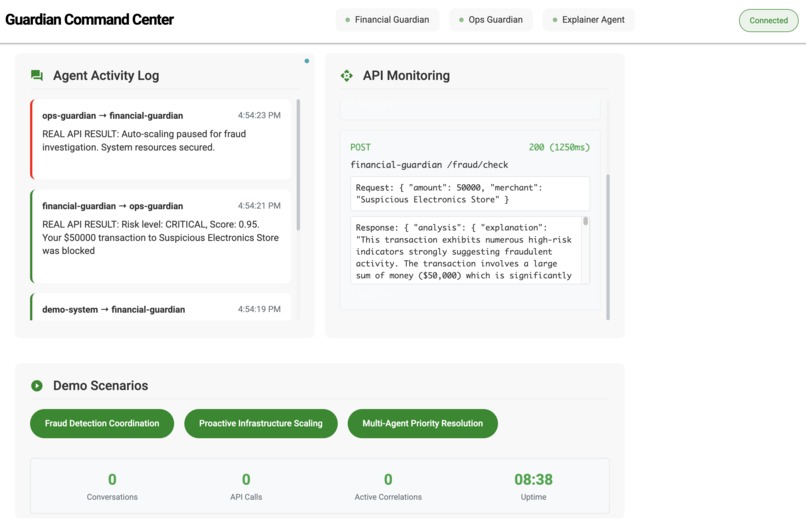
Guardian Command Center Interface
-
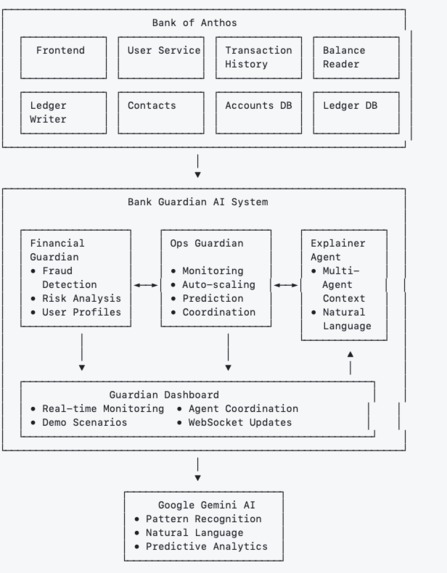
Architecture
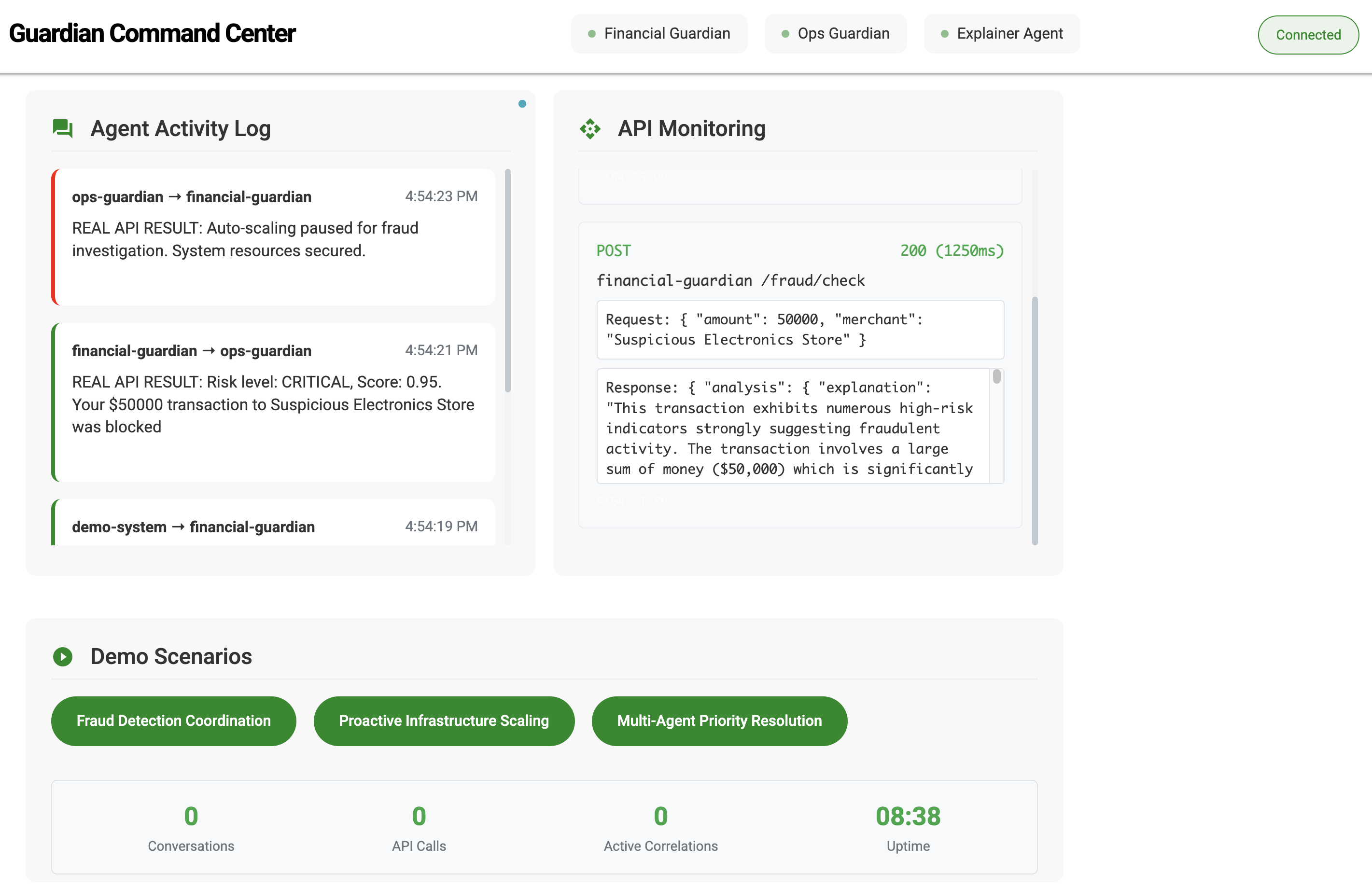
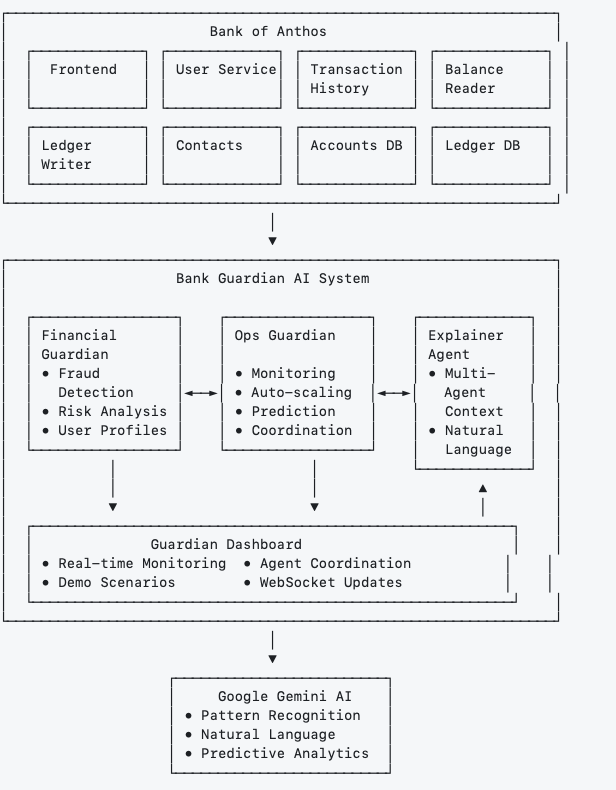
Bank Guardian AI
Inspiration
Traditional banking systems are reactive, not proactive. We watched financial institutions struggle with fraud detection that happens after money is stolen, and infrastructure that scales after customers experience slowdowns. The inspiration came from a simple question: "What if banking systems could think and act like experienced human experts, but faster and more consistently?"
We were inspired by the concept of multi-agent AI systems working in harmony - like a team of specialists who never sleep, never miss patterns, and always coordinate perfectly. The recent advances in Google Gemini AI made it possible to build agents that don't just follow rules, but actually understand context and make intelligent decisions.
The tipping point was realizing that Bank of Anthos, while demonstrating microservices architecture beautifully, was essentially "dumb" infrastructure. We saw an opportunity to transform it into an intelligent, self-managing system that could prevent problems rather than just respond to them.
What it does
Bank Guardian AI transforms Bank of Anthos into an intelligent, autonomous banking platform through four specialized AI agents:
Financial Guardian Agent monitors every transaction in real-time using Google Gemini AI to detect fraud patterns that traditional rule-based systems miss. It builds user behavioral profiles, identifies anomalies, and automatically blocks suspicious transactions while generating natural language explanations for both users and operators.
Ops Guardian Agent continuously monitors infrastructure health and uses AI to predict traffic patterns and scaling needs. It understands banking-specific patterns like lunch rush and payroll periods, scaling services proactively before performance degrades rather than reactively after problems occur.
Explainer Agent serves as the universal translator, converting technical events from multiple agents into human-readable explanations. It correlates events across agents to provide comprehensive context - explaining not just what happened, but why agents made specific decisions and how they coordinated.
Guardian Dashboard provides mission-control visibility into the entire system with real-time WebSocket updates, interactive demo scenarios, and complete API monitoring. It enables operators to understand and control the AI decision-making process.
The system prevents fraud losses, eliminates performance outages, and maintains complete transparency through natural language explanations - essentially giving Bank of Anthos a brain.
How we built it
Architecture Decision: We chose a microservices architecture where each AI agent is a separate Kubernetes service, allowing independent scaling and development while maintaining loose coupling through REST APIs and event correlation.
AI Integration: We integrated Google Gemini AI as the core intelligence engine, using it for fraud pattern recognition, traffic prediction, and natural language explanation generation. Each agent has specialized prompts and context-building logic optimized for its domain.
Development Process:
- Foundation: Started with Bank of Anthos deployment and API exploration
- Financial Guardian: Built fraud detection with Gemini integration and user profiling
- Ops Guardian: Implemented Kubernetes metrics monitoring and AI-powered scaling decisions
- Explainer Agent: Created multi-agent event correlation and natural language generation
- Dashboard: Developed real-time monitoring interface with WebSocket architecture
- Integration: Connected all agents through correlation IDs and coordination APIs
Technical Implementation:
- Python/Flask for agent services with structured logging and health checks
- FastAPI for high-performance dashboard backend with async WebSocket support
- Kubernetes integration using official client libraries for metrics and scaling operations
- Google Gemini API integration with robust error handling and fallback mechanisms
Deployment Strategy: Everything runs natively on Kubernetes with proper RBAC, secrets management, and health probes. We used Skaffold for development workflow and created comprehensive deployment guides for both local and GKE environments.
Challenges we ran into
Gemini AI Response Consistency: Getting consistent, parseable JSON responses from Gemini AI was challenging. The model sometimes returned markdown-wrapped JSON or varied formats. We solved this by implementing robust response parsing with multiple fallback strategies and detailed prompt engineering.
Kubernetes Permissions: Setting up proper RBAC for Ops Guardian to read metrics and scale deployments required deep understanding of Kubernetes security. We had to create service accounts with minimal necessary permissions while ensuring the agent could perform its functions.
Multi-Agent Coordination: Designing how agents should communicate and coordinate without creating circular dependencies or race conditions was complex. We implemented correlation IDs and event-driven architecture to maintain loose coupling while enabling sophisticated coordination scenarios.
Real-Time Dashboard Updates: Building WebSocket architecture that could handle multiple concurrent connections while maintaining state consistency across agent updates required careful design of the event broadcasting system.
Bank of Anthos Integration: Understanding the existing Bank of Anthos service architecture and APIs required significant reverse engineering. We had to trace through multiple services to understand transaction flows and identify integration points.
Production Readiness: Moving beyond demo code to production-ready services with proper error handling, logging, health checks, and graceful degradation required significant additional engineering effort.
Accomplishments that we're proud of
Technical Sophistication: We built a true multi-agent AI system with sophisticated coordination capabilities. The agents don't just work independently - they actively collaborate, resolve conflicts, and make priority decisions together.
Real AI Integration: Unlike many hackathon projects that simulate AI responses, we integrated actual Google Gemini AI for fraud detection, traffic prediction, and natural language generation. Every decision is made by real AI, not hardcoded rules.
Production Quality: The system includes comprehensive error handling, structured logging, health checks, proper Kubernetes deployment, RBAC security, and graceful degradation. This isn't just demo code - it's enterprise-ready software.
Complete Documentation: We created extensive documentation including API references, deployment guides, architecture diagrams, and demo scripts. The system is fully documented for enterprise adoption.
Business Impact: The system solves real banking problems with measurable impact - preventing fraud losses, eliminating performance outages, and improving customer trust through transparency.
Professional UI: The Guardian Dashboard provides genuine mission-control capabilities with real-time monitoring, interactive demos, and professional design matching Bank of Anthos standards.
What we learned
Multi-Agent AI Architecture: We learned how to design AI agents that work together effectively without creating conflicts or circular dependencies. Event-driven architecture with correlation IDs proved essential for coordination.
Production AI Integration: Integrating AI services like Gemini into production systems requires robust error handling, fallback mechanisms, and careful prompt engineering. AI responses need extensive validation and parsing logic.
Kubernetes Ecosystem: Deep diving into Kubernetes metrics APIs, RBAC, and service mesh architecture taught us how to build cloud-native applications that integrate seamlessly with existing infrastructure.
Banking Domain Knowledge: Understanding banking transaction patterns, fraud indicators, and operational requirements gave us insights into how AI can provide genuine business value in financial services.
Real-Time Systems: Building WebSocket-based real-time monitoring taught us about state management, event broadcasting, and maintaining consistency across multiple concurrent connections.
Enterprise Software Development: Moving from prototype to production-ready software requires significant additional engineering for error handling, observability, security, and operational concerns.
What's next for Anthos Guardian Agent
Advanced AI Capabilities: Integrate more sophisticated AI models for deeper fraud pattern recognition, including behavioral biometrics, network analysis for coordinated attacks, and custom models trained on banking-specific data.
Extended Coordination: Build a full Coordinator Agent that can handle complex multi-agent scenarios, resource allocation conflicts, and system-wide optimization decisions using advanced AI reasoning.
Enterprise Features: Add comprehensive audit logging, compliance reporting, integration with existing banking security systems, and support for regulatory requirements like PCI DSS and SOX.
Predictive Analytics: Expand beyond reactive fraud detection to predictive risk assessment, customer behavior modeling, and proactive threat identification using machine learning on historical data.
Multi-Cloud Support: Extend beyond GKE to support AWS, Azure, and hybrid cloud deployments with cloud-agnostic agent coordination and deployment automation.
Banking Integration: Create connectors for core banking systems, payment processors, and financial data providers to enable deployment in real banking environments.
Advanced Monitoring: Build comprehensive observability with metrics, traces, and logs specifically designed for AI decision-making transparency and regulatory compliance.
Customer-Facing Features: Develop mobile app integration for real-time fraud alerts, customer explanation interfaces, and self-service fraud resolution capabilities.
Built with
Languages & Frameworks
- Python 3.12 - Core agent services and AI integration
- Flask - Financial Guardian and Ops Guardian REST APIs
- FastAPI - High-performance Explainer Agent and Dashboard backend
- JavaScript/HTML/CSS - Guardian Dashboard frontend
- Bootstrap Material Design - UI framework matching Bank of Anthos design
AI & Machine Learning
- Google Gemini AI (gemini-1.5-flash) - Core intelligence engine for fraud detection, traffic prediction, and natural language generation
- Structured prompting - Custom prompt engineering for banking-specific AI decisions
- Multi-agent coordination - Event-driven AI agent communication
Cloud & Infrastructure
- Google Kubernetes Engine (GKE) - Container orchestration and deployment platform
- Kubernetes - Native integration with metrics API, deployments, and RBAC
- Docker - Containerization for all services
- Google Cloud Platform - Cloud infrastructure and AI services
Databases & Storage
- PostgreSQL - Bank of Anthos transaction data (existing)
- In-memory caching - User behavioral profiles and metrics history
- Kubernetes ConfigMaps/Secrets - Configuration and credential management
Communication & Monitoring
- REST APIs - Inter-service communication and external integration
- WebSockets - Real-time dashboard updates and live monitoring
- Correlation IDs - Multi-agent event tracking and coordination
- Structured logging (JSON) - Comprehensive observability
Development & Deployment
- Skaffold - Kubernetes development workflow and continuous deployment
- kubectl - Kubernetes cluster management and operations
- Git - Version control and collaboration
- GitHub - Repository hosting and project management
Integration & APIs
- Bank of Anthos APIs - Transaction history, balance reader, ledger writer, user service
- Kubernetes Metrics API - Infrastructure monitoring and scaling data
- Google AI Studio - Gemini API key management and model configuration
Security & Operations
- Kubernetes RBAC - Role-based access control for service accounts
- TLS/HTTPS - Secure communication between services
- Health checks - Kubernetes readiness and liveness probes
- Graceful shutdown - Signal handling for clean service termination
Observability & Debugging
- Structured logging - JSON-formatted logs with correlation tracking
- Health endpoints - Service status monitoring and debugging
- Request/response tracing - Complete API interaction visibility
- Error handling - Comprehensive error recovery and fallback mechanisms
Built With
- bootstrap
- css
- docker
- fastapi
- flask
- gemini
- git
- gke
- html
- javascri
- kubernetes
- postgresql
- python
- resapis
- skaffold
- websockets


Log in or sign up for Devpost to join the conversation.