-
-
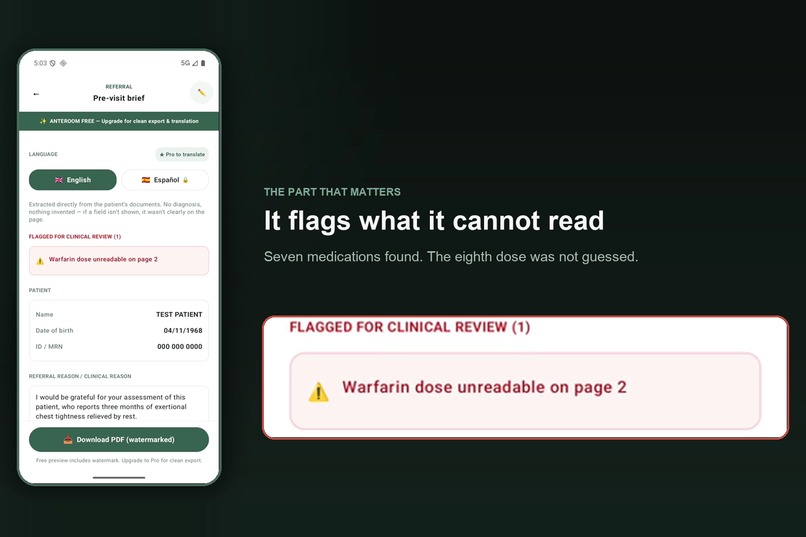
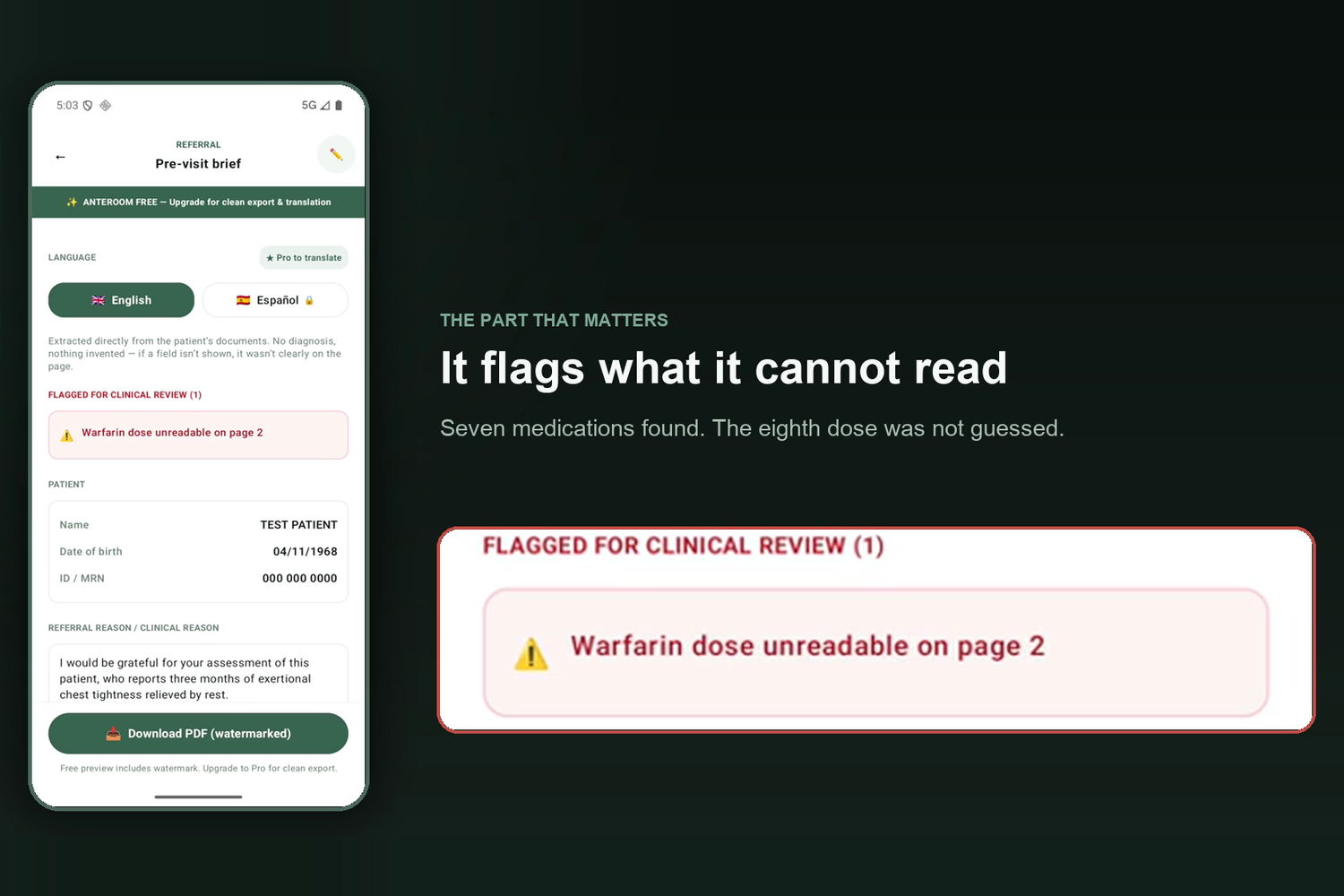
The Warfarin dose was illegible, so Anteroom left it blank and flagged it. Real model output.
-
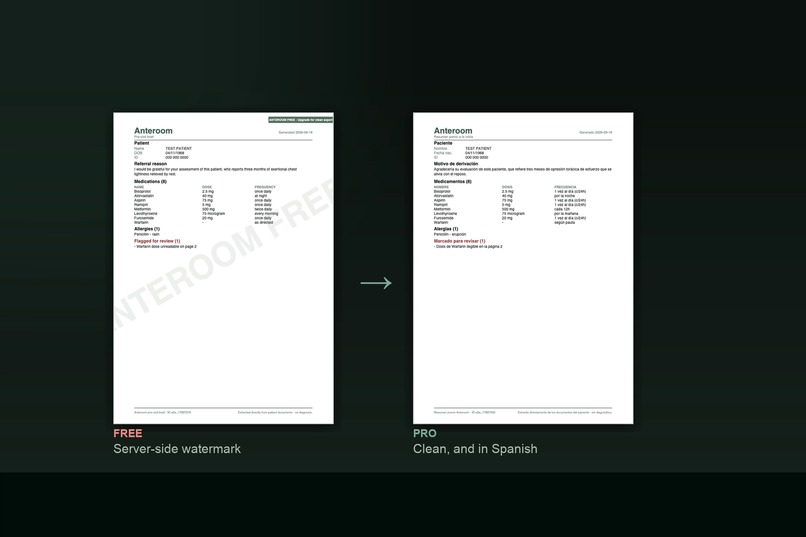
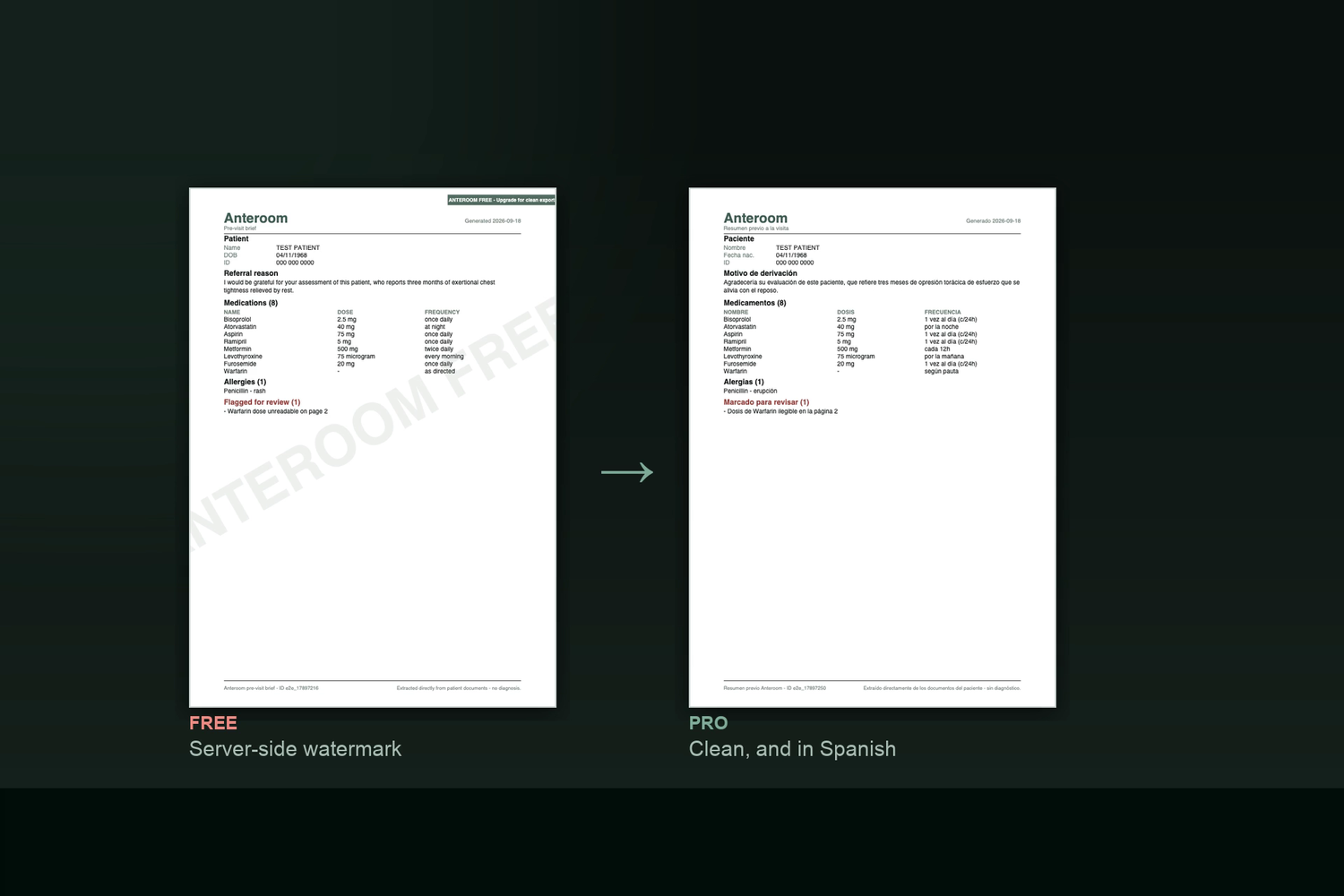
Free tier: the server watermarks the PDF. Pro: clean, in Spanish, with doses copied, never re-translated.
-
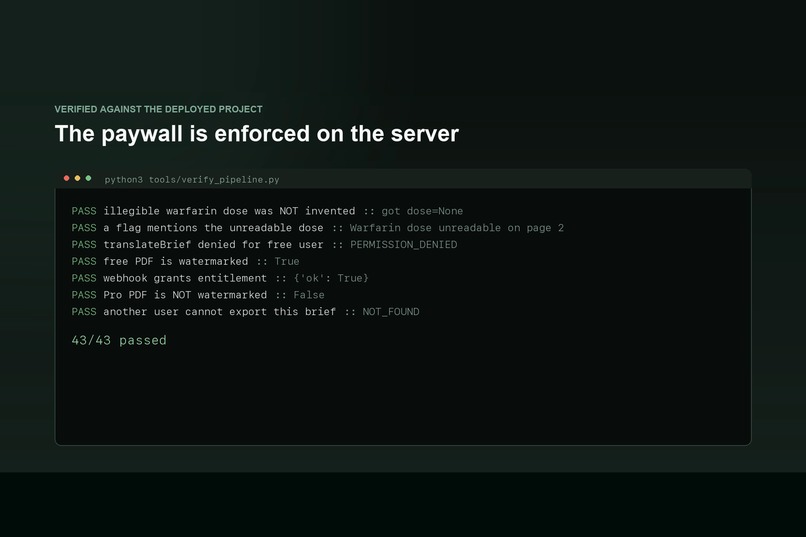
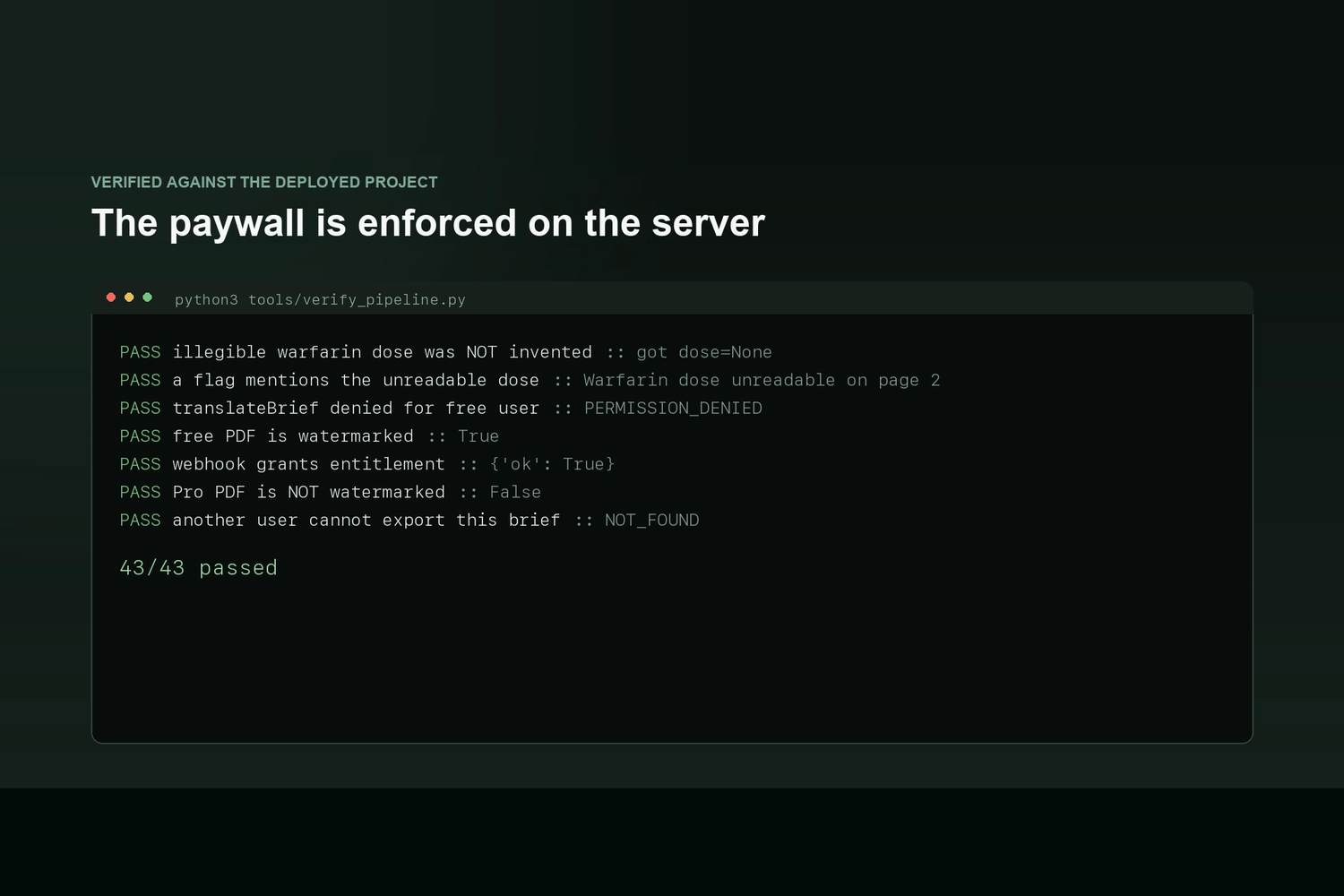
43 checks against the deployed project. The clean export is decided by the server, not the client.
-
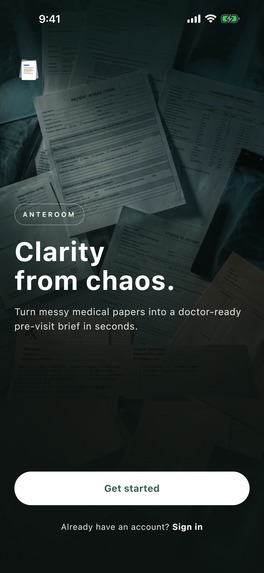
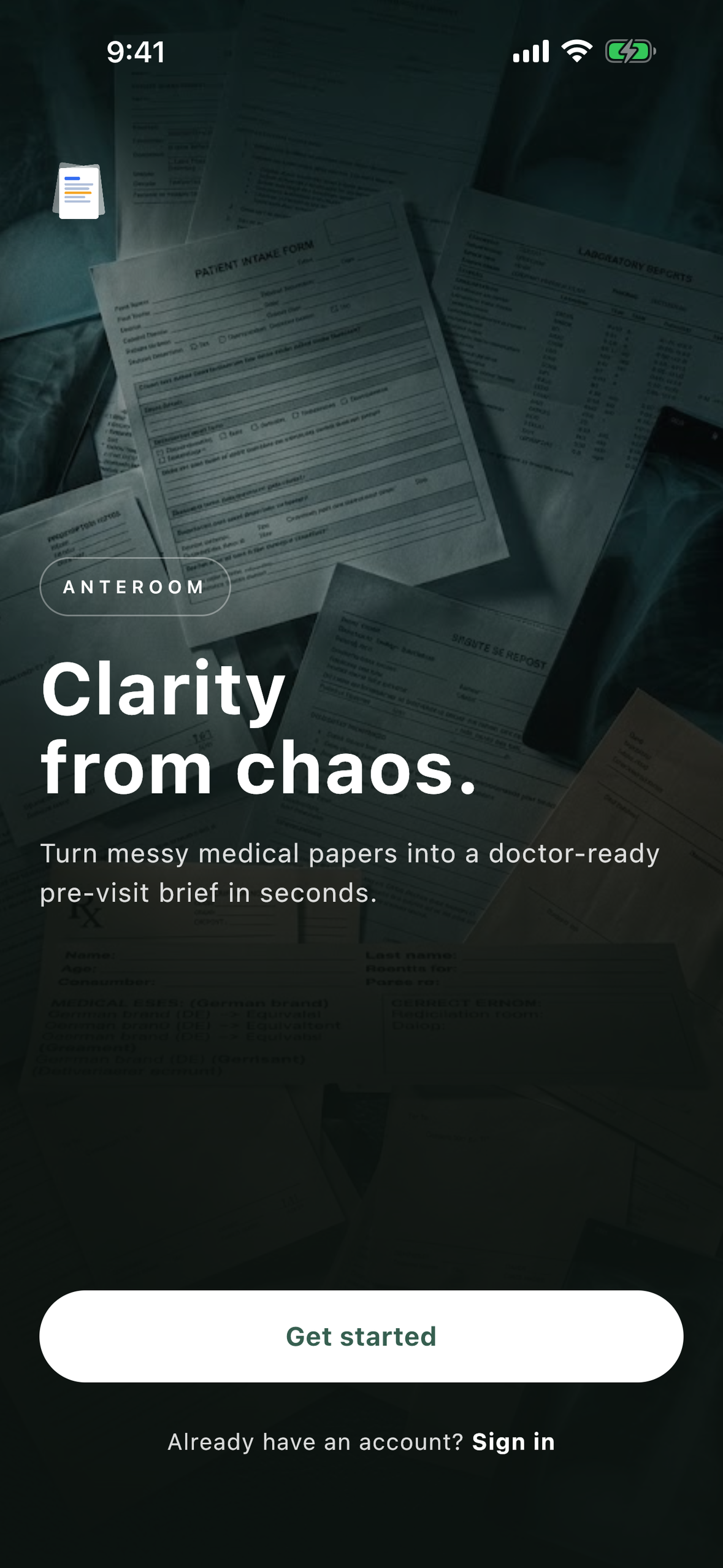
The iOS app, live on TestFlight.
-

App icon, 1024×1024.

For judges
- Install. iOS beta on TestFlight: https://testflight.apple.com/join/EvbxqXGU. This is build 1.0 (2), approved by Apple for external testers. TestFlight is a beta channel, not a public App Store release.
- Sign in. The demo account's email and password are in the README's For judges section. It already has three generated briefs, two of them translated to Spanish. Pro is deliberately inactive so that you meet the paywall.
- Reach the paywall. Tap Upgrade in the dashboard header, or tap any locked Pro feature: Pro to translate on a brief, the upgrade ribbon on a brief, or adding a family profile.
- Purchases on TestFlight are free. In-app purchases in a TestFlight build run in Apple's sandbox and are never charged. You can buy Monthly or Lifetime and watch Pro unlock without paying anything.
- The demo account is shared. The entitlement follows the account, so a purchase on it unlocks Pro for every judge who signs in after you. To test the purchase itself, create your own account from the sign-in screen.
- After the App Store release, Pro access for judges will be by App Store offer code.
Elevator pitch
Anteroom converts a shoebox of referrals, lab printouts, and medication boxes into one structured brief your doctor can read in 30 seconds — in English or Spanish, with every claim traceable to the original photo.
Inspiration
In Spain, the appointment is short and the paperwork is long. An expat or a retiree arrives at a consulta with a plastic folder: a referral from a GP in another country, a lab printout in a third language, three medication boxes, and a memory of what a specialist said eight months ago. The physician spends the first half of a 10-minute slot doing document triage instead of medicine.
The friction is specific, and it has two halves:
- The intake bottleneck. Nobody has structured the patient's history before the consultation starts. The doctor does it live, under time pressure, from paper.
- The language bottleneck. The patient's documents and the doctor's working language often differ. Translation happens ad hoc, by a family member, at the worst possible moment.
Anteroom moves both jobs out of the consultation room and into the waiting room — the anteroom. That's the name.
The clinical framing comes from 12 years of emergency and general practice. The failure mode we care most about isn't a missing document; it's a confidently wrong one. A medication dose transcribed incorrectly is more dangerous than a medication that was never transcribed at all.
What it does
Anteroom gives one family a shared, structured medical record they control.
- Capture. Photograph referrals, lab results, and medication lists with the device camera, or import from the photo library.
- Classify. Each capture is typed as a referral, medication list, lab result, or other, with a confidence level. You can override the classification with one tap.
- Generate a brief. The captures collapse into a single
BriefContentrecord: patient identifiers, referral reason, medications with dose and frequency, allergies with reactions, and a list of flagged items. - Flag, don't guess. Anything ambiguous or contradictory lands in
flagged_itemsand renders as a red "Flagged for clinical review" banner instead of being silently resolved. A dose that reads 20 mg on the referral and 10 mg on the bottle becomes a flag, not an answer. - Keep the source. Original photos stay attached to the brief, and a photo verification view lets the doctor check any line against the paper it came from.
- Translate. A brief generated in English can be rendered in Spanish, and the reverse, with the source language recorded on the record.
- Manage a family. Profiles cover you, a partner, children, and parents, each with their own briefs.
- Export. Produce a PDF for the clinic. The free tier watermarks it; Pro doesn't.
The zero-hallucination design constraint
"Zero-hallucination" is a constraint on the data model, not a claim about a model's accuracy. Three decisions enforce it:
- A closed schema.
BriefContenthas fixed fields. There is no free-text summary field for a model to fill with plausible prose, so there's nothing for a narrative hallucination to occupy. - Uncertainty is a first-class value.
flagged_items,detected_confidence, anddoc_type_manual_overrideexist so the app can say "these two documents disagree" rather than picking a winner. - Provenance survives. Extracted fields never replace the source. The original photographs remain on the brief and are reachable from the clinical view, so every line is falsifiable in one tap.
A clinician doesn't need the app to be right. A clinician needs to know, fast, where the app is unsure.
This is tested, not asserted. tools/sample_page_illegible.jpg is a
prescription whose Warfarin dose has been blurred and blotted out. A model
that guesses a plausible dose passes any test that only checks the readable
rows, so the end-to-end suite asserts the opposite: that the dose is
absent from medications and present in flagged_items. Against
the live backend it comes back as
medications: ... Warfarin (no dose) as directed
flagged:     Warfarin dose unreadable on page 2
and the brief screen renders Warfarin as the one medication in the list with no dose line under it.
How we built it
The whole product is one Kotlin Multiplatform codebase.
| Layer | Technology |
|---|---|
| UI | Compose Multiplatform 1.12, Material 3, shared across all targets |
| Shared logic | Kotlin Multiplatform 2.4.20 |
| Targets | Android, iOS (arm64 and simulator), Desktop (JVM), Web (JS) |
| Auth and data | Firebase Auth, Firestore, and Storage through GitLive |
| Backend | Firebase Cloud Functions, Python 3.12, europe-west1 |
| Extraction | Gemini 2.5 Pro and 2.5 Flash on Vertex AI, europe-west1 |
| Billing | RevenueCat purchases-kmp 3.8.0 |
| Networking | Ktor client |
There is no per-platform UI code. App.kt is the single entry point that
MainActivity on Android, MainViewController on iOS, the Compose desktop
window, and the web viewport all render. Screens, the paywall, the family
profile strip, and the clinical brief view are written once.
The RevenueCat integration
The entitlement is anteroom_pro. The default offering carries two
packages: $rc_monthly and $rc_lifetime.
The interesting engineering problem is that purchases-kmp publishes
artifacts for Android and Apple targets only, while Anteroom also ships
Desktop and Web. Putting the SDK in commonMain breaks the JVM and JS
compilations.
The solution is a small expect/actual seam in the subscription package
under app/shared/src:
RevenueCatServiceis the common interface: fourStateFlows plusinitialize,fetchOfferings,purchasePackage,restorePurchases, andrefreshCustomerInfo.expect fun createRevenueCatService()picks the implementation per target.- The store-backed
RevenueCatServiceImpllives insrc/mobileMain/kotlin, which is compiled into bothandroidMainandiosMain. One implementation, zero duplication: the same Kotlin runs against StoreKit on iOS and Google Play Billing on Android, with no platform branches in the calling code. - What is live today: in-app purchases are active on iOS, through StoreKit, on a public TestFlight build that anyone can install: https://testflight.apple.com/join/EvbxqXGU. The monthly and lifetime products exist in App Store Connect and the paywall resolves their prices from the store at runtime.
- Android runs the identical code from the identical source set and
installs as an APK built from this repo with
./gradlew :app:androidApp:assembleDebug. Its Play Store products are not registered yet, so purchases cannot complete there. A new Google Play Console account has to run a 14-day closed test with 20 testers before it can publish, which does not fit inside this hackathon — so Play registration is scheduled for after the beta rather than rushed. The app handles the unconfigured state rather than leaking it: the RevenueCat SDK returnsConfigurationError, and the paywall shows one sentence, falls back to the catalogue price, and logs the diagnostic. - Desktop and Web get
SimulatedRevenueCatService, which keeps the paywall navigable on a laptop and reportsisSimulated = trueso the UI says out loud that no charge occurred.
Entitlement state has exactly one source of truth. applyEntitlement()
reads customerInfo.entitlements["anteroom_pro"]?.isActive and pushes the
result into the app-wide SubscriptionService. Everything else in the app —
locked family profile avatars, the watermark notice on export, the
translation lock, the upgrade banner — observes that flow. Nothing in the UI
sets the entitlement directly.
Because the app registers a PurchasesDelegate, entitlement changes that
originate outside the paywall propagate on their own: a renewal, a lapse, a
restore performed on another device, or a promoted App Store purchase. If
the paywall happens to be open when anteroom_pro turns on, it closes
itself.
Failures are handled as distinct cases rather than one generic error:
- A user dismissing the store sheet is a cancellation, not an error, and shows no red text.
- A purchase that succeeds without granting the entitlement says so and points you at Restore purchases.
- A restore that finds nothing says it found nothing instead of silently unlocking.
- An unreachable store falls back to dashboard pricing so the paywall still renders, and surfaces the reason.
The extraction pipeline
Four callables and a webhook, deployed to europe-west1. The client never
writes a clinical field: firestore.rules rejects content, status,
generated_at and the share token from any client, and the Admin SDK inside
these functions is the only thing that may. "Nothing invented" is therefore
a property of the system rather than a promise about the UI.
| Function | Model | Owns |
|---|---|---|
classifyDocType |
Gemini 2.5 Flash | detected_doc_type, detected_confidence |
generateBrief |
Gemini 2.5 Pro | content, status, generated_at |
translateBrief |
Gemini 2.5 Pro | content_translations |
renderBriefPdf |
none | nothing — returns bytes |
revenuecatWebhook |
none | users/{uid}/billing/entitlement |
Everything stays in the EU. Firestore is eur3, functions and Vertex AI
are both pinned to europe-west1. That costs us model capability and we
took the trade knowingly: Gemini 3.x exists on Vertex, but only on the
global endpoint, which routes a photograph of someone's referral letter to
whichever region Google picks. These are medical documents, so the residency
is worth more than the newer model.
Translation cannot touch a dose. merge_translation takes prose from
the model and every clinical field from the already-extracted content, so a
translation pass is structurally unable to alter a drug name, a dose, a
frequency, a patient's name or an ID. The test feeds it a deliberately
hostile response that corrupts all of those and asserts none of it lands.
Dosing frequency is localised for Spanish clinicians — by a fixed lookup
table, not the model, and anything the table doesn't recognise is left in
the source language rather than guessed at.
The paywall moved server-side. renderBriefPdf takes no watermarked
argument. The server derives it from the entitlement, so the clean export —
one of the two things Pro sells — stopped being a boolean the client could
flip. translateBrief returns PERMISSION_DENIED to a free caller. The
RevenueCat webhook is the only writer of that entitlement document.
It spends real money, so it has a brake. A per-user daily cap charged
transactionally before the model call, and a kill switch at
config/runtime.ai_enabled read on every call — flip it and spend stops
within seconds, with no deploy. Pages are downscaled to a 1536px long edge on
both the client and the server, because the server must not depend on a
client having behaved. A two-page brief costs about $0.02 end to end.
What runs today
Being precise about this matters more than the pitch does.
Live and verified against the deployed project:
- The complete Compose Multiplatform UI across Android, iOS, Desktop, and Web.
- RevenueCat billing through
purchases-kmp: offerings fetch, package purchase, restore, customer info refresh, and delegate-driven entitlement updates, all verified againstanteroom_pro. Purchases complete on iOS, through StoreKit, on a TestFlight build Apple has approved for external testers: https://testflight.apple.com/join/EvbxqXGU - Firebase authentication, Firestore persistence, and Storage photo upload — including on Desktop, which uploads over the Storage REST API because GitLive ships no JVM implementation.
- Real extraction: a photographed referral and a photographed prescription
become a populated
BriefContentin about 13 seconds, with the illegible dose flagged rather than guessed. - Translation into Spanish, and PDF export whose watermark is decided by the server.
- Family profile management and the clinical brief view with flagged-item banners and photo verification against the original page.
Honest limits:
- Android purchases do not complete yet. The Play products are not registered, so the store returns no offering and the paywall falls back to the catalogue price with a plain "Plans aren't available on this device right now." A new Google Play Console account must run a 14-day closed test with 20 testers before it can publish, which cannot finish before the deadline — so Android ships as a direct APK this cycle and Play registration follows. The billing code itself is the same source set that is live on iOS; what is missing is a store listing, not an implementation.
- Two languages, English and Spanish.
- Six pages per brief. The cap is the spend ceiling as much as a product limit, and it is enforced in the security rules, not just the client.
- The public share page was cut. An earlier build advertised a QR code
pointing at a guessable
/s/{brief_id}URL; the page, the QR and the claim were removed together. - Desktop and Web run
SimulatedRevenueCatServicefor billing and label themselves as a simulation on screen. Everything else on those targets is the real backend. - The Ktor server module is a scaffold and is unused.
How we know
Four suites, all runnable against the live project rather than a mock:
| Suite | Checks | Proves |
|---|---|---|
tools/verify_rules.py |
21 | Cross-user denial, server-only clinical fields, storage limits |
tools/verify_pipeline.py |
43 | The whole pipeline, both paywall gates, entitlement grant and revoke |
tools/verify_account_deletion.py |
17 | That deleting an account really erases it, checked from outside |
functions/tests/test_pipeline.py |
56 | Translation safety boundary, PDF, frequency lookup |
The rules suite earned its keep immediately. It found that our brief-create
rule could never have passed: it required status == 'draft' while also
requiring the key status to be absent, and the Kotlin client serialises
defaults, so every nullable field arrives as an explicit null. A test
written from the rules would have agreed with the rules. Only a test built
from the real client payload caught it.
Challenges we ran into
- A multiplatform SDK that isn't available on every platform.
Reconciling
purchases-kmp's Android-and-Apple artifact set with a four-target app took the shared-source-directory approach described above. The obvious fix — an intermediate source set wired withdependsOn()— disables Kotlin's default hierarchy template and breaksiosMain. - Two SDKs configuring one singleton. An earlier build configured the
native Android RevenueCat SDK in
MainActivitywhilepurchases-kmppulled in a different major version of the same library. Removing the native call and letting shared code configure once fixed both the version conflict and the double configuration. - Designing for uncertainty. The hard product question wasn't extraction accuracy. It was what the screen does when two documents disagree. Showing both and flagging the conflict took more UI work than picking one would have.
- A security rule that no client could satisfy. Described above. The general lesson: a test written from your rules will agree with your rules. Build the payload the way the client actually builds it.
- Deleting the fallbacks was the risky part. The repositories used to
swallow every failure and return mock data, so a permission error, an
offline device and an empty account were indistinguishable — from each
other and from success. Removing that turned silent wrong answers into
crashes until there was somewhere for failures to go, so the error banner
and
try/finallyon every long call had to land in the same change. - Firebase on Desktop fails twice, late, and somewhere else.
Firebase.initialize(context = null)is correct on Web and leaves the JVM app uninitialised — which surfaces at the first auth call as "Default FirebaseApp is not initialized". Passing aContextgets further: auth succeeds, and Firestore then dies on its own async queue because it casts toandroid.app.Application. Writing the integration test before the implementation is the only reason both were found.
Accomplishments we're proud of
- One
RevenueCatServiceimplementation drives billing on iOS and Android with no platform branches in the calling code — live against StoreKit today, and pointed at Google Play Billing by the same source set the moment the Play products exist. - A paywall that reacts to entitlement state rather than to button taps, so it behaves correctly when a subscription changes somewhere else.
- A clinical data model that treats "we don't know" as information worth rendering — and a test that proves the model honours it, by handing it a dose it cannot read and checking that the field stays empty.
- Both Pro gates enforced on the server. The clean export is not a flag the client can set.
- A pipeline that spends real money behind a daily per-user cap and a kill switch that stops it in seconds without a deploy.
What we learned
purchases-kmp collapses two native billing integrations into one Kotlin
surface, and the remaining work is almost entirely about state, not stores.
The lesson that transferred best from clinical practice: the value of an
intake document is not how much it asserts, it's how clearly it marks what
it can't confirm.
What's next
- Validate the brief format with clinicians, as a student research project. The question we want answered is not "is it accurate" but "does the flagged-items section change what you ask the patient".
- Expand language coverage beyond English and Spanish. The frequency lookup table is per-language and the extraction prompt is language-agnostic, so the work is mostly clinical review of the wording.
- Google Play registration, then the 14-day closed test, then Play Billing
live against the same
RevenueCatServiceImplthat already runs on StoreKit. - On-device classification, so the doc-type triage costs nothing and works offline.
- A clinic handoff that is safe by construction — the previous design was a guessable URL, and we would rather ship nothing than ship that again.
Award tracks
- Main prizes. These require the first public version to be released on the App Store, Google Play or Galaxy Store during the submission period, and TestFlight does not count. Anteroom 1.0 is being submitted to the App Store this week. It is eligible if Apple approves the release before the deadline, and not otherwise.
- Next Gen / Student Award. No store release is required. Anteroom is
submitted with a demo video and a public open-source repository,
github.com/sorarx27/anteroom-mobile
(branch
kotlin), under the MIT license inLICENSE. It is built by an actively enrolled Master's student. - Ship Kotlin Everywhere. This award needs live App Store and Google Play
listings. The code qualifies: 100% Compose Multiplatform UI and one
purchases-kmpimplementation for both stores. The listings do not yet. The Play products do not exist, and a new personal Play Console account must run a 14-day closed test with 20 testers before it can publish. Anteroom is eligible only if the Play listing is live by the deadline, and we are not counting on it. - Most Likely to Make Money. The clinical intake and language bottleneck for expats and retirees seeing doctors in Spain is a recurring, paid-for problem with a clear willingness to pay at the household level.

Log in or sign up for Devpost to join the conversation.