-
-
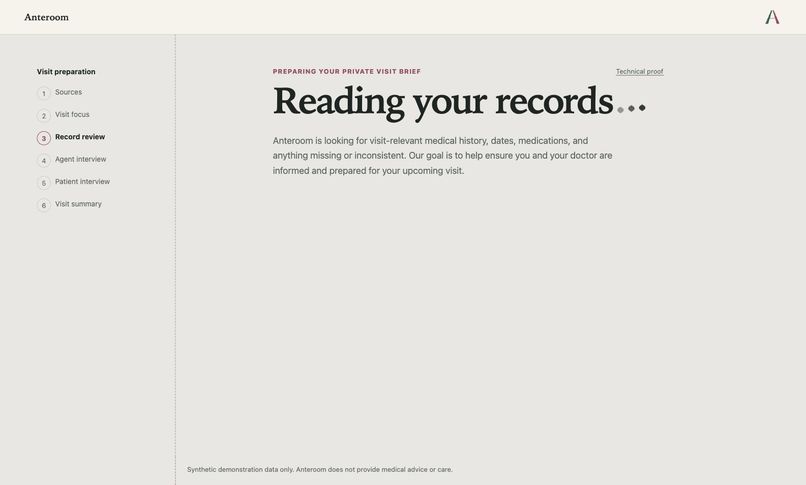
Ingest your records
-
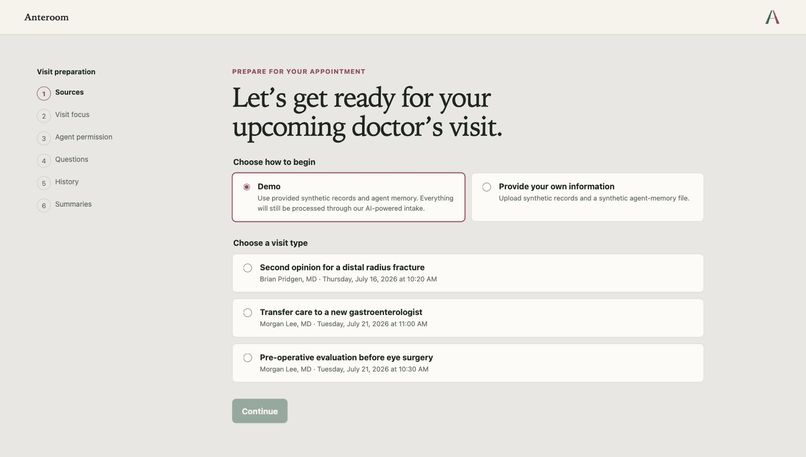
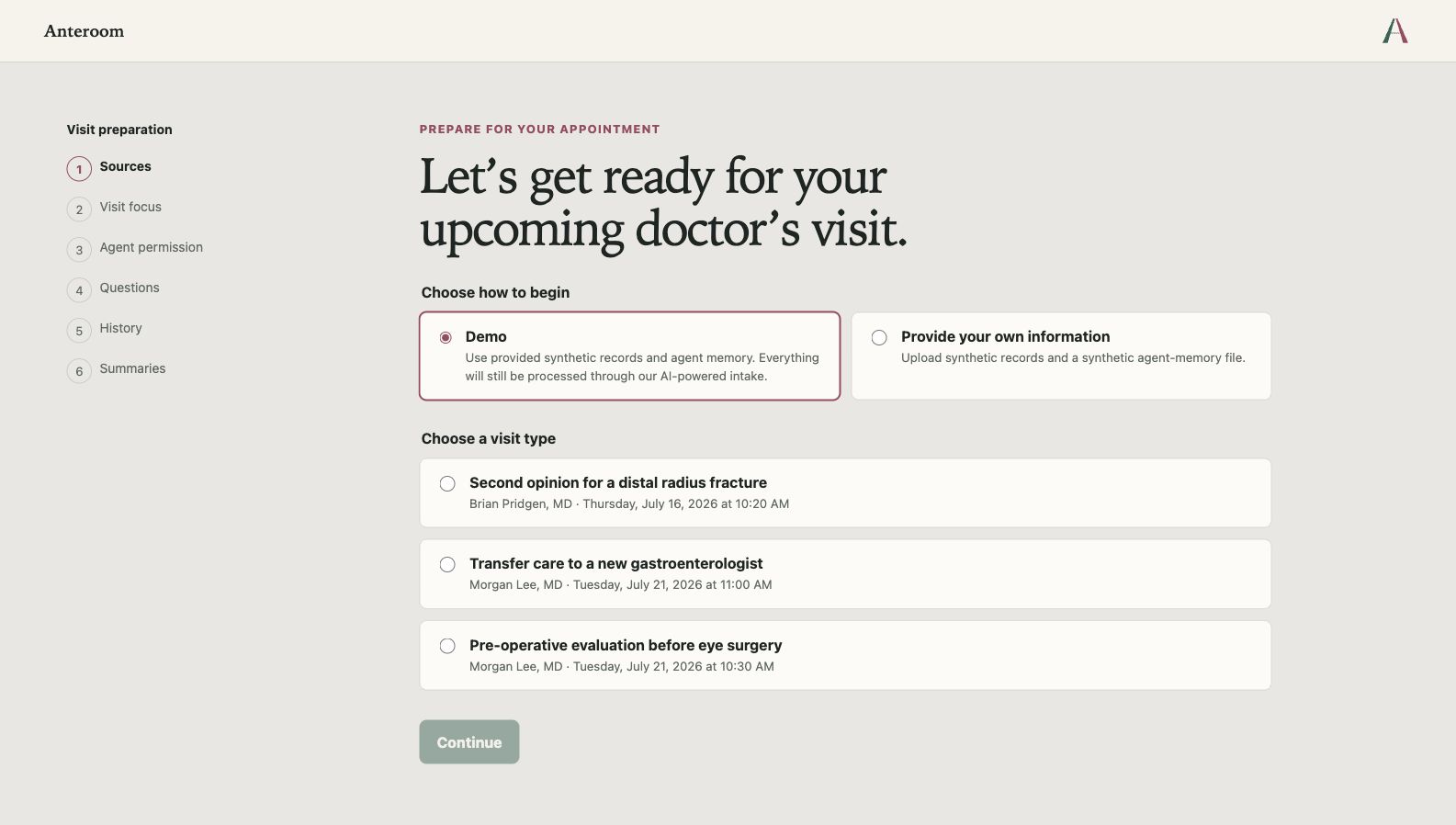
Choose your records
-
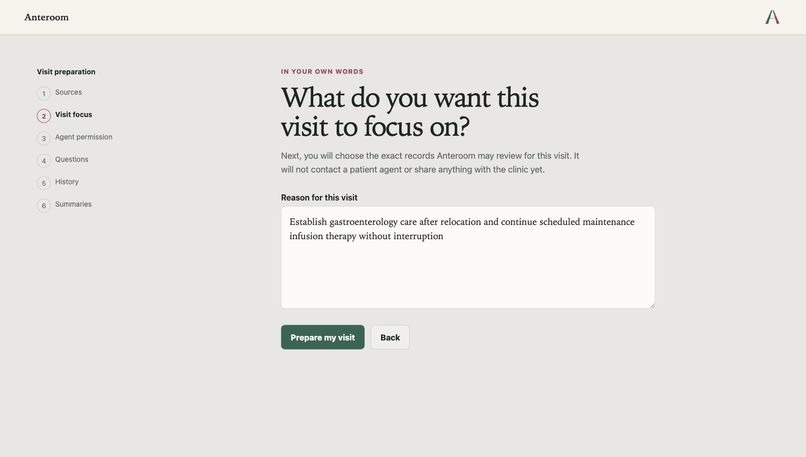
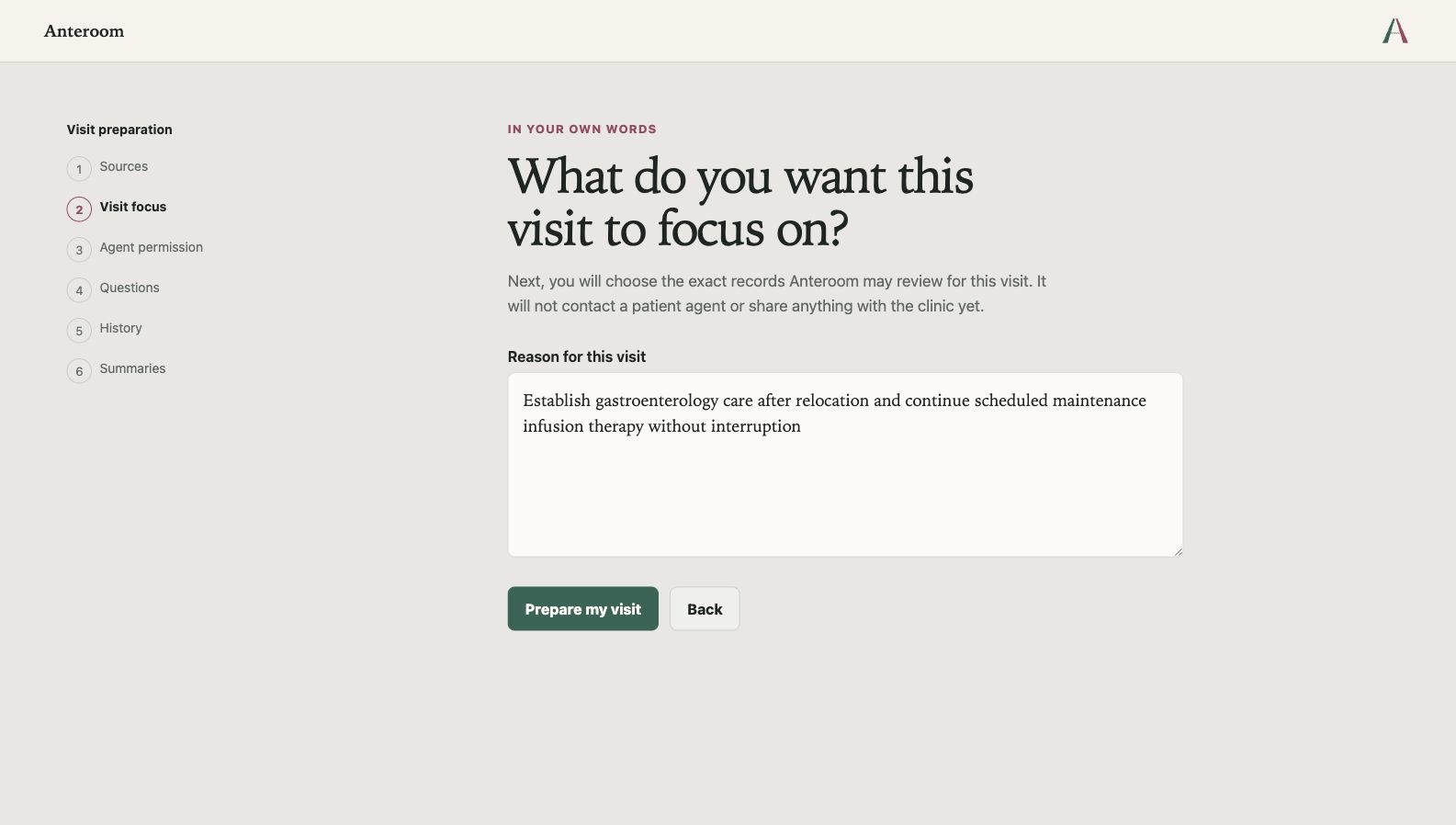
Describe the reason for your doctor's visit
-
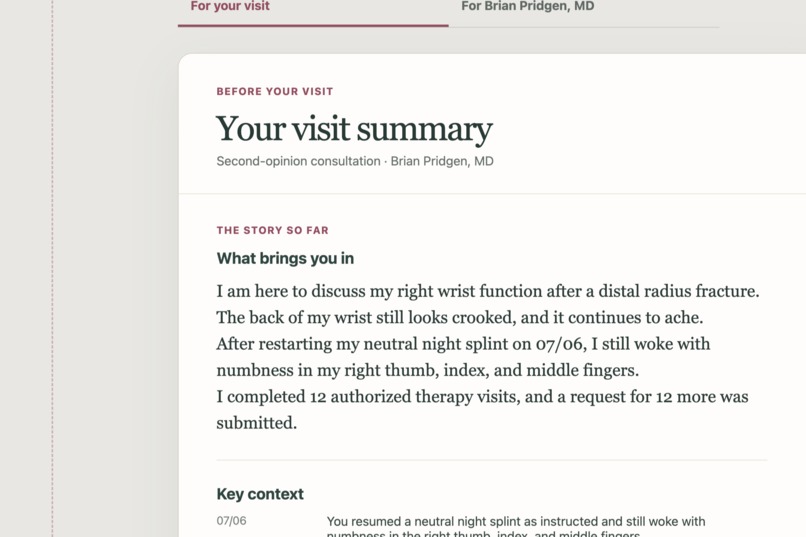
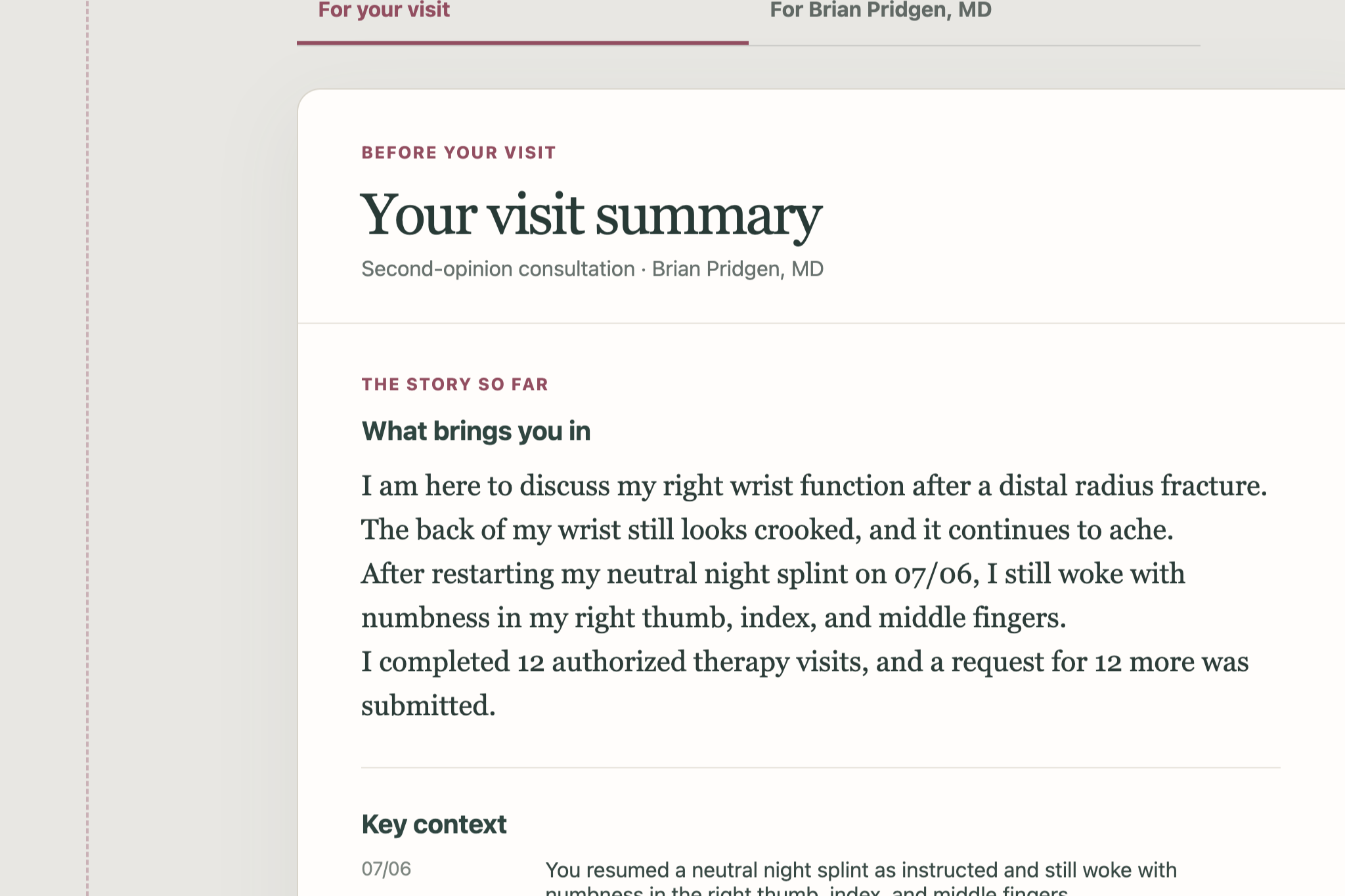
Patient-facing summary
-
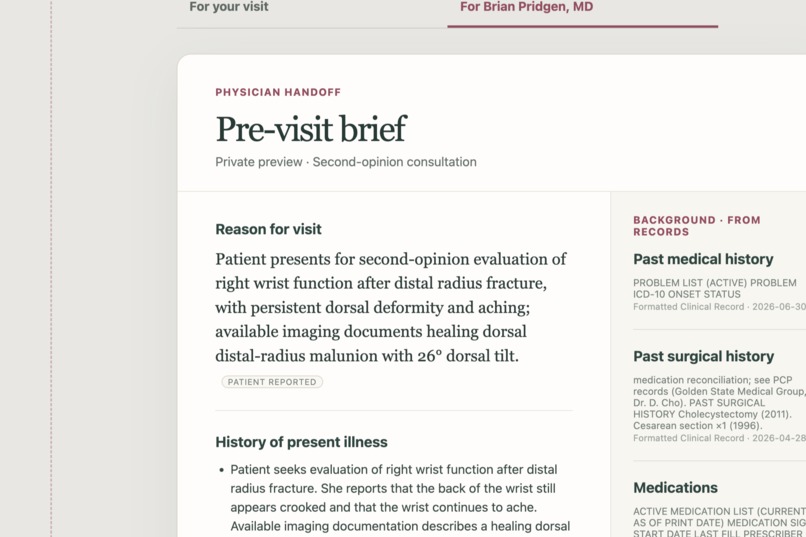
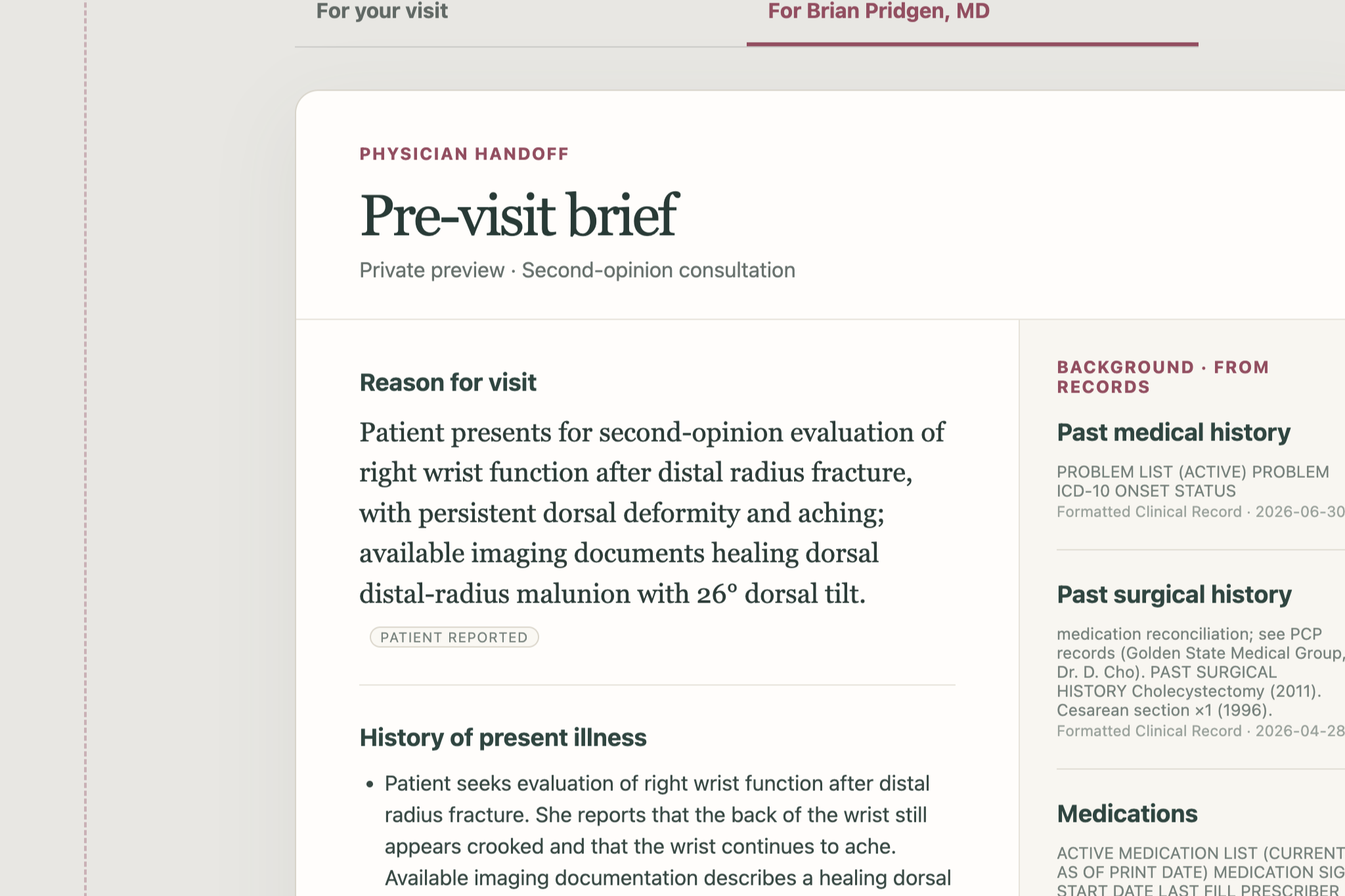
Physician-facing summary
Inspiration
I'm a hand and microsurgeon in San Francisco. I built Anteroom to address a shared pain point for myself and my patients. Medical visits with specialists are often high stakes and information dense encounters, yet they may be rushed. From the patient's standpoint, they have a rich story to share, which they rightfully want and need to be heard and understood. From the physician's standpoint, we may have dozens or even hundreds of pages of records to review, and we may have a series of very specific questions that we need to review with the patient. This can sometimes lead to a misaligned visit, even though the patient's goal and my goal ultimately are the same -- to receive and to deliver exceptionally high quality personalized care.
To address this problem, I built Anteroom.
What it does
Healthcare information about a patient lives in their medical record, in their head, and increasingly with their AI agent. I built Anteroom to connect these disorganized and disconnected information sources.
Anteroom does the following:
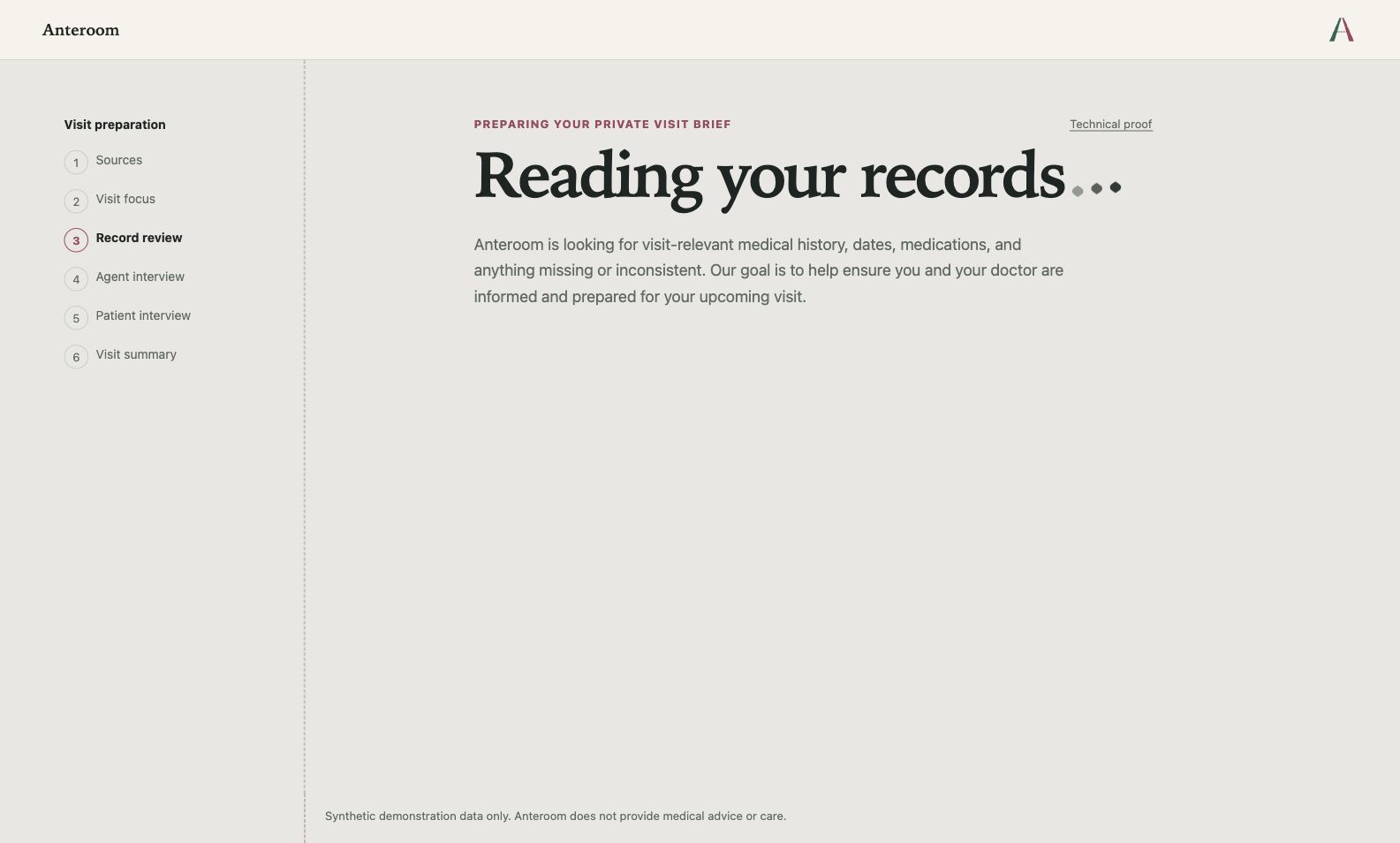
- GPT-5.6 ingests and reviews the medical records the patient has authorized for the visit.
- The patient connects their personal AI agent and approves exactly what it may share.
- Based on the GPT-5.6 record review, a physician agent interviews the patient agent to fill in gaps, uncertainty, and conflicts noticed in the medical records.
- The patient is then interviewed by voice through the Realtime-2 API to fill in what only they can answer and to capture their questions and concerns heading into the visit.
- All of this information is summarized for the patient and the physician. The patient summary includes topics to read in advance and questions to ask the physician. The physician summary reads as if an experienced colleague had reviewed the chart and evaluated the patient in advance.
The goal is that the patient and physician can spend less time aligning on the facts of the case and spend more time on counseling, treatment planning, and meaningful human-to-human interaction.
(NOTE: For data privacy, Anteroom uses synthetic patient records and a synthetic agent memory. The interactions are all real and flow live through GPT-5.6 and the Realtime-2 API.)
How I built it
I'm a surgeon, not a software engineer. I worked with Codex to interview me and turn my vision into a written plan. I then used long-running execution loops overseen by an orchestrator to build out the app. Lastly, I discovered the speed and power of GPT-5.6 Terra (medium thinking), which I used to rapidly debug and iterate to get Anteroom submission-ready.
Challenges I ran into
Realtime voice is going to be an unlock for human-agent interactions, but it is still really tough. Having a natural conversation with a model still is rough around the edges: navigating pauses, recovering from interruptions, and even knowing when to end the conversation. The Realtime-2 API I used for this demo is a glimpse into the future. I can't wait for GPT-Live and other frontier realtime APIs to continue rolling out.
Getting deterministic outputs from a probabilistic machine presents real challenges for high stakes healthcare workflows. GPT-5.6 will review the same chart twice and output two different lists of gaps, conflicts, and questions. The outputs often overlap but are not a perfect union. Just as in medicine we measure inter- and intra-rater reliability, this will be important to measure when bringing Anteroom into clinical workflows. I began building synthetic evals to track this, and this will be an area of ongoing work.
Accomplishments that I'm proud of
I am proud of building a prototype that solves a pain point for both patients and physicians, while also hopefully restoring the humanity and connection in healthcare.
Additionally, as a "non-technical" surgeon, I also am proud to have built a product where:
- GPT-5.6 reading raw records to identify important information, gaps, and conflicts
- Patient agent and physician agent conversation over an A2A exchange with privacy limits controlled by the patient
- Realtime voice interview structured around gaps in the available records
- Patient- and physician-facing summaries that link to the evidence supporting them
What I learned
I discovered interesting parallels between agentic software development and clinical work. Anteroom captures some of those primitives:
- Just as a large codebase may be too dense and semi-structured for any one person to hold in their head, so is a patient record, particularly for time-compressed patient visits. In both fields, agents can review these repositories of context before the human gets involved.
- Just as Codex interviewed me before writing the plan to build Anteroom, Anteroom interviews the patient before drafting the plan for their visit. In both fields, the most important context lives in someone's head, not in the record.
- Just as my build plan for Anteroom was a working document, Anteroom's patient- and physician-facing summaries are working documents. In both fields, the document's purpose is to start a conversation from a shared understanding.
What's next for Anteroom
Next, I will harden Anteroom with the safety, security, and privacy work necessary for deployment in healthcare. This demo fits into a much broader vision that I am building with Luminos (luminoshealth.co) and SurgiScribe (surgiscribe.co). My mission is to deliver top percentile quality healthcare to all people and to restore the humanity and connection to the patient-physician relationship.
Built With
- cloud
- codex
- docker
- node.js
- openai
- react
- realtime
- typescript

Log in or sign up for Devpost to join the conversation.