-
-
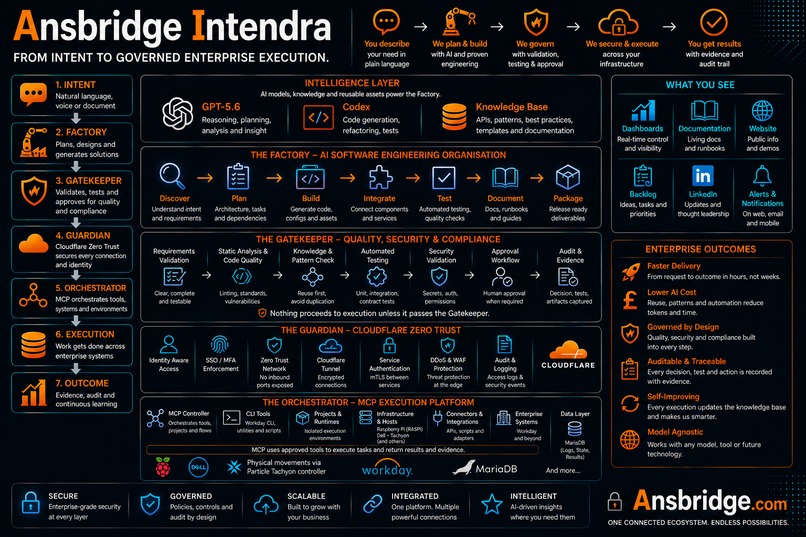
Architecture Infographic
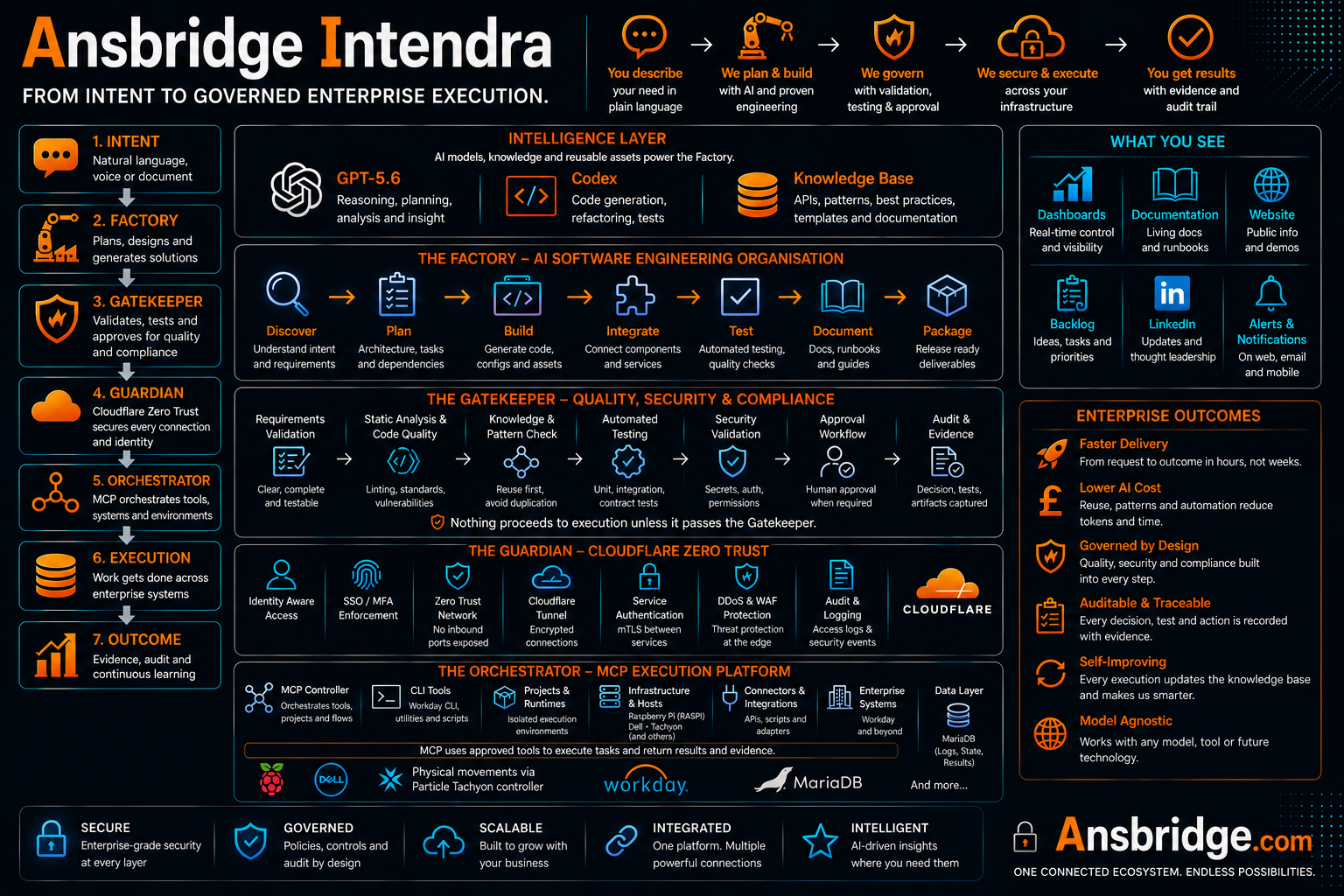
Inspiration
I work for a Workday implementation partner and regularly see clients wanting to develop expensive Studio integrations for a one time deployment effort. Currently this requires integration expertise and is a slow process. I though that users could use AI that can understand business intent, follow governed processes, securely interact with enterprise systems and provide complete auditability to perform this task at a low cost. I wanted to explore what an AI engineering organisation would look like if it could plan, build, govern, execute and continuously improve enterprise work from a single natural language request.
This began as a personal learning project to better understand how enterprise AI could safely execute real work. To keep it affordable and accessible, it is built on low-cost, self-hosted infrastructure using the hardware I already owned, without requiring cloud-scale resources or sponsorship.
What it does
Ansbridge Intendra transforms business intent into governed enterprise execution.
Starting from a natural language request, Intendra decomposes work into executable tasks, selects the correct enterprise knowledge and integrations from a locally hosted knowledge base, exposed securely through the Model Context Protocol (MCP), generates solutions, validates them through an AI Gatekeeper, securely executes work through an MCP orchestration layer and captures evidence from every decision and outcome.
The result is enterprise AI that is transparent, auditable and trusted by design.
How we built it
Intendra combines OpenAI GPT-5.6 and Codex with a custom enterprise architecture built in Python using Flask, MariaDB and the Model Context Protocol (MCP). The platform has evolved over time and can use models from multiple AI providers, allowing the architecture to remain model-agnostic rather than tied to a single vendor.
The platform is organised into specialised AI capabilities including the Factory, Gatekeeper, Guardian, Knowledge Base and MCP Orchestrator. Together they transform natural language into validated enterprise execution while maintaining governance, security and continuous learning.
The demonstration uses Workday integrations to show how the platform selects the correct integration, creates an execution plan, validates it, securely connects to the tenant and verifies successful execution.
The demonstration solves a genuine implementation problem: "Our business needs to load this data into Workday." Intendra maps that business intent to known implementation patterns, identifies an existing integration or creates a new one where required, generates an execution plan, performs pre-flight validation, executes the load and then carries out post-flight verification. Throughout the process, every action is governed, auditable and visible through the Dev Orc monitoring platform.
GPT-5.6 and Codex provide the primary reasoning and software engineering capabilities within Intendra. They are responsible for understanding business intent, planning work, generating implementation approaches and assisting with code generation, while the surrounding architecture provides governance, orchestration and secure enterprise execution.
Challenges we ran into
The biggest challenge wasn't generating code—it was building trust and developing in a scalable way. Use of credential stores, MCP layers and agents with defined roles aid in addressing these issues.
Enterprise AI needs governance, auditability, repeatability and security. Designing a platform that could validate decisions before execution, maintain evidence and continuously improve its knowledge base required significantly more engineering than simply connecting a language model to an API.
Another challenge was keeping the architecture model-agnostic so that reasoning models can evolve independently from governance and execution.
A practical challenge was making the platform affordable to develop as a side project. Keeping token consumption low, reusing locally hosted infrastructure and building custom MCP services allowed the platform to grow without requiring significant ongoing compute costs.
Accomplishments that we're proud of
Created an AI engineering organisation rather than a traditional coding assistant.
Built custom MCP services on Raspberry Pi, Dell Linux workstations, virtual machines and Particle Tachyon hardware.
Developed a governed execution pipeline with automated validation and evidence capture.
Connected a backlog-driven workflow that tracks work across conversations while minimising token usage.
Demonstrated secure orchestration across enterprise systems using MCP.
Built a continuously improving enterprise knowledge base.
Delivered a working Workday demonstration covering planning, integration selection, execution and validation.
What we learned
I learned that the real challenge isn't building capable AI components—it's orchestrating them into a coherent, governed system that delivers measurable business value.
The real challenge is combining reasoning with governance, enterprise knowledge, orchestration and evidence. AI becomes far more valuable when it can safely deliver real business outcomes instead of simply generating code.
What's next for Ansbridge Intendra
The next stage is expanding Intendra's enterprise knowledge base, adding more governed integrations and supporting additional enterprise platforms beyond Workday.
The long term vision is an AI engineering organisation capable of planning, governing and securely executing enterprise change across finance, HR, cloud infrastructure and business applications—while continuously learning from every successful execution. For now I've mainly focused on the Finance aspect as that aligns with my background and it made most sense for the first stage of development.
Built With
- agentic-ai
- ai-agents
- automation
- claude
- cloudflare
- codex
- docker
- flask
- github
- gpt-5.6
- jinja
- json
- knowledge-base
- linux
- mariadb
- mcp
- model-context-protocol
- oauth-2.0
- openai-api
- python
- raspberry-pi
- rest-api
- virtual-machines
- workday

Log in or sign up for Devpost to join the conversation.