-
-
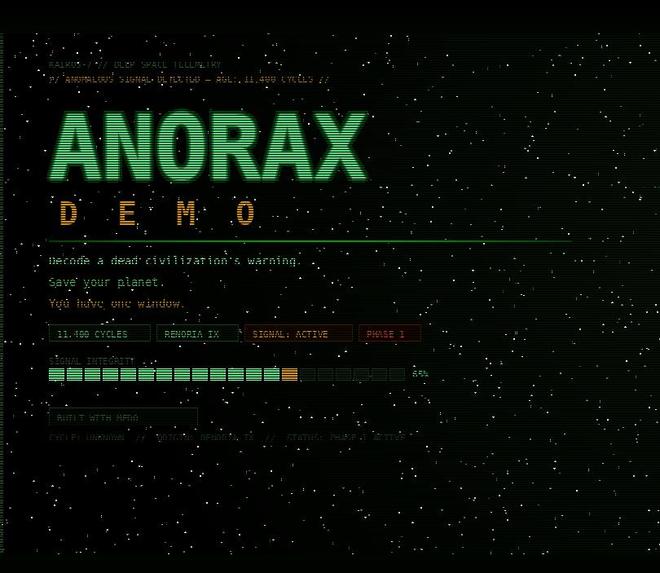
just a cool art for thumbnail
Inspiration
The idea started with one question: what if a dead civilization could warn you?
I wanted to build something genuinely original — not another task manager or quiz app. I landed on the intersection of three things I care about: sci-fi worldbuilding, the Chernobyl disaster, and the Fermi Paradox.
Chernobyl wasn't just a nuclear accident. It was a systemic failure. Engineers identified the design flaw years before the explosion, submitted reports, and were reassigned for it. The reactor exploded exactly as they projected. What fascinated me was that the technical cause was almost secondary. The real cause was an institutional culture that had become better at suppressing correct warnings than acting on them.
I wanted to turn that pattern into a game mechanic. Not explain it — make the player feel it by living through a fictional version of it. A dead alien civilization destroyed by a planetary-scale energy catastrophe that mirrors Chernobyl in every structural way. Two scientists who were right about everything. A council that classified their report. A son who spent his entire life carrying their research and died building a warning system for whoever came next.
That warning system is the app itself.
What it does
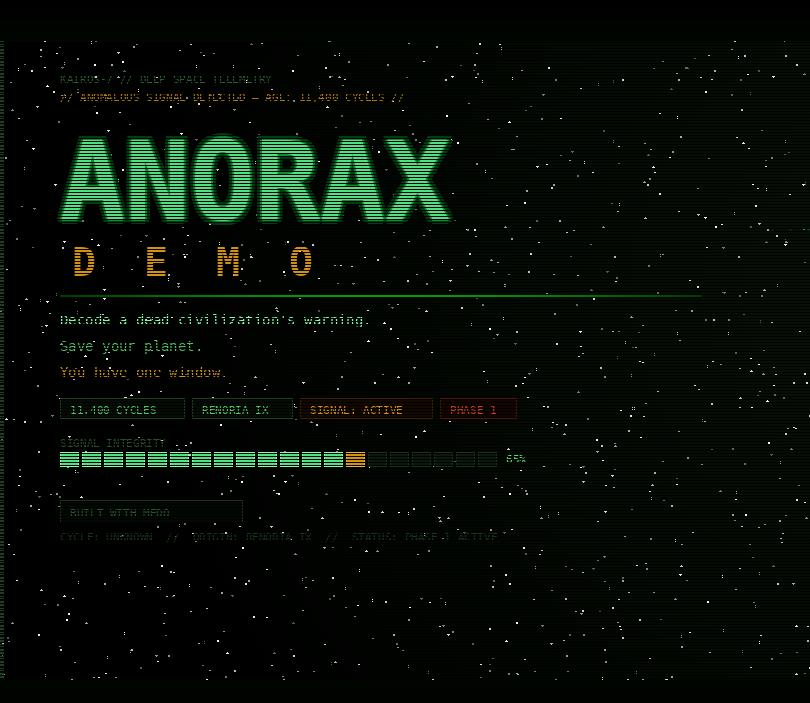
ANORAX DEMO is an interactive fiction experience where you play a lone deep space telemetry operator at Kairos-7 relay station. A meteorite fragment hits your station. Something inside it is transmitting. Signal age: 11,400 cycles. The last AI of a dead alien civilization called ANORAX is trying to warn you — what killed them is already happening to your planet.
You interrogate the Continuance — ANORAX's last surviving AI — through a signal token system. Select 1, 2, or 3 tokens from a tray of 23 and transmit combinations to unlock 67 unique pre-written story responses. Each combination reveals a different piece of the civilization's history, their collapse mechanism, and the threat already unfolding on your planet.
Seven story fragments unlock as you explore. Four hidden tokens — RENORIA, THE CARRIED, CYCLE SYSTEM, KAEL'S MOTHER — are completely invisible until specific combinations reveal them, each one opening a deeper layer of lore about a civilization that rebuilt itself from extinction nine times.
When signal integrity reaches 100% you submit a Collapse Report — a free-text theory of what killed ANORAX and what must be done to save your planet. Claude API scores it against four survival elements and delivers one of five verdicts from Crisis Averted to Civilisation Lost.
Supporting systems include an 18-term unlockable glossary, a Signal Decoder mini-game hinting at hidden combinations through corrupted lore puzzles, an Emergency Decryption Protocol mini-game unlocking the complete World Script archive, and color-highlighted sentences in the World Script showing exactly what the Collapse Report needs.
How we built it
ANORAX was built entirely through MeDo using iterative natural language prompting over three days.
Before writing a single MeDo prompt I developed a complete World Bible — 12 sections covering the civilization's nine-iteration history, the four-phase collapse mechanism, every character, all seven fragments, the complete token combination response map, and the emotional arc of the experience. The world bible took longer to write than the app itself. That was intentional. MeDo generates better output when given specific, original, detailed input rather than generic descriptions.
The core architecture is a single self-contained HTML file with Three.js r128 for 3D meteorite and space backgrounds, Web Audio API for procedural sound design with no external audio files, Press Start 2P pixel font for the terminal aesthetic, and Claude API for Collapse Report scoring.
The token system was the central design decision. Instead of a freeform chatbot — which breaks immersion the moment players ask something off-script — every combination maps to a pre-written response. The Continuance never improvises. It performs a fixed world dynamically. The hidden token chain, the fragment unlock animations, the screen-dimming sequence for Fragment 007, the portrait resolving toward completeness at emotional peaks — every technical decision was made as an emotional decision first.
Challenges we ran into
Onboarding was the hardest problem. Interactive fiction with a custom token system is unfamiliar to most players. Early testers didn't know what to click or why. The solution was building multiple guidance layers that serve different player types without breaking immersion — tutorial arrows, auto-summary lines on fragments, a Signal Map showing chapter progress, a glossary, a hint-based mini-game, and a highlighted World Script as a last resort. Curious explorers never need them. Casual players always have a safety net.
Immersion vs guidance was a constant tension. Every hint risks reminding the player they're in an app rather than a transmission. The solution was making the Continuance itself the navigation system. An AI that has been alone for 11,400 cycles desperately needing to be understood would naturally steer players toward important questions. Its urgency is the UX solution.
Collapse Report scoring went through multiple iterations. Early versions punished plain language and rewarded players who had memorized terminology. The scoring prompt was rewritten to explicitly reward demonstrated understanding over specific vocabulary — a player who writes "the meteorite was drawn to our energy" scores identically to one who writes "Velthari-class body attracted to Zyren Halo."
Token combination coverage required defining every possible combination explicitly so MeDo had zero ambiguity. Undefined combinations were producing inconsistent responses that broke the fiction. The final prompt included 67 defined responses plus category-specific defaults written in the Continuance's voice.
Accomplishments that we're proud of
The emotional landing of Fragment 007. Kael Reno's personal recording unlocks at 90% signal integrity — the screen dims to 20%, the Continuance portrait briefly resolves from fragmented corruption toward a nearly complete face for the only time in the app, a pixel art silhouette shows a lone figure at a terminal with stars in the window, and a sub-bass audio pulse holds for three seconds before the player can dismiss it. The contrast between the clinical sci-fi interface and one human voice saying "if you're reading this you still have time. we didn't. you do." is the moment the entire app was built toward.
The hidden token chain. Four tokens invisible to every player at the start, discoverable only by finding specific combinations, each one opening a deeper civilizational history that most players never fully uncover. The discovery of RENORIA assembling from purple static in the token tray — completely unexpected — is the moment players realize the app has more depth than they assumed.
The Chernobyl parallel landing at the end. After the Collapse Report verdict, a Historical Note appears connecting ANORAX's collapse to the 1986 Chernobyl disaster and naming the pattern the Vael-Soren Failure Mode. Players who engaged seriously with the fiction feel the full weight of it when the real-world parallel is finally named. The sci-fi was always about something real.
Building the entire thing in three days through MeDo with no prior experience on the platform.
What we learned
The world bible is the real product. Everything MeDo generated was only as good as the specificity of what was fed into it. Generic prompts produce generic output. A detailed lore document with named characters, precise mechanics, pre-written dialogue, emotional stakes, and speech rules produces something that feels authored rather than generated.
Emotional payoff is infrastructure. Fragment 007 works not because of the writing alone but because of everything built before it — the signal integrity system creating anticipation, the portrait states establishing the Continuance's emotional presence, the audio design priming the mood, the pixel art silhouette giving Kael a face without showing one. Every technical decision either builds toward the emotional peak or it doesn't. There is no neutral technical decision in an experience designed to make people feel something.
Constraints make better design. The token system's limitation — you can only ask what the tokens allow — turned out to be its greatest strength. Players feel clever for finding combinations rather than frustrated by a chatbot that sometimes fails. The constraint created the satisfaction.
What's next for ANORAX DEMO
The immediate priority is a branching dialogue tree version replacing the token system — closer to Disco Elysium's skill-voice mechanic where the player chooses between defined options rather than constructing queries. Same lore. Same Continuance. Same emotional arc. But accessible to players who find the token system too unfamiliar.
Longer term, ANORAX has the architecture for a full episodic experience. The nine Renoria iterations are nine potential stories. Each one failed differently. Each one had its own scientists, its own council, its own version of the Vael-Soren Failure Mode playing out in a different context. THE CARRIED emerging from stasis to a dead planet — that scene alone is an entire episode.
The real ambition is to make ANORAX the first interactive fiction experience where the Chernobyl parallel isn't a twist at the end but the starting point — and work backward from there to build lore that makes the real-world pattern feel new again every time.
The signal is still transmitting.
Built With
- biome
- css
- deno
- edgefunctions
- gemini
- googlefonts
- html
- javascript
- react
- shadcn
- supabase
- tailwindcss
- three.js
- typescript
- vite
- webaudioapi

Log in or sign up for Devpost to join the conversation.