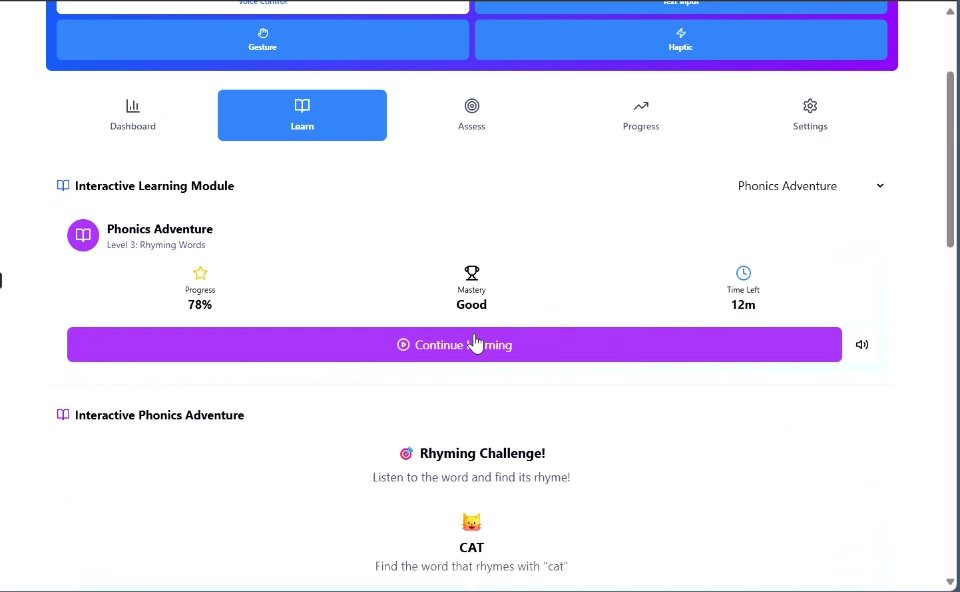
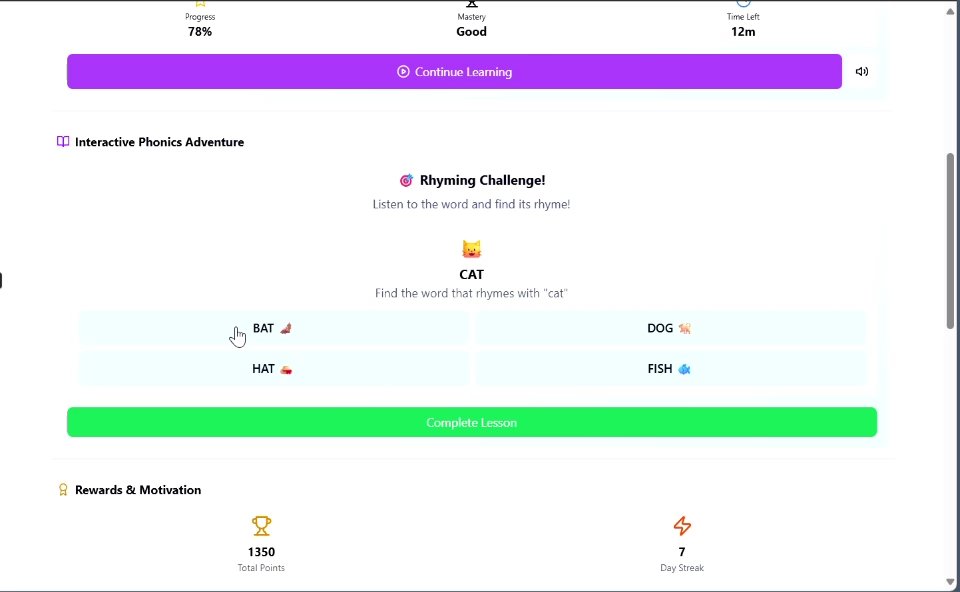
TH GLIMPSE OF OUR SECRET NOVEL AI-INTEGRATED SOLUTION IS POSTED AND WRITTEN BELOW
Inspiration
The spark behind this project came from a simple thought: “why are AI assistive tools for specially abled students still a problem statement?”. Then we found out that it was because: Because most tools stop at accessibility, they don’t enable true learning, growth, or confidence. Because they remain generic, not adaptive to the diverse needs of each disability. Because they still exclude students socially, focusing only on classrooms, not life beyond them. Because despite AI building self-driving cars, it hasn’t yet built self-belief for children who struggle to learn. This gave us the idea to create something that boosts self-confidence and goes beyond simple "teaching." We asked ourselves, "If AI can build self-driving cars, why can't it build self-belief for children who struggle to learn?".
What it does
This project is an AI-assisted education platform specially designed for disabled students by bringing them together in one unified app.It uses smart assessments after each learning session and AI-powered disability profiling to detect the type and level of disability, then creates personalized learning paths that adapt to each learner’s pace, strengths, and challenges.The platform ensures inclusivity by providing multi-access entry modes like voice, touch,text, and vibration and also by offering gamified interactive learning modules with reward points to make learning more engaging.Progress is continuously tracked with recommendations from AI that motivate the student to move towards learning a new skill while the adaptive features inside adjusts learning difficulty by personalisation.Finally by combining accessibility, interactivity, scalability, the project creates a flexible, barrier-free learning ecosystem.
How we built it
We started to build our project by identifying the challenges faced by the disabled people in the field of education .In search of the solution, we came with a great idea and here is how we built it: *We designed a simple test flow using react for the front end to identify the type and level disability. *We used FastAPI and Python to handle user data securely and integrated Hugging Face models for personalization by which we generate a customized course plan. *We built features like 1. speech to text, text to speech using Google speech API. 2.sign language converter using Tensorflow and pytorch. *We also used IBM’s AI agents to enhance accessibility features and improve decision-making in course recommendations. *We used SQLite to store the details of the disabled students. *The courses available for the students are dynamically allocated based on their type of disability and needs. *By combining these elements,we created a feasible, easily accessible and mobile friendly Web app using react native die the disabled students
Challenges we ran into
But in a positive tone: “A single platform where no disability is left behind.” -catering to incredibly diverse range of disabilities “Learning that adapts to you—without overwhelming you.” -personalising courses and interactive modules according to the user’s capabilities “From one child to a million, inclusion must scale.” -scalabilty
Accomplishments that we're proud of
“ Disability will hereafter never be a limit to education” “Successfully built a working interface of an inclusive web and mobile app using React, React Native, FastAPI, Python, and SQLite. *To Integrated AI-driven personalization with Hugging Face models and IBM’s AI agents to generate customized learning plans for disabled students. *Implemented key accessibility features such as speech-to-text, text-to-speech (Google Speech API), and a sign language converter using TensorFlow and PyTorch.
What we learned
We learned how to integrate different technologies like react, react native, FastApi ,Tensor Flow to create a feasible web app for the disabled students. We learned how to use the react and react native to build an accessible interface for the disabled students based on their needs. We learned and gained experience in using FastApi and Python and by integrating hugging face models, we developed a solution to create personalized course plans for disabled students. We also learned how to integrate features like text to speech using Google speech API, speech to text and sign language converter and as well as we learned to manage students personal data using SQLite. Most importantly, this app is about empathy and understanding the real challenges faced by the disabled people.
What's next for ANONYMOUS
*Enhance personalization by improving Hugging Face models and IBM’s AI agents to better adapt to different types of disabilities. *Expand coverage to more disabilities in near future. *Move from SQLite to a larger database cloud to store the larger data of the students. *We really wish to collaborate with Institutions like schools, universities, and NGOs to make the app widely available and accessible to more students with disabilities. *Connects disabled students with speech therapy peers in live mentor sessions, where Al checks accuracy to enable human-Al collaboration Can be extended for all types of users.Personalised courses are designed based on each one’s weakness( memorization is a problem? Not anymore) To add on more languages for better accessibility
Built With
- aider
- api
- ibm-watson
- python
- pytoch
- sqlite
- tensorflow

Log in or sign up for Devpost to join the conversation.