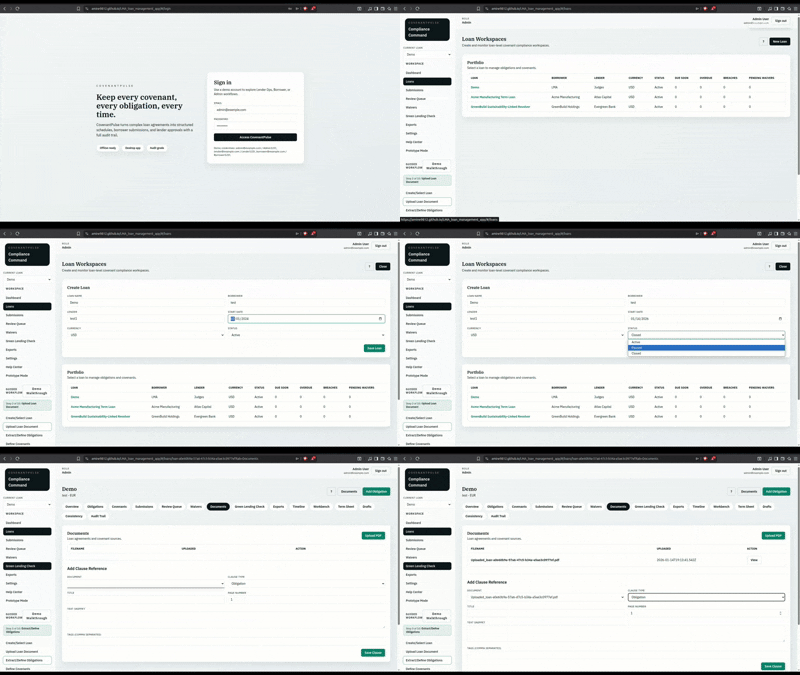
CovenantPulse - Loan Covenant and Obligation Compliance WEB/Desktop App
CovenantPulse turns complex loan agreements into structured obligations, covenant calculations, borrower submissions, lender review workflows, alerts, audit trails, and exportable reporting - all offline in a desktop app.
Inspiration
Loan agreements are still treated as long legal PDFs, but once a deal closes, the real work begins: tracking covenants, monitoring deadlines, collecting evidence, and responding to issues before they become breaches. We noticed that many teams still rely on spreadsheets and email chains for this, which makes compliance fragile—deadlines slip, data gets duplicated, and it becomes hard to explain “who did what, when, and why.” At the same time, greener lending is increasing, but whether a loan is truly “green” often depends on fragmented evidence and inconsistent criteria. We wanted to build a practical tool that turns loan compliance into a structured, auditable workflow, and makes sustainability checks explainable.
What it does
CovenantPulse is a desktop Loan Compliance Tracker that helps borrowers and lenders keep loans on track after signing. Users can create a loan workspace, upload documents, and capture key clauses as structured references. The app tracks obligations (what the borrower must deliver and when) and covenants (financial rules that must be maintained), generates schedules, and surfaces alerts for what is due, overdue, or at risk. Borrowers can submit financial inputs and evidence packages, while lenders manage decisions through a review queue, including approvals, rejections, and waiver handling. The app also generates real PDF/CSV exports for compliance packs. Finally, the Green Lending Check assesses whether a loan qualifies as Green/Transitional/Not Green using transparent scoring, banker-facing metrics, red flags, and missing-data prompts.
How we built it
We built CovenantPulse as a workflow-driven product rather than a collection of screens. We started with a clear data model: loans, documents, obligations, covenant formulas, schedules, submissions, review decisions, waivers, and audit events. Then we focused on the operational flow: create a loan, ingest a document, define obligations and covenants, generate instances by reporting period, submit evidence, review and decide, and export a compliance pack. As we iterated, we added the “Green Lending Check” as a first-class tab inside each loan and structured it around the kind of inputs bankers actually review: use of proceeds, KPI ambition, verification, reporting cadence, and exclusion flags. To reduce confusion, we added guided navigation and a Help Center that explains each tab with step-by-step instructions and definitions.
Challenges we ran into
The biggest challenge was moving from a prototype that “looked right” to one that “worked right.” Early on, data was not consistently saved or refreshed, meaning a created loan might not appear across the dashboard and lists. We also found that alerts and dashboards are only valuable if they are driven by real scheduling logic, not static placeholders. Exports were another pain point: links and previews are not enough—users need a real file saved to their machine. Finally, the green lending feature was initially hard to discover and hard to trust; it needed to be visible in the UI, deterministic, and explainable with clear thresholds and evidence mapping.
Accomplishments that we’re proud of
We are proud that CovenantPulse became an end-to-end compliance workflow: obligations and covenants are no longer abstract concepts, but trackable items with schedules, statuses, and decisions. We implemented a clearer review process and waiver handling, making the lender side feel operational rather than theoretical. We also delivered practical exports that produce real documents, and we made the Green Lending Check a banker-friendly feature with scoring breakdowns, red flags, and evidence prompts instead of vague sustainability claims. Most importantly, we improved usability with a guided flow and an in-app Help Center so a first-time user can understand the system quickly.
What we learned
We learned that in lending operations, usability is not a “nice-to-have”—it is the difference between a tool that gets adopted and one that becomes another abandoned dashboard. We also learned that compliance is fundamentally about trust: every alert, status, and score needs a clear source, logic, and audit trail. Finally, we learned that sustainability assessment must be transparent and explainable; the goal is not to “guess” whether a loan is green, but to show the evidence, the criteria, and what data is missing.
What’s next for CovenantPulse
Next, we would expand document intelligence to reduce manual setup by helping users extract obligations and covenant definitions from loan documents more quickly, while keeping human verification in the loop. We would also strengthen interoperability by exporting standardized structured loan data (JSON schemas), and add more advanced covenant libraries and ESG templates aligned with common market frameworks. On the product side, we would add configurable notifications, role-based dashboards per institution, and stronger reporting for portfolio-level oversight across many loans.
Built With
- css-frameworks/libraries:-electron
- electron
- github
- html
- javascript
- languages:-typescript
- pages
- pdfkit-(pdf-export)-testing:-vitest
- playwright-build/packaging:-electron-builder-ci/hosting:-github-actions
- prototype
- react
- react-router
- sqlite
- tailwind-css
- tanstack-react-query
- vite-desktop-platform:-electron-(cross?platform-desktop-app)-database:-sqlite-(via-better?sqlite3)-validation:-zod-pdf/docs:-pdfjs-dist-(viewer/extraction)

Log in or sign up for Devpost to join the conversation.