-
-
Results
-
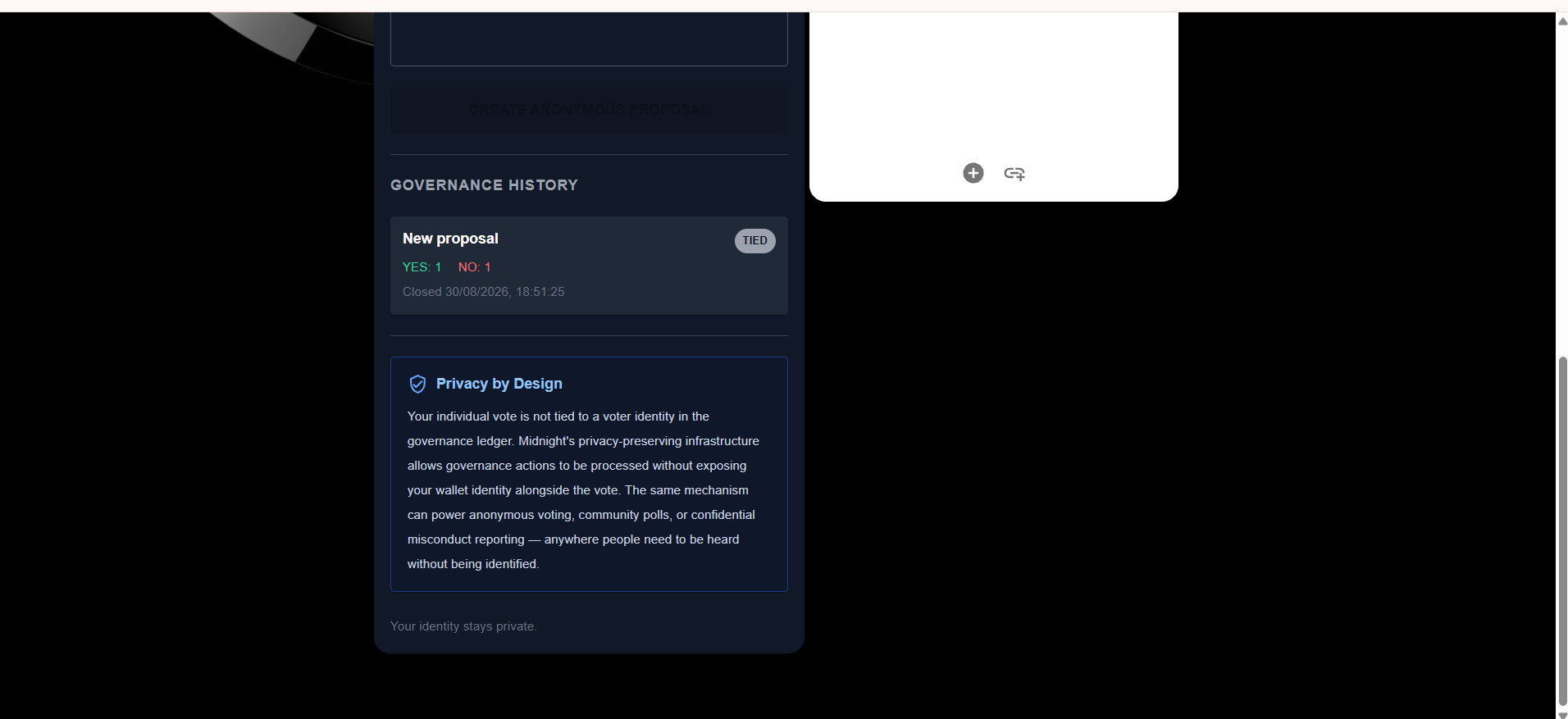
Governance history
-
Voting
Inspiration
This was my first hackathon and my first time building anything on blockchain. I wanted to explore what "privacy by design" actually means in practice, not just as a buzzword — so I built a governance/voting tool where votes are recorded on-chain, but no individual vote is tied to a voter's identity.
The idea that excites me most: the same privacy pattern used here for anonymous community voting could power something more sensitive — like confidential workplace misconduct reporting, where people need a verifiable way to be heard without fear of being identified.
What it does
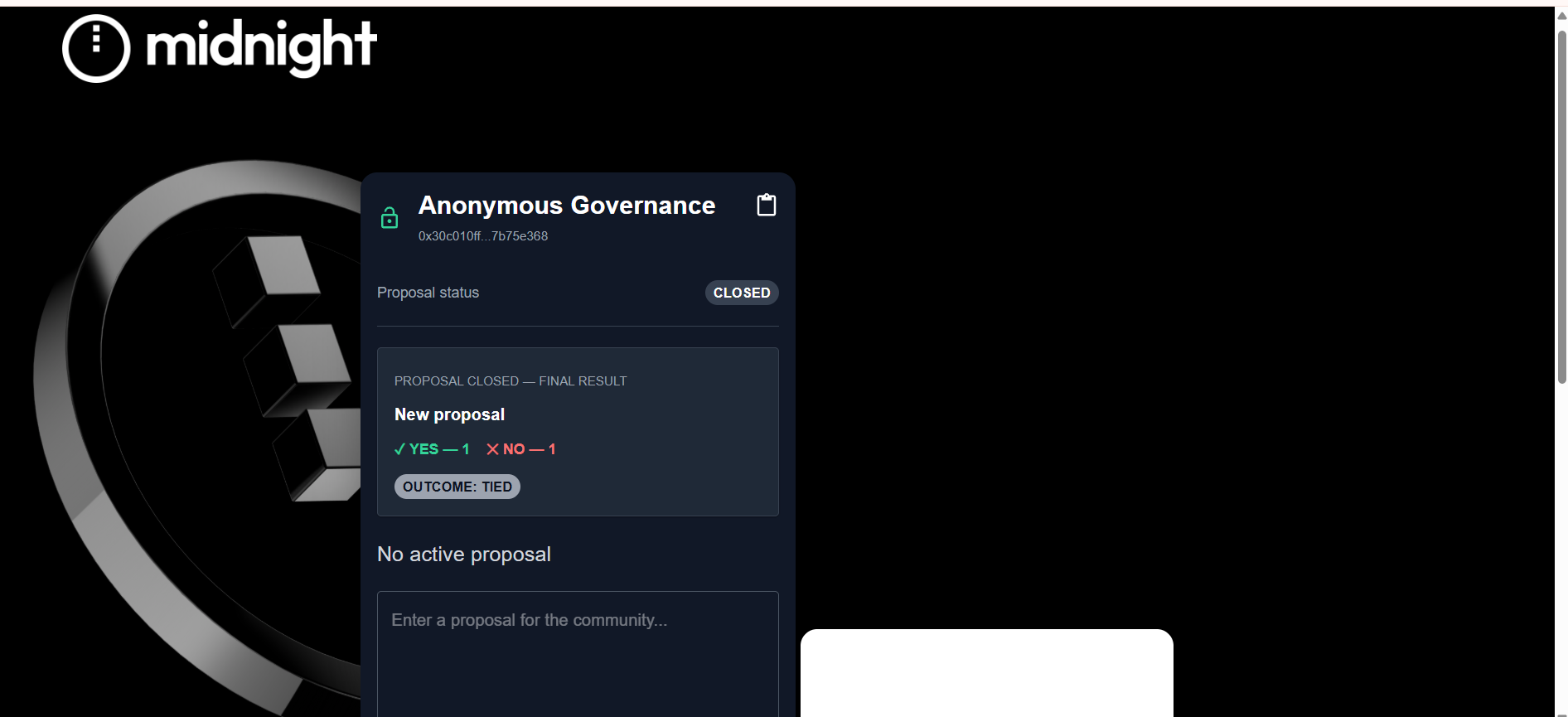
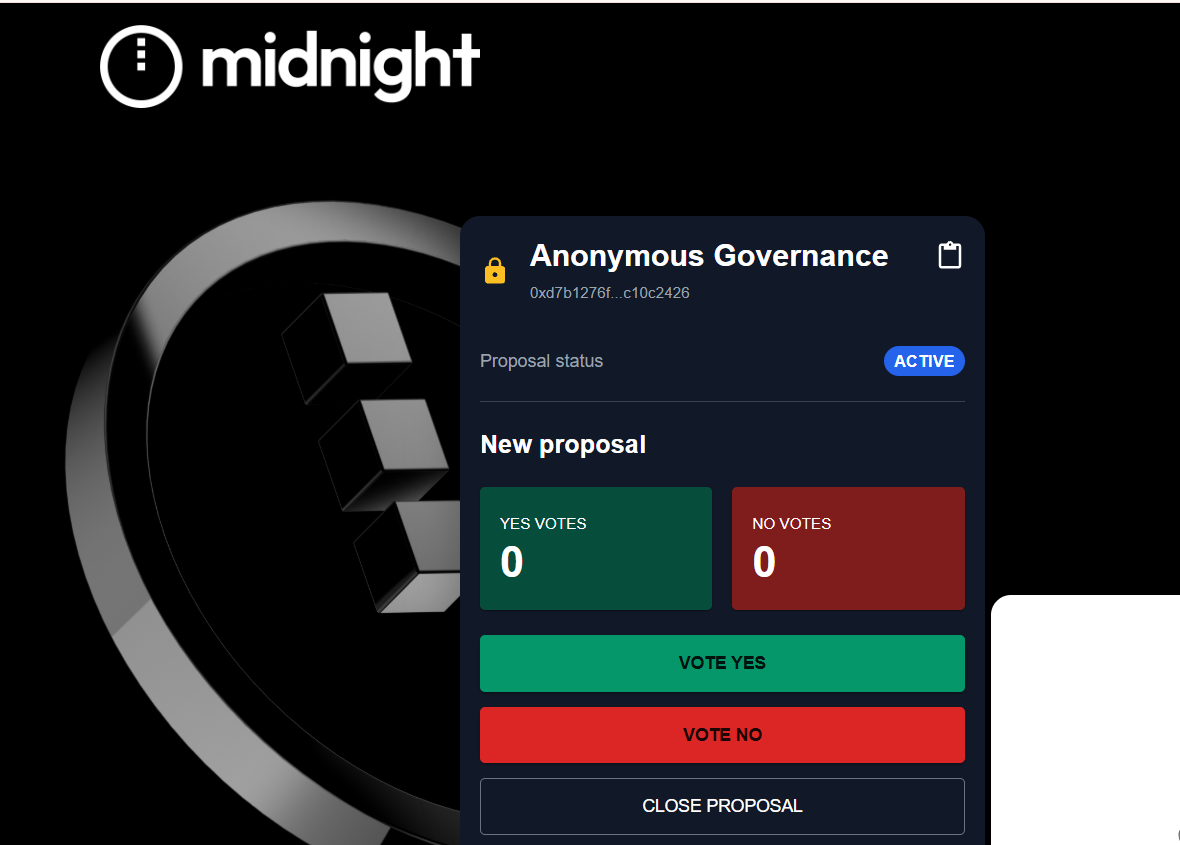
Anonymous Governance lets a community:
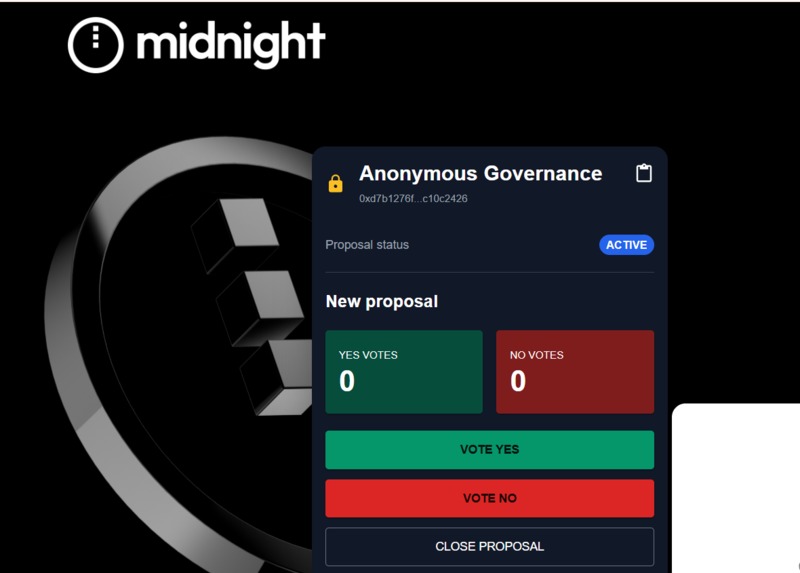
- Create a proposal
- Vote yes or no
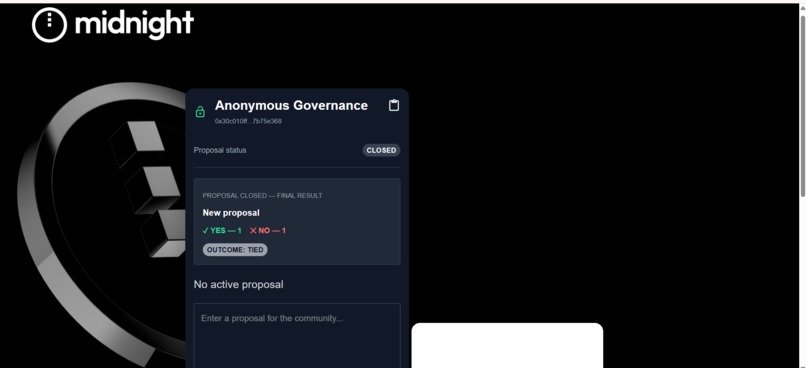
- Close the proposal to reveal a final tallied result (Approved / Rejected / Tied)
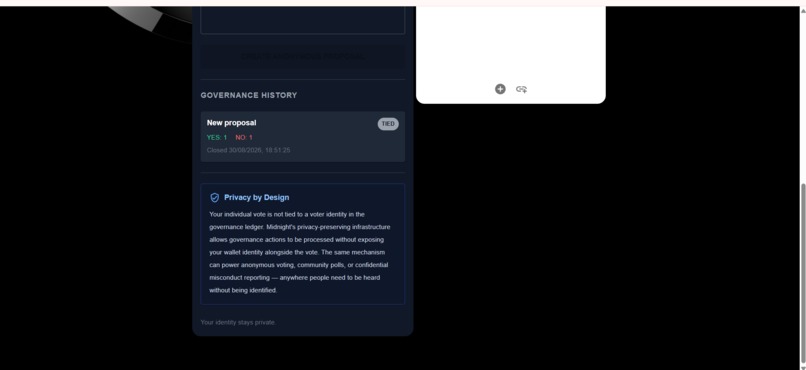
- View a history of past closed proposals and their outcomes
Individual votes are recorded through Midnight's zero-knowledge proof infrastructure, so the aggregate tally is public, but no voter identity is stored alongside any single vote in the governance ledger.
How I built it
- Contract: Written in Compact, Midnight's smart contract language, based on the official Bulletin Board (Bboard) template from
create-mn-app, extended with proposal voting and closure logic - Frontend: React + TypeScript + Vite, using MUI components
- Wallet integration: Midnight's DApp Connector API
- Network: Midnight preprod, with a locally run proof server (Docker) for zero-knowledge proof generation
I also extended the base template with:
- A "Final Result" card showing the computed outcome (Approved/Rejected/Tied) when a proposal closes
- A "Governance History" section so closed proposals aren't lost
- A "Privacy by Design" explainer, written precisely against what the contract actually guarantees (not just marketing language)
Challenges I faced
The single biggest challenge was wallet connectivity. I initially built and tested everything using the Lace wallet extension, and hit a persistent bug where Lace's "Authorize" popup would appear but not register clicks at all — reproducible even in a completely fresh Incognito Chrome profile with a brand-new wallet. After extensive debugging (extension reloads, Chrome restarts, disabling other extensions, checking for Lace updates), I switched to the 1AM wallet instead, which resolved the issue immediately with no other changes needed.
As a complete beginner to blockchain development, I also had to learn, in real time: how Midnight's wallet connector API works, how zero-knowledge proof generation happens locally via a proof server, how DUST (the network's fee resource) is generated from NIGHT tokens, and how to read and reason about a Compact smart contract well enough to accurately describe its actual privacy guarantees (rather than overstating them).
What I learned
- How zero-knowledge proofs are used in practice to separate "what happened" from "who did it"
- That not all wallet extensions for the same network behave identically — switching wallets can matter as much as writing code
- How to read a smart contract closely enough to know exactly what privacy guarantees it does and doesn't provide, and to document that honestly rather than overclaiming
- That a working, honestly-scoped project is more valuable than a broken, overambitious one — I deliberately chose not to attempt adding one-vote-per-participant enforcement (which would require contract changes and a redeploy) this close to the deadline, and documented it as a known limitation instead
What's next
- Add per-voter nullifier tracking to the voting circuits, so the contract enforces one vote per eligible participant while still preserving anonymity (true Sybil resistance, not just anonymous-looking votes)
- Support multiple concurrent proposals instead of one active proposal at a time
- Add deadline-based proposal closing instead of manual closing
- Explore adapting the same privacy pattern for a dedicated anonymous misconduct-reporting tool
Built With
- 1am-wallet
- blockchain
- compact
- docker
- midnight
- mui
- react
- typescript
- vite
- zero-knowledge-proofs

Log in or sign up for Devpost to join the conversation.