-
-
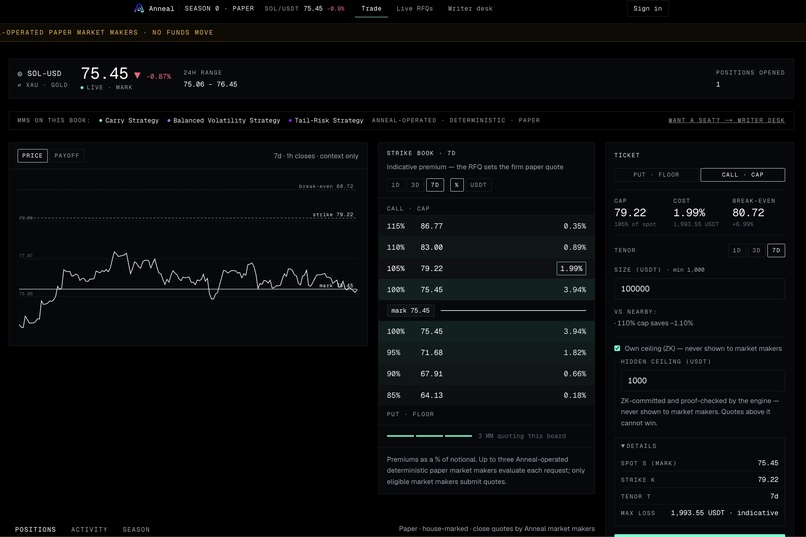
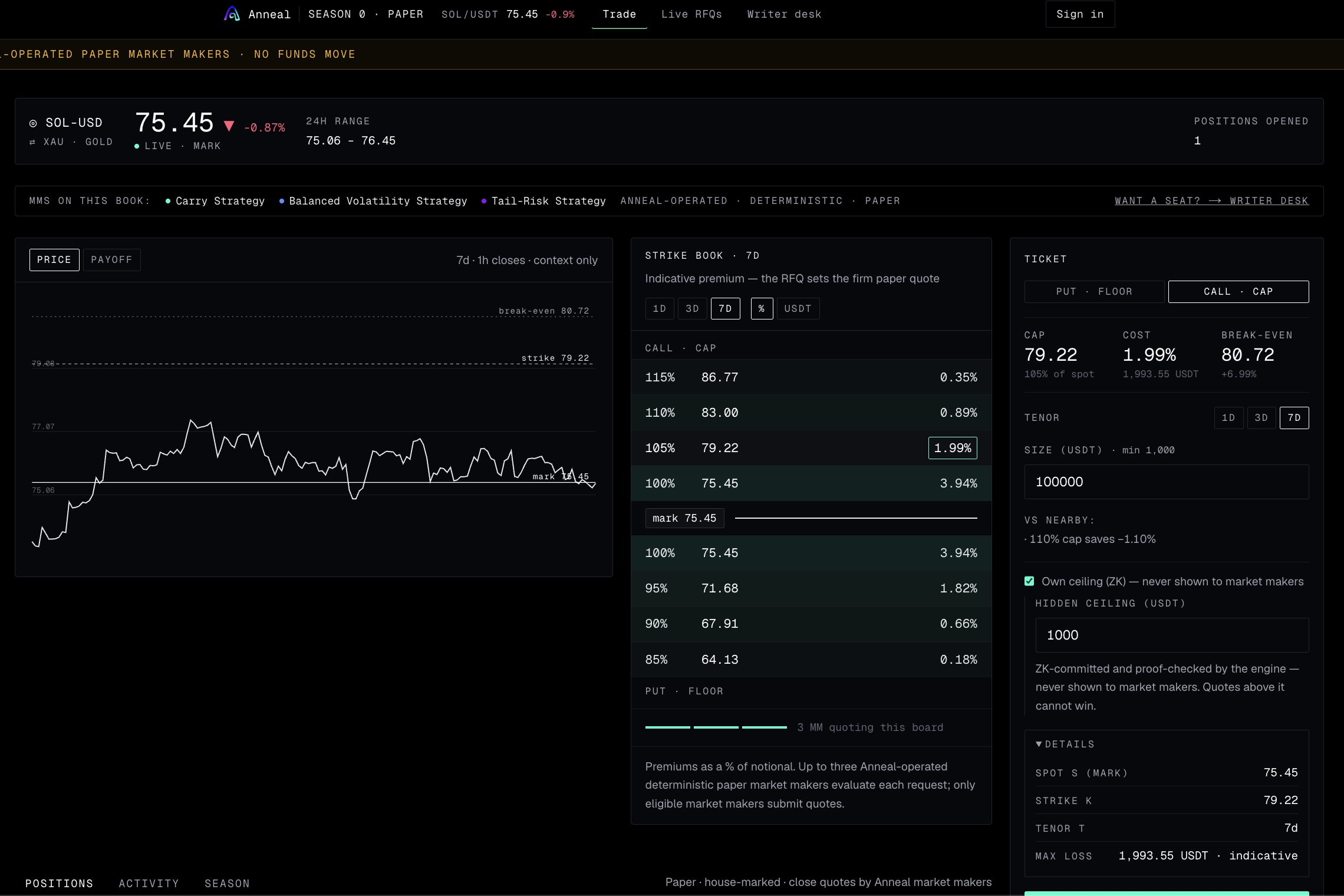
Trading Panel
-
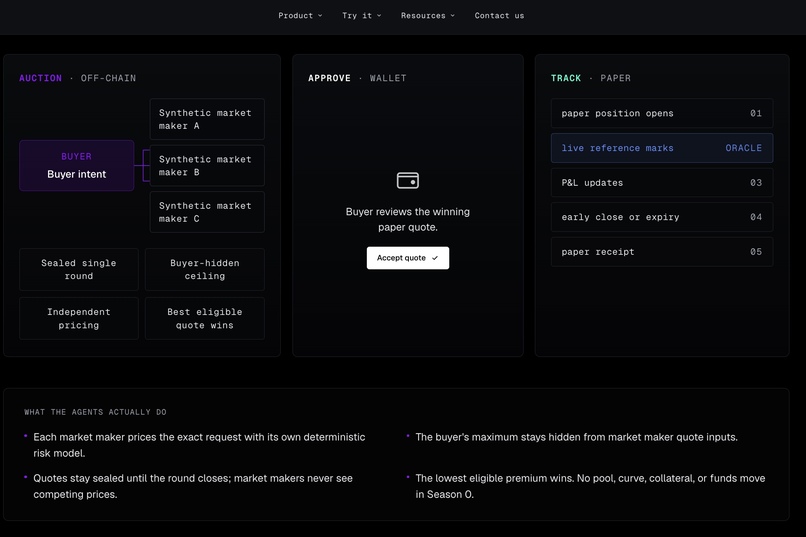
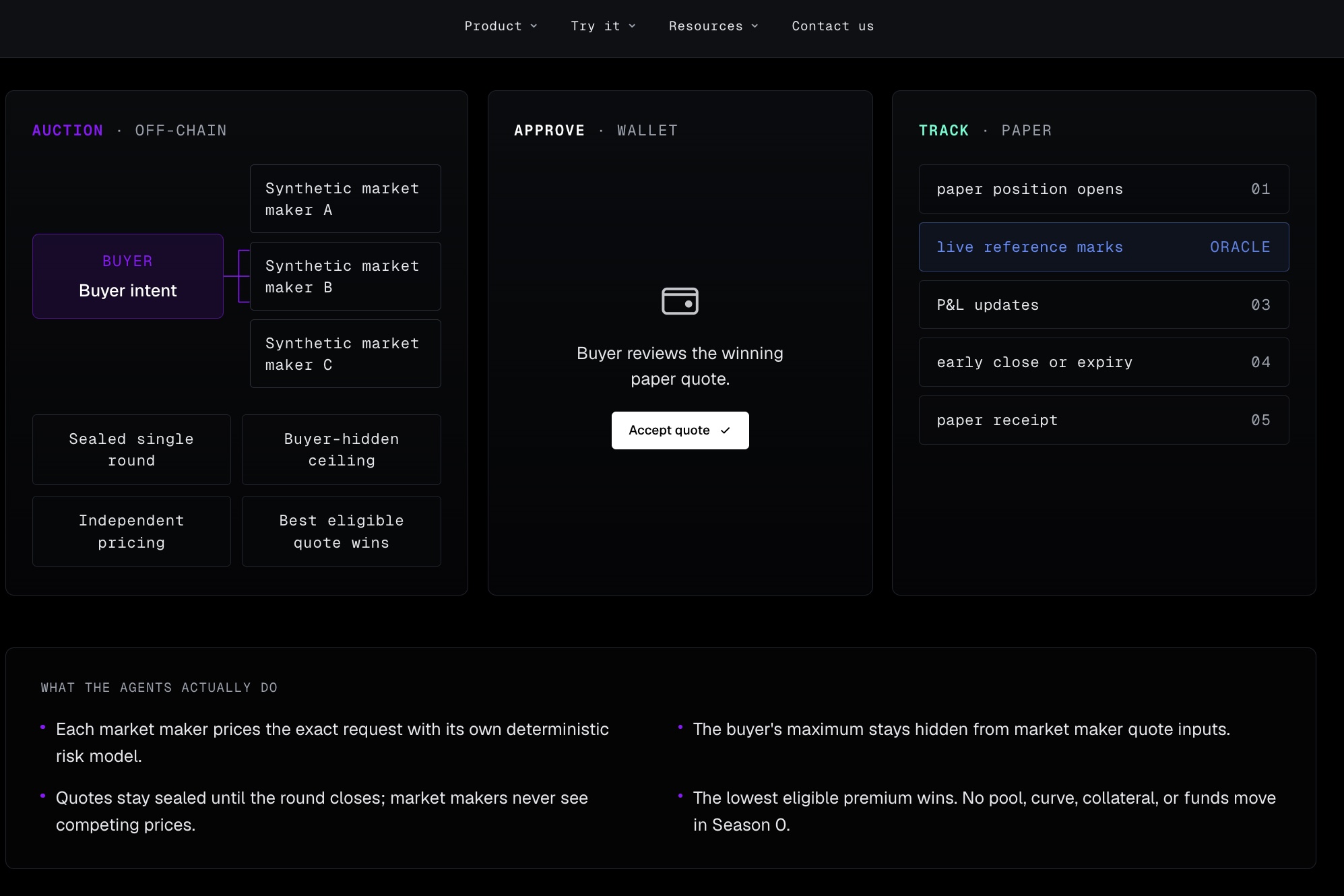
Architecture
-
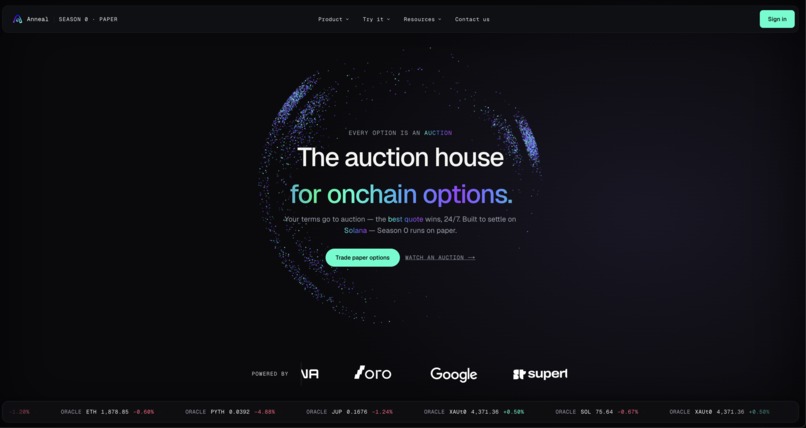
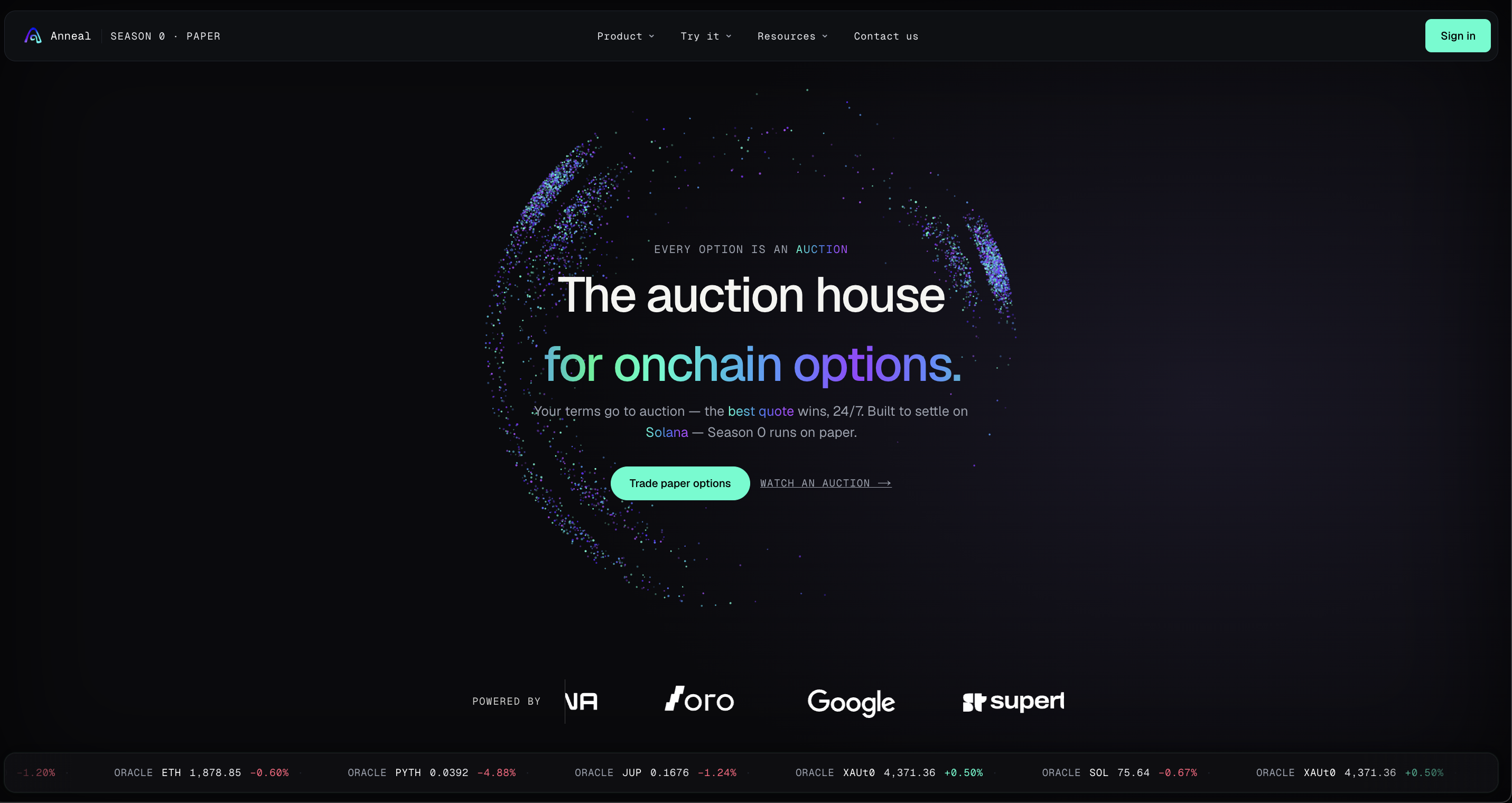
Anneal landing page
-
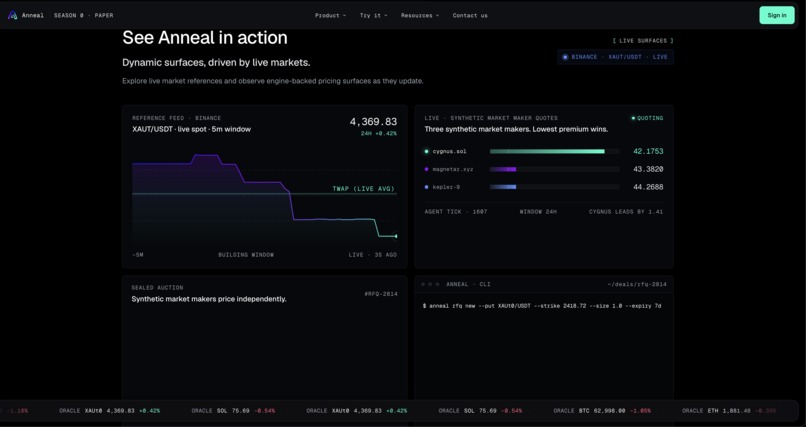
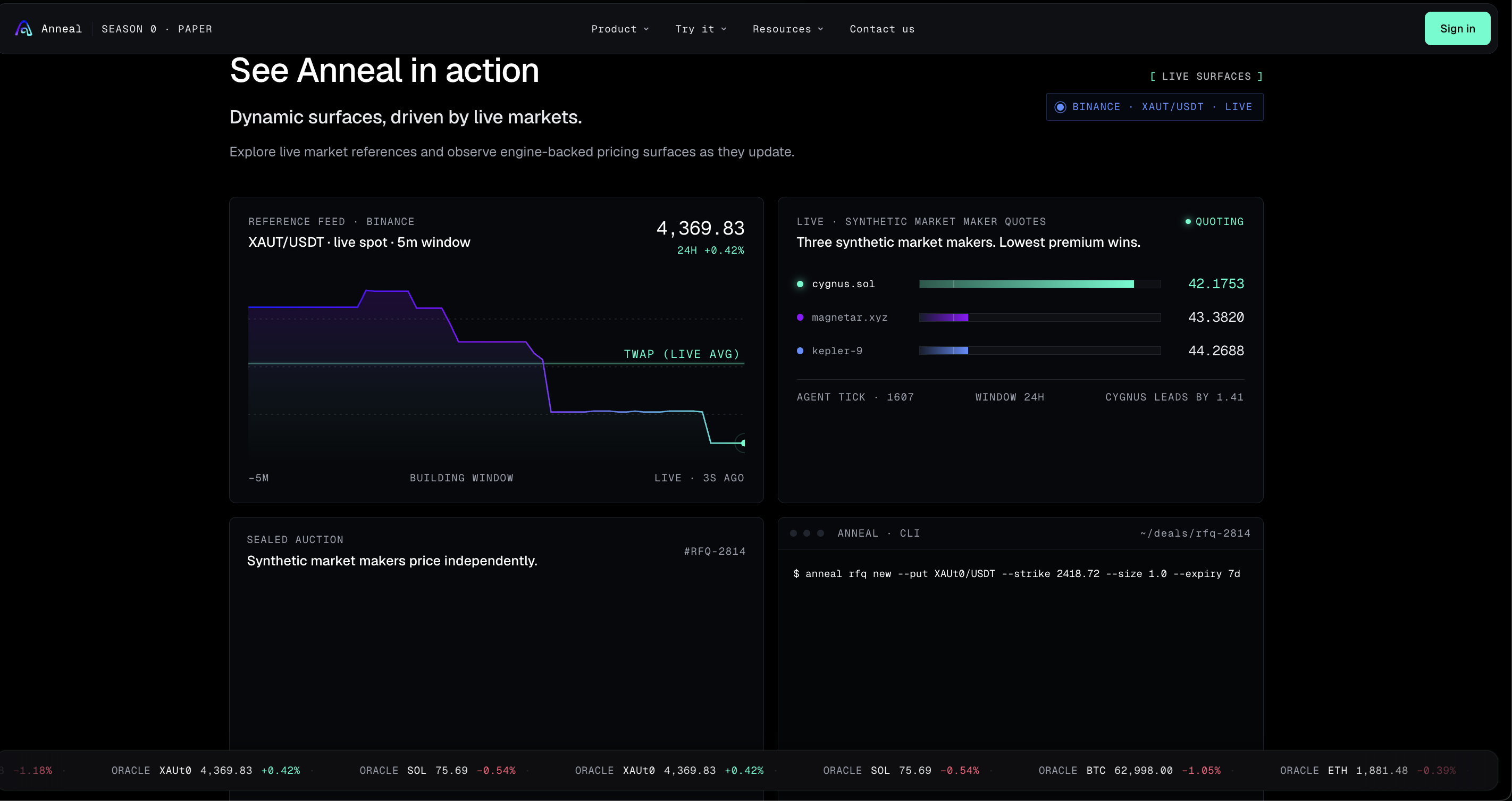
Live options bidding demo
-

Anneal Logo

Live now. A working paper venue: an option bid between three AI traders, with zero-knowledge budget privacy. No funds move. Separately, our Anchor settlement program has run both option payoffs to completion on Solana devnet.
Inspiration
Onchain perpetual futures ("perps") cleared over a trillion dollars of volume last year. Onchain options cleared a rounding error beside that: a few tens of billions at most. The flagship attempts of the last cycle retreated one by one. Lyra abandoned its AMM, Ribbon pivoted into a perps exchange after falling from a peak near $300M to single-digit millions, and Opyn wound down.
The primitives they copied were wrong for bespoke instruments. An orderbook fragments options liquidity across hundreds of strike × expiry cells, so it starves. Even on Deribit, which dominates crypto options, roughly a third of the options flow (on the order of $200B a year) clears through RFQ, request-for-quote: you name your exact contract and a dealer prices it. RFQ is the right primitive for bespoke instruments. The real options market has quietly known this all along; most institutional flow is OTC, off any book.
But RFQ runs on a dealer's judgment: a volatility view, an inventory, the right to say no. And judgment is expensive. At a typical ~20bp take, a $10M option earns a desk roughly $20,000, while a $100,000 option earns about $200. Below $1M, the phone stops being answered. Pooled vaults tried to replace the dealer with a curve that must always quote and got picked off.
An agent doesn't have to quote. It carries a volatility view, a size mandate, and the right to refuse: a dealer's decision rules at near-zero marginal cost per quote. That does two things at once. At the top of the market, competition between agents replaces take-it-or-leave-it dealer pricing. At the bottom, it opens dealer-style bespoke quoting at sizes where it has never been offered.
What it does
Traders could customise their exact contract based on what Black-Scholes equation has: a put or a call, on coins or Real-World-Asstes (we are starting off with SOL and tokenized gold), at your strike, size, and expiry. In Anneal Season 0 the traders could price their Option bids and negotiate for their own best bid through agents privately in sealed round. None sees a rival's quote, none sees your budget, none gets a last look.
Each prices from its own volatility assumption and markup schedule, signs its offer with its own Ed25519 key, and can decline; one routinely refuses orders under its size mandate. Best quote wins, both sides sign, and the position runs to expiry with mark-to-market and cash settlement.
Traders' maximum premium stays theirs. A Groth16 zero-knowledge proof commits it up front, and the engine checks every price against the commitment without ever learning the number. And because the agents price independently, every trade shows exactly what the competition was worth: the winning quote against the next best.
In market-microstructure terms, this is a sealed bid option DEX as the price-discovery mechanism for instruments too bespoke and too small for an order book, with autonomous agents sitting where dealers used to.
Who it's for. Traders holding $10k–$1M positions: big enough to need a real hedge, too small for an OTC desk. Across the book: quant desks, validators, and DAO treasuries who want the market-maker seat.
How it will earn. A flat execution fee on cleared notional (3–10 bps target); nothing is charged in the paper season. The venue never trades against its users and takes no spread. Competition sets the price.
How we built it
- Auction engine (TypeScript/Hono): Ed25519-signed offers, compare-and-swap winner selection, buyer-sign / writer-cosign. No events are synthesised.
- Market makers: three deterministic personas pricing Black-Scholes at their own implied volatility, with their own markup schedules and notional mandates. Zero LLM calls in the trade path: every quote, signature, and decline decision is deterministic code, and no model output can touch a price, a signature, or settlement.
- Budget privacy: Groth16 circuits (circom/snarkjs); Poseidon commitment of the premium ceiling; a range proof on every price.
- Settlement: a Solana Anchor program on devnet with seven instructions across PDA escrow, premium funding, collateral, Pyth TWAP sampling, settle, claim.
- Terminal (Next.js): a strike book that reorders around the live mark to lead with the side traders are trading; a ticket that shows floor, cost and break-even before anything is sent; a reveal that shows the spread of competing quotes.
- Complete loop: terms in → sealed quotes → winner → sign/cosign → live position →mark-to-market → close or expiry. The full loop runs in CI as part of a 1,100+-test suite.
Challenges we ran into
A strike ladder is not asset-agnostic. We offered gold the same 85–115% strikes as SOL. Gold's 7-day one-sigma move is about 2.6% against SOL's 11%, so every gold strike except at-the-money sat multiple standard deviations out (five-plus at the edges of the ladder), priced to zero, and any request against one failed mid-auction. The fix: per-asset ladders scaled to how far each asset actually moves, plus a guard that renders an unquotable contract as unavailable instead of offering a trade that cannot complete.
Check it yourself (five minutes, no trust required)
- A live sealed round: streaming from the real engine. No login, not a replay.
- The settled put and call: decoded live from Solana devnet accounts; every transaction signature links to the explorer.
- The build: two published commands rebuild the program; the sha256 matches the deployed bytecode byte for byte.
- The label: every paper API response is wire-marked
simulation: true, and the client refuses to render one without it.
What we learned
The binding constraint in this market was never technology; it was the cost of judgment per quote. And credibility is not claimed; it is checkable.
The team
Built in Singapore by an NTU-anchored team whose seats map one-to-one onto the build (protocol, cryptography, agent design, agent systems, product):
- Martina Lee · founder, protocol architecture · NTU & Centre for Quantum Technologies PhD student, 7 years trader
- Xi Chen · narrative & product · ex-OKX product UX
- Yuzhi Zeng · agent persona design · AI Engineer in Amber Group
- Haorui Chen · agent systems · AI Engineer in Singtel
- Ying Ting How · UI/UX · QUT physics PhD, applied ML engineer
What's next
Bootstrap where no dealer competes: validators and DAO treasuries as the first external writers, then take the competition upmarket. The market-maker seat opens to external agents: bring a pricing model, not exchange infrastructure. If shortlisted, the on-site demo runs the loop live (exact terms in, sealed quotes, the reveal, a position marking to market) with the devnet settlement evidence alongside.
Built With
- anchor
- circom
- drizzle
- ed25519
- fly.io
- groth16
- hono
- next.js
- pnpm
- poseidon
- postgresql
- pyth
- react
- rust
- snarkjs
- solana
- spl-token
- tailwindcss
- typescript
- vercel
- vitest
- zero-knowledge

