-
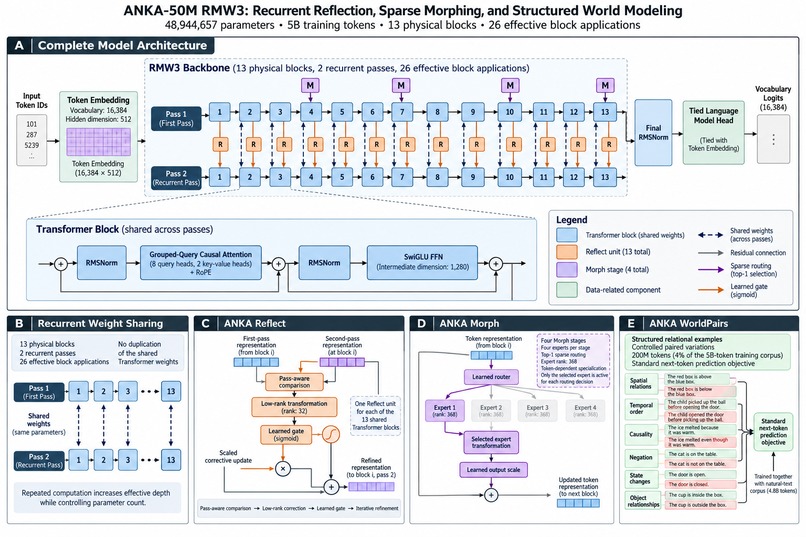
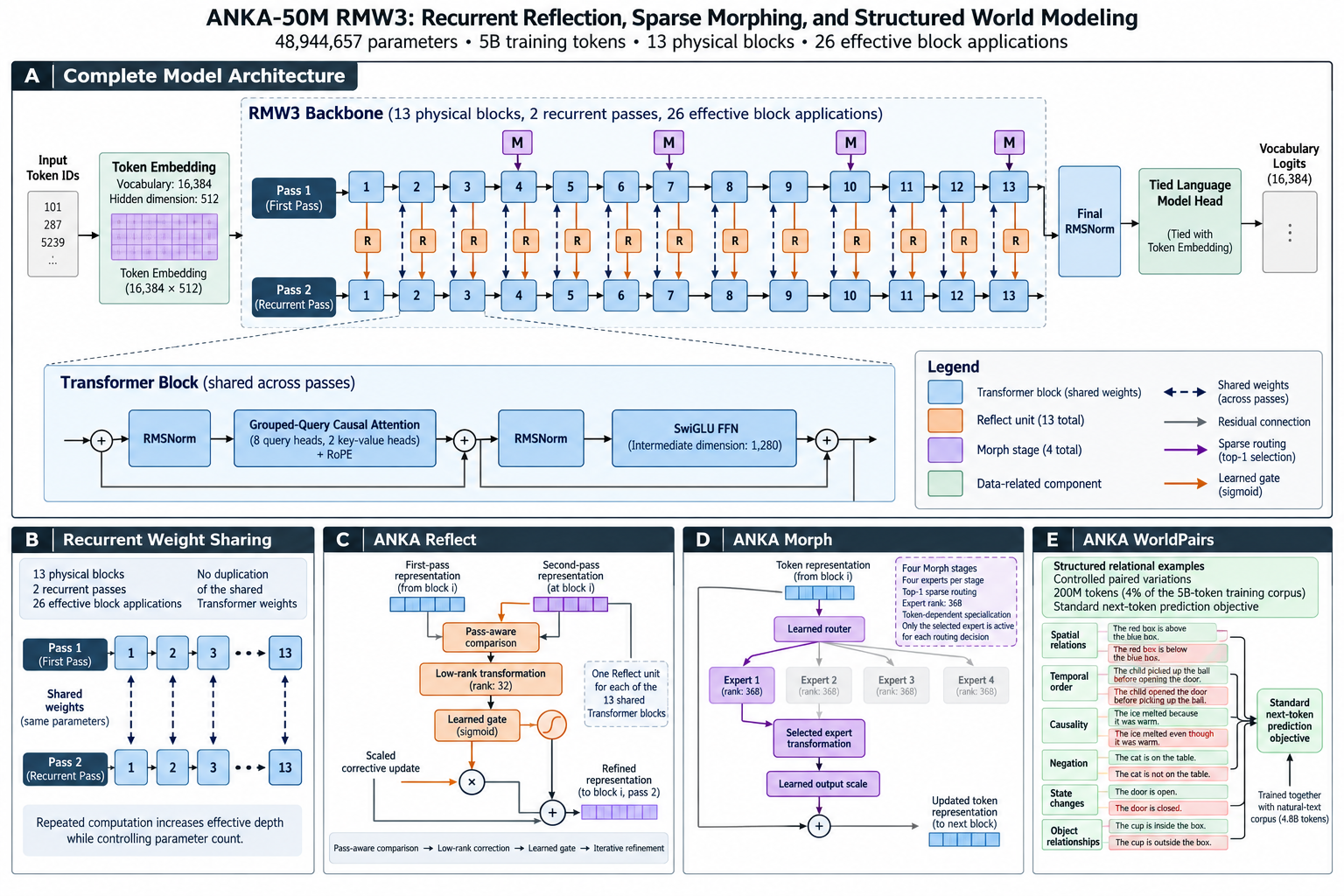
complete architectural diagram
Inspiration
Large language models are usually improved by increasing parameter count, training data, and compute. ANKA-50M began with a different question:
How much useful language capability can we obtain from fewer than 50 million parameters and a single GPU?
I built ANKA-50M as an independent research project to explore whether recurrent computation, learned self-correction, and sparse specialization could improve the efficiency of a very small language model. The goal was not to imitate a large model at a smaller scale, but to design an architecture specifically around a strict parameter and compute budget.
What it does
ANKA-50M RMW3 is a 48,944,657-parameter English foundational language model trained from scratch on 5 billion tokens.
It can:
- Complete English text
- Generate short explanations and structured passages
- Continue scientific, educational, and narrative prompts
- Perform zero-shot multiple-choice language benchmarks
- Run locally on systems with sufficient CPU or GPU memory
- Serve as a compact base model for later instruction tuning
ANKA is a base completion model rather than a chat-aligned assistant. No pretrained model, distillation target, or external model initialization was used.
How I built it
The model uses a decoder-only Transformer foundation with:
- 512-dimensional hidden representations
- 13 physical Transformer blocks
- Two recurrent passes, producing 26 effective block applications
- Grouped-Query Attention with 8 query heads and 2 key-value heads
- RMSNorm, RoPE, SwiGLU, and tied input/output embeddings
- A 16,384-token tokenizer
- A 1,024-token context window
The architecture adds three main ideas.
ANKA Reflect
Reflect compares representations produced across recurrent passes and applies a learned low-rank correction.
Instead of treating the second pass as a simple repetition, Reflect allows each shared block to modify its state based on what changed between passes. This gives the model a lightweight form of iterative refinement without duplicating the full Transformer stack.
In a 4,096-token ablation sample:
- Full model loss: 2.6290
- Reflect disabled: 2.8961
- Loss degradation when disabled: +0.2671
- Every one of the 13 Reflect units produced a positive individual ablation contribution on the measured sample
ANKA Morph
Morph is a sparse transformation system composed of four stages. Each stage contains four low-rank experts and a learned router that selects a transformation for each token.
This gives tokens access to specialized transformations while keeping the total parameter count below 50 million.
In the same ablation sample:
- Full model loss: 2.6290
- Morph disabled: 2.7969
- Loss degradation when disabled: +0.1678
- All four Morph stages produced positive individual contributions
- Shifting router-to-expert assignments increased loss by 0.0266, showing that the learned routing decisions were meaningful
ANKA WorldPairs
WorldPairs is a structured data component containing paired relational examples involving order, position, causality, negation, state changes, and physical relationships.
The final 5-billion-token corpus contained 200 million WorldPairs tokens, representing 4% of training data. These examples were trained through the same next-token prediction objective as the rest of the corpus.
Training
ANKA-50M was trained from scratch using:
- Training tokens: 5,000,000,000
- Hardware: One NVIDIA A100-SXM4 80GB
- Precision: BF16
- Batch size: 64
- Sequence length: 1,024
- Training steps: 76,294
- Training time: 42,409 seconds, approximately 11 hours 47 minutes
- Average end-to-end throughput: 117,899 tokens per second
- Training efficiency: approximately 424 million tokens per GPU-hour
- Best internal validation loss: 2.3344
The complete training pipeline, architecture implementation, experiment notebooks, parameter verification, evaluation scripts, and architecture audits are publicly available.
Results
The final base checkpoint was evaluated with zero-shot settings.
| Benchmark | Metric | Result |
|---|---|---|
| HellaSwag | Accuracy normalized | 28.46% |
| ARC-Easy | Accuracy normalized | 42.26% |
| PIQA | Accuracy normalized | 56.80% |
| WinoGrande | Accuracy | 51.46% |
| WikiText-103 | Perplexity | 25.97 |
ANKA was designed primarily as an architecture and efficiency experiment. Its strongest result is not that it replaces much larger models, but that a model below 50 million parameters can combine recurrent depth, learned correction, and sparse specialization while remaining fast enough to train from scratch on one GPU.
Challenges
The strict 50-million-parameter limit affected every design decision. Increasing vocabulary size, hidden width, expert capacity, or normalization parameters meant reducing capacity somewhere else.
The most difficult challenges were:
- Designing meaningful architectural additions without exceeding the parameter limit
- Preventing sparse expert routing from collapsing
- Making recurrent weight sharing improve capability rather than simply repeating computation
- Building and tokenizing a multi-billion-token corpus
- Keeping the data pipeline fast enough to feed a small model on an A100
- Measuring architecture contributions separately from ordinary validation loss
- Recovering safely from interrupted Colab sessions and GPU-memory failures
- Packaging custom model code and weights into reproducible public releases
Several early Reflect and Morph versions failed to outperform the control architecture. I redesigned both systems, tested them independently, combined them only after ablation studies, and verified their contribution in the final RMW3 checkpoint.
What I learned
This project taught me that small-model development is not simply large-model development with smaller dimensions.
At this scale:
- Tokenization consumes a meaningful part of the parameter budget
- Kernel-launch and memory overhead can matter as much as raw compute
- Parameter sharing must be paired with mechanisms that distinguish repeated computation
- Sparse routing requires direct monitoring and ablation
- Validation loss alone is insufficient for judging architectural changes
- Data quality and composition can be more important than adding another layer
- Reproducibility, throughput, and deployment are part of the model design
The most important lesson was that architectural ideas should be validated by disabling them and measuring what is lost—not only by observing that the complete model trains.
Accomplishments
I am proud that ANKA-50M:
- Was designed and trained independently from scratch
- Fits under the competition’s 50-million-parameter limit
- Processes 5 billion training tokens in under 12 hours on one A100
- Includes reproducible parameter-count and benchmark scripts
- Provides public model weights, tokenizer, inference code, and training notebooks
- Demonstrates measurable contributions from Reflect and Morph
- Can be downloaded and run without relying on a hosted proprietary API
What is next
The released checkpoint is intentionally the foundational base model.
Future work includes:
- Instruction tuning for natural multi-turn conversation
- Longer-context training
- Quantized CPU and edge deployment
- More extensive architecture-matched control experiments
- Improved Morph routing and token-dependent Reflect gates
- A larger Turkish-focused ANKA model with a Turkish-specific tokenizer
- Broader safety, factuality, and reasoning evaluations
ANKA-50M demonstrates a practical direction for language models that learn more from limited parameters, data, and compute.


