-
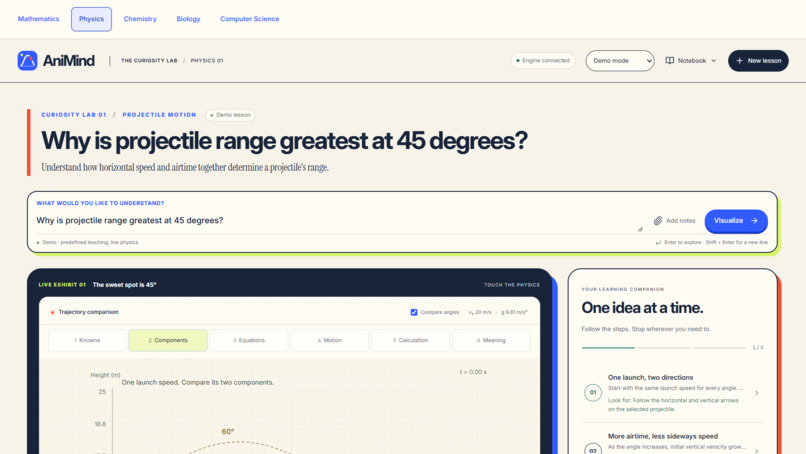
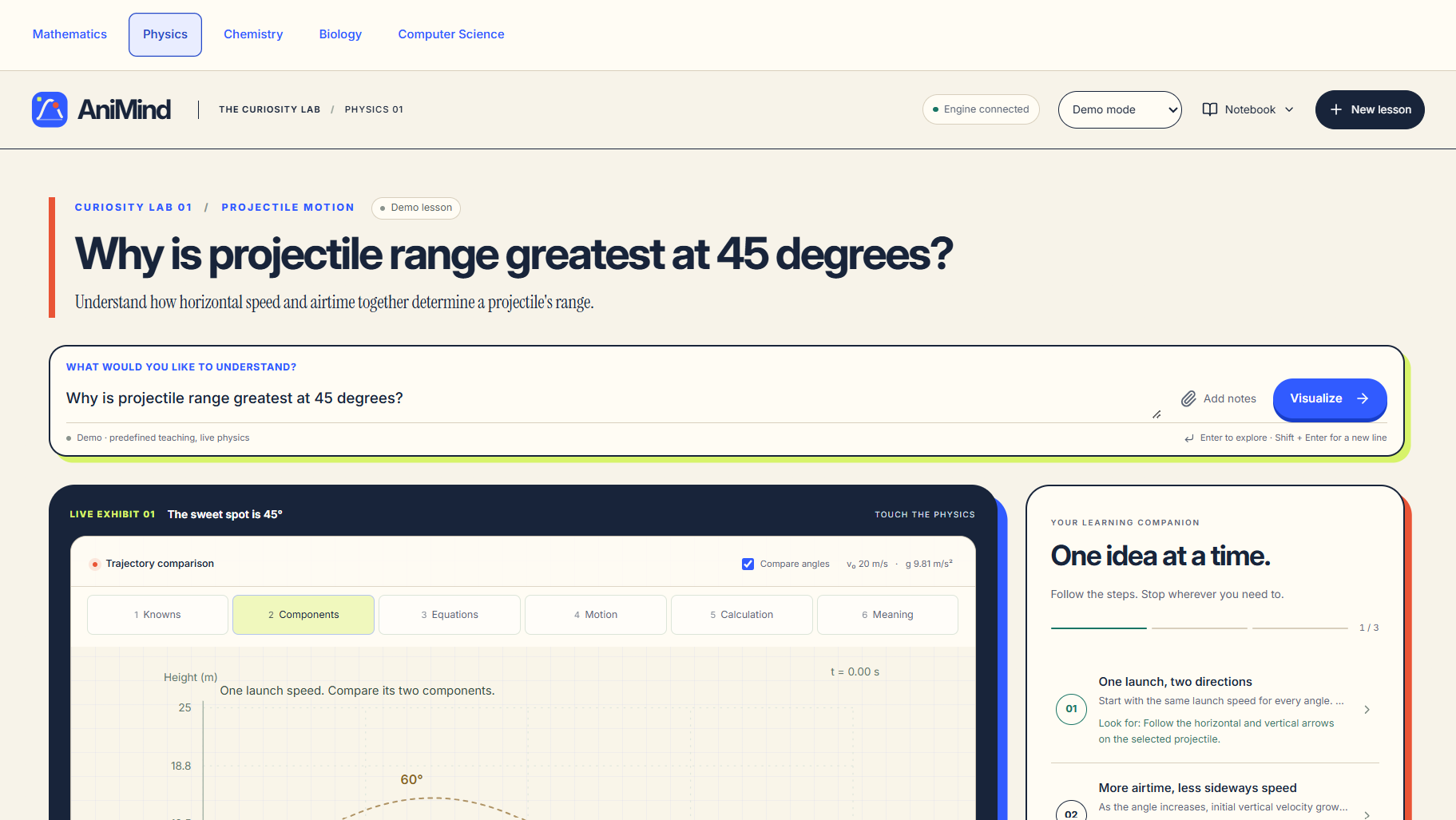
a screenshot of our website
Inspiration
We've all had that moment when an explanation makes sense on paper, but we still can't picture what's actually happening. Traditional textbooks rely on static diagrams, while AI chatbots often respond with long paragraphs.
We wanted to bridge that gap by creating something that doesn't just explain concepts but brings them to life.
That's why we built AniMind.
Our guiding idea is simple: Don't Just Learn It. See It.
What it does
AniMind is an AI-powered interactive learning platform that transforms educational questions into visual experiences.
Instead of just reading an answer, students can explore concepts through interactive animations, guided explanations, and spoken narration.
Our features include:
- Curiosity Lab: An inviting interface for asking questions and exploring new ideas.
- Eight interactive visualizers: Covering topics across physics, mathematics, chemistry, biology, and computer science.
- Guided Lesson Player: Step-by-step teaching alongside visual demonstrations.
- Voice Tutor: Spoken explanations using browser-based speech synthesis.
- Red Pen Challenge: Interactive exercises that encourage students to identify misconceptions.
- PDF Learning: Support for learning from uploaded educational materials.
- Demo Mode: Prepared examples that showcase AniMind's learning experience.
Whether someone is studying projectile motion, quadratic functions, molecules, cells, or sorting algorithms, AniMind helps make abstract ideas more understandable.
How we built it
We built AniMind using Next.js, React, TypeScript, and Tailwind CSS for the frontend, with Python and FastAPI powering the backend.
We integrated Google Gemini to generate educational explanations and support AI-assisted learning.
Our interactive visualizations use SVG-based animations, allowing students to explore concepts with responsive visual controls.
For the Voice Tutor, we used the browser's built-in speech synthesis capabilities.
We collaborated through GitHub, integrated multiple feature branches, and used automated testing, including Playwright, to validate important user interactions.
Challenges we ran into
One of our biggest challenges was coordinating the different parts of the learning experience.
It wasn't enough to create an animation or generate an explanation independently. We wanted the visuals, narration, and lesson progression to feel connected.
Another challenge was supporting multiple subjects without sacrificing clarity or consistency.
We also encountered integration challenges while combining contributions from different branches. Automated tests helped us identify issues involving the Voice Tutor and Red Pen Challenge as the interface evolved.
Finally, balancing ambitious features with reliability under a hackathon deadline required us to prioritize what would make the biggest difference for students.
Accomplishments that we're proud of
We're proud that AniMind is more than a chatbot with a nicer interface.
We created an interactive learning environment that combines AI explanations, visual demonstrations, and student participation.
Some highlights include:
- Building eight subject-specific interactive visualizers.
- Designing our distinctive Curiosity Lab interface.
- Integrating spoken narration with guided lessons.
- Creating the Red Pen Challenge to encourage active learning.
- Combining AI assistance with predictable, controllable animations.
- Building and integrating a collaborative full-stack project during a hackathon.
What we learned
We learned that making an educational AI product requires more than generating useful text.
The way information is presented matters just as much as the information itself.
Building AniMind taught us about frontend and backend integration, working with AI APIs, interactive animation design, automated browser testing, and collaborative Git workflows.
Most importantly, we learned how powerful visual learning can be when students are encouraged to explore instead of simply memorize.
What's next for AniMind
We want to expand AniMind into a more personalized, accessible learning platform.
Our next goals include supporting additional subjects, creating richer interactive visualizations, improving personalized lesson generation, strengthening PDF-based learning, and adding more adaptive comprehension challenges.
We also hope to make AniMind useful for teachers who want to demonstrate difficult concepts in engaging ways.
Our long-term vision is to make learning feel like discovery.
AniMind — Don't Just Learn It. See It.
Built With
- fastapi
- gemini-api
- git
- github
- google-gemini
- javascript
- next.js
- playwright
- python
- react
- svg
- tailwind-css
- typescript
- web-speech-api
