-
-
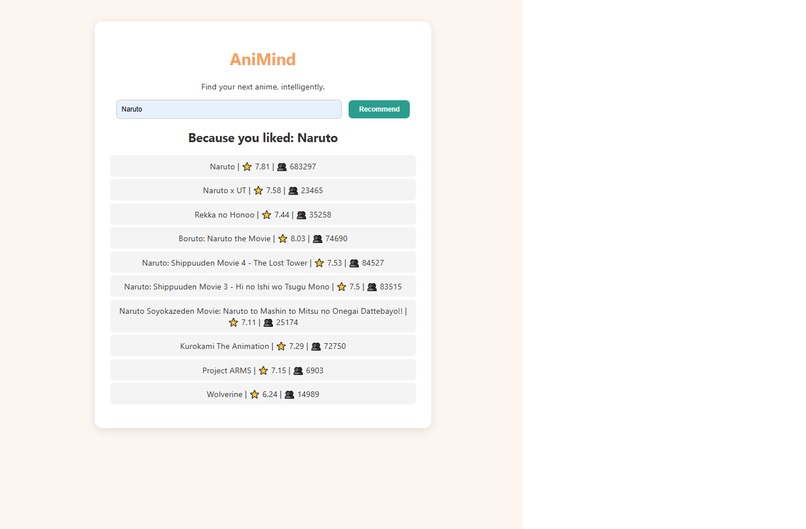
Basic GUI
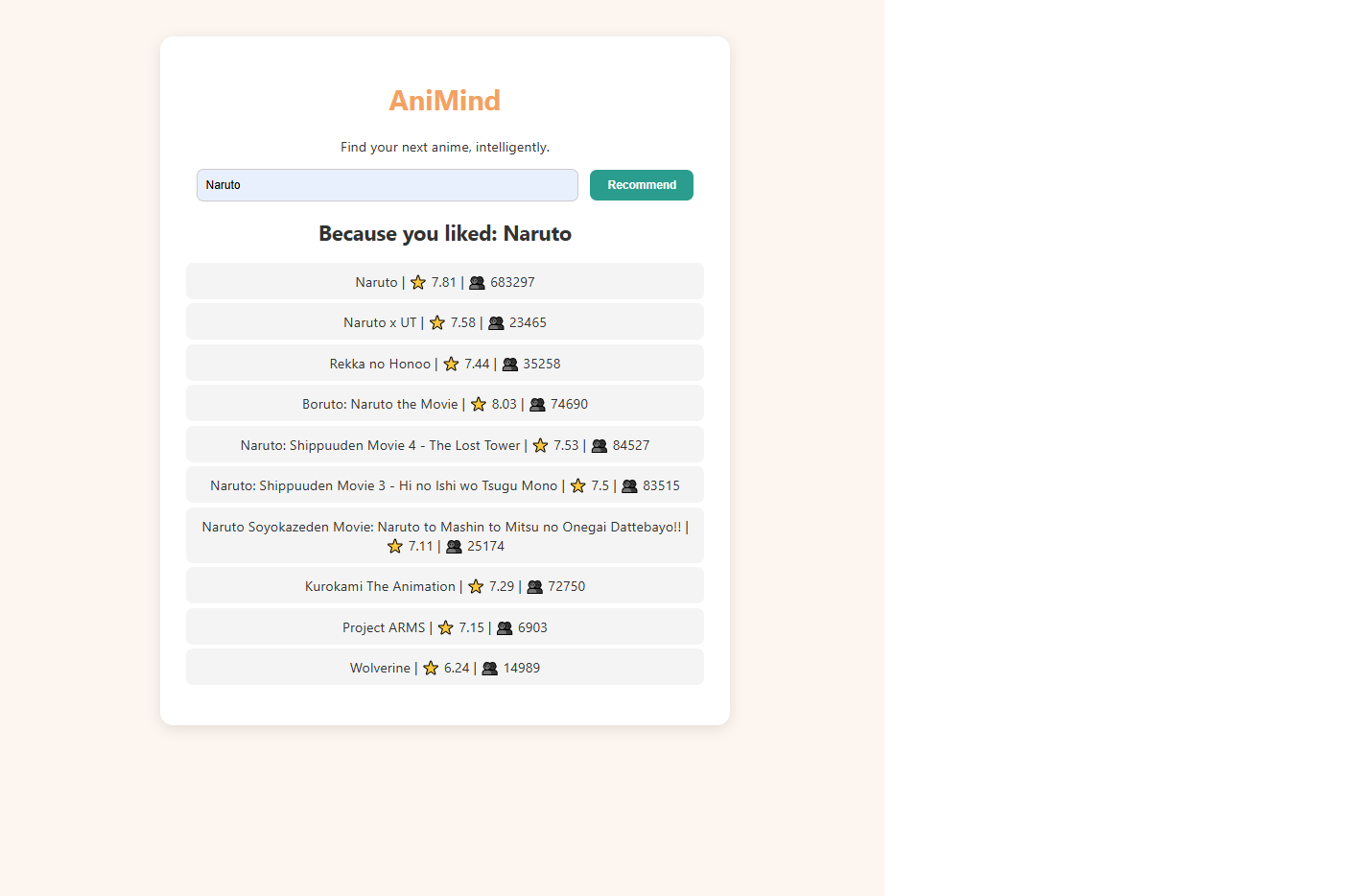
AniMind – Anime Recommendation System
Find your next anime, intelligently.
📌 Inspiration
Choosing what to watch next is overwhelming. There are thousands of anime, and scrolling endlessly wastes time and energy. I wanted to create a tool that understands your anime taste and automatically recommends similar anime.
Watching platforms like Netflix, YouTube, and Spotify use recommendation systems to guide users. I thought:
Can I build a lightweight version specifically for anime that’s fast, accurate, and easy to use?
That curiosity led to AniMind.
🧠 What I Learned
Through this project, I gained hands-on experience in:
Data Science & Machine Learning: Using TF-IDF vectorization and cosine similarity to compare text data.
Web Development: Building a clean, responsive UI using Flask and CSS.
Handling Real-World Datasets: Cleaning and preprocessing a large anime dataset (~thousands of entries).
Project Deployment Concepts: Preparing for cloud deployment (Render / Railway).
Mathematically, the core of the recommendation engine uses cosine similarity:
similarity ( 𝐴 , 𝐵
)
𝐴 ⋅ 𝐵 ∥ 𝐴 ∥ ∥ 𝐵 ∥ similarity(A,B)= ∥A∥∥B∥ A⋅B
This calculates the angle between vectors representing anime content, helping the system find similar anime efficiently.
🏗️ How I Built It
Dataset Preparation I used a MyAnimeList dataset with fields like name, genre, type, rating, and members. Empty fields were cleaned and preprocessed.
Feature Engineering Combined important text features into a single column:
tags = genre + " " + type
Vectorization Converted textual features into numerical vectors using TF-IDF, which weighs important keywords higher.
Similarity Calculation Calculated cosine similarity across all anime vectors. This allows the system to find the most similar anime to a user’s choice.
Web App Integration
Built a Flask web app for a clean, professional interface.
Users can type an anime name and get Top 10 recommendations instantly.
Added soft colors and professional styling for user experience.
⚔️ Challenges I Faced
Performance: Calculating similarity for thousands of anime can be slow. Learned to save precomputed matrices for faster queries.
Data Cleaning: Some anime entries were missing genres or types, so preprocessing was crucial.
Math Understanding: TF-IDF and cosine similarity were tricky at first, but implementing them clarified the concepts.
UI Design: Making a simple, professional, soft-colored interface that works on both desktop and mobile.
🚀 Future Scope
Add anime posters and synopsis from MyAnimeList API.
Filter recommendations by rating, type (TV/Movie), episodes, or popularity.
Add user login and watch history for personalized recommendations.
Deploy as a cloud-based web app, accessible worldwide.
Upgrade to a hybrid recommendation system combining content + user behavior for smarter predictions.
🏁 Conclusion
AniMind combines data science, machine learning, and web development into a single project. It’s not just a demo—it’s a practical, scalable recommendation system designed to help anime fans discover their next favorite series quickly.
With AniMind, choosing your next anime is no longer guesswork—it’s intelligent, fast, and fun.
