-
-
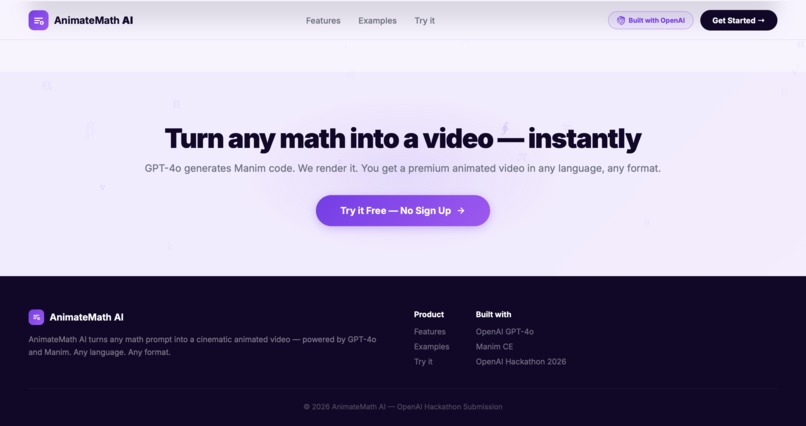
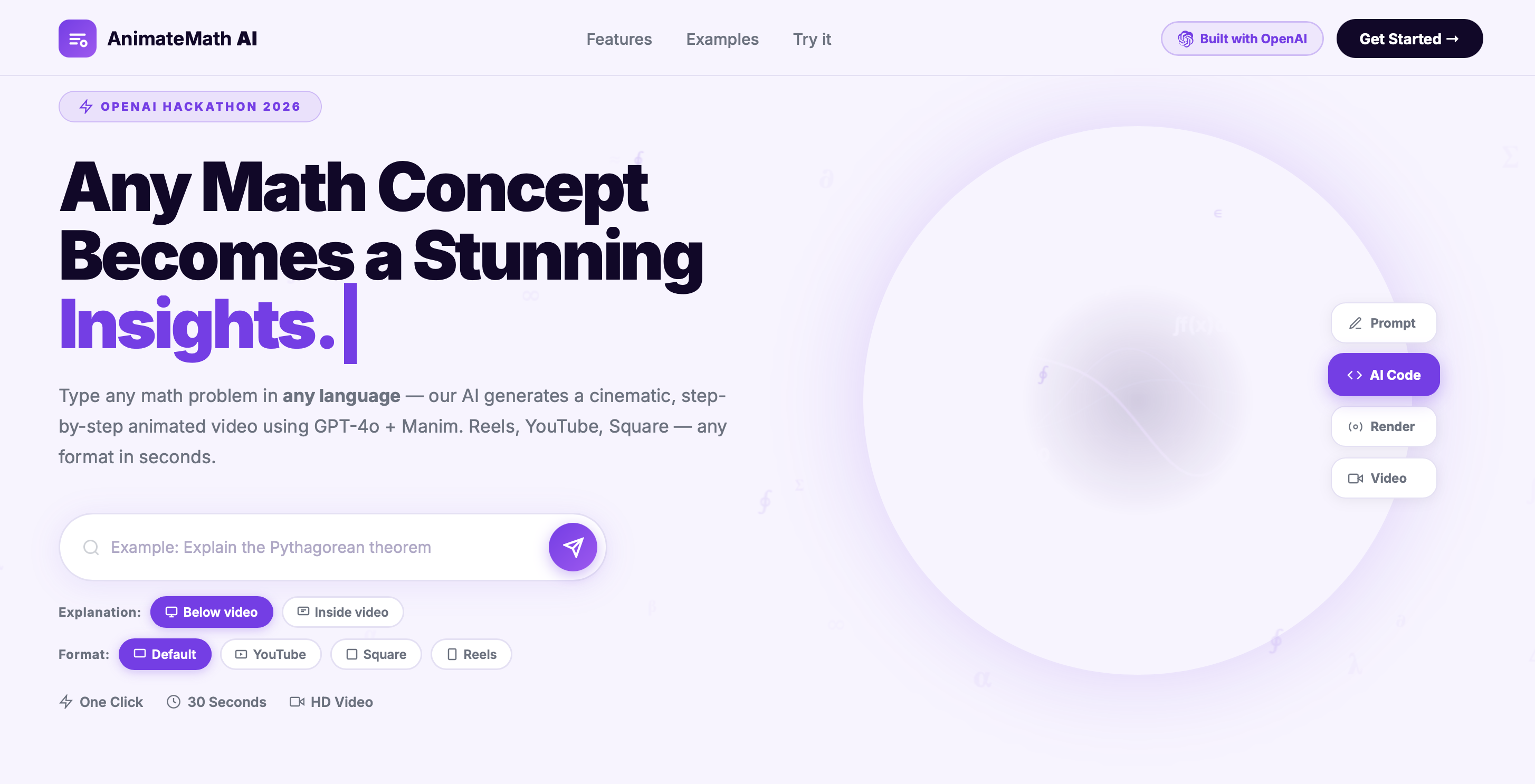
Any math concept becomes a stunning animation instantly
-
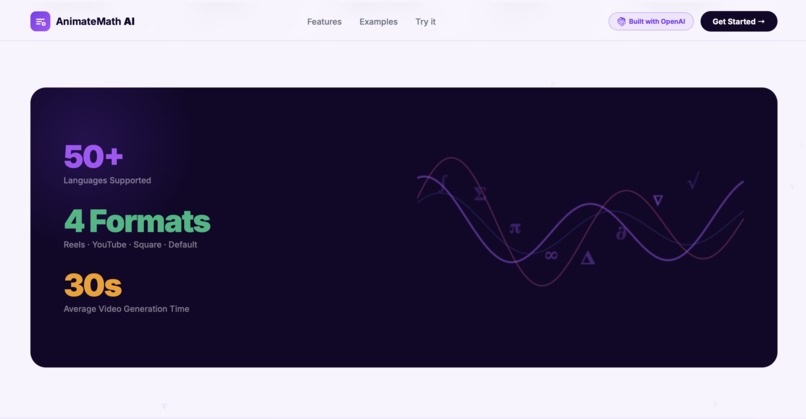
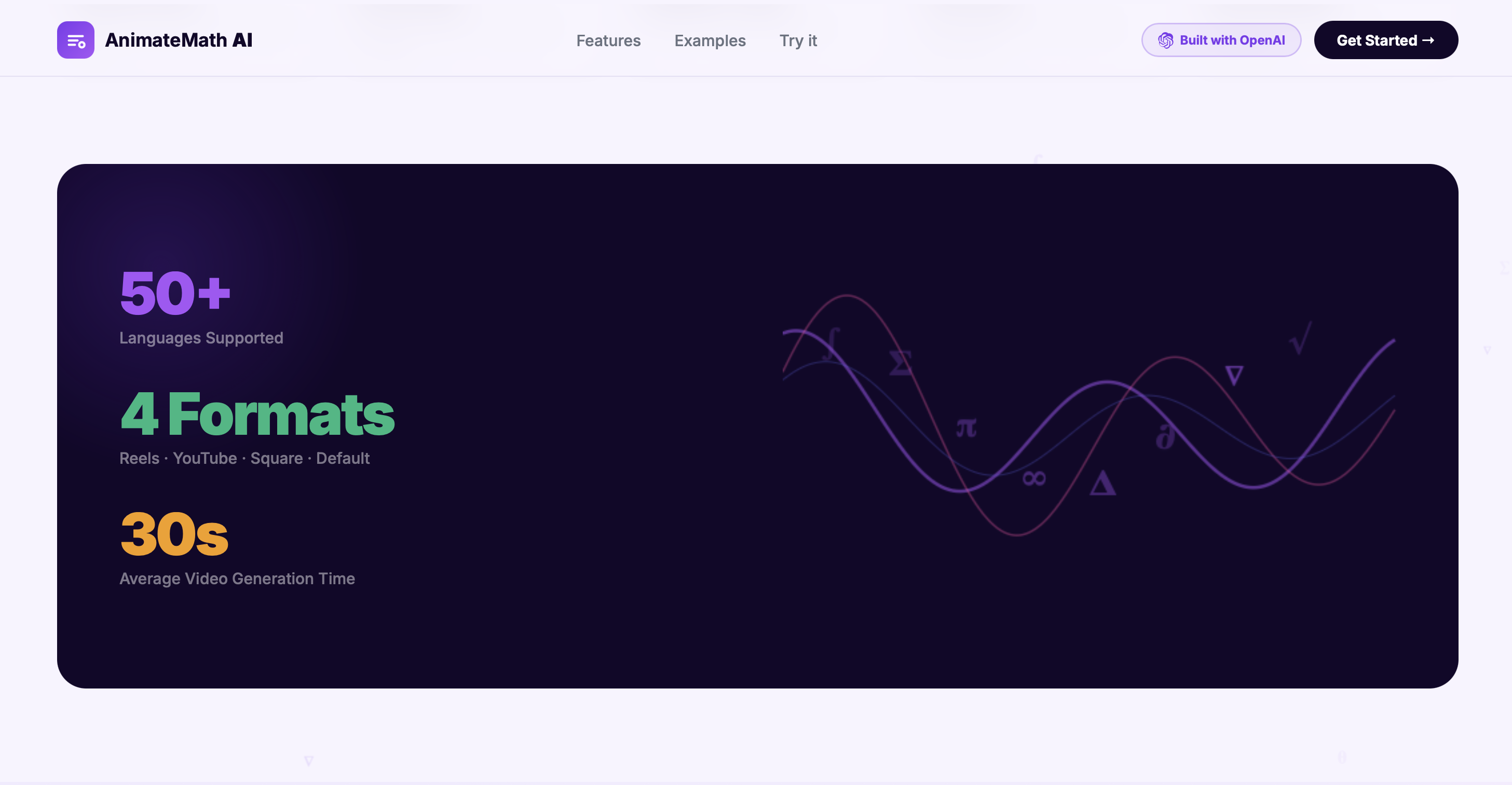
Supports 50+ math topics, 4 formats, renders in 30 seconds
-
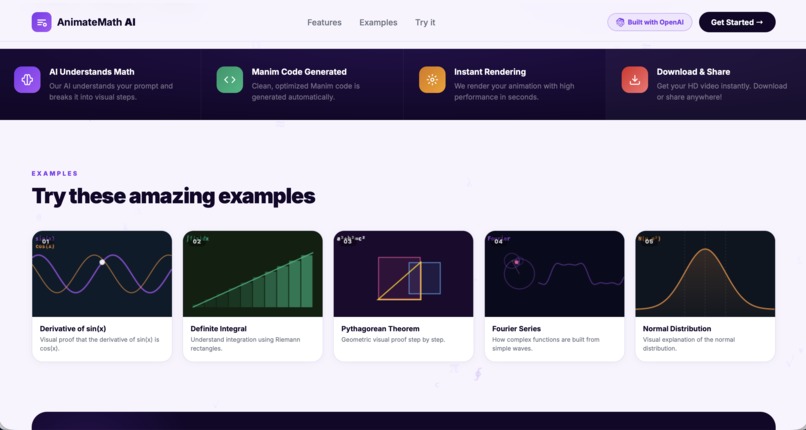
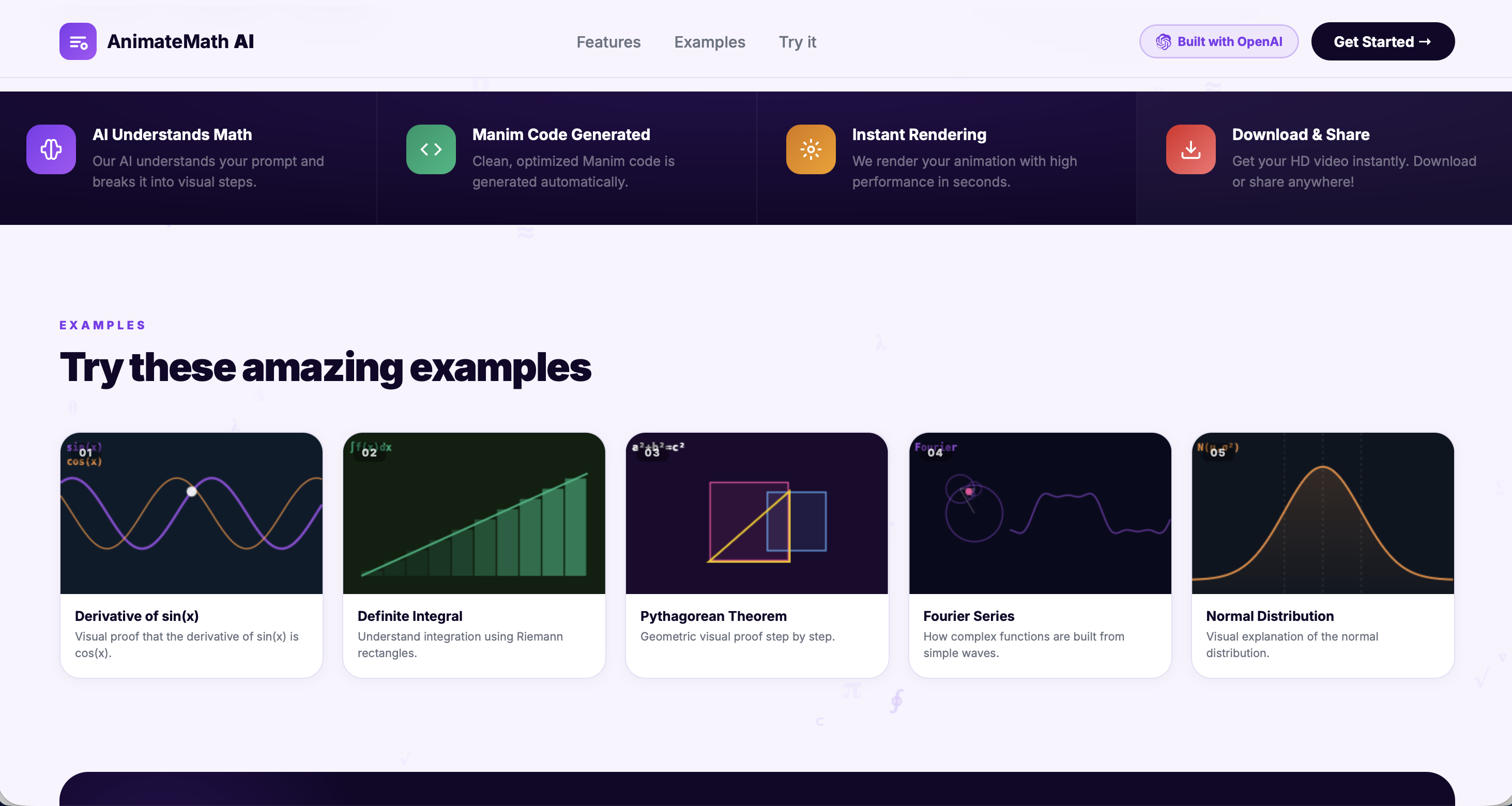
Try these amazing examples — sine, Pythagorean theorem, matrices
-
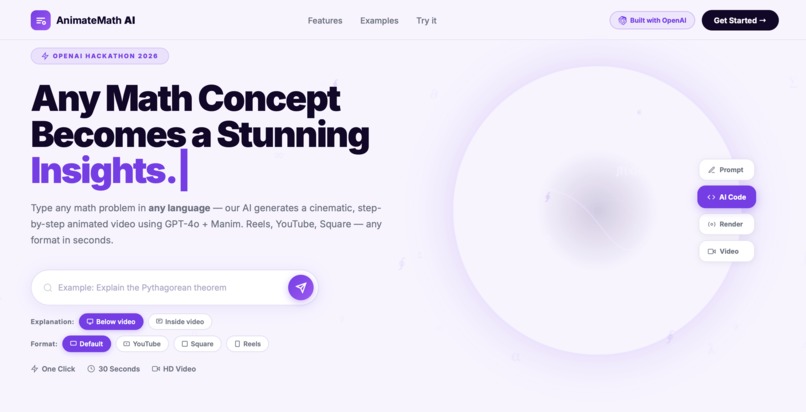
AnimateMath AI - Homepage
Inspiration
Although I never studied computer science, six months ago I decided to teach myself programming with AI. Everything started with mathematical animations. I discovered beautiful Manim videos on social media and wanted to create similar content for my sister’s educational business. But I quickly realized that this type of content was almost nonexistent in Kazakhstan, especially in the Kazakh language. For nearly two months, ChatGPT became my mentor. It helped me learn Python, LaTeX, and Manim by explaining concepts, fixing bugs, and writing code with me. Those first animations became the beginning of my programming journey. When I shared them online, many people asked, “How did you make this?” That’s when I realized how difficult the process really was—even with AI, creating a single animation required coding knowledge. So I asked myself: What if anyone could create beautiful math animations without learning Manim or programming? That idea became AnimateMath AI.
What it does
AnimateMath AI transforms a simple text prompt into a complete mathematical animation.
Users describe any math concept in natural language—for example, “Explain the Pythagorean Theorem”—and AI automatically:
- Generates Manim code
- Explains the concept step by step
- Renders the animation in the cloud
- Returns a ready-to-use MP4 video in seconds
No coding. No Manim. No LaTeX.
How we built it
- GPT-4o generates Manim code and educational explanations.
- A Python backend validates and safely executes the generated code.
- Manim renders the mathematical animation.
- Videos are processed in the cloud and returned through a modern web interface built with HTML, CSS, and JavaScript.
Challenges we ran into
Generating reliable Manim code wasn’t the hardest part—making it consistently render was.
We had to handle AI-generated code errors, LaTeX compilation issues, rendering failures, and prompts that produced visually incorrect animations. We also focused on making animations educational, not just visually appealing.
Accomplishments that we’re proud of
- Built an end-to-end pipeline from natural language to animated math videos.
- Reduced a process that normally takes hours of coding to just a few seconds.
- Created a tool that makes advanced mathematical visualization accessible to teachers, students, and content creators with no programming experience.
- Turned my own learning experience into a product that can help thousands of others.
What we learned
We learned that AI can do much more than generate code—it can make specialized creative tools accessible to everyone.
We also learned that the biggest barrier isn’t understanding mathematics; it’s the technical complexity of tools like Manim. Removing that barrier unlocks creativity for many more people.
What’s next for AnimateMath AI
We’re planning to expand AnimateMath AI beyond text-to-animation by adding:
- Voice narration in multiple languages
- Interactive animations instead of only videos
- Support for diagrams, geometry, and physics
- Classroom features for teachers
- One-click export for YouTube Shorts, TikTok, and presentations
Our vision is to become the easiest way for anyone in the world to turn mathematical ideas into beautiful educational animations.
Note: We attempted GPT-5.6 integration, but it exceeded memory limits on our free hosting tier. Currently using GPT-4o (OpenAI). If selected as a winner, upgrading to GPT-5.6 is the immediate next step.
Built With
- css
- express.js
- ffmpeg
- html
- javascript
- manim
- node.js
- openai-gpt-4o

Log in or sign up for Devpost to join the conversation.