-
-
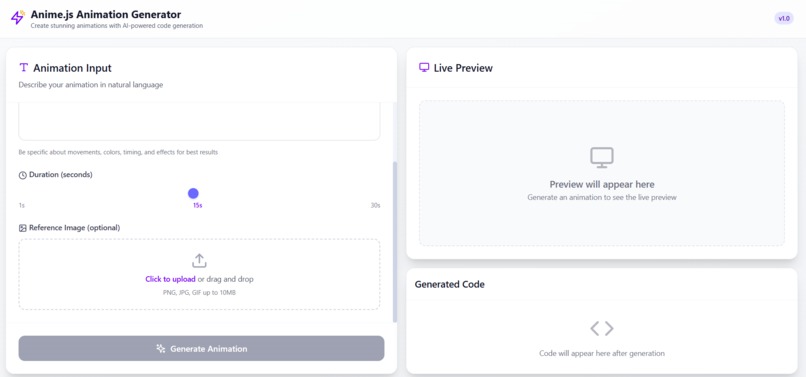
Homepage

Inspiration
We were inspired by the gap between creative vision and technical implementation in web animation. Designers and developers often struggle to translate animation ideas into code, spending hours writing complex Anime.js syntax. We wanted to democratize animation creation by making it as simple as describing what you want to see.
What it does
AnimateGPT transforms natural language descriptions into production-ready Anime.js animations. Users simply describe their vision - "a bouncing ball that changes color" or "text that slides in with a elastic effect" - and our AI generates clean HTML, CSS, and JavaScript code. The tool provides real-time preview, code export, and downloadable packages, making professional animation accessible to everyone.
How we built it
We built AnimateGPT using React and TypeScript for the frontend, with Tailwind CSS for styling. The core AI integration uses Google's Gemini API to process natural language and generate structured animation code. We implemented a sophisticated preview system that safely executes generated code in an isolated environment, and added features like code syntax highlighting, ZIP export, and responsive design.
Challenges we ran into
The biggest challenge was safely executing user-generated JavaScript code in the browser without security risks. We solved this by creating an isolated execution environment with scoped selectors and contained animations. Another challenge was ensuring the AI consistently generates valid, well-structured Anime.js code that follows best practices and modern syntax.
Accomplishments that we're proud of
We're proud of creating a tool that genuinely bridges the gap between creativity and code. The real-time preview system works flawlessly, the AI generates high-quality animations consistently, and the user experience is intuitive enough for non-developers while powerful enough for professionals. The code export feature produces production-ready files that developers can immediately integrate into their projects.
What we learned
We learned the importance of prompt engineering for consistent AI output, the complexities of safely executing dynamic code in web applications, and how to design interfaces that serve both technical and non-technical users. We also gained deep insights into animation principles and how to translate creative concepts into structured code.
What's next for AnimateGPT
We plan to add support for more animation libraries (GSAP, Framer Motion), implement collaborative features for teams, add animation templates and presets, integrate with popular design tools like Figma, and develop a plugin ecosystem. We're also exploring advanced AI features like animation optimization suggestions and automatic responsive breakpoint generation.
Built With
- anime.js
- api
- css3
- eslint
- filesaver.js
- gemini
- html5
- javascript
- jszip
- lucide
- node.js
- postcss
- prism.js
- react
- tailwind
- typescript
- vite


Log in or sign up for Devpost to join the conversation.