-
Animal Crossing: Wildlife Protection Tracker
Inspiration
After walking around my neighborhood, I came across a squirrel that had been run over by a car. In subsequent weeks, I would see rabbits and squirrels on the road that had been killed by traffic. This experience raised my awareness of the animals that live in urban areas that often face injuries or death because of dangerous traffic. This was the reason I wanted to start this project, in an effort to conserve, protect, and raise awareness of urban wildlife.
What it does
Using a custom-trained model, the model detects and outputs audio informing the driver of the presence and position of the animal. Using the bounding box to calculate the position, the driver may get a warning of the animal being on the right or left. In addition, the model focuses on animals that are common in urban wildlife. Species including squirrels, turkeys, raccoons, and cottontail rabbits are the animals that could be detected by this device. The device also utilizes a VL53L1X LiDAR sensor to alert users of how far away a detected object, or animal in this case, is.
How we built it
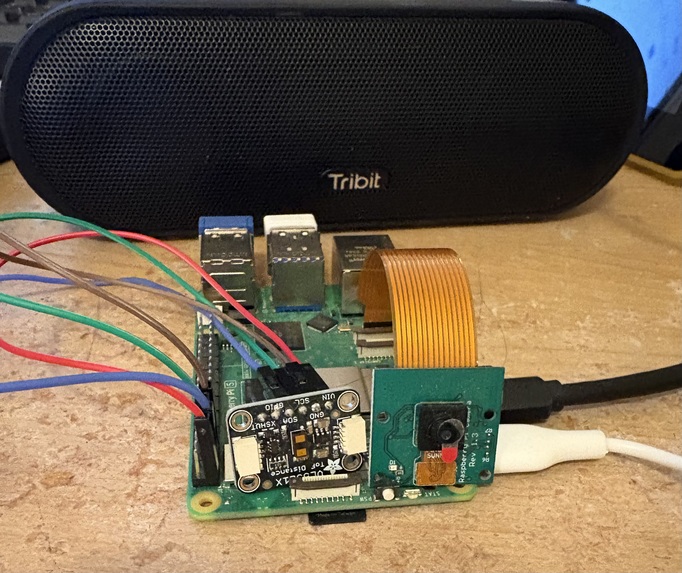
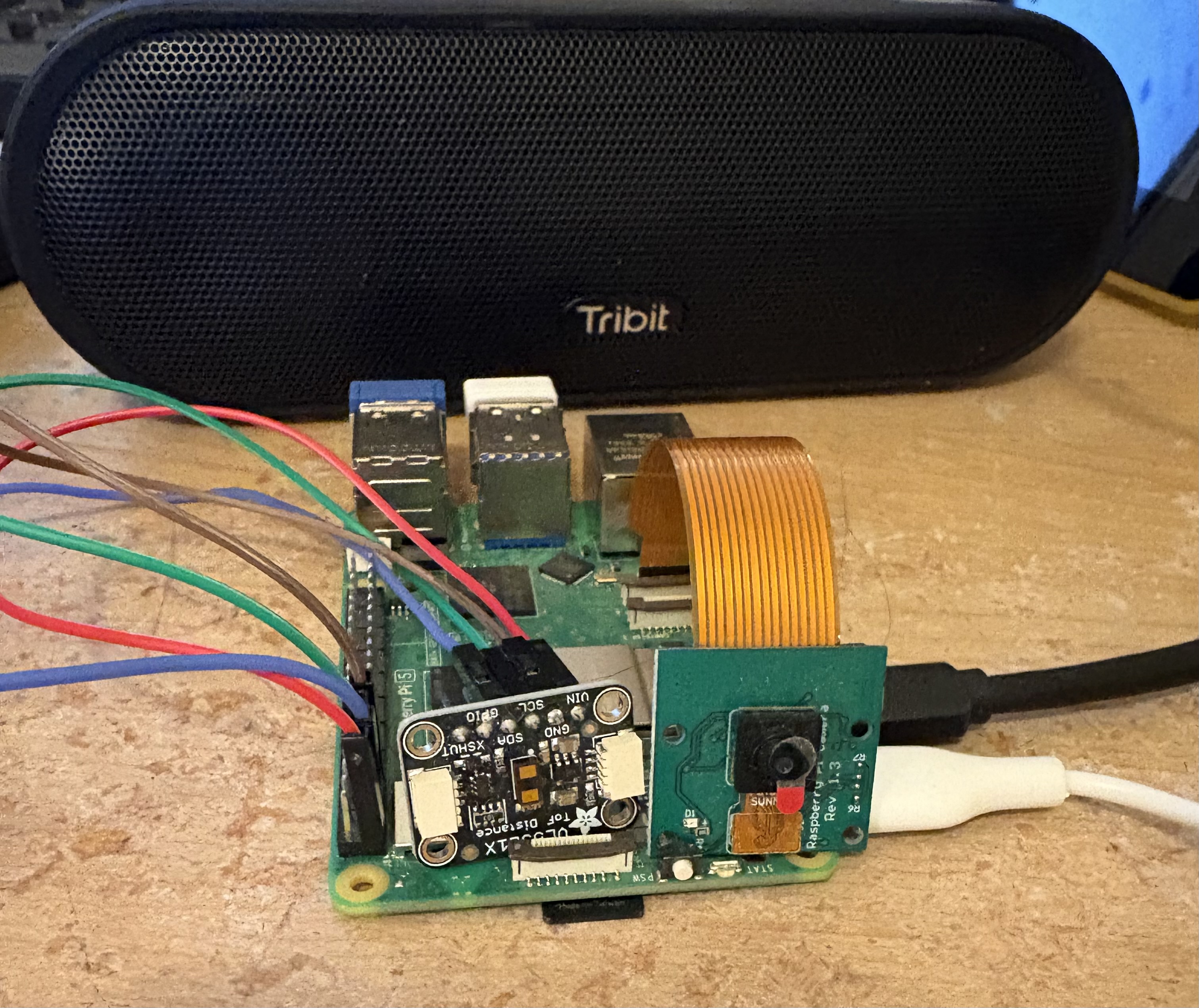
The components that were included in this project are a ribbon cable camera, a Raspberry Pi 5, a VL53L1X LiDAR sensor, and a Bluetooth speaker. The ribbon cable camera is used to capture images run through the YOLO model to detect the animals. Using Label Studio, 100 images were selected and manually labeled for each animal to include in the training of the model. Then, these images were used to train and test the model, which is deployed in the code.
Challenges we ran into
Some challenges I ran into include the installation of Anaconda. In order to run Label Studio, a terminal or an IDE was necessary. However, due to a lack of storage, I was not able to download this application. Instead, however, I was able to find an alternative, which was to use my PC’s terminal. In addition, it was difficult to find valid and varied photos of the animals that would be good for training. I tried to collect as many photos of the animals on roads and images of them running as possible. However, due to the limited number of pictures I could find, many of them were forward-facing or close-up. Thus, I was not able to select a wider variety of images that would encapsulate the way animals would be tracked on the road.
Accomplishments that we're proud of
I am proud of learning how to custom train a computer vision model to fit the needs of a specific project. Using a step-by-step tutorial, I was able to collect photos, store them, label them, and train them to create a model. This was a new skill that I learned, and thus, I am proud of it.
What we learned
Through this project, a specific thing I learned was that when I am training my model, I must include multiple different pictures to capture the different positions in which an animal may be detected (front, side, behind, angle, etc.). In addition, I learned how to utilize a LiDAR and a camera simultaneously such that the frames were synchronized to match similar timestamps while running.
What's next for Animal Crossing: Wildlife Protection Tracker
Some of the next steps for this project include training my model on different animals that were not trained yet on this device. Some of these include opossums, beavers, woodchucks, mice, etc. In addition, sufficient testing is needed to verify that this device has fast enough processing to ensure that the alert is in time to avoid the animal at a certain speed.
Built With
- gtts
- opencv
- yolo


Log in or sign up for Devpost to join the conversation.