-
-
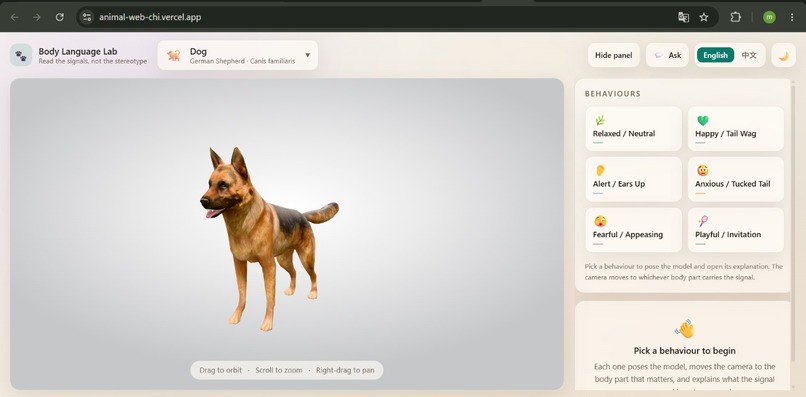
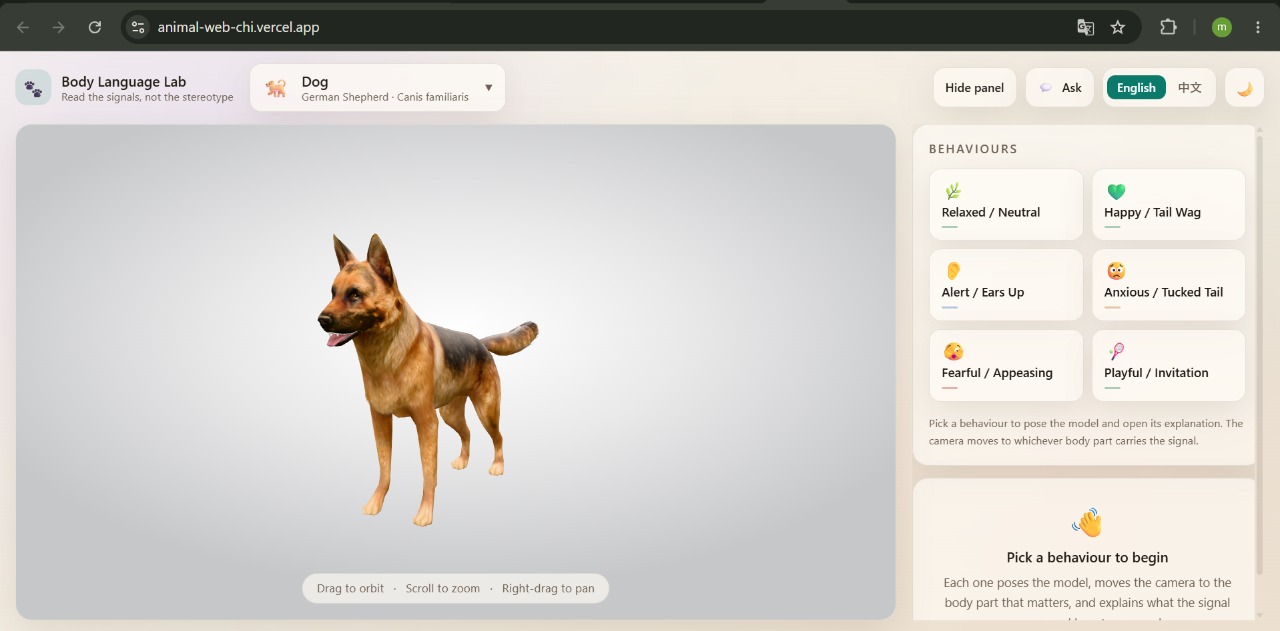
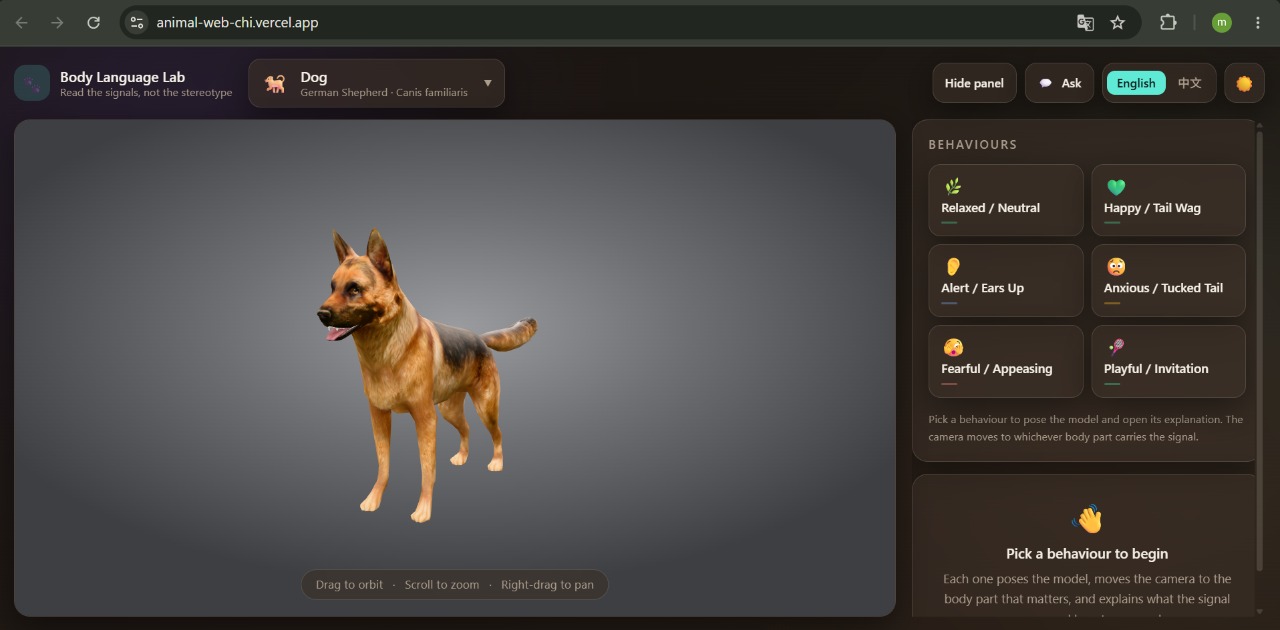
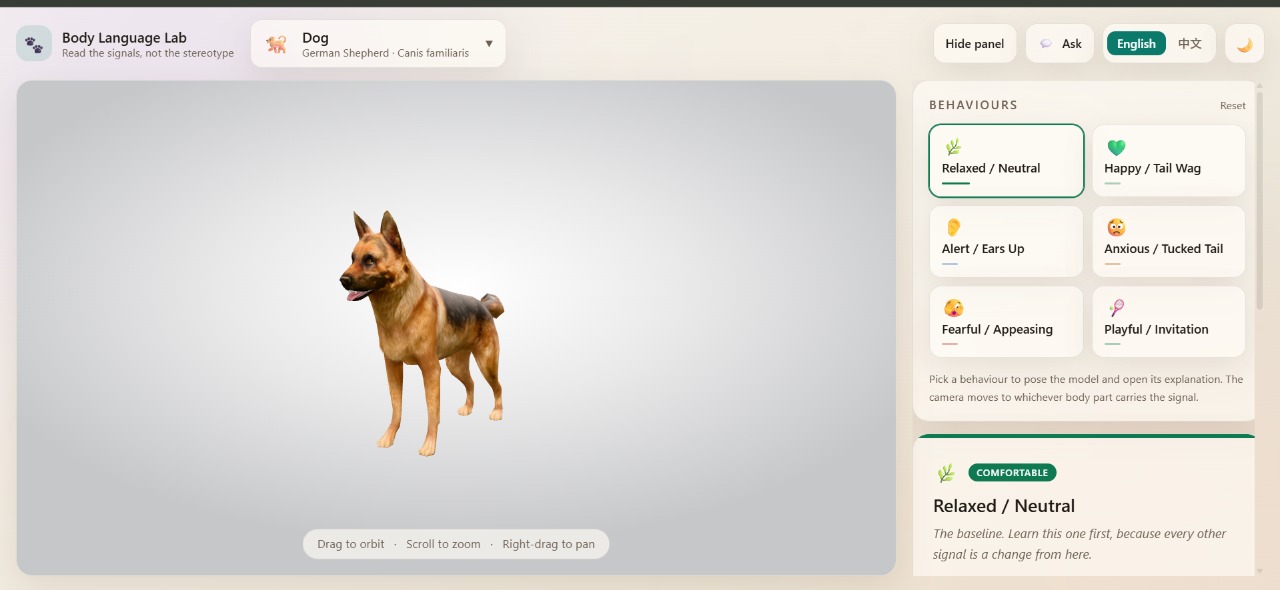
Interactive 3D Dog Model View
-
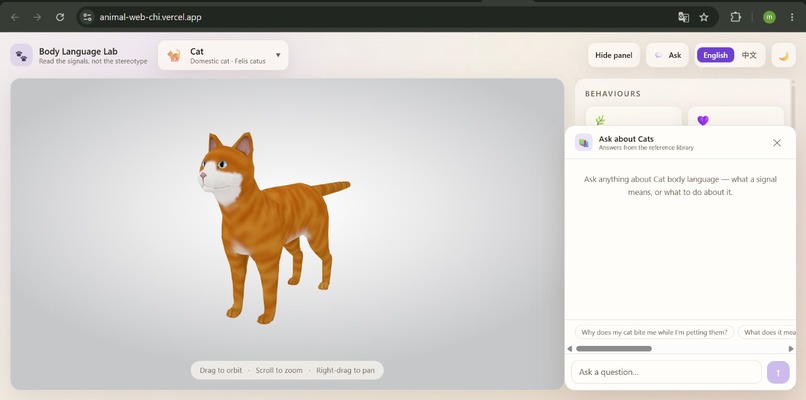
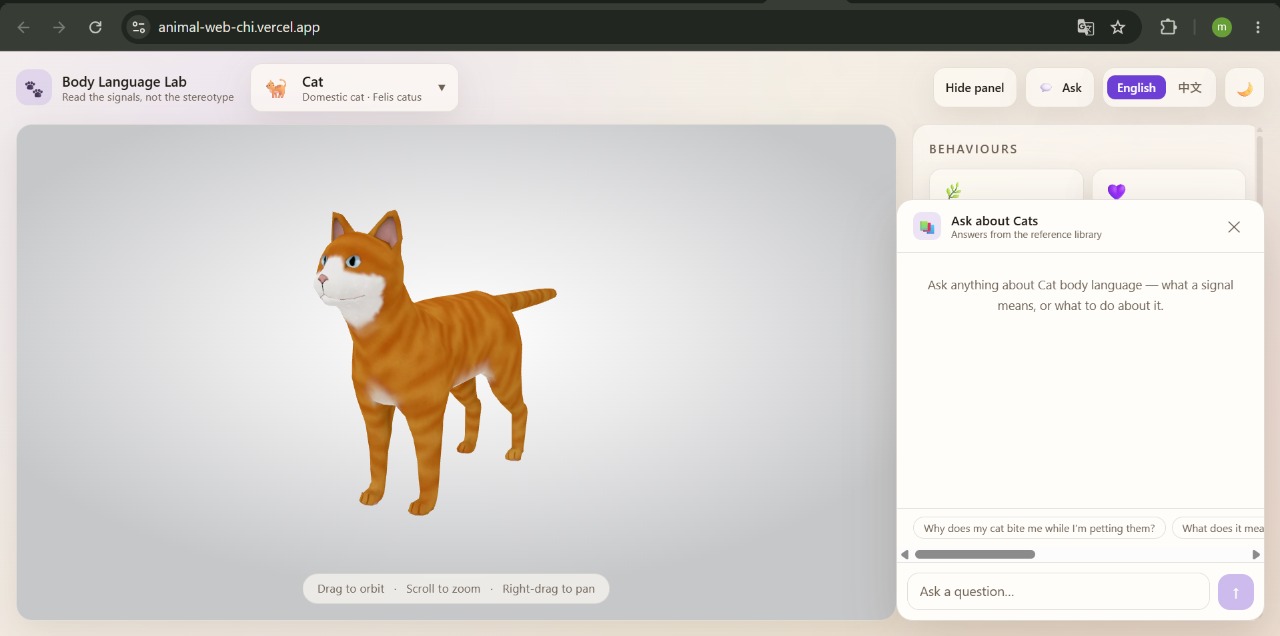
Interactive 3D Cat Model View
-
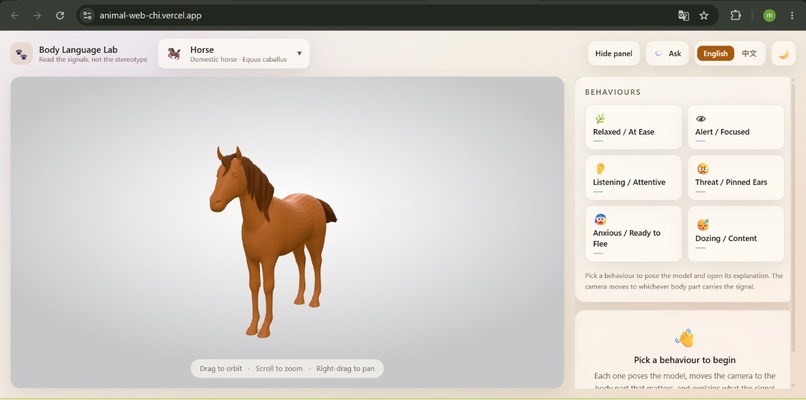
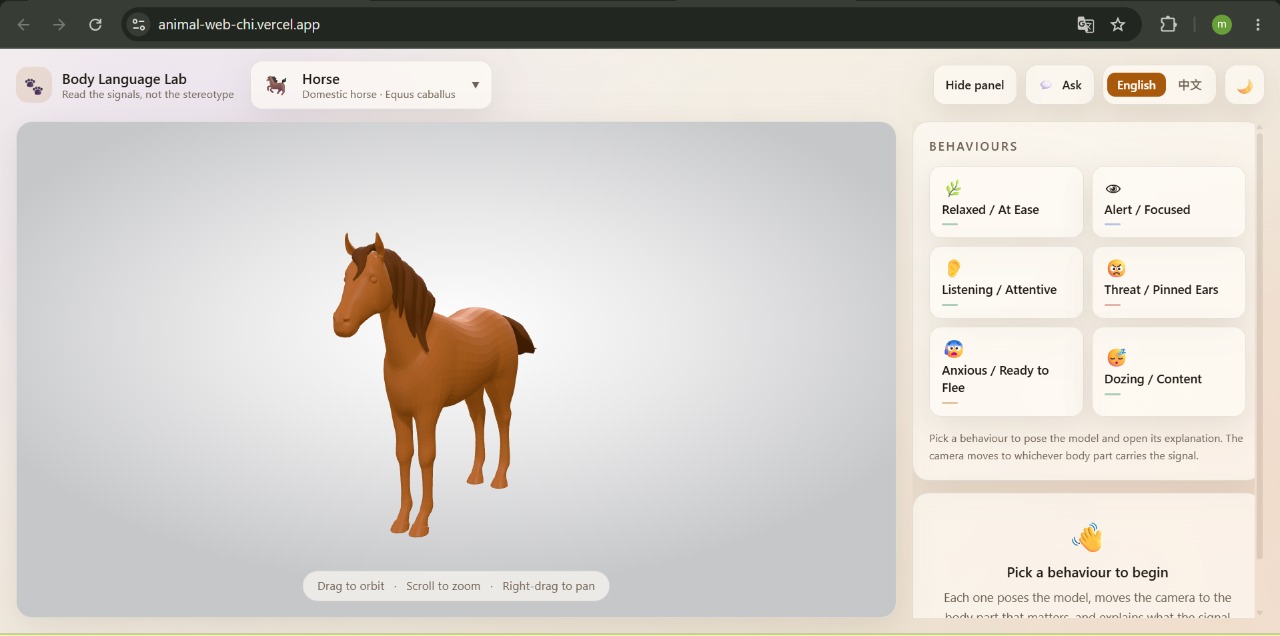
Interactive 3D Horse Model View
-
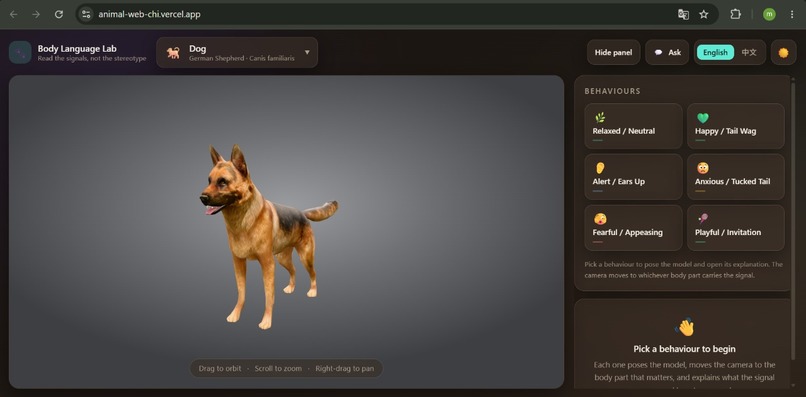
Dark Mode Interface
-
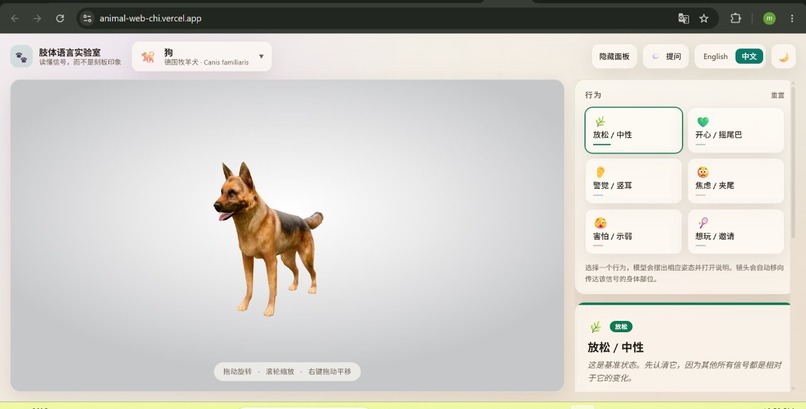
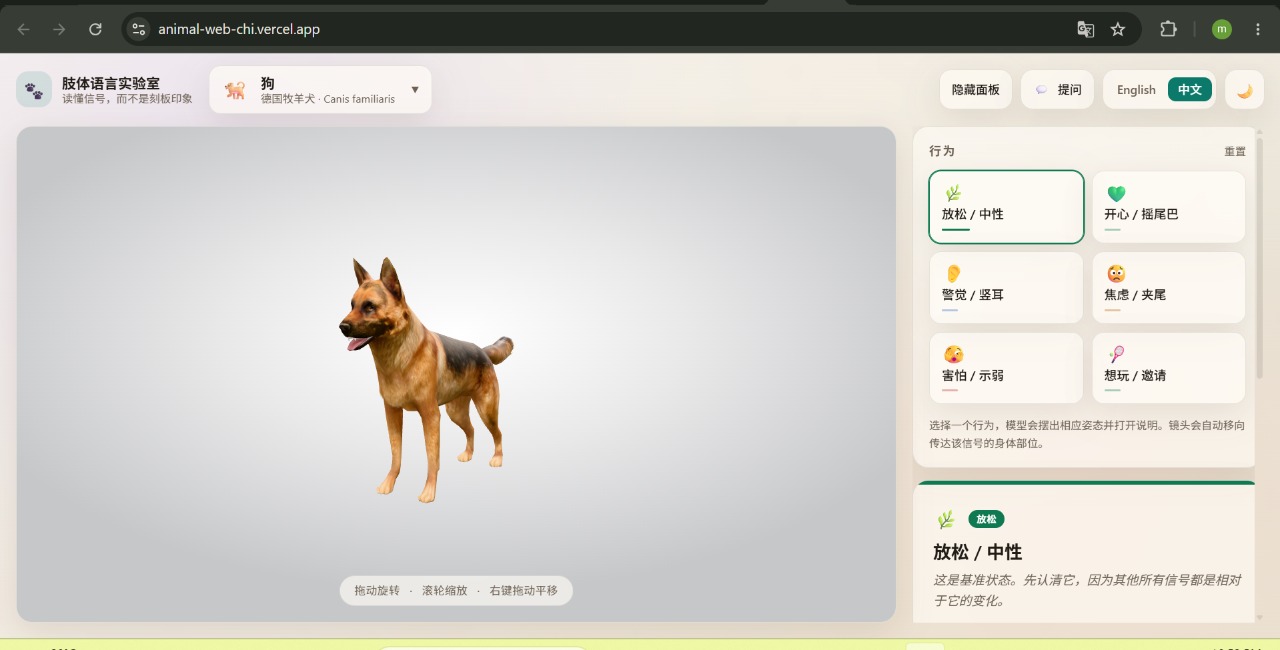
Bilingual Language Support (English / Chinese)
-
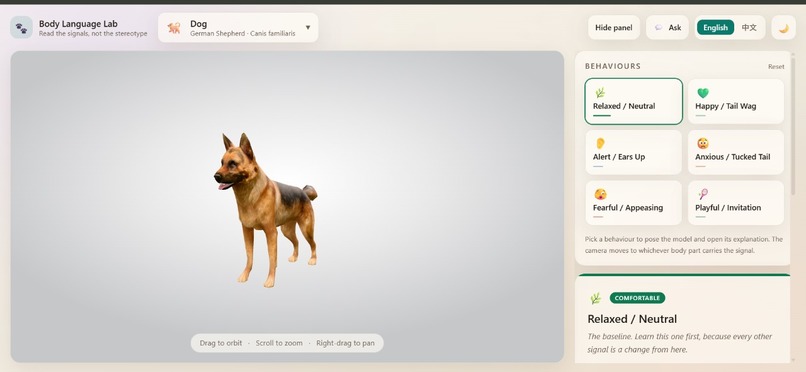
Real-time 3D Posing & Behavioral Explanation
-
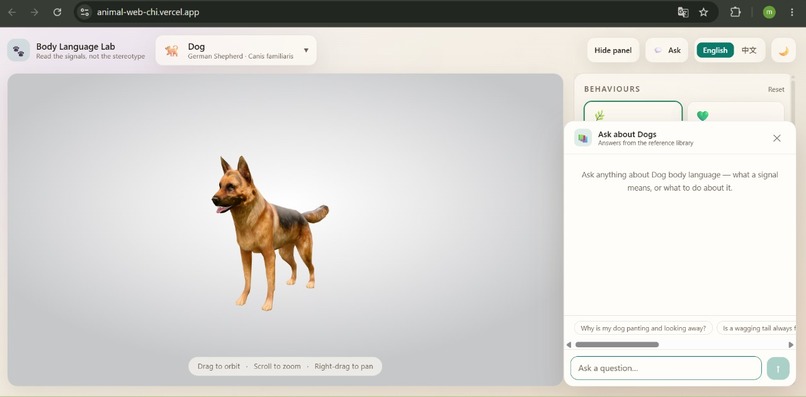
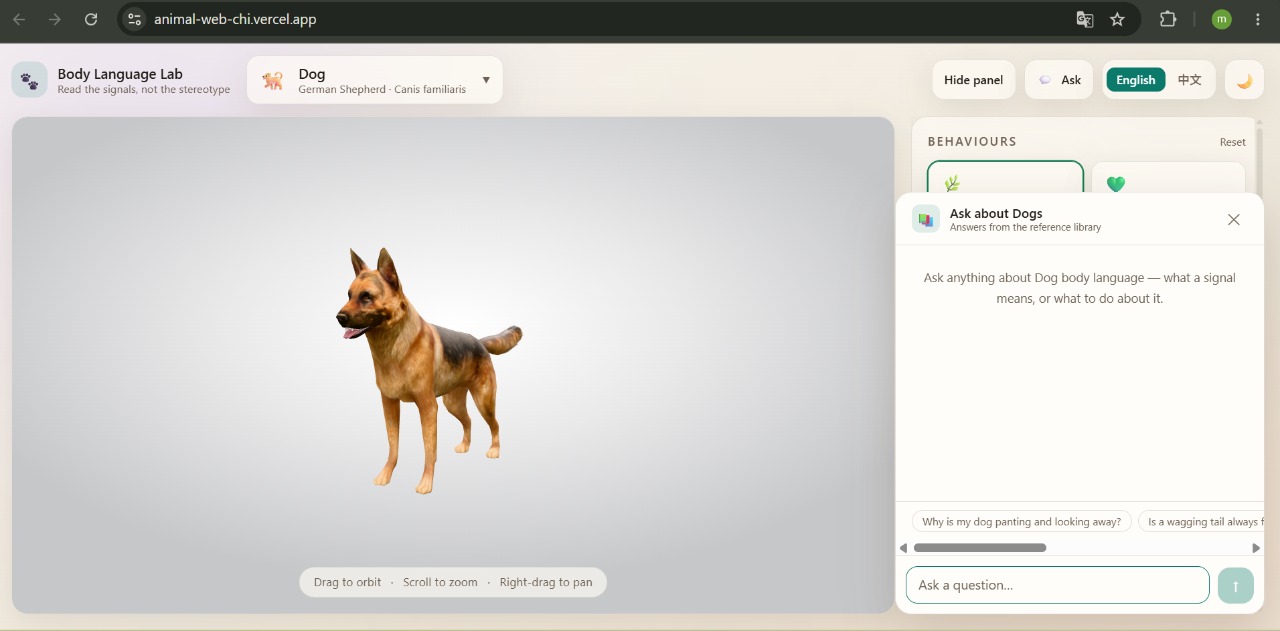
AI Behavioral Assistant
Inspiration
Many pet owners love their pets deeply, yet struggle to recognize subtle non-verbal signals like posture, ear, and tail changes that indicate early stress or illness. Traditional pet care resources rely on flat 2D photos that fail to capture real-world angles and spatial context. To bridge this gap, we built Animal Body Language Lab—an interactive 3D web platform where users can freely rotate and inspect 3D animal models alongside real-time behavioral guidance, empowering owners to spot early warning signs confidently and act quickly.
What it does
The Animal Body Language Lab provides a suite of interactive tools that transform behavioral education into a hands-on web experience. Users can freely rotate, zoom, and inspect detailed 3D pet models to examine subtle physical cues —such as ear alignment, spinal curvature, and tail positioning—from any angle. The platform features full English and Chinese localization, powered by a CJK-optimized search system capable of understanding colloquial pet expressions. Additionally, users can consult an integrated AI behavioral assistant for real-time explanations of specific pet actions, giving pet owners immediate, actionable insights to better care for their animals.
How we built it
Our platform was built with TypeScript, React, and Three.js, featuring custom 3D dog, cat and horse models optimized in Blender for fast browser loading. As non-expert coders tackling 3D web development for the first time, we relied on Claude AI as a core development partner—using AI-driven coding to assist with front-end logic, debug 3D scene mechanics, and power our live behavioral advice chat. To make the tool accessible globally, we added full English and Chinese language support and deployed the final application on Vercel.
Challenges we ran into
As first-time 3D developers, our main challenge was getting different system components to communicate with each other smoothly. We had to sync the 3D model viewport, the bilingual search engine, and the AI chat assistant so that when a user selected a specific animal behavior, the 3D scene, text explanations, and language toggles all updated instantly without breaking the UI state.
Accomplishments that we're proud of
Most online pet care guides rely entirely on flat, static images that leave pet owners guessing about real-world body language. We are proud of breaking past that barrier by creating an intuitive 3D web platform where users can rotate, inspect, and explore animal postures from every angle. Overcoming the steep learning curve of 3D web graphics to replace non-interactive pictures with real-time 3D models and paired with AI guidance is an achievement that directly impacts how well owners can recognize early warning signs in their pets.
What we learned
We learned a great deal about animal body language—from reading subtle ear adjustments to recognizing signs of discomfort long before obvious symptoms show. Technically, with the help of AI coding tools, we picked up the fundamentals of 3D web graphics, Blender model optimization, and TypeScript. This experience showed us how interactive 3D technology can turn flat, text-heavy guides into engaging, real-world educational tools.
What's next for Animal Body Language Lab
Looking ahead, our primary goal is to collaborate directly with licensed veterinarians to validate our behavioral models and explore integrating direct telehealth consultation features so pet owners can connect with professionals when warning signs are detected. We also plan to expand our 3D animal library beyond cats and horses to include hamsters, birds, and small exotic pets, giving a wider range of pet owners access to interactive body language tools. Finally, we will continue expanding the knowledge base for our AI behavioral engine , training it on deeper clinical datasets to provide even more accurate, species-specific guidance for pet care.
Built With
- 3d
- ai
- animal-behavior
- bilingual
- blender
- claude-ai
- education
- pet-care
- typescript
- vercel
- web-development

Log in or sign up for Devpost to join the conversation.