-
-
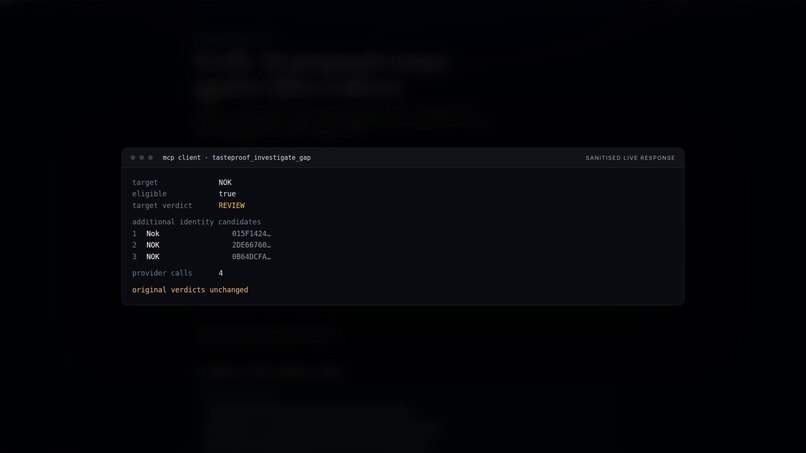
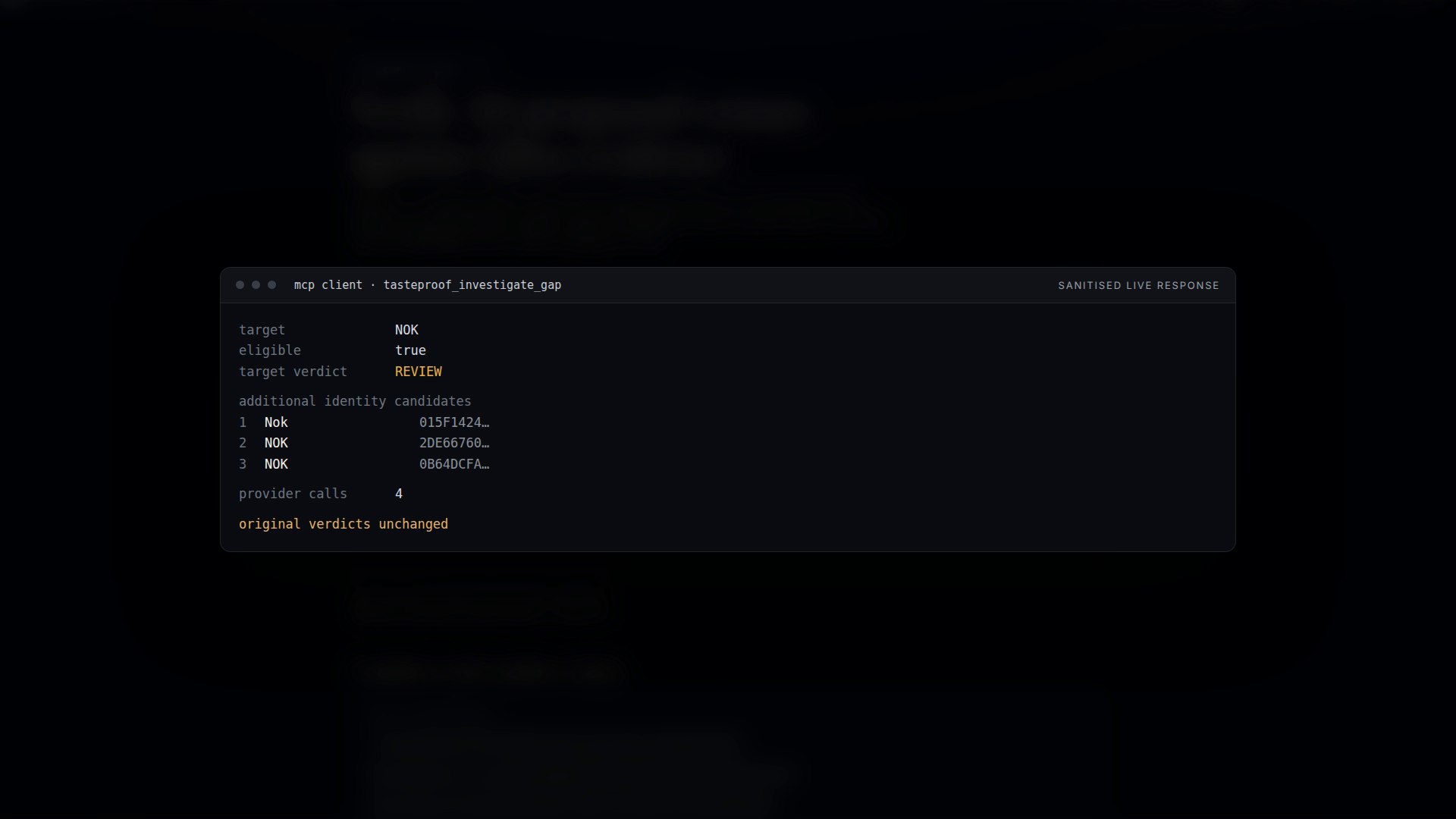
MCP investigation trace
-
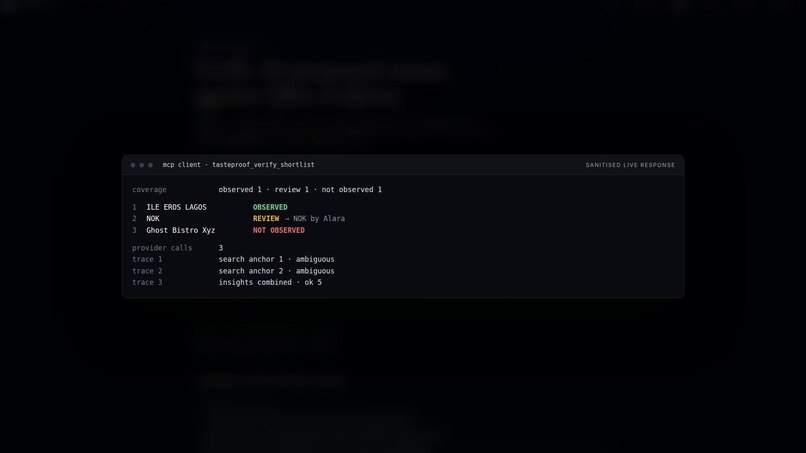
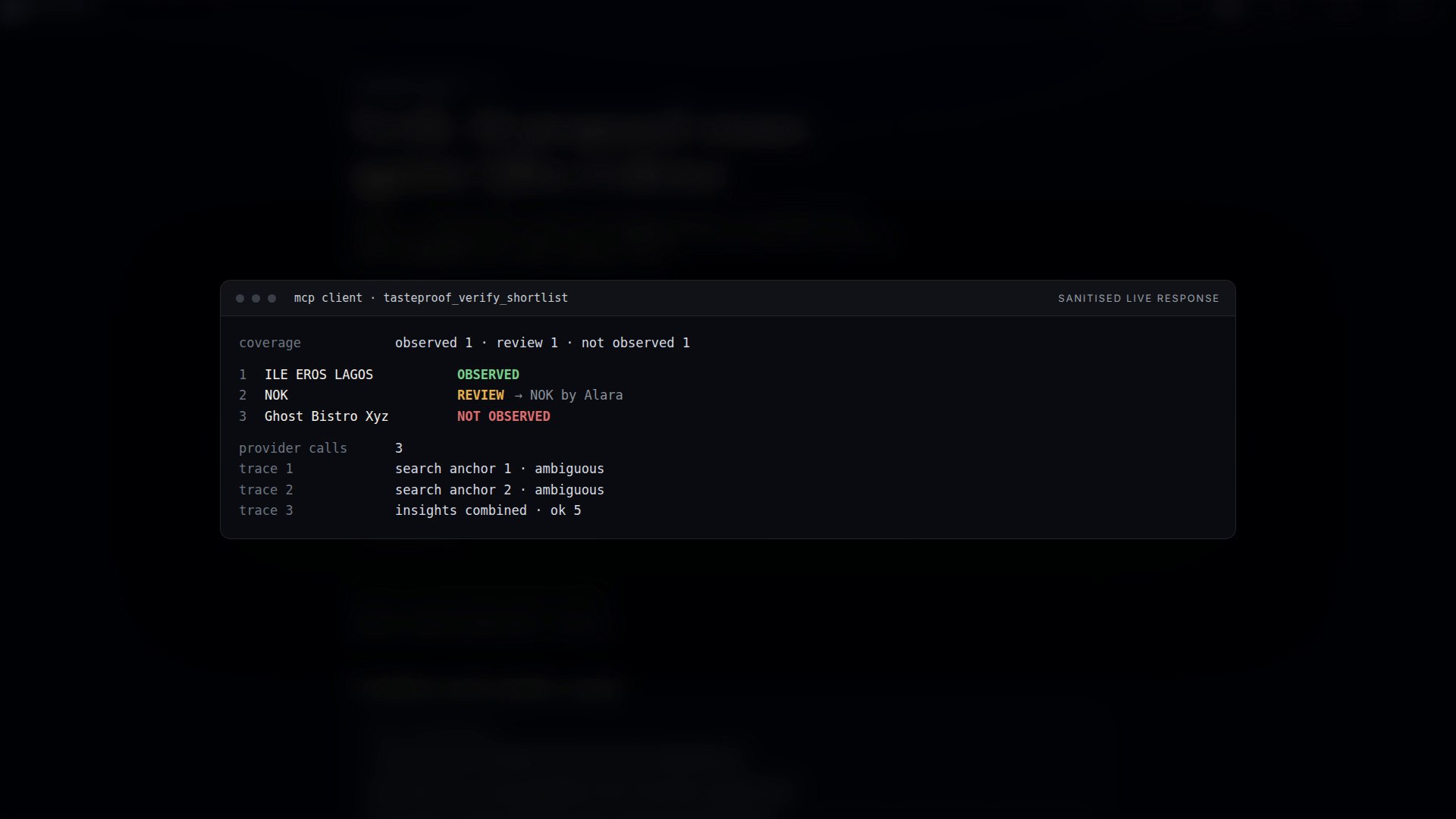
Sanitized MCP verification trace
-
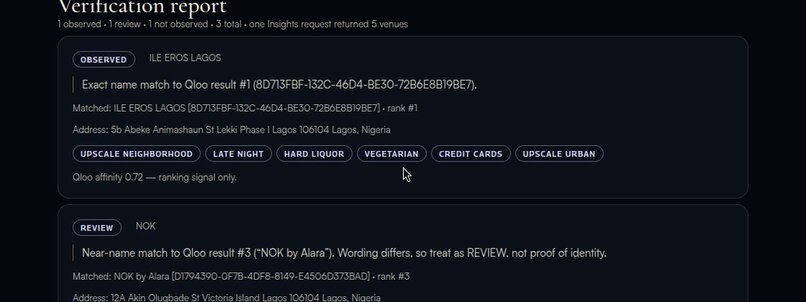
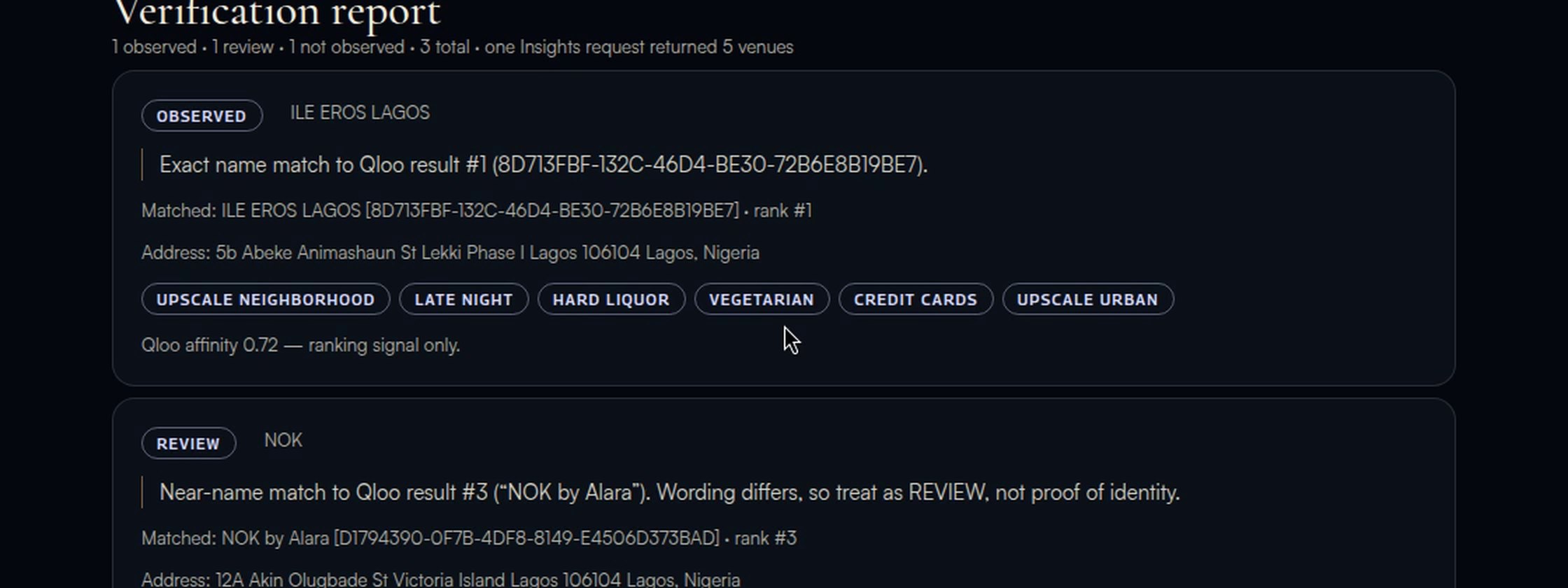
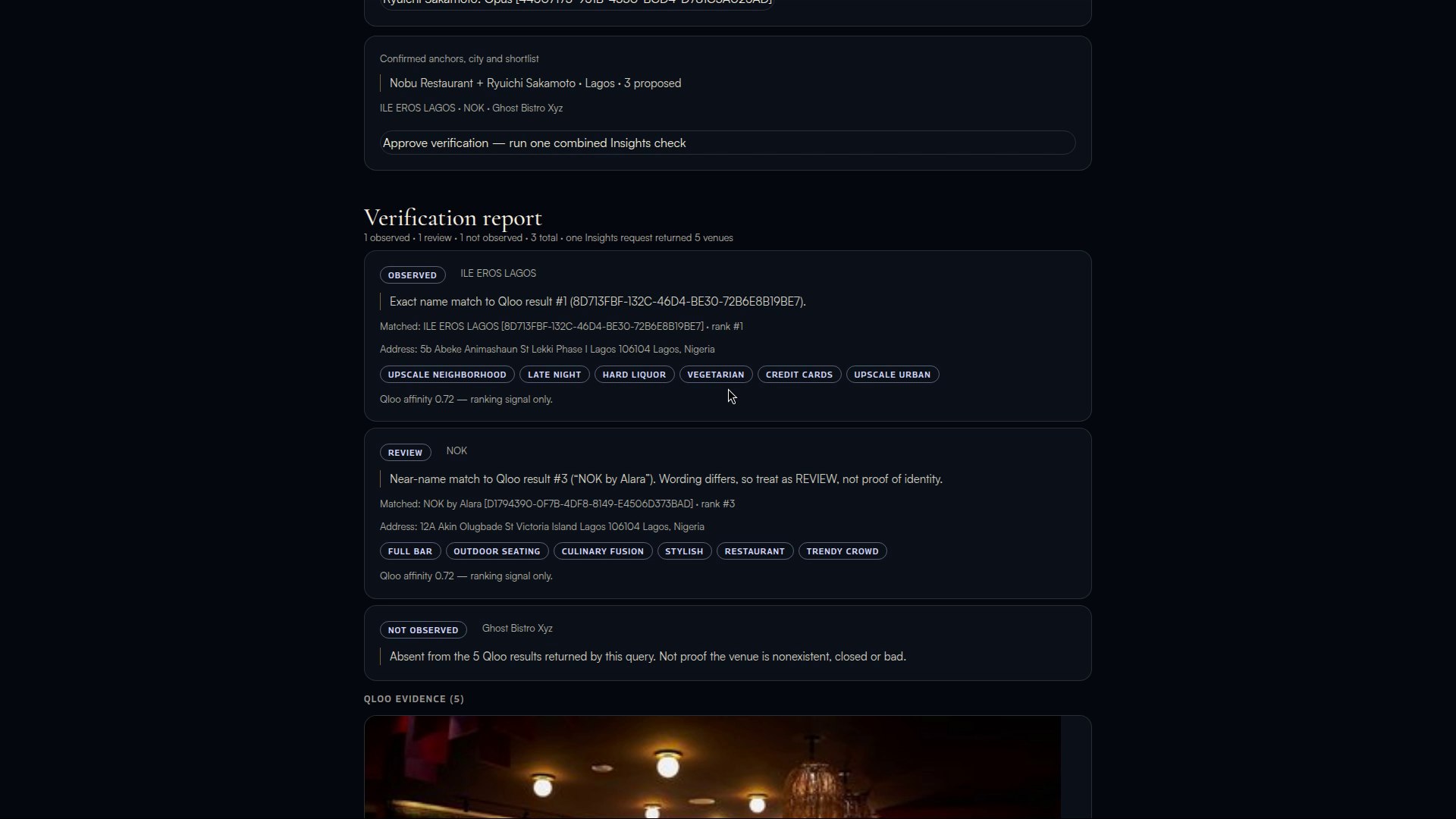
Qloo-verification report
-
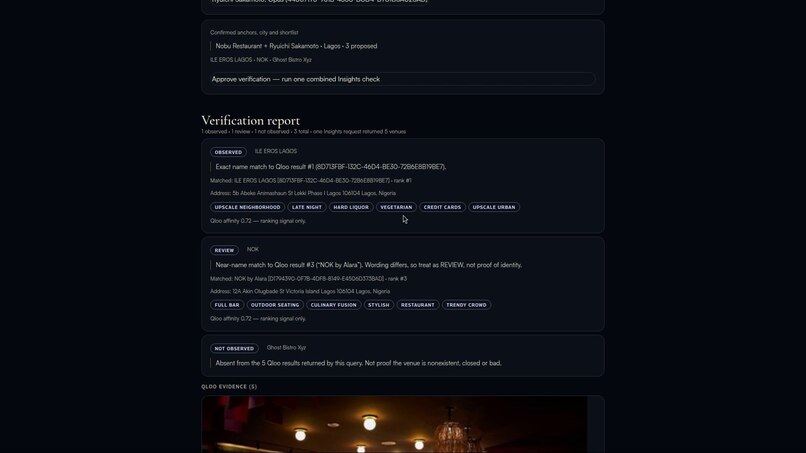
Qloo-supported evidence panel
-
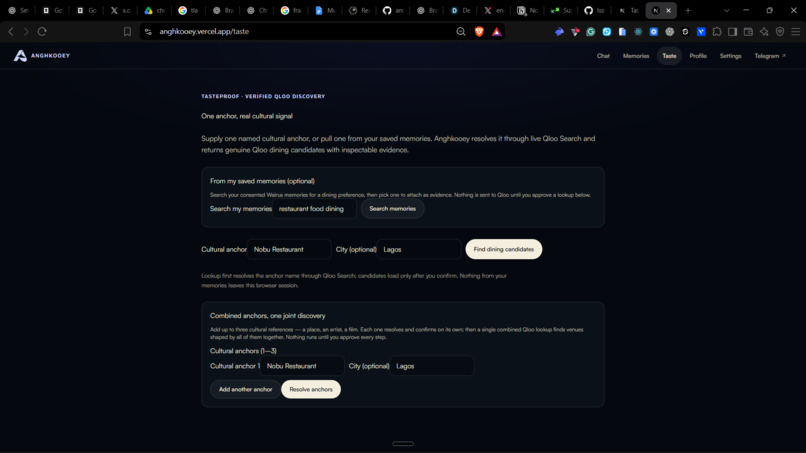
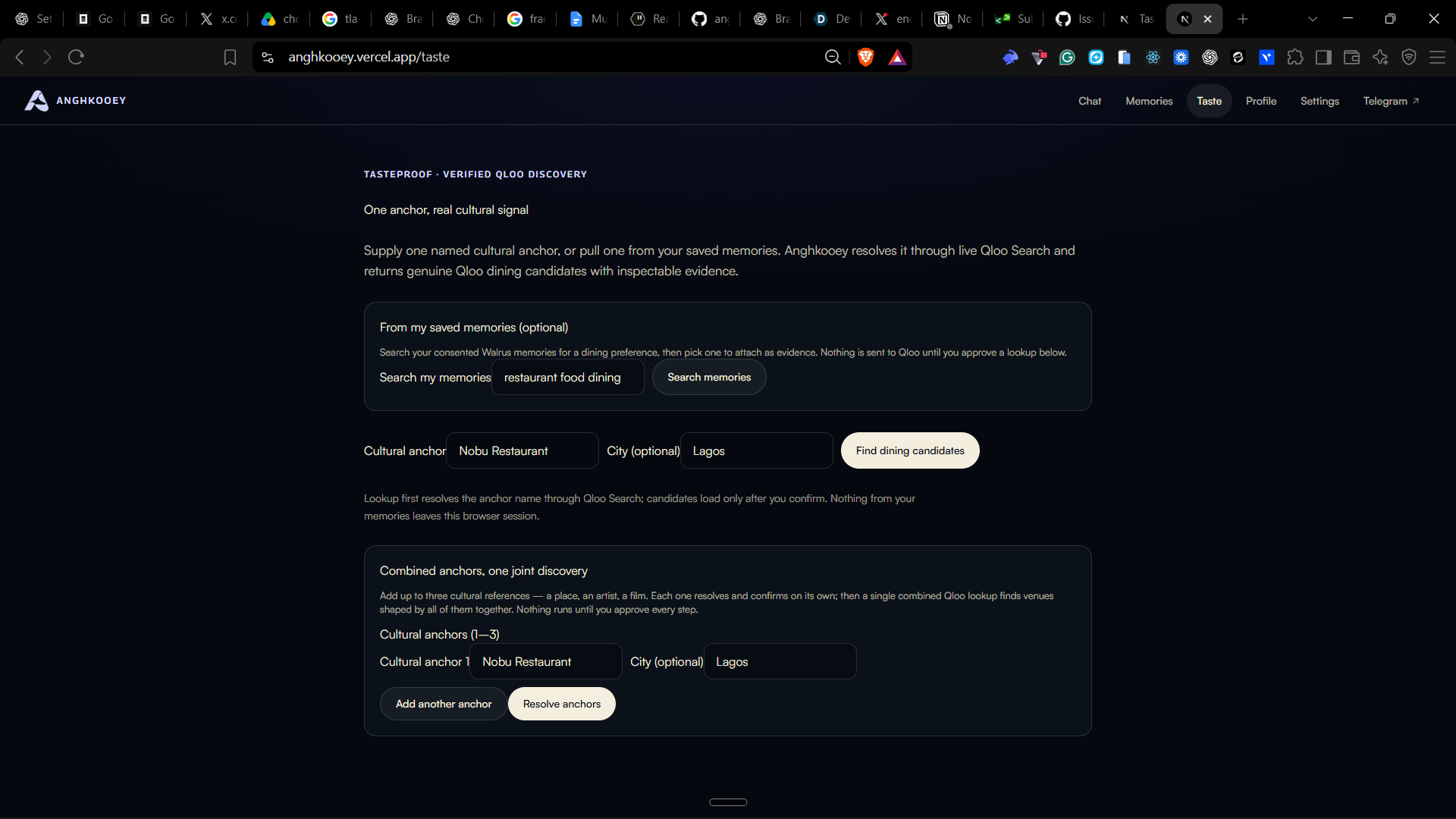
Tasteproof feature/page on Angkooey
-
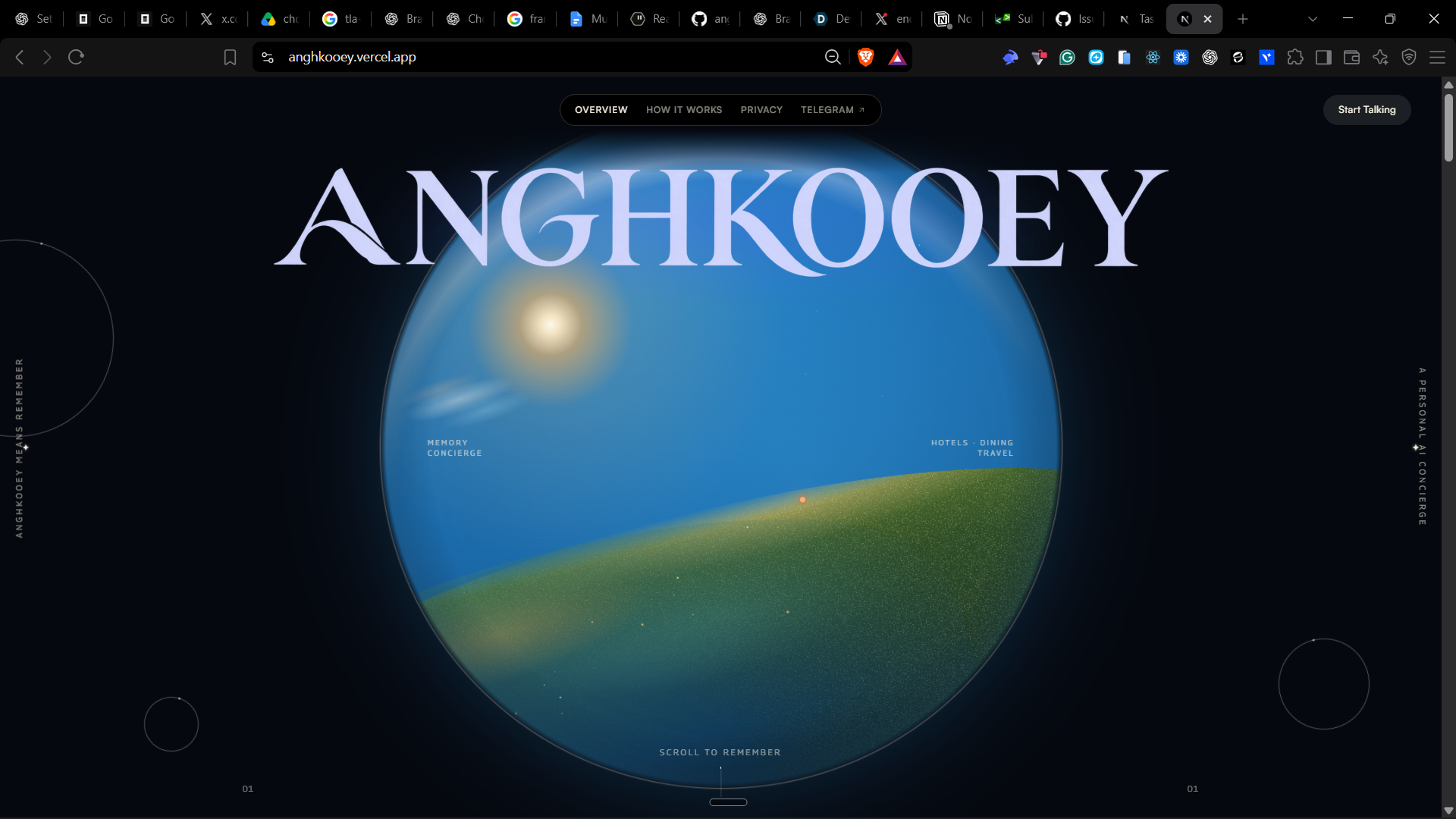
Anghkooey landing page
Anghkooey × TasteProof
AI agents can recommend anything. But can they show what the evidence actually supports?
Anghkooey × TasteProof is a Qloo-powered cultural discovery and recommendation verification system. It helps AI concierges and discovery agents move beyond plausible-sounding suggestions by checking recommendations against real cultural-intelligence data, investigating uncertainty, and making the available evidence visible.
Try TasteProof Verify · Explore Anghkooey · View source code
Inspiration
AI is making recommendations easier to generate than ever. But for developers building travel concierges and discovery agents, there's a problem: a convincing recommendation isn't necessarily a well-supported one.
An assistant might suggest a restaurant because its name sounds relevant, confuse two similarly named venues, or treat a missing search result as proof that somewhere doesn't exist.
We wanted to answer a different question:
What if cultural intelligence could help AI agents evaluate their own recommendations instead of simply generating more of them?
Anghkooey was already a consent-first AI concierge. For the Qloo Agentic Hackathon, we significantly expanded it with Qloo-powered discovery, cultural evidence attribution, a standalone recommendation verifier, and MCP tools that other agents can call.
TasteProof turns cultural intelligence into a practical evidence-checking workflow.
What it does
TasteProof has two connected experiences.
1. Qloo-powered cultural discovery
Anghkooey allows users to explore destinations through meaningful cultural references rather than generic popularity rankings.
For example, a user can combine Nobu Restaurant and Ryuichi Sakamoto as cultural anchors while exploring dining in Lagos.
The system:
- Requests approval before contacting Qloo.
- Resolves named references using Qloo Search and asks the user to confirm the intended entities.
- Runs one combined Qloo Insights request using the confirmed entity IDs.
- Displays actual returned venues, available cultural signals, entity attribution, and supporting details.
- Allows users to compare single-anchor and combined discoveries.
The result is an inspectable cultural-discovery workflow rather than a recommendation list with unexplained reasoning.
2. TasteProof Verify — evidence checks for AI recommendations
TasteProof Verify is the central new capability.
A reviewer provides up to three cultural anchors, a destination city, and up to five proposed venues. After explicit entity confirmation and approval, the system compares that shortlist against the venues returned by Qloo Insights.
It produces three deterministic verdicts:
OBSERVED — A unique, exact normalized name match is present in the returned Qloo results.
REVIEW — The available match is ambiguous or insufficient to establish the intended venue's identity.
NOT OBSERVED — The venue is absent from this bounded result set. This does not mean it doesn't exist, is closed, or is unsuitable.
A real production example
For Nobu Restaurant + Ryuichi Sakamoto in Lagos, we tested this sample shortlist:
| Proposed venue | TasteProof verdict | Qloo evidence |
|---|---|---|
| ILE EROS LAGOS | OBSERVED | Exact match in the returned Insights results |
| NOK | REVIEW | Near-name match to NOK by Alara; identity not automatically confirmed |
| Ghost Bistro Xyz | NOT OBSERVED | Absent from the five returned venues, without claiming nonexistence |
Instead of assigning unsupported confidence scores or inventing explanations, TasteProof preserves the actual query context, entity references, available evidence, coverage, limitations, and execution receipt.
3. Real MCP tools for external AI agents
TasteProof is not limited to its web interface. It also exposes a working Model Context Protocol (MCP) endpoint with three tools:
tasteproof_capabilities— Discover the verification capabilities and limitations.tasteproof_verify_shortlist— Run approval-gated Qloo verification and return structured verdicts.tasteproof_investigate_gap— Investigate an uncertain proposed venue using a bounded additional Qloo Search.
The third tool is the important distinction.
In our live test, NOK received a REVIEW verdict because Qloo Insights returned NOK by Alara. A subsequent Qloo Search surfaced additional similarly named identity candidates with different entity IDs.
TasteProof kept the original REVIEW verdict.
Additional search evidence is useful, but it isn't permission to silently claim two records describe the same place.
This follow-up is governed by a deterministic evidence-gap policy with a strict request budget, not an unbounded autonomous research loop.
How we built it
The system combines a real AI concierge with a dedicated Qloo evidence-verification layer.
Qloo integration
We use Qloo Search to resolve cultural anchors into real entities. After explicit confirmation, we use Qloo Insights to retrieve destination-specific venue candidates with combined cultural signals and available explainability data.
The verification engine performs conservative identity matching against the actual returned candidates. It does not fabricate venue attributes, use affinity as a match probability, or treat top-result absence as nonexistence.
Agent interface
We built a standards-based MCP server using the TypeScript MCP SDK, with structured tool input/output schemas and shared server-side verification logic.
Every Qloo-backed MCP call is approval-gated. An owner-issued, signed approval binds the permitted operations to the exact anchors, entity IDs, destination, and shortlist, with a ten-minute expiration.
The system freshly revalidates anchor selections, enforces fail-closed rate limits, and records completed provider operations. The additional identity investigation is capped at one follow-up Search per call.
Application stack
- Qloo Search and Qloo Insights
- Model Context Protocol (MCP)
- Next.js, React, TypeScript, Tailwind CSS, and Zod
- DeepSeek Flash for Anghkooey's conversational AI
- Neon/PostgreSQL for existing application infrastructure and rate limiting
- Walrus Mainnet for Anghkooey's existing opt-in memory capabilities
- Vercel for production hosting
- Vitest and Playwright for automated verification
The Qloo verification workflow is session-based and does not transmit raw private memories or conversation histories to Qloo.
Challenges we ran into
Entity ambiguity: A cultural reference can resolve to multiple Qloo records. We implemented explicit entity confirmation and fresh server-side validation instead of assuming the first search result is always correct.
Evidence versus certainty: Qloo Insights returns a bounded set of candidates. A missing venue isn't necessarily nonexistent, and a similar name isn't proof of identity. Getting those distinctions right shaped the entire verdict system.
Safe agent access: Exposing Qloo-backed functionality to external agents required more than publishing an MCP endpoint. We built scoped approval tokens, issuer authorization, input limits, quota enforcement, and a secure owner-side approval handoff.
Reliable end-to-end integration: We tested the browser workflow, deterministic matching, MCP protocol, authorization failures, and genuine Qloo results. The released implementation has a recorded validation result of 351 passing unit tests and 42 passing intercepted browser checks, alongside successful production MCP verification.
Accomplishments we're proud of
We shipped a working, publicly accessible application that uses Qloo as part of a real user-facing decision workflow.
The strongest result isn't that TasteProof can return a list of venues. It's that the system can explain which proposed venues were observed, identify ambiguity, investigate a relevant evidence gap, and preserve uncertainty instead of manufacturing a confident answer.
We've also made that functionality available to external agent clients through actual MCP tools, while retaining an independently usable web reviewer.
What we learned
Cultural intelligence becomes especially valuable when its evidence is treated carefully.
A provider's ranking signal is not a probability of user satisfaction. A near-name match is not confirmed identity. And an absent result is not a universal negative fact.
For an AI product, knowing when to request review can be just as useful as knowing when to return an answer.
We also learned that meaningful agent tooling needs clear authorization, inspectable operations, and bounded behavior—not just a tool-calling demonstration.
What's next
TasteProof's immediate use case is verification for AI travel and local-discovery applications.
Next, we want to make the verifier easier for developer teams to integrate, support more cultural recommendation categories where Qloo provides suitable evidence, and develop clearer human-review and evaluation workflows.
The longer-term goal is a reusable cultural-evidence layer that recommendation agents can consult before presenting uncertain claims to users.
Try it yourself
Live verification: https://anghkooey.vercel.app/taste/verify
Qloo-powered discovery: https://anghkooey.vercel.app/taste
Open-source code (MIT): https://github.com/Devendurance/anghkooey
MCP endpoint: https://anghkooey.vercel.app/api/mcp
The public browser verifier requires no issuer credential. The MCP verification and investigation tools require owner-issued, scoped approvals; the capabilities tool can be discovered without approval.
Quick judge walkthrough
- Open the TasteProof Verify link.
- Use Nobu Restaurant and Ryuichi Sakamoto as anchors, with Lagos as the destination.
- Enter
ILE EROS LAGOS,NOK, andGhost Bistro Xyzas the sample shortlist. - Approve Qloo Search and confirm the intended Nobu restaurant and Sakamoto artist entities.
- Approve verification and inspect the evidence report, verdicts, and limitations.
Live Qloo results may vary. The sample Ghost Bistro Xyz name is used to demonstrate bounded evidence absence, not to assert that a real venue does or doesn't exist.
TasteProof's principle is simple: an AI recommendation should not claim more certainty than its evidence supports.
Built With
- deepseek
- model-context-protocol
- neon
- next.js
- node.js
- postgresql
- qloo
- react
- tailwind-css
- typescript
- vercel
- walrus
- zod

Log in or sign up for Devpost to join the conversation.