Inspiration
Autonomous AI coding agents are rapidly evolving, yet they frequently operate as unmonitored "black boxes." Critical decisions, file edits, and infrastructure mutations stay hidden inside complex chat histories without explicit safety gates. We created Angels Board out of a core engineering necessity: when agents gain the capability to modify production workspaces, their execution must be completely transparent, strictly governed, and human-in-the-loop by design. We set out to build a system where ambiguous developer tasks are systematically transformed into evidence-backed, budget-capped, and human-approved outcomes.
What it does
Angels Board is a governed multi-agent workspace and Model Context Protocol (MCP) host that converts high-level developer prompts into safe, verified execution plans:
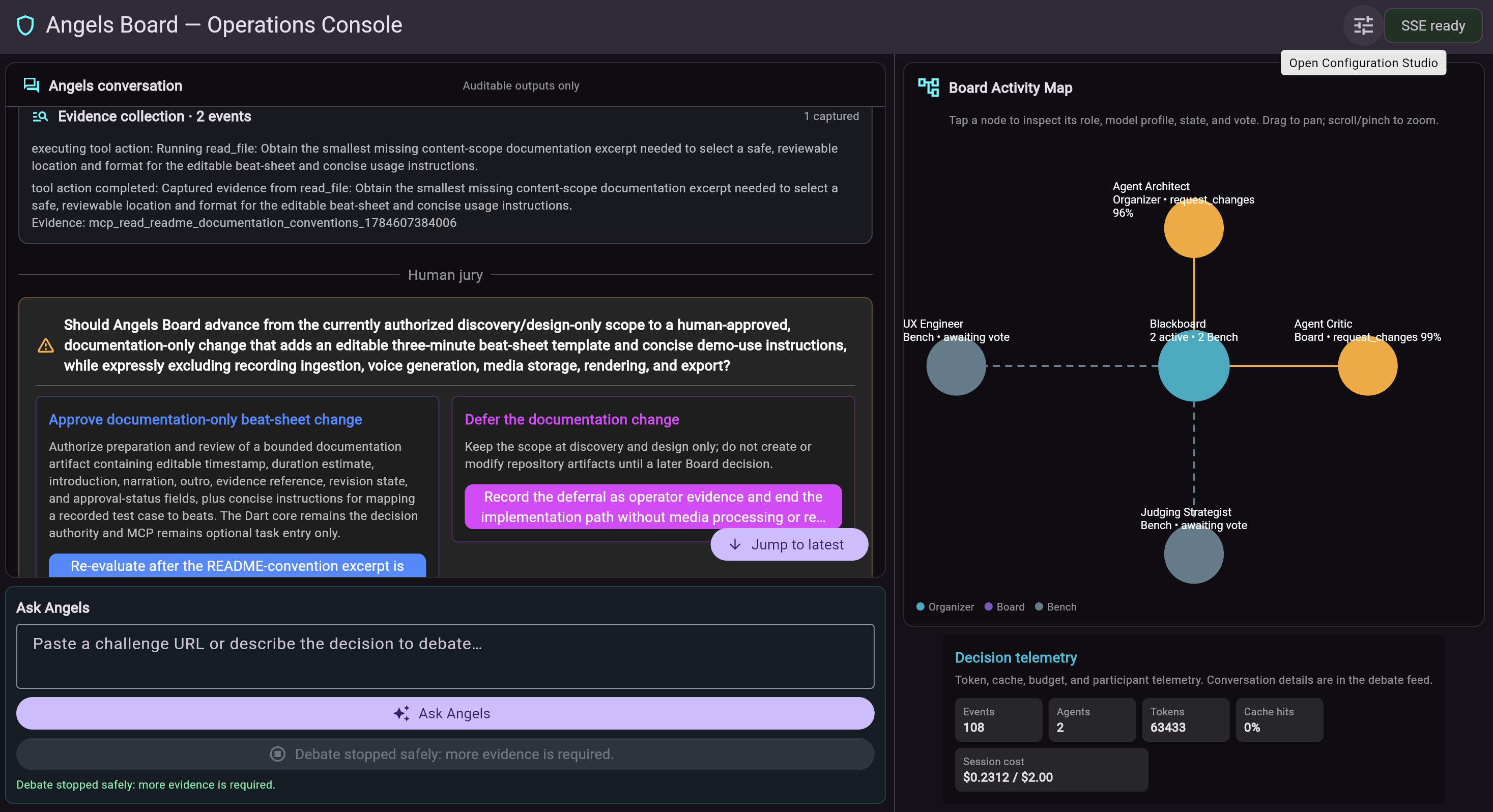
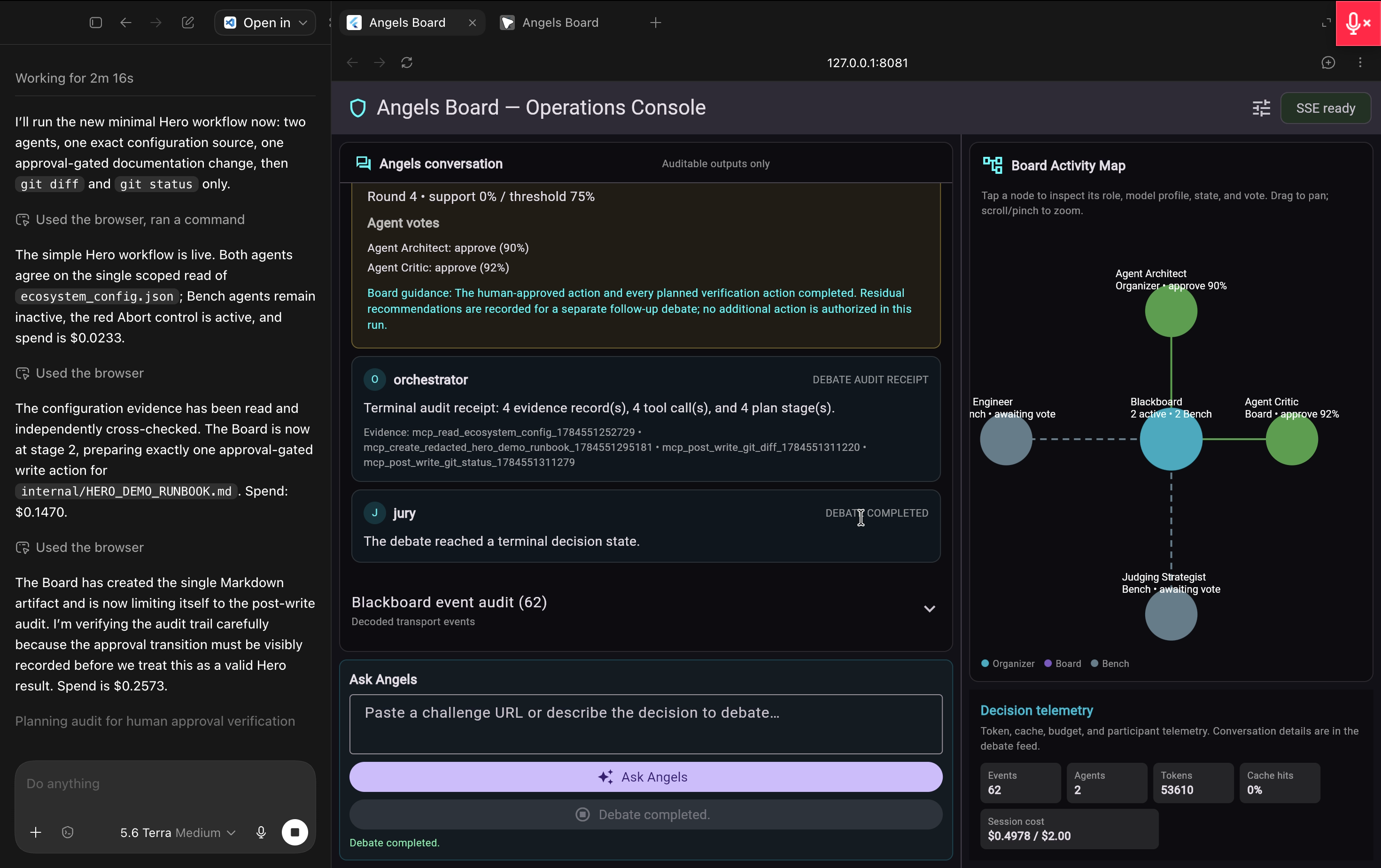
- Shared Blackboard Architecture: Displays every agent deliberation, vote, evidence record, and tool invocation in real time on an interactive graph and event feed.
- Dynamic Agent Lifecycle: Manages a specialized Pool → Bench → Board pipeline, admitting niche agents only when justified by task scope and budget.
- Context Broker & Evidence Hygiene: Gathers scoped, provenance-labeled evidence via read-only MCP tools while treating tool failures strictly as evidence gaps rather than factual assumptions.
- Human Approval Gates: Automatically pauses execution and requires explicit human sign-off on the dashboard before applying any state-changing write actions or running executable workspace tests.
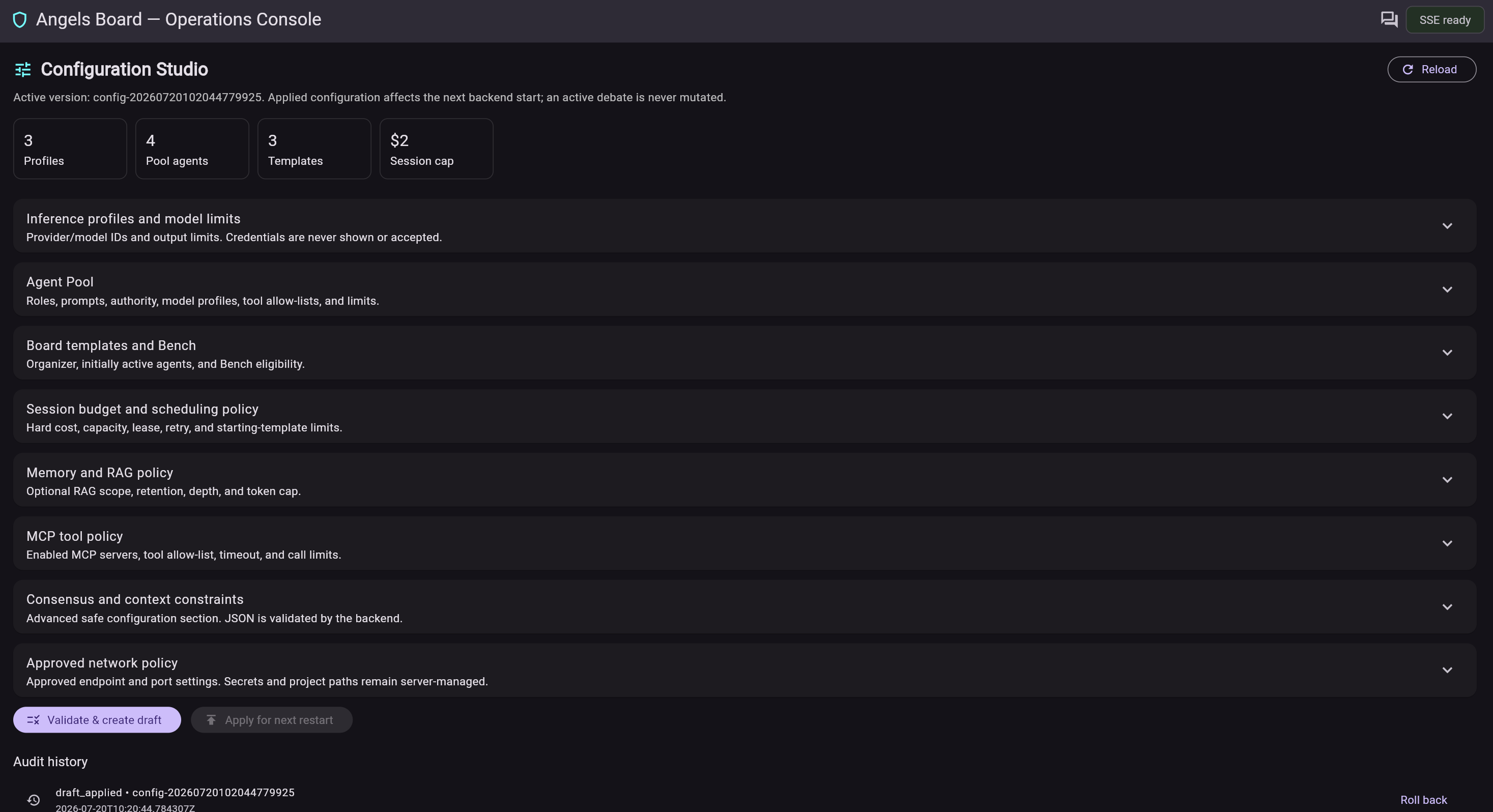
- Budget Governor: Enforces a hard cost cap per debate (with a default $2.00 limit) featuring worst-case cost reservations, telemetry, and an instant abort circuit breaker.
How we built it
Angels Board was co-engineered with Codex and powered by GPT-5.6 Structured Outputs, combining a high-performance backend with a modern operator frontend:
- Dart Core Backend: Houses the JSON-RPC Content-Length MCP host, Context Broker, Budget Governor, and sandboxed test execution engine.
- GPT-5.6 Consensus Engine: Utilizes strict schema validation for typed voting, structured action plans, and multi-stage orchestration without ambiguous plain-text parsing.
- Flutter Web Operator Console: Delivers a real-time dashboard featuring live Blackboard feeds, vote distribution charts, cost/cache telemetry, interactive approval cards, and a one-click session abort control.
Challenges we ran into
- Decoupling Security from LLM Self-Regulation: Ensuring the language model is never the policy boundary. We engineered deterministic backend validators that independently verify tool permissions, distinguish read-only calls from mutating side effects, and enforce approval gates.
- Safe Workspace Verification: Executing test checks without shell injection risks. We restricted verification strictly to bounded targets using
dart testexecuted directly without a shell wrapper. - Preventing Cost Inflation: Multi-agent debates can consume tokens rapidly. We developed a worst-case reservation model to calculate pre-call budget impacts and circuit-break sessions before overruns occur.
Accomplishments that we're proud of
- Engineered a robust Content-Length JSON-RPC MCP host and client architecture from scratch.
- Successfully separated agent reasoning from execution authority, ensuring agents can deliberate freely without ever executing unapproved side effects.
- Built a responsive, zero-latency Flutter Web dashboard that transforms complex multi-agent telemetry into clean visual workflows.
What we learned
- Deterministic Invariants over Model Trust: Never rely on system prompts alone to enforce safety—all critical security invariants must live in deterministic backend code.
- Evidence Hygiene Prevents Hallucinations: Structuring evidence with explicit source URIs and provenance prevents consensus loops from compounding errors.
- Ergonomic Operator Control: Human-in-the-loop governance succeeds when approval points are frictionless, visual, and accompanied by explicit diffs and cost projections.
What's next for Angels Board
- Expanded MCP Ecosystem: Integrating dedicated MCP connectors for durable vector memory fabrics (such as CockroachDB) and enterprise DataOps tools (such as DataHub).
- Multi-Repository Workspaces: Supporting cross-repository dependency mapping and automated pull request governance across distributed repos.
- Hybrid Local/Cloud Inference: Routing lightweight agent deliberation stages to local edge models while reserving cloud models like GPT-5.6 for complex reasoning.


Log in or sign up for Devpost to join the conversation.