Inspiration
After traveling different to different countries, I've noticed the lack of medical assistance in many developing areas. Many people don't have the transportation to travel to certified hospitals, or lack the funds to get a professional checkup. According to the World Health Organization, 42% of children less than 5 years of age and 40% of pregnant women are anaemic; in addition, anemia is significant in developing countries. I was inspired by this statistic to develop AneTech to identify individuals if they possibly have anemia.
What it does
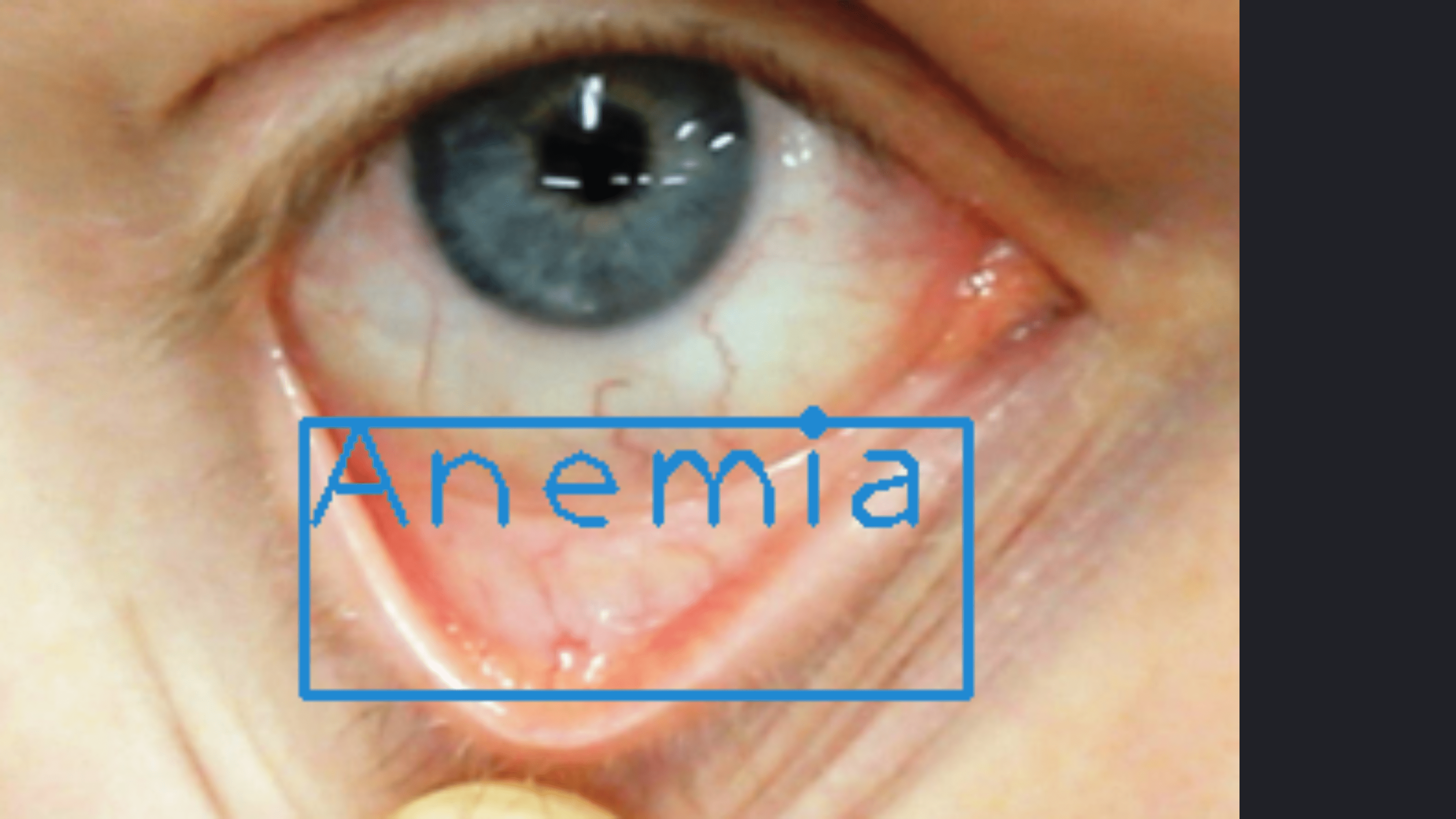
AneTech is a program that takes in a folder of images, specifically images of the eye, and compares it to a custom built model to identify if an individual might have anemia.
How we built it
AneTech does this by using YOLOv3 and opencv for object detection in addition with using labelImg for image and model compiling.
Challenges we ran into
One major challenge was the lack of datasets; the only available data set for anemia was restricted, so I manually compiled a set of images and used a YOLO compatible model creation software. Another challenge was the unfamiliarity with opencv which caused many indexing errors, which I fixed later on.
Accomplishments that we're proud of
Prior to this project, I was unfamiliar with YOLOv3, darknet, and notebooks which were necessary for this project for the model training, but after completion, I was comfortable with the format and functions. In addition, I was unfamiliar with opencv, but after completion, I understand its core functions which I am proud of. Overall, I'm proud of my learning, but also important, the actual program itself, which uses the detection software.
What we learned
I learned a significant amount of computer vision/machine learning through Ane(mia)Detech. Through this program, I learned about object detection modules such as OpenCV, and efficient object detection algorithms that identify objects such as YOLO(You Only Look Once)v3. Through this project, I also learned about symptoms of anemia and how to differentiate between who might have anemia, and who might not have anemia by looking at the redness of the eyelid (which shows how gives a hint on the number of red blood cells in a person's eye), and otherwise by patterns on the eye.
What's next for AnemiaDetech
The next step for this program is to have a much larger data set. Due to GPU constrictions, the program was forced to create a model under a limited amount of images. By creating a larger dataset, AneDetech will be able to be more efficient in identifying possible anemia.

Log in or sign up for Devpost to join the conversation.