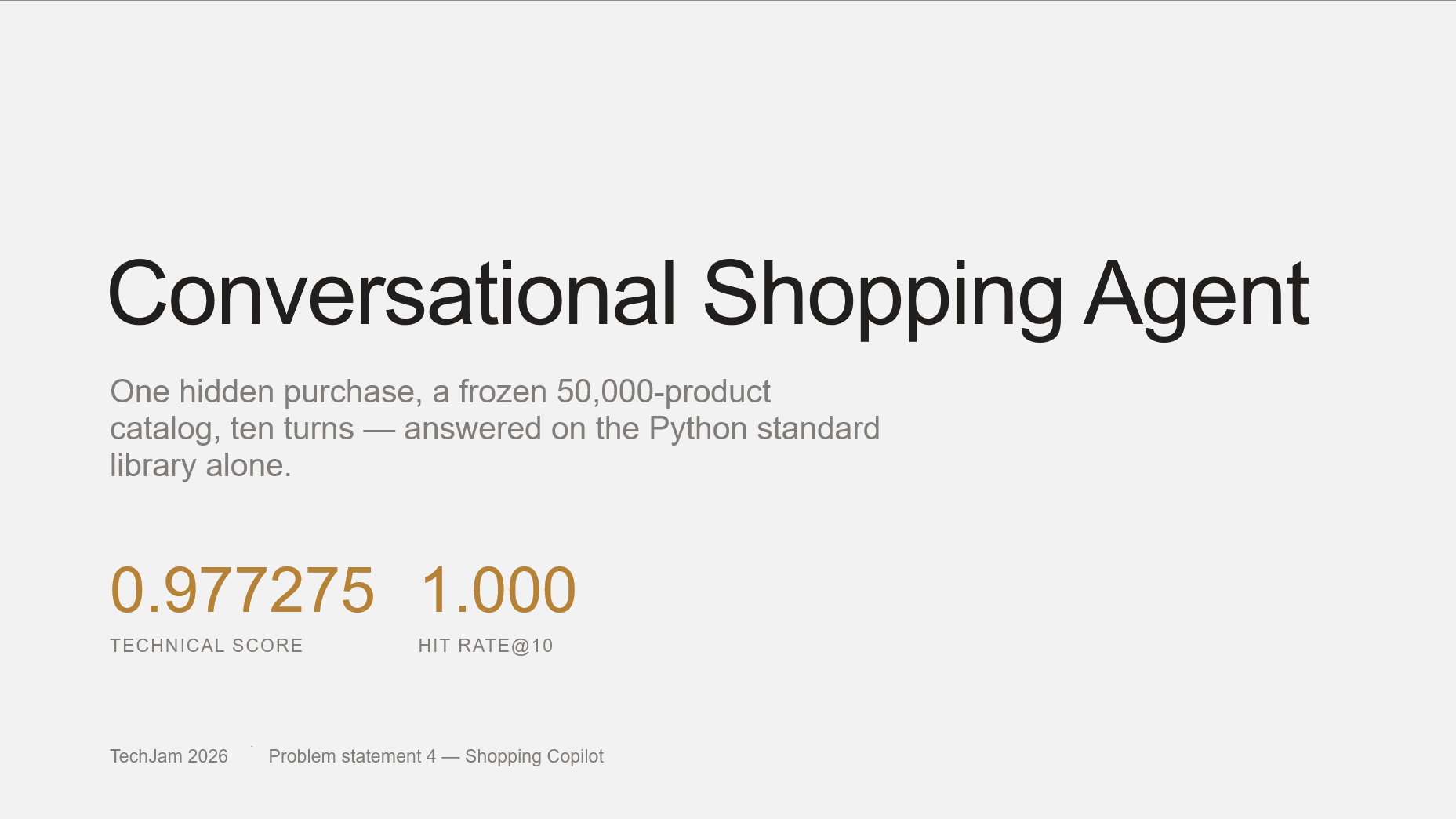
Conversational Shopping Agent
🛍️ 50,000 products · 10 turns · zero API calls · zero tokens · zero cost
Conversational Shopping Agent is a multi-turn shopping system that identifies a customer's intended product in a frozen 50,000-item Amazon catalog. It runs entirely on the Python standard library and reaches a TechnicalScore of 0.977275 on the official evaluator.
Inspiration
💡 Shopping search should understand a conversation, not just a query.
Real shoppers rarely express everything they want in one perfectly structured sentence. They explore, add requirements over time, decline questions, change their minds, and sometimes replace an earlier preference entirely. We wanted to build an agent that could follow that evolving intent and still retrieve the right product quickly.
The challenge also created an unusually interesting engineering constraint: the agent may receive only a message, a turn number, and an anonymised profile. It is never told whether the customer is browsing, buying, or about to override an earlier preference. It must infer the situation from the conversation itself.
At the same time, we did not want to mistake benchmark familiarity for genuine intelligence. The public set contains only 200 templated sessions and exposes the target category in the opening message. A 50-line agent that exploits only that leak scores 0.831, making almost any additional work look like progress. That inspired a second goal alongside retrieval: build evaluation tools capable of proving our own ideas wrong before the private set did.
What it does
🧭 It listens, remembers, clarifies, retrieves, and changes strategy when the conversation stops making progress.
Infers buying versus browsing intent
The agent re-evaluates intent on every turn. It reads requirement markers such as “must be” and “I need,” exploration markers such as “still exploring” and “open to,” and—weighted above both—whether a genuinely filterable constraint has entered the conversation state.
A buying turn leans harder on the customer's own vocabulary. A browsing turn spreads recommendations across sellers to cover more ground. State deliberately beats wording: if a session opens with “just browsing” and later states a firm requirement, the agent treats it as buying regardless of how it began.
Maintains multi-turn state and handles intent overrides
Requirements accumulate across turns and are weighted by how firmly the shopper asserted them. When the customer overrides their intent, the agent removes only revocable preferences and preserves requirements that were restated as firm.
The hardest edge case occurs before the override arrives. The protocol suppresses conversion until that later turn, so an earlier recommendation can silently contain the target. The agent detects that state and suspends its elimination memory instead of permanently discarding the answer. Fixing this single rule moved the Intent Override scenario from 0.233 to approximately 1.000.
Clarifies proactively by information gain
The agent recommends and asks a question in the same turn. The protocol permits both, so spending a whole turn on a question alone costs time without adding any benefit.
It starts with an open question while open questions are still productive, then selects the attribute that divides the remaining candidate pool closest to 50/50. That maximises expected elimination whichever way the customer answers. Declined attributes are remembered and never asked again.
Re-orchestrates retrieval at runtime
A fixed pipeline cannot recognise one of its worst failure modes: the opening message was routed to the wrong product family, so every later turn searches a pool that cannot contain the target. A lightweight supervisor watches observable signals—turns elapsed, whether new information arrived, and how much of the pool has been exhausted—and escalates through:
focus → broaden → diversify
Produces strong results without an online model
On the official 200-session evaluator, the agent achieves:
| Metric | Result |
|---|---|
| TechnicalScore | 0.977275 |
| Hit Rate@10 | 1.000 |
| MRR | 0.99125 |
| MTTC | 2.005 |
| Rank-1 conversions | 197 / 200 |
That is a 9.2× improvement over the published 0.1067 baseline, with a Hit Rate@10 of 1.000 in all four scenario types.
How we built it
⚙️ A deterministic retrieval stack, built from first principles with the standard library.
Retrieval and ranking
At startup, the agent reads the frozen catalog and builds complementary in-memory indexes:
- a category index for high-recall product-family filtering;
- an IDF-weighted phrase index for precise catalog-attribute matches;
- an intent-card index containing only constraints the simulated shopper could actually disclose; and
- a hand-built BM25 inverted index for robust lexical fallback.
The ranker combines exact phrase evidence, intent-card evidence, BM25 relevance, category fit, profile-derived preferences, and a measured popularity prior. The entire process is deterministic and byte-identical across repeated runs.
Technology
- Development tools: VS Code, Git, and Python 3.12, targeting Python 3.10+.
- Libraries and frameworks: none. The submitted agent uses only the Python
standard library, including
json,math,re,typing,dataclasses,collections, andpathlib. There is no PyTorch, Transformers, scikit-learn, or vector database. - APIs: none in the submitted agent. A separate external LLM was used only during development to generate frozen perturbation test sets. It is not needed to run, score, or reproduce the agent, and the repository contains no credentials.
- Datasets and assets: the organiser's frozen 50,000-product
Clothing_Shoes_and_Jewelrycatalog and 200 labelled public sessions from Amazon Reviews 2023. Our additional session pools are derived from the same catalog, which is never modified.
Runtime disclosure
| Network access required | No |
| Model / API | None |
| Token usage | 0 prompt, 0 completion |
| Estimated cost | $0.00 |
| Per-turn latency | median 12.8 ms, p95 97 ms, p99 128 ms, max 168 ms |
| Representative one-time index build | 12.1 s |
| Full 200-session evaluation | 13.4 s |
Absolute timings are hardware-dependent; the recorded run used a machine roughly 1.5× slower than an earlier one. Zero tokens, zero cost, and zero network access are properties of the agent itself: it reads no environment variable and opens no socket, so it runs unchanged under the organiser's CPU, memory, timeout, and network restrictions.
Team contributions
| Member | Contribution |
|---|---|
| Ng Ming Yu | Retrieval core and ranking: catalog indexing, BM25, the IDF-weighted phrase index, and the commit-to-one-pick recommendation policy (src/catalog.py, src/shopping_agent.py) |
| Aeson Ng | Dual-track intent routing: buying/browsing inference and per-track retrieval weights (src/routing.py) |
| Seng Boon Kiat | Dialog state machine: weighted slots, intent-override handling, retraction, and the elimination-validity rule (src/dialog.py) |
| Nathan Quek Xiu Han | Runtime orchestration and personalised context distillation: the focus → broaden → diversify supervisor and profile layer (src/strategy.py, src/profile.py) |
| Nguyen Duy Minh | Evaluation and robustness: held-out session pools, seven blind perturbation sets, the overfitting audit, and the test suite (heldout_eval.py, reports/, tests/) |
Challenges we ran into
🧩 The hardest problem was not retrieval—it was avoiding false confidence.
The public set is small, templated, and unusually easy to overfit. With roughly a dozen adjustable parameters, polishing the visible score could easily produce a system that failed when the private evaluation swapped in different users and target products. We therefore built held-out product pools and blind language perturbations before trusting any improvement, and reverted two changes that looked like wins on tuned data.
Natural language introduced another class of traps. A template-matching bug could silently discard an otherwise parseable turn. Semicolons could either separate two disclosed constraints or belong inside one catalog field. Singular product names had to resolve plural catalog labels without mangling words such as “dress.” Each fix had to improve robustness without coupling runtime code to the evaluator.
Intent overrides were especially subtle because the simulator can withhold conversion until the override lands. Ordinary elimination logic is correct in a normal session but destructive in that temporary state. We had to make the agent know when not to trust its own earlier exclusions.
We also prototyped an LLM parser that handled free-form messages better, but it created the wrong operational trade-off. It required a live endpoint, raised per-turn latency from approximately 9 ms to approximately 1.3 s, and, when the endpoint was unavailable, would burn the full timeout for every message—a projected 13+ hours across 800 sessions. Since the organiser may disable network access, a solution dependent on that endpoint could score zero despite looking better locally.
Accomplishments that we're proud of
🏆 We built not only a strong agent, but also the test suite that could prove it was wrong.
Generalising to unseen products
The public evaluation contains 200 sessions, while the private evaluation uses 800 sessions with different users and different targets. To measure product generalisation directly, we created two additional 800-session pools from the frozen catalog:
- a matched pool reproducing the purchase-popularity profile of real Amazon orders, our closest available proxy for the private set; and
- a long-tail pool sampled uniformly as an adversarial test of whether the popularity prior was load-bearing.
| Pool using official wording | TechnicalScore | Hit@10 |
|---|---|---|
| Public 200—the visible set | 0.977275 | 1.000 |
| Matched 800—unseen products, purchase-like popularity | 0.957786 | 0.989 |
| Long-tail 800—uniform adversarial sample | 0.925450 | 0.968 |
0.9578 is our honest private-set estimate, not the visible public score of 0.9773. Even if private targets were uniformly long-tail—which the purchase-record-based specification makes unlikely—the score would decline by only another 0.032 and Hit@10 would remain 0.968. There is no performance cliff within that range.
Surviving language variation
The specification allows natural-language paraphrasing, and a real shopper will not follow a simulator template. Using a separate model that was deliberately never shown our parser, we generated seven blind perturbation styles: natural, terse, rambling, typos, indirect, renamed categories, and information loss.
That harness uncovered issues the clean score could not:
- The inherited version's Hit@10 collapsed to 0.535 under light rewording, missing the target in almost half of all sessions despite a clean score of 0.907.
- A ranking change that improved every style we had tuned on was anti-correlated with target popularity and would have reduced private-set performance, so we reverted it.
- A template-matching bug silently discarded fully parseable turns.
| Style on public 200 | Inherited | Ours |
|---|---|---|
| Official wording | 0.9068 | 0.977275 |
| Rambling | 0.8815 | 0.936576 |
| Renamed categories | 0.8832 | 0.931116 |
| Terse | 0.4520 | 0.890260 |
| Typos | 0.4520 | 0.882156 |
| Natural | 0.4967 | 0.841981 |
| Indirect | 0.4819 | 0.802883 |
Showing that the architecture—not one lucky tuning—is carrying the result
We perturbed every fitted constant simultaneously by a uniform random factor. At ±25%, the worst of eight draws lost only 0.003 and Hit@10 remained 1.000. At ±50%, one draw even scored above the shipped configuration. The parameters sit on a plateau rather than a fragile peak.
What we learned
📚 Measurement changed our architecture more than intuition did.
Returning more products is not always safer
The evaluator stops a session as soon as the target enters the top ten, fixing the product's rank at its first appearance. A low-ranked early guess is therefore the opposite of a hedge: it permanently locks in that low rank.
For one session out of 200, an extra turn costs 0.0001 of score, moving a target from rank 3 to rank 1 gains 0.0010, and losing a hit costs 0.0025. While the customer can still disclose useful information, the agent returns only its best candidate and asks a question. Once disclosures are exhausted, it returns ten products and sweeps the remaining pool.
That policy moved the public score from 0.9095 to 0.9773 and the matched-800 score from 0.8901 to 0.9578, with public Hit@10 still at 1.000. Every one of the sixteen pool-by-wording combinations we measured improved.
The three-turn commitment window comes from the simulator rather than a fitted constant: an intent card contains at most four constraints and each reply releases two, so no new information arrives after turn 3. Beyond that point, the Hit@10 curve turns over exactly where the evaluator's incentives predict.
Offline reliability can outweigh a higher local NLP score
Our LLM parser scored 0.839 under full rewording, outperforming the offline parser. We removed it anyway because its network dependency and timeout behavior made it unsuitable for the grading environment. A solution that cannot run where it is evaluated scores zero, whatever it scores on a developer's machine.
Some headroom cannot be reached under the protocol
With Hit@10 at 1.000 and 197 of 200 conversions at rank 1, only 0.019 of score remains, while MTTC cannot fall below 1.390. An intent-override session is forbidden from converting before the override arrives on turn 3 or 4. Knowing that boundary stopped us from spending time optimising against a wall.
Negative results are still results
We built, measured, and disabled four ideas:
- cross-category browsing pools;
- a corpus-trained LSA semantic encoder;
- a larger personalisation weight; and
- a confidence gate that committed only when the top candidate's score margin crossed a threshold—which performed worse at every tested threshold.
Documenting those failures was as important as documenting the wins.
What's next for Conversational Shopping Agent (Andesine)
🚀 The next version will improve semantic reach without giving up offline, deterministic execution.
We plan to explore:
- A locally bundled pretrained sentence encoder. Our corpus-trained encoder failed, but a pretrained model is a different proposition, and vocabulary mismatch is exactly what the weakest perturbation styles expose.
- A learned
P(purchase | category, profile)prior. This would replace the manually weighted popularity signal with a measured purchase-likelihood model. - A permanent held-out tuning split. We want to guarantee that weights are never fitted on the same sessions used to report results.
The goal is not merely a higher visible score. It is an agent that remains fast, private, reproducible, and useful when real shoppers stop speaking like a test template.


Log in or sign up for Devpost to join the conversation.