Inspiration
Most productivity tools are lists you have to remember to open. Anchor runs your day by voice instead.
What it does
The first time you talk to it, Alexa sets you up in three steps:
Anchors: the fixed points of your week, like lunch, end of work and the gym, or your prayer times. Routines: your morning and evening routines, each with a start time so it becomes an anchor too. Planning: what you want done before each anchor, and what you want reminding of when you get there. Then Anchor runs your day. Alexa sets a reminder for every anchor. When one fires, Alexa greets you by name, asks how the tasks you planned went, saves your reflection, and saves whatever you say you'll do next. Across the day, Bedrock reads your check-ins and gives you a coaching tip at the next anchor.
Routines are walked through one step at a time. Alexa lists the steps, times each one, and reads back how long things really took. If a step keeps taking longer than planned, its planned time moves to your average. Tell Alexa "the shower felt rushed, make it 20 minutes" and Bedrock rewrites the routine for next time.
It's built for people who struggle to start things, and for anyone whose day moves. Prayer times shift every day of the year, so for Muslim users Anchor calculates them on the server and the anchors move by themselves.
How it's built
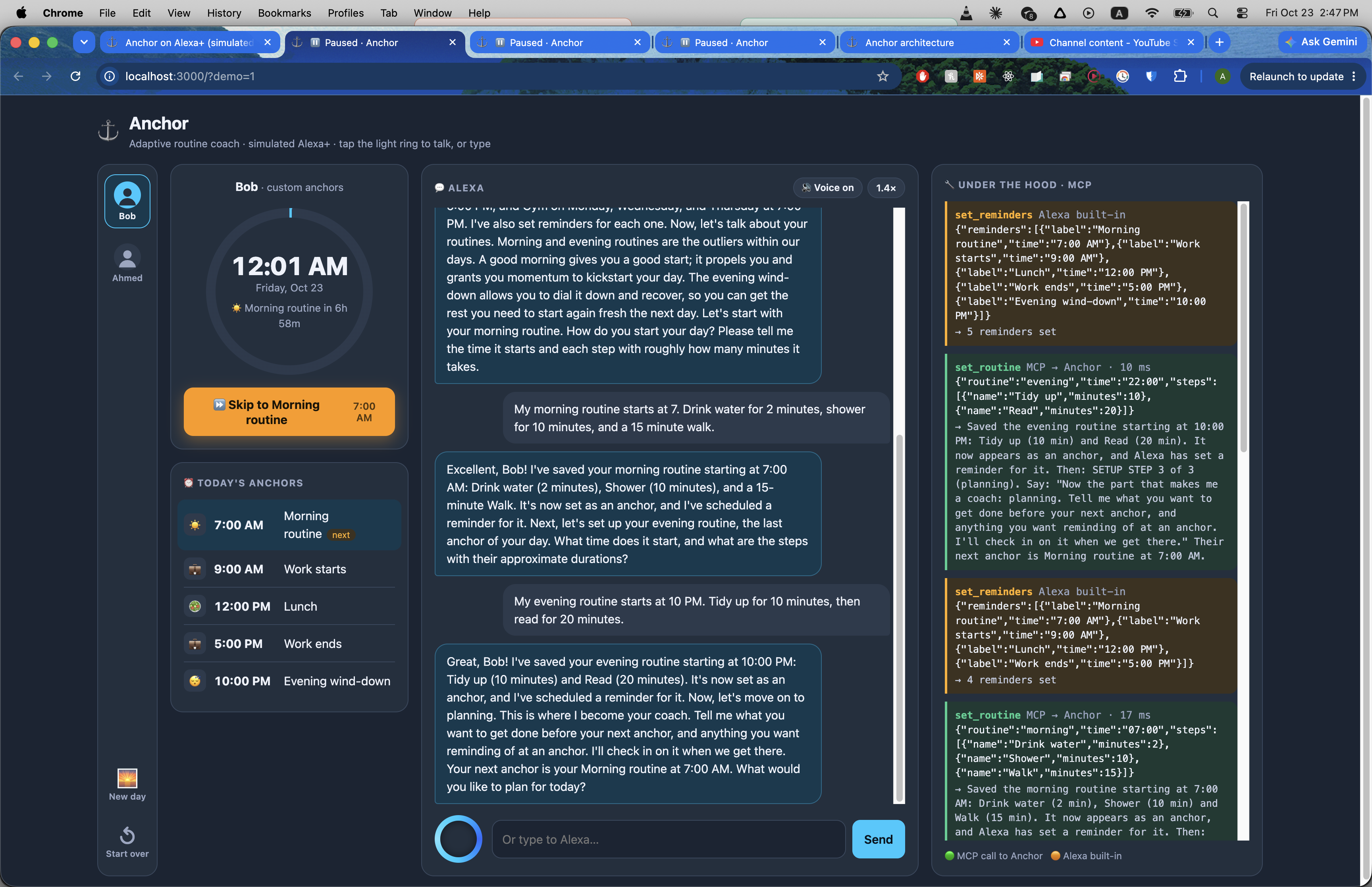
MCP server: 10 tools (get_started, set_anchors, set_routine, get_day, plan_tasks, anchor_arrived, check_in, start_routine, next_step, reflect_and_adjust), MCP spec 2025-11-25 over Streamable HTTP, built with the official TypeScript SDK on Node.js and Express. State is kept per user and persists between sessions. The server drives the conversation: setup progress lives in Anchor, not in the model's memory. get_started tells Alexa which step you're on and what to say, so a returning user is never walked through setup twice. Structured tool output: every answer also carries today's anchors as MCP structuredContent, and Alexa keeps its reminders in sync from it. The model never has to copy times correctly for a reminder to fire. Fast by design: Alexa+ expects tool answers within 500 ms. Every tool answers from local data in under 30 ms, and Bedrock work runs in the background after the reply. A failed background call never blocks the user. Amazon Bedrock: Nova Pro is the simulated Alexa+ brain, in a Converse API tool-use loop over Anchor's MCP tools. Nova Lite rewrites routines as validated JSON from feedback plus real step timings, and turns check-ins into coaching tips. Amazon Polly: gives the simulated Alexa its voice, using neural voices streamed sentence by sentence (generative is optional). Simulated Alexa+: we didn't have Alexa+ add-on developer access, so we built a web version as the track allows. It's a separate MCP client that reaches Anchor only through its MCP endpoint, the way Alexa+ would. It has voice in and out, a live log of every MCP call with its latency, a clock per user, and reminders that fire on their own. Prayer times are calculated astronomically with the adhan library from location and date. There's no API call, it works for any city, and the calculation method is configurable to match your mosque.
$$Built with Node.js · Express · MCP TypeScript SDK · Amazon Bedrock (Nova Pro, Nova Lite) · Amazon Polly · adhan
Built With
- bedrock
- express.js
- mcp
- node.js
- polly

Log in or sign up for Devpost to join the conversation.