
Inspiration
Our inspiration for this project comes from both personal experience and firsthand exposure to the challenges of dementia. One of our team members has worked closely with older adults living with dementia in an assisted living setting, witnessing how memory loss can affect independence, communication, and daily routines. Through these interactions, it became clear that while many existing tools focus on safety and medical management, fewer solutions address the emotional importance of maintaining identity and connection with loved ones. Seeing the impact the disease has had on both individuals and their families highlighted the need for technology that not only supports daily living but also preserves meaningful relationships and memories. We created this project to help people living with dementia stay connected to their families, maintain a sense of self, and receive support in moments of confusion or distress.
What it does
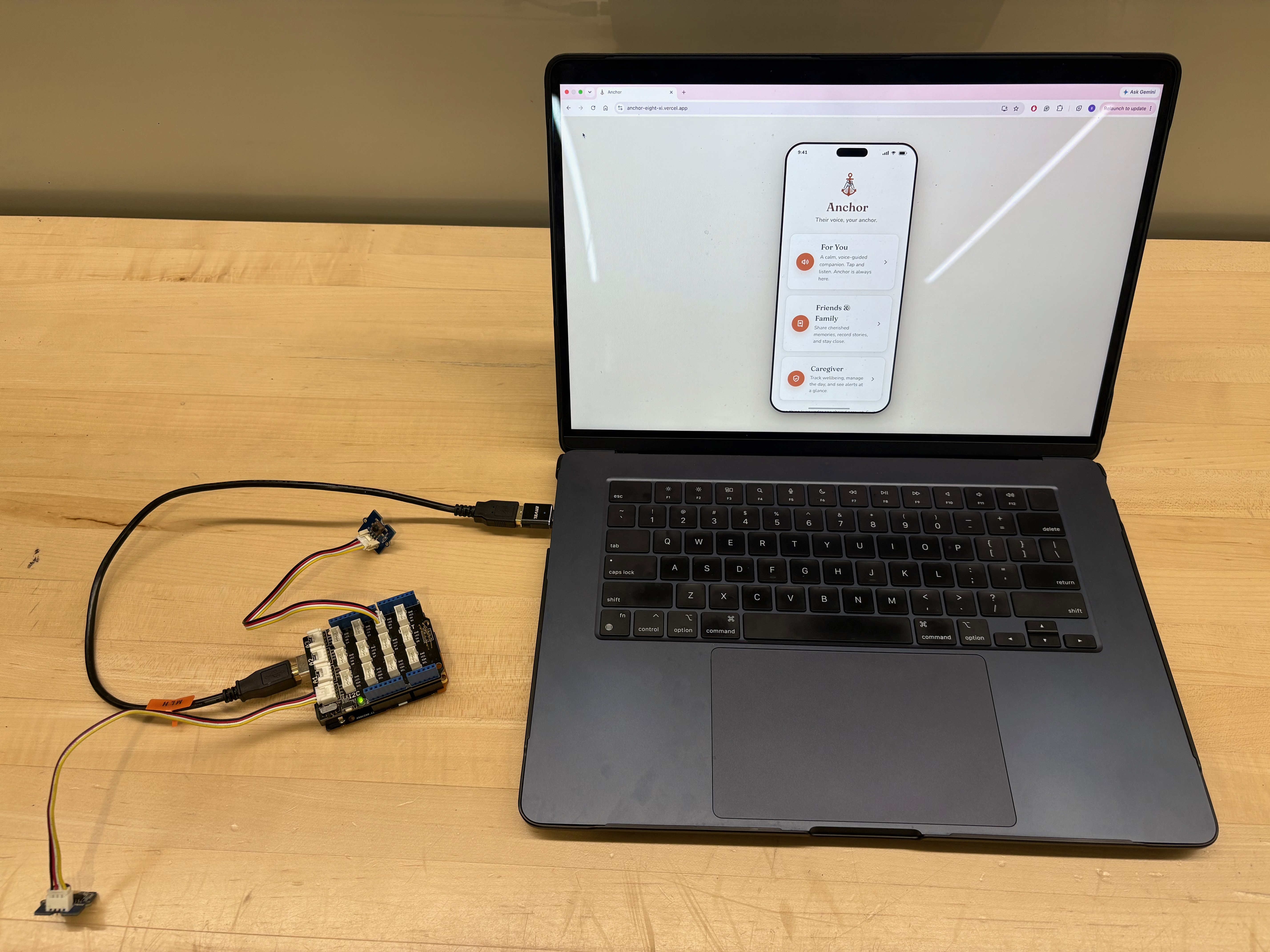
Our app is tailored for individuals living with dementia in the early- to mid-stages, living at home or in the hospital. The hardware component detects loud noises, triggering the app, Anchor, to begin listening to what the user is saying. Words of distress will activate the app's conversational AI that mimics the voice of a family member and helps them calm down. Simultaneously, the app alerts the person's caregiver (this can be a nurse if the user is living at the hospital, or a family member if they are living at home) that the user is distressed, allowing the caregivers to check on them. Furthermore, in the caregiver's view, the app also has features that allows them to check on the user's location, add their voice to be used by the conversational AI when they are not available, and send requests to friend's to add memories into the conversational AI's database. On the user's end, not only do they have access to the conversational AI, they also have access to pictures uploaded by their friends and family to remind them of old memories, to messages sent by their friends and family, and to a button that allows them to send an alert to their caregiver in emergency situations. Overall, the goal of Anchor is to respond quickly to crises and help individuals with dementia by giving them a grounding and familiar voice, as well as a friendly interface, while their caregiver is on the way to help them. Anchor doesn't replace human connection, it strengthens it by offering calm, familiar support until a caregiver can be there in person.
How we built it
Our solution combines hardware sensing, real-time web technologies, and voice AI to provide support during moments of confusion and caregiver stress.We built the frontend using React, TypeScript, and Vite, creating a mobile-style interface for memory storage, caregiver tools, and reality orientation support. The app communicates with an Arduino/Genuino 101 connected to a Grove Sound Sensor and Grove Touch Sensor. Using the Web Serial API, sensor events such as loud noises or button presses are sent directly to the web app in real time.For voice guidance, we integrated ElevenLabs Text-to-Speech, allowing grounding messages and memory prompts to be spoken aloud. User memories, notes, recordings, and media are stored locally using browser localStorage, eliminating the need for accounts or external databases.
Challenges we ran into
One of the biggest challenges was integrating the hardware with our web application. We used an Arduino UNO R4 with Grove sensors to detect environmental triggers, but ensuring reliable communication between the hardware and browser through the Web Serial API required significant troubleshooting.Another challenge was integrating ElevenLabs Text-to-Speech into our application. We initially struggled to connect the frontend interface with the voice generation service, and encountered issues where the selected voice profiles were not being recognized correctly. We ultimately resolved this by creating a secure server-side endpoint that handled communication with the ElevenLabs API and streamed the generated audio back to the application. Finally, balancing functionality with accessibility was an ongoing challenge. Since our target users include individuals experiencing confusion and cognitive decline, we had to continuously simplify the interface while still providing meaningful features for both users and caregivers.
Accomplishments that we're proud of
We are especially proud of successfully integrating multiple technologies into a seamless experience. Our project combines hardware sensors, browser-based communication, voice AI, and a responsive web interface, allowing real-world events to trigger personalized support in real time. We are also proud of the user experience we created. Because our audience includes older adults and caregivers, we focused heavily on designing a calming, intuitive interface that is easy to navigate during stressful situations. The warm visual design and voice-guided support help make the experience feel approachable rather than overwhelming. Most importantly, we are proud that the system can actively respond to potential moments of distress. By connecting environmental triggers with personalized voice-based grounding prompts, we created a solution that moves beyond passive monitoring and provides immediate support when it may be needed most.
What we learned
Through this project, we gained hands-on experience working with APIs and third-party services. We learned how frontend applications communicate with external services through secure backend endpoints, how API requests and responses are handled, and how to integrate AI-powered tools such as ElevenLabs into a larger application. We also learned a great deal about hardware-software integration. Connecting Arduino sensors to a modern web application required us to understand sensor data processing, and real-time event handling between physical devices and browser-based software. Finally, we learned the importance of UI/UX design in healthcare-focused technology. Building for older adults and caregivers reinforced how critical accessibility, clarity, and simplicity are when designing technology intended to support vulnerable users.
What's next for Anchor
In the future, our platform could integrate with wearable technologies to provide more personalized support. Smartwatches and other wearable devices could monitor activity levels, sleep patterns, heart rate, and potential signs of distress, allowing caregivers to be alerted when unusual patterns are detected. As brain-computer interface (BCI) technology advances, neural activity data could potentially be used to better understand a user's cognitive state and adapt support accordingly. For example, the system could detect signs of confusion, cognitive overload, stress, or fatigue and automatically simplify the user interface, provide additional reminders, or offer calming guidance. BCI data could also help identify periods of increased engagement during memory activities, allowing the platform to recommend personalized content and exercises. We also envision integrating AI-powered smart glasses that can provide real-time assistance by identifying familiar faces, recognizing locations, reading signs aloud, and offering contextual reminders to help users navigate their daily lives more independently.
Built With
- aurdino
- elevenlabs
- github
- grove-sensors
- node.js
- react
- typescript
- vercel
- vite
- web-serial-api

Log in or sign up for Devpost to join the conversation.