-
-
Title
-
-
-
-
-
-
-
-
-
-
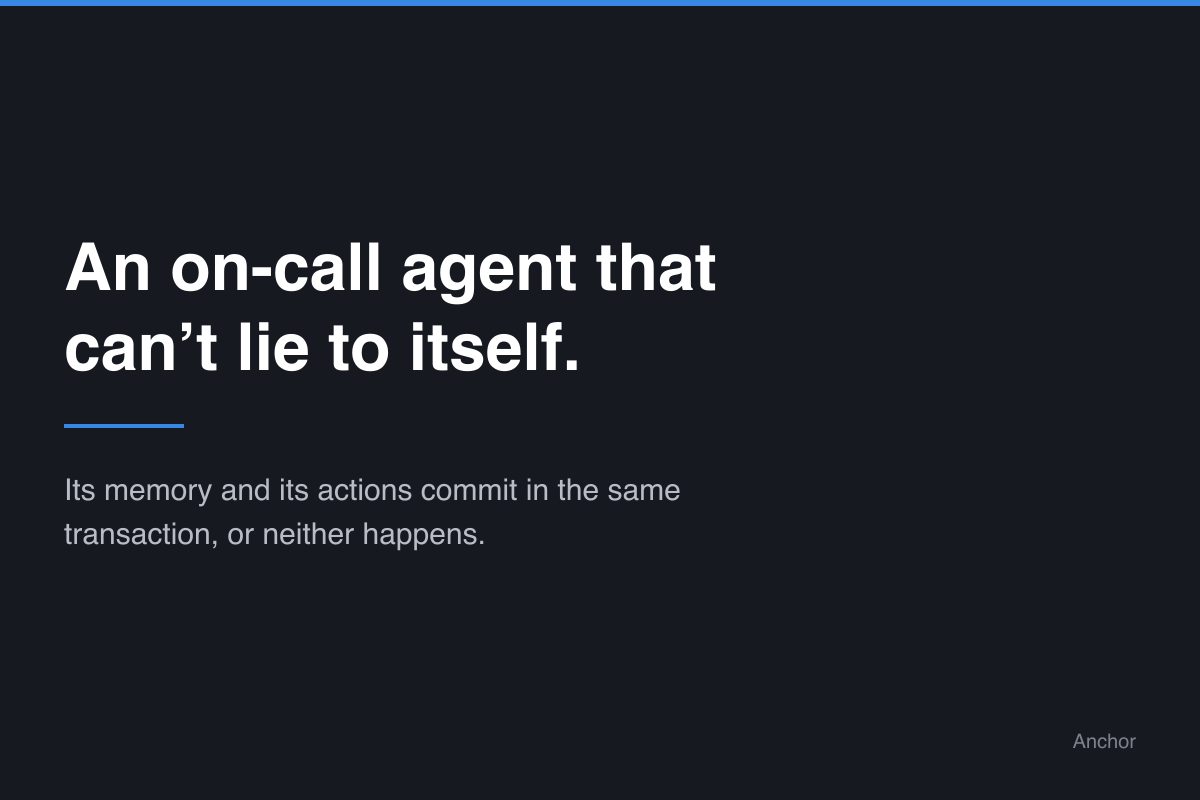
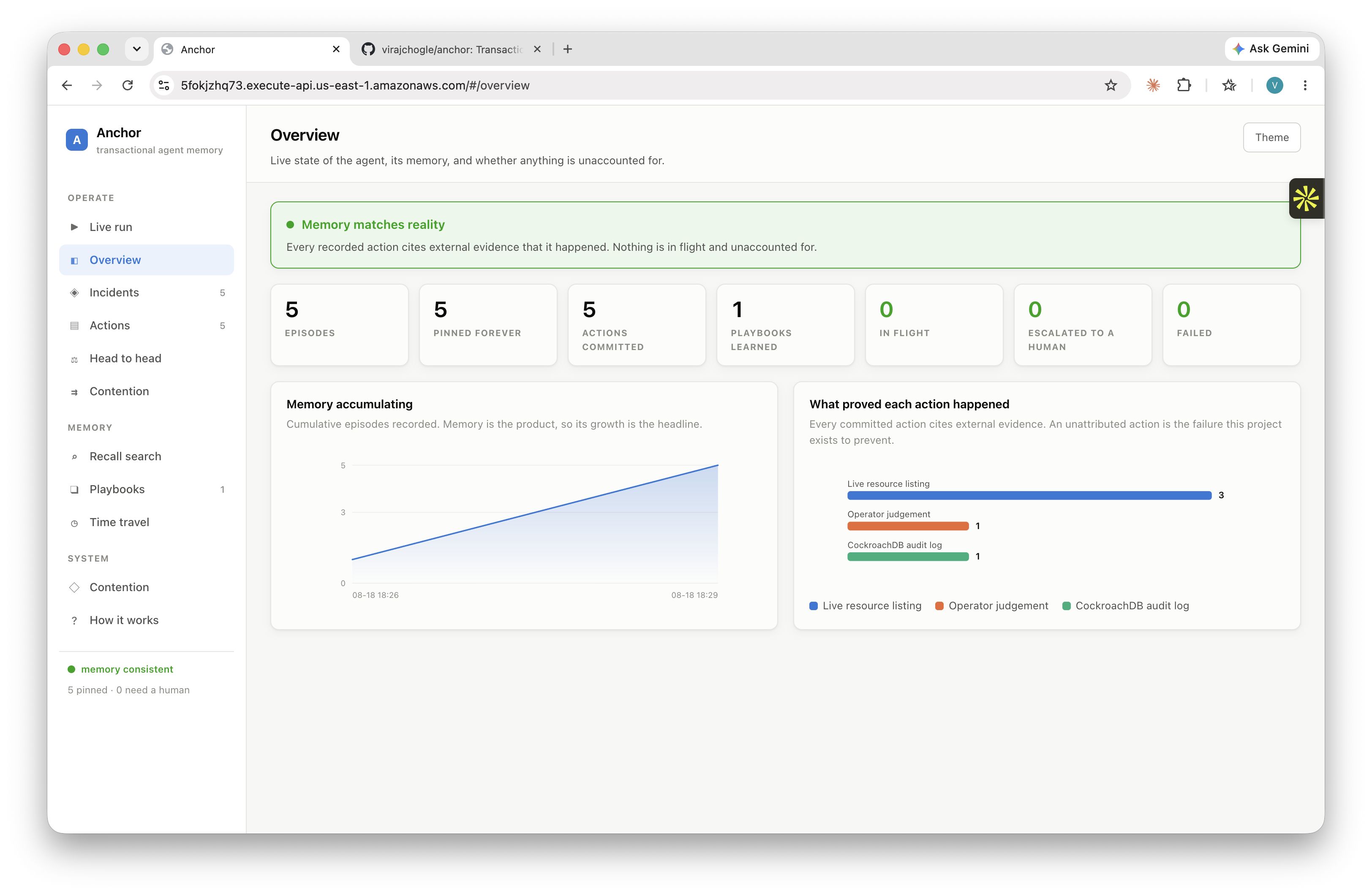
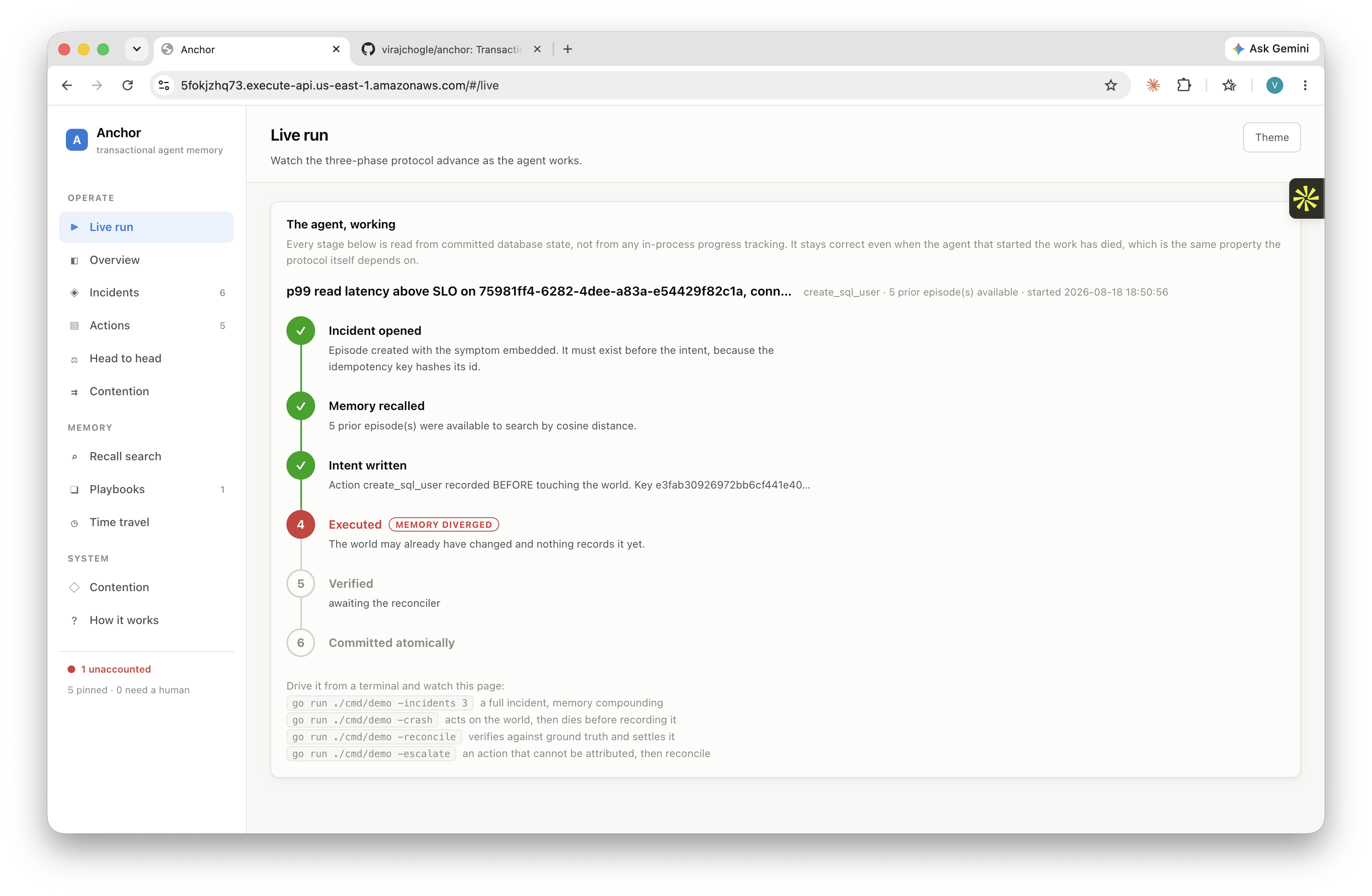
An on-call agent that can't lie to itself. Its memory and its actions commit in the same transaction, or neither happens.
Inspiration
Every agent-memory framework treats memory as storage: write it down, search it later. That's solved.
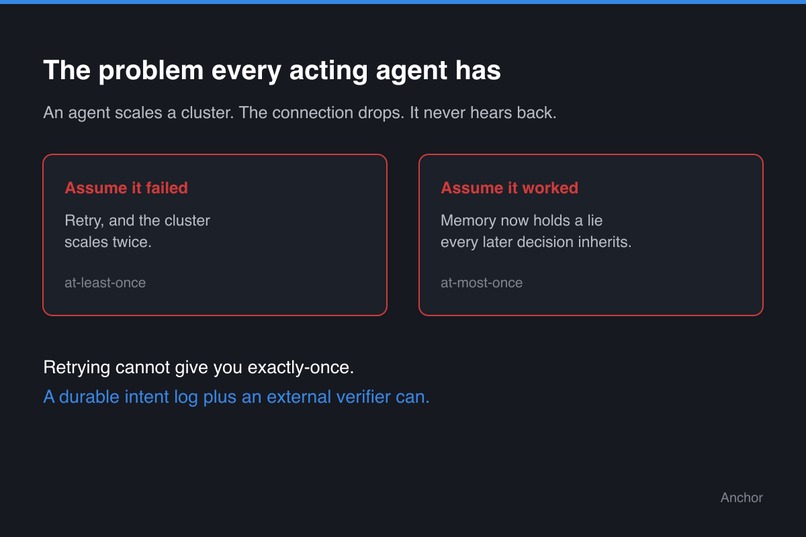
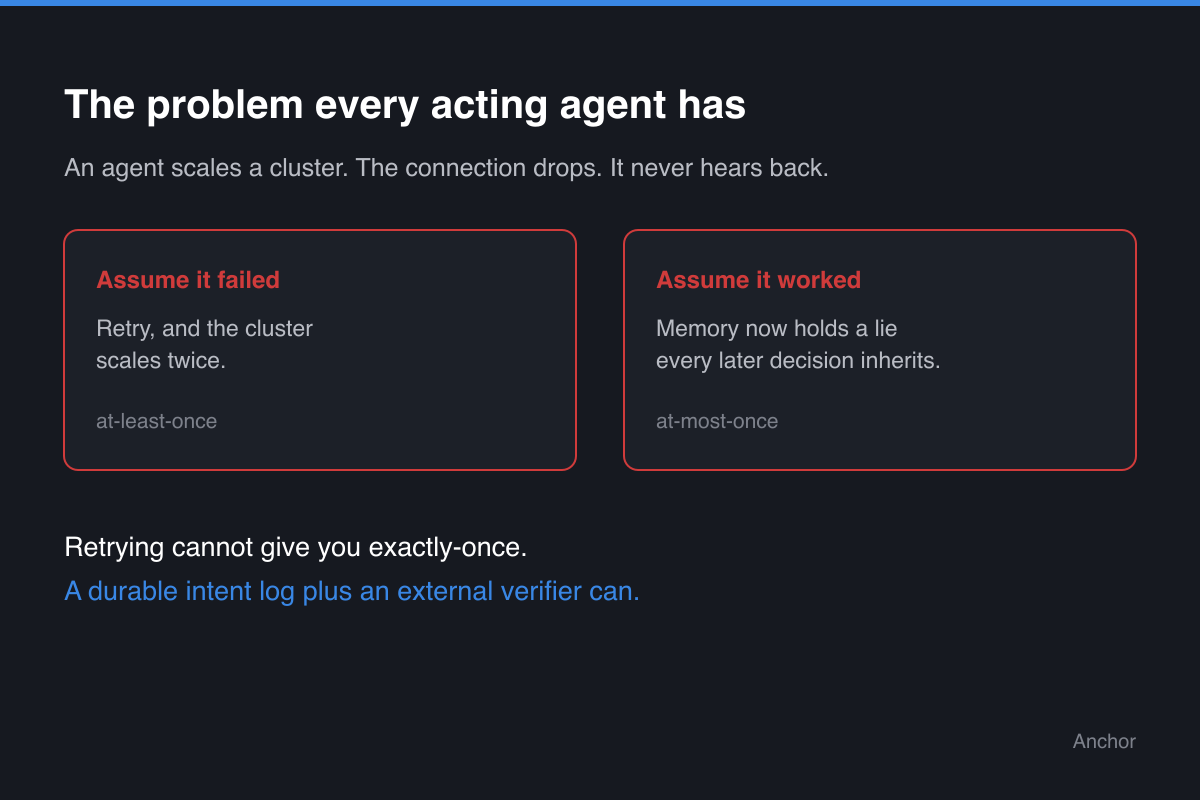
The moment an agent acts, correct memory isn't enough. Its record has to match what actually happened. An agent scales a cluster, the connection drops, and it doesn't know whether it worked. Retry and it scales twice. Assume success and its memory now holds a lie that every later decision inherits.
You cannot achieve exactly-once against a non-idempotent external API by retrying. Retry gets you at-least-once. You get exactly-once by pairing a durable intent log with an external verifier, and that intent log has to commit in the same transaction as the memory write, or the agent's history diverges from reality.
What it does
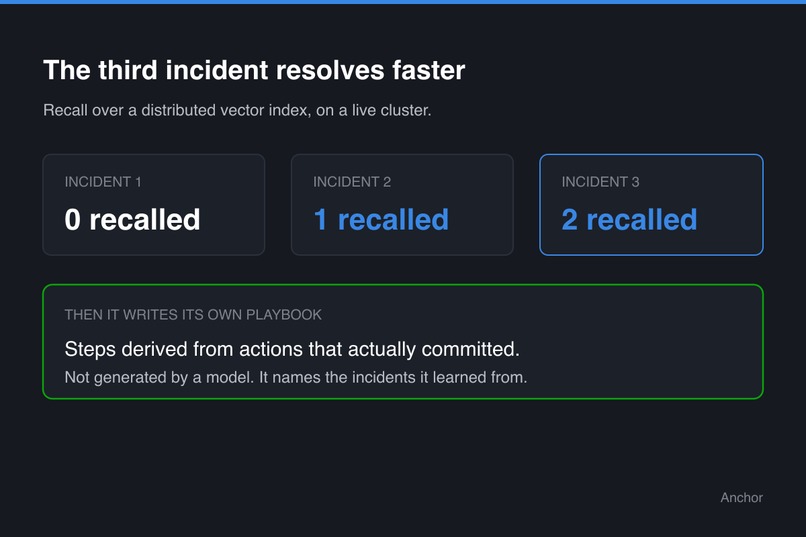
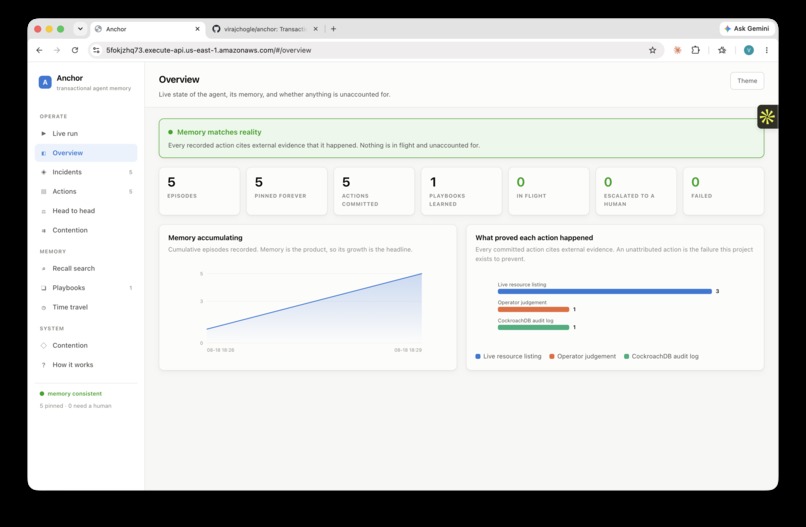
Anchor is an autonomous on-call agent for CockroachDB Cloud. It diagnoses
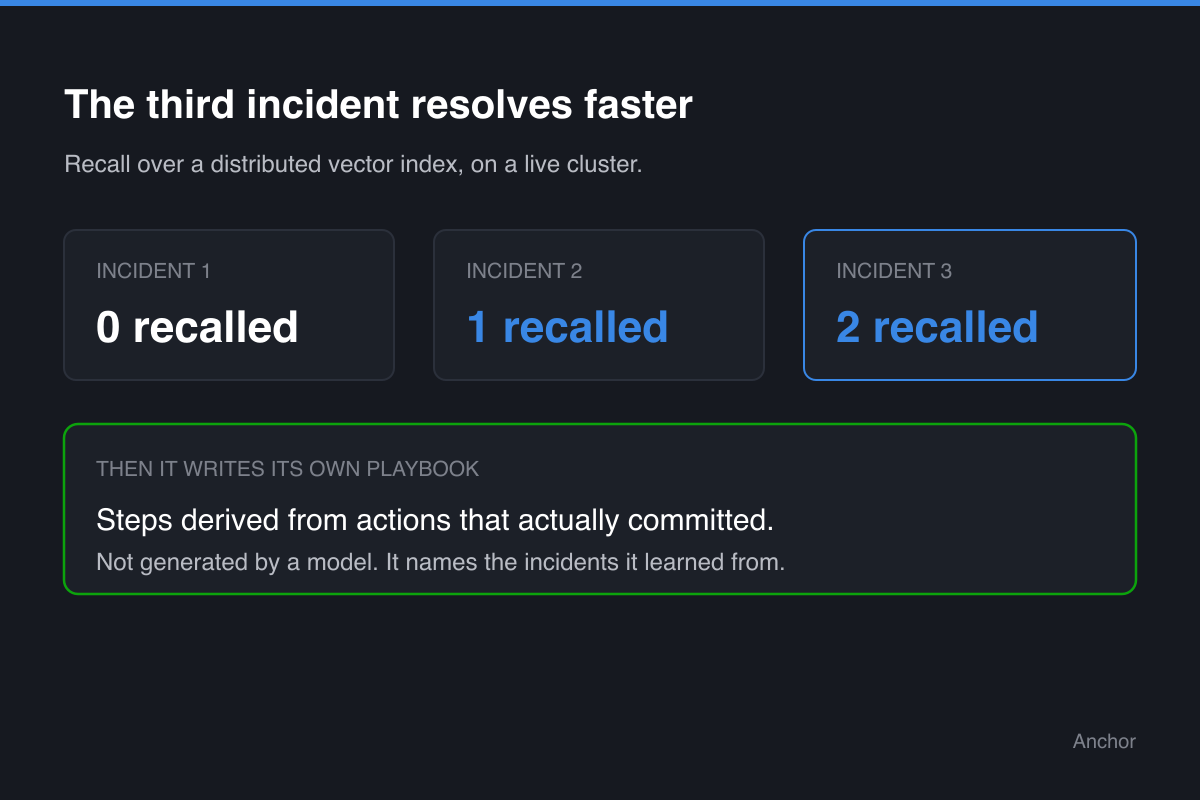
incidents, takes real actions through the ccloud CLI, and gets faster at each
recurring incident class. Its actions are deliberately non-idempotent: creating a
SQL user twice is an error, not a no-op.
How we built it
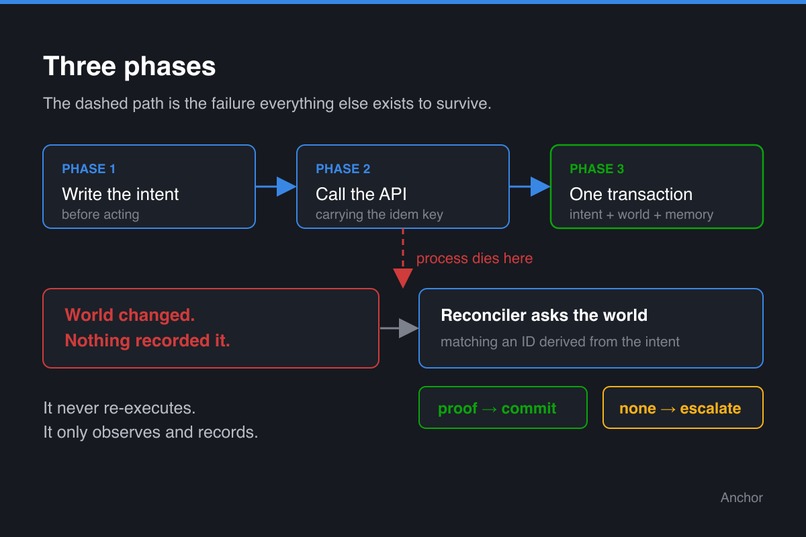
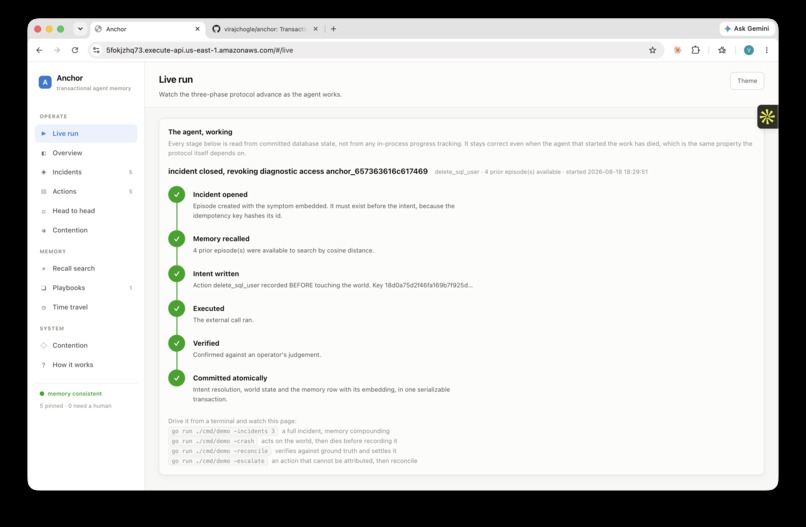
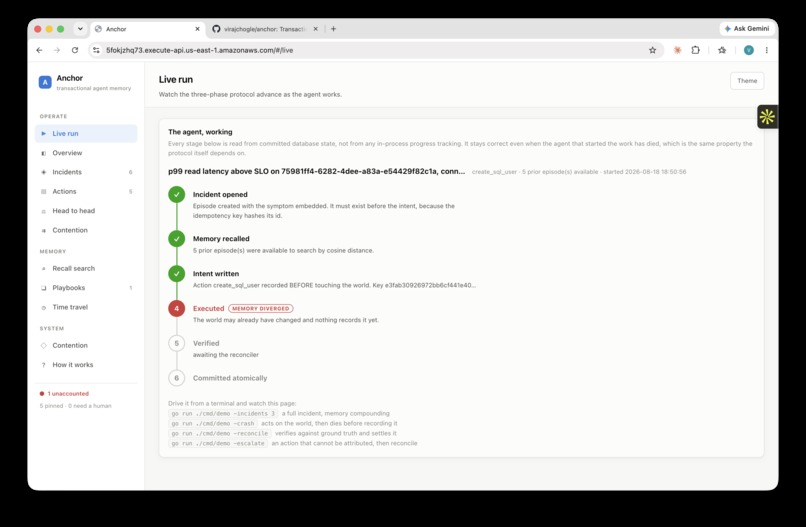
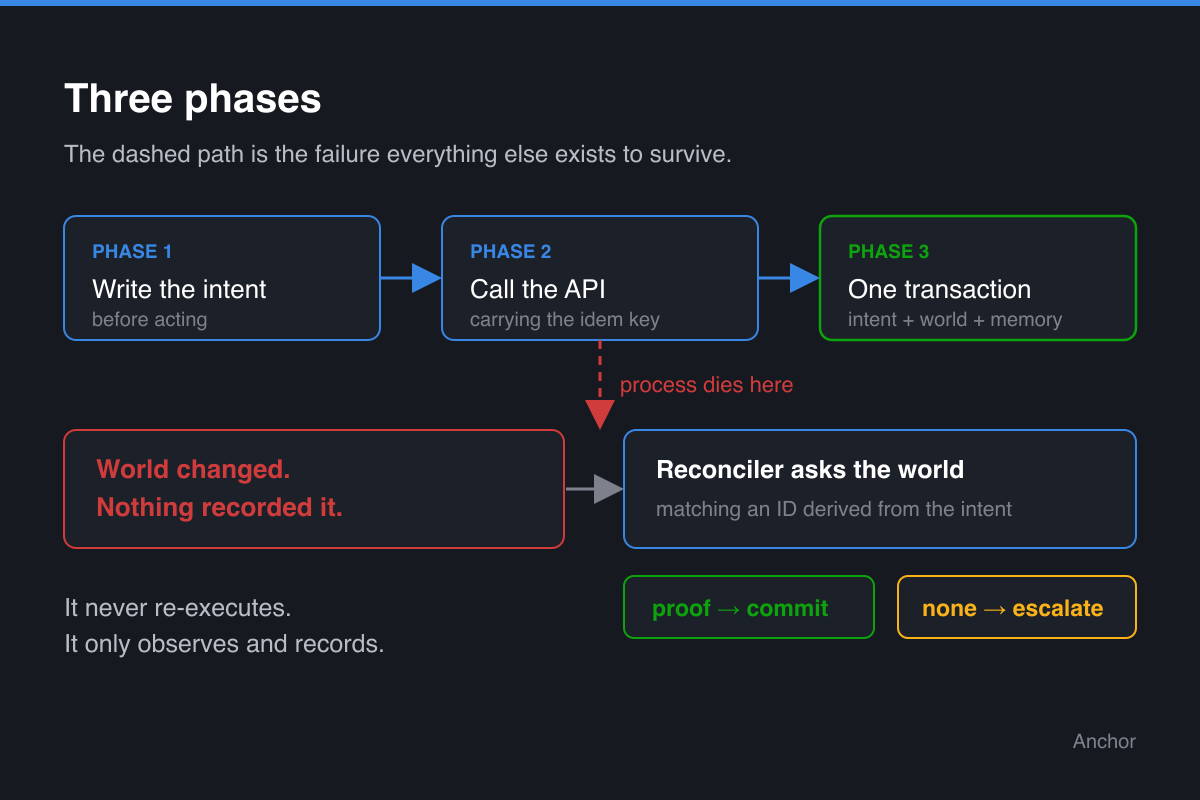
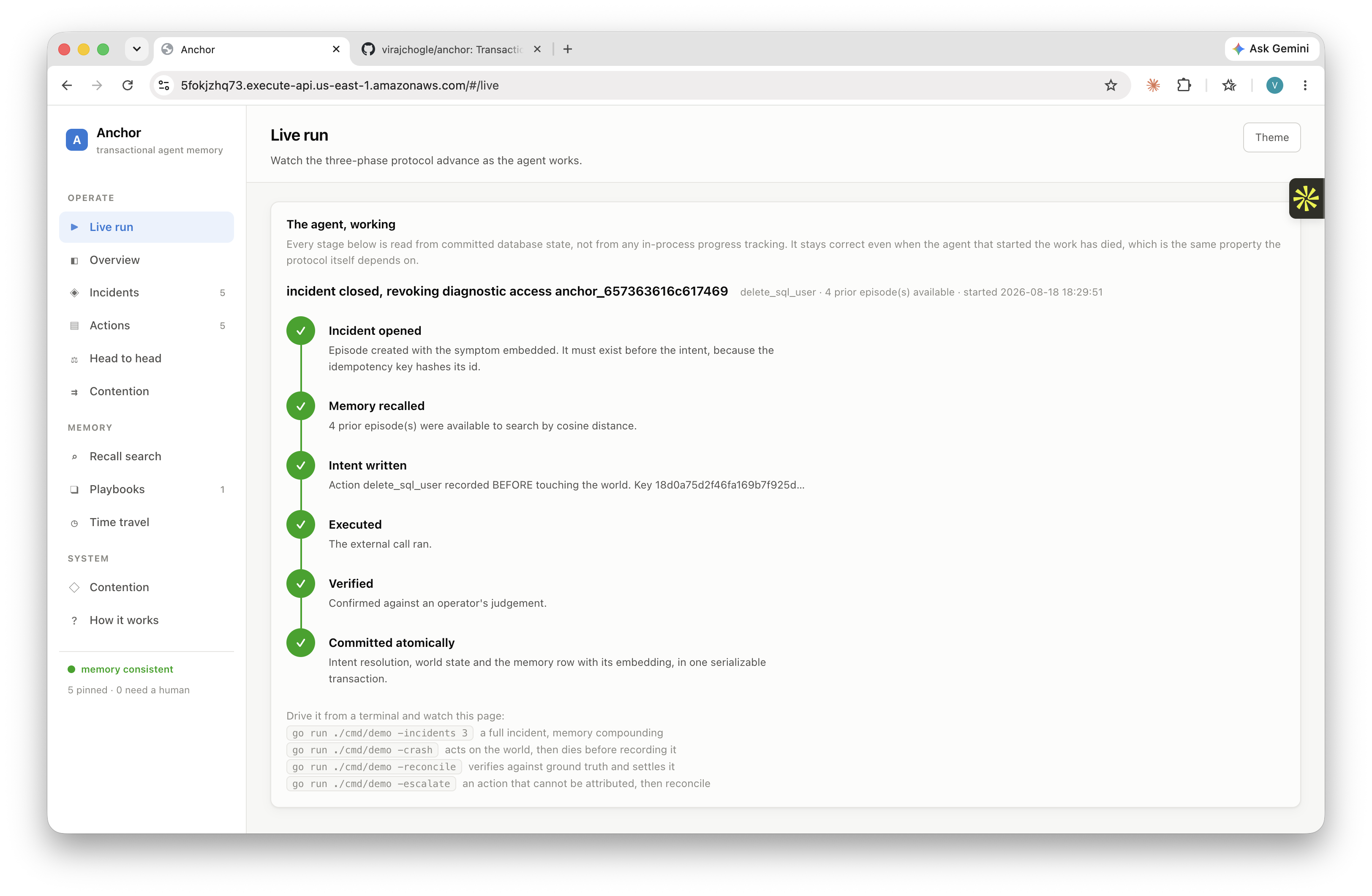
Three phases. Intend writes a durable record before acting, keyed by a
length-prefixed hash so ("ab","c") can't collide with ("a","bc"):
$$\text{idem_key} = \mathrm{SHA256}\big(\ell(\text{episode_id}) \,|\, \ell(\text{action_type}) \,|\, \ell(\mathrm{canonical_json}(\text{args}))\big)$$
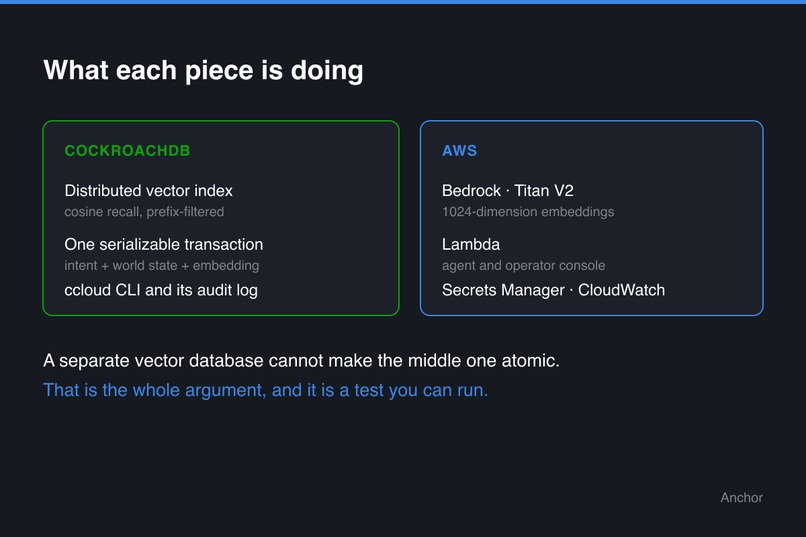
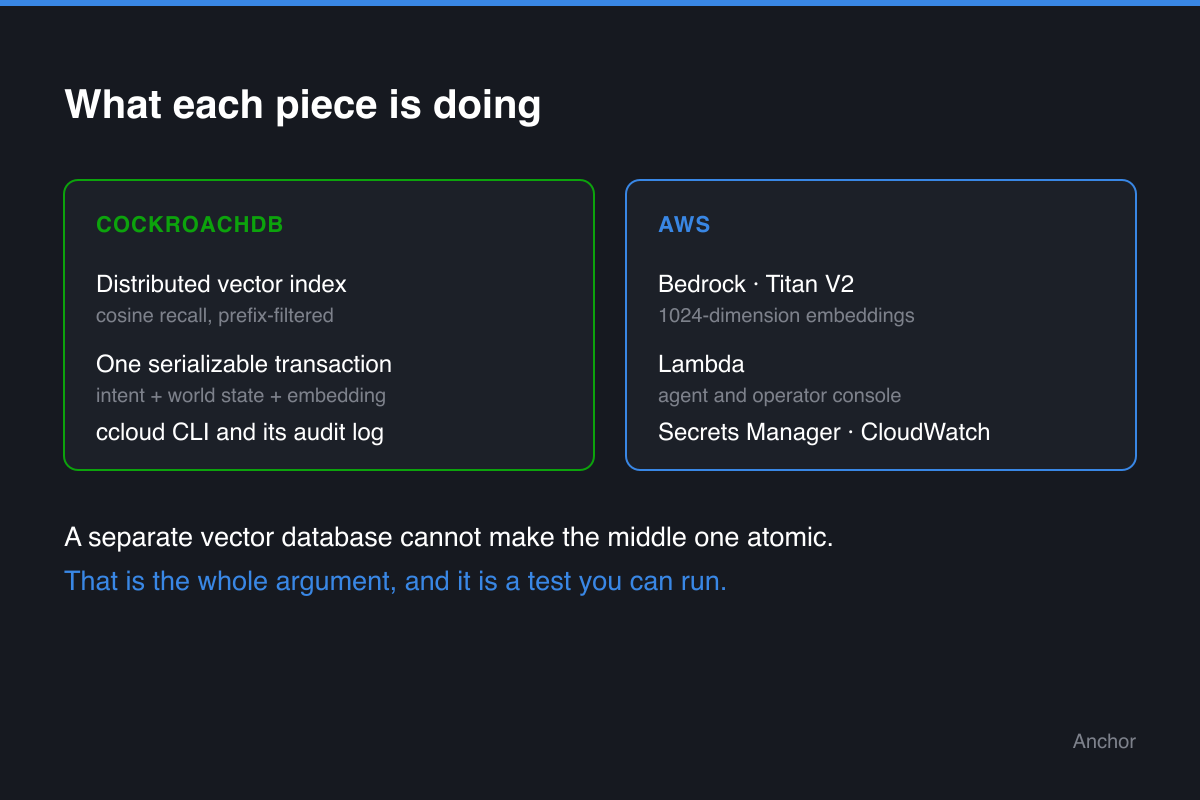
Execute makes the call. Commit writes the intent resolution, world state and the 1024-dimension embedding in one serializable transaction. That transaction is the whole argument.
Two ideas carry the rest. Attribution over observation: the SQL username is
derived from the idempotency key, so an entry in CockroachDB Cloud's audit log
containing it proves this intent ran, rather than that the world merely looks
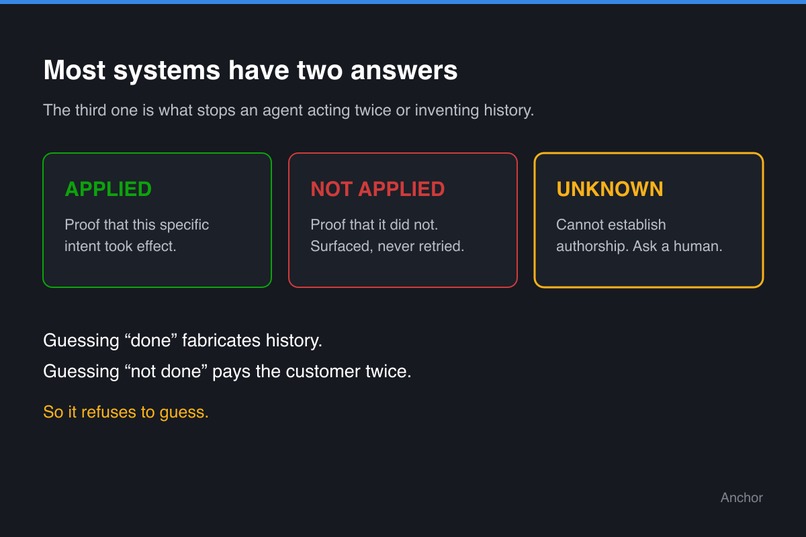
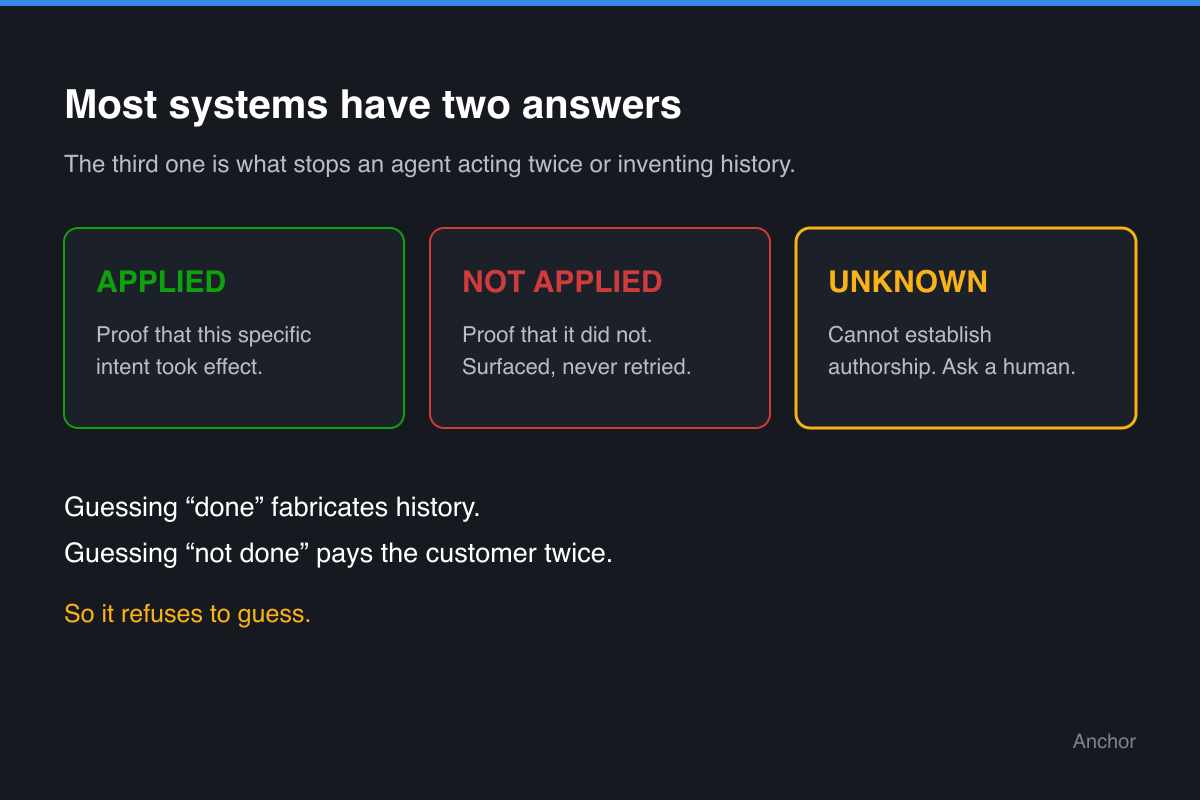
right. And three-valued verdicts: applied, not applied, and Unknown. Where
evidence can't establish authorship, Anchor escalates to a human instead of
guessing, because guessing "done" fabricates history and guessing "not done"
repeats a destructive action.
Go, CockroachDB Cloud with a distributed vector index, Bedrock for embeddings, Lambda serving the agent and console.
Challenges
- Row-level TTL silently fights foreign keys. Accepted at DDL time, then
fails at run time with
23503on exactly the rows that matter. Fixing it produced a better design: memory decays, the record of what the agent did does not. - The vector index degrades silently. Wrong operator or a non-prefix
predicate drops to a full scan with no warning. Both are now
EXPLAINregression tests. - Our own test lied to us. The decay guard was never exercised, so the test passed while doing nothing. We caught it by deleting the guard and noticing. Every load-bearing assertion is now mutation-tested.
- pgx can't bind
VECTOR,crdb_internalis restricted in v26.2, the ccloud CLI can't authenticate with a service account key, and Lambda Function URLs are blocked by default on new AWS accounts. All written up indocs/feedback.md.
What we learned
Exactly-once is a property of a protocol and a verifier together, never the
protocol alone. We learned it the hard way: our delete verifier matched an
audit entry by username, then we realised the username wasn't derived from our
key, so it proved a deletion happened, not that ours did. It now returns
Unknown.
What we're proud of
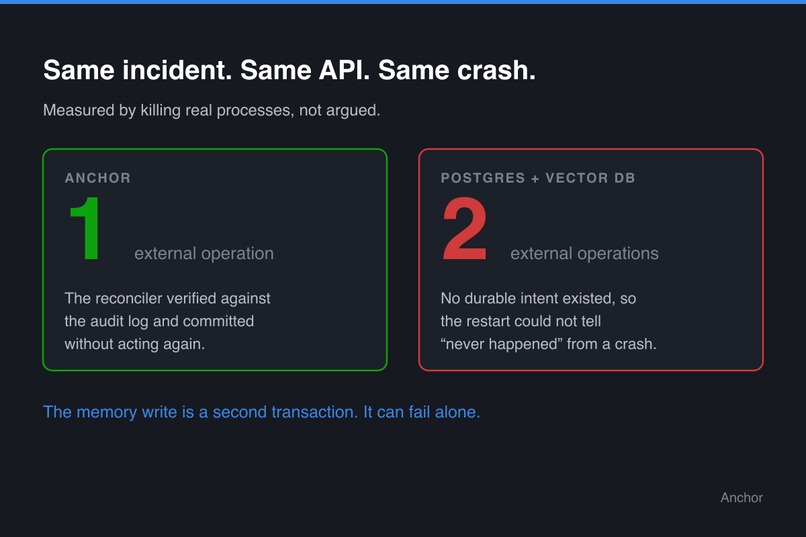
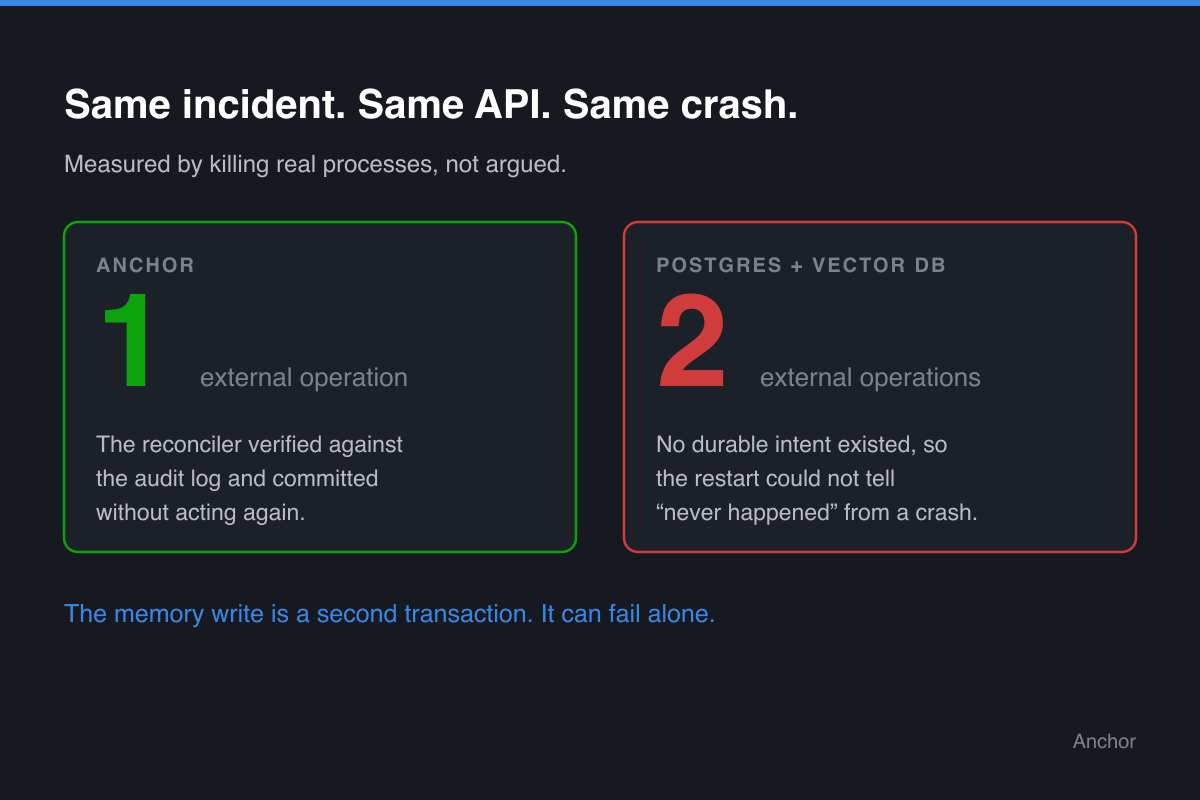
We tested the thesis instead of asserting it. internal/control is a fair
implementation of the standard architecture. Same incident, same API, same crash:
| Scenario | Anchor | Control |
|---|---|---|
| Crash between acting and recording | 1 external operation | 2 external operations |
| Memory write fails, no crash | structurally impossible | world changed, memory empty |
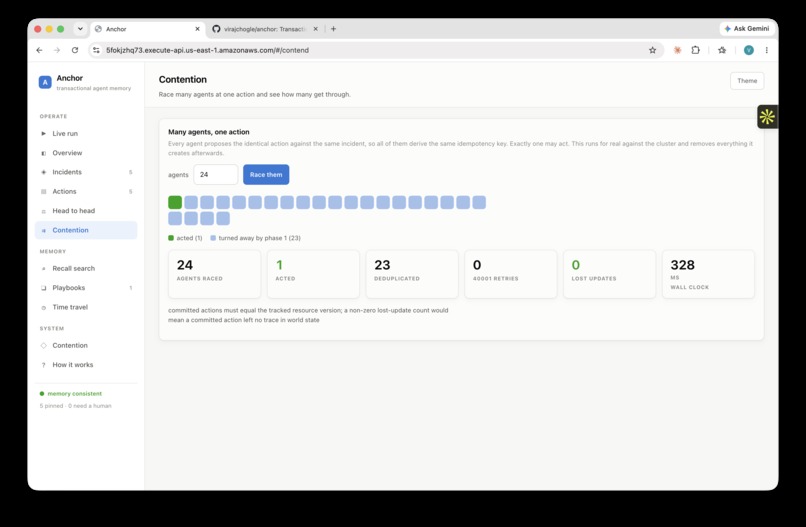
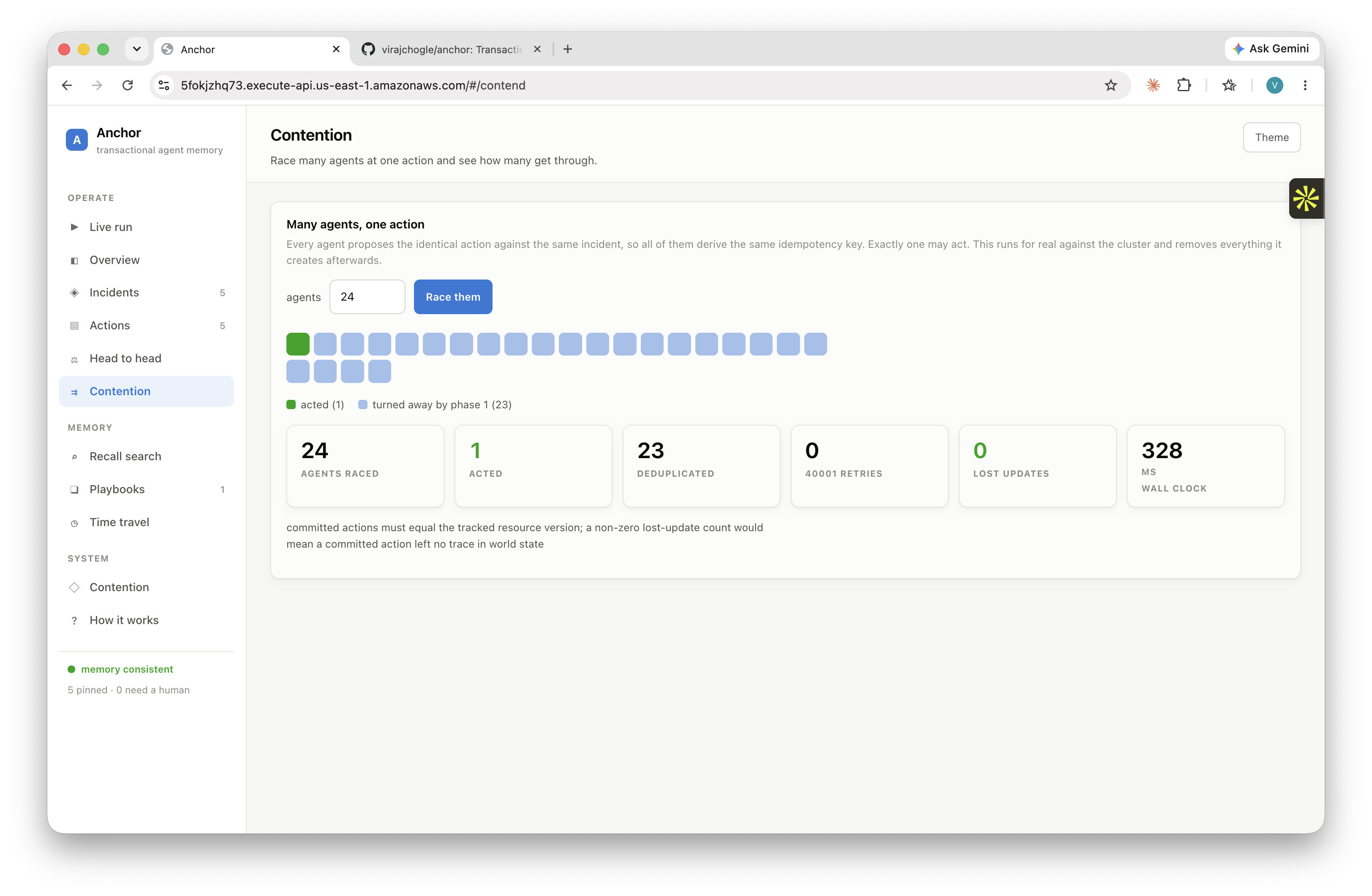
24 concurrent agents on one action: 1 acted, 0 lost updates, 355 ms. 35 tests
pass, including one that kills a real OS process mid-action. And it generalises:
internal/payments implements refunds against the same interface with no protocol
changes, and the same crash doesn't pay a customer twice.
Built With
- agentic-ai
- amazon-api-gateway
- amazon-bedrock
- amazon-cloudwatch
- amazon-titan
- amazon-web-services
- aws-lambda
- aws-secrets-manager
- ccloud-cli
- cockroachdb
- cockroachdb-cloud
- distributed-systems
- docker
- exactly-once
- go
- idempotency
- javascript
- observability
- pgx
- postgresql
- serverless
- sql
- svg
- vector-database
- vector-search


Log in or sign up for Devpost to join the conversation.