-
-
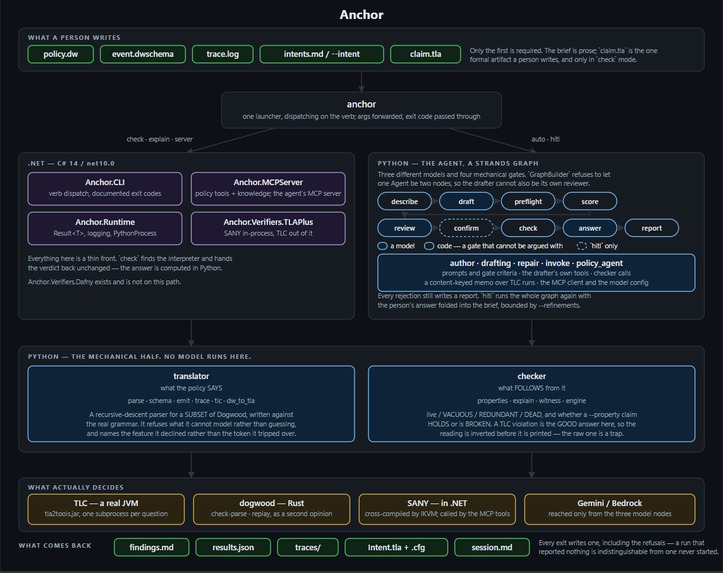
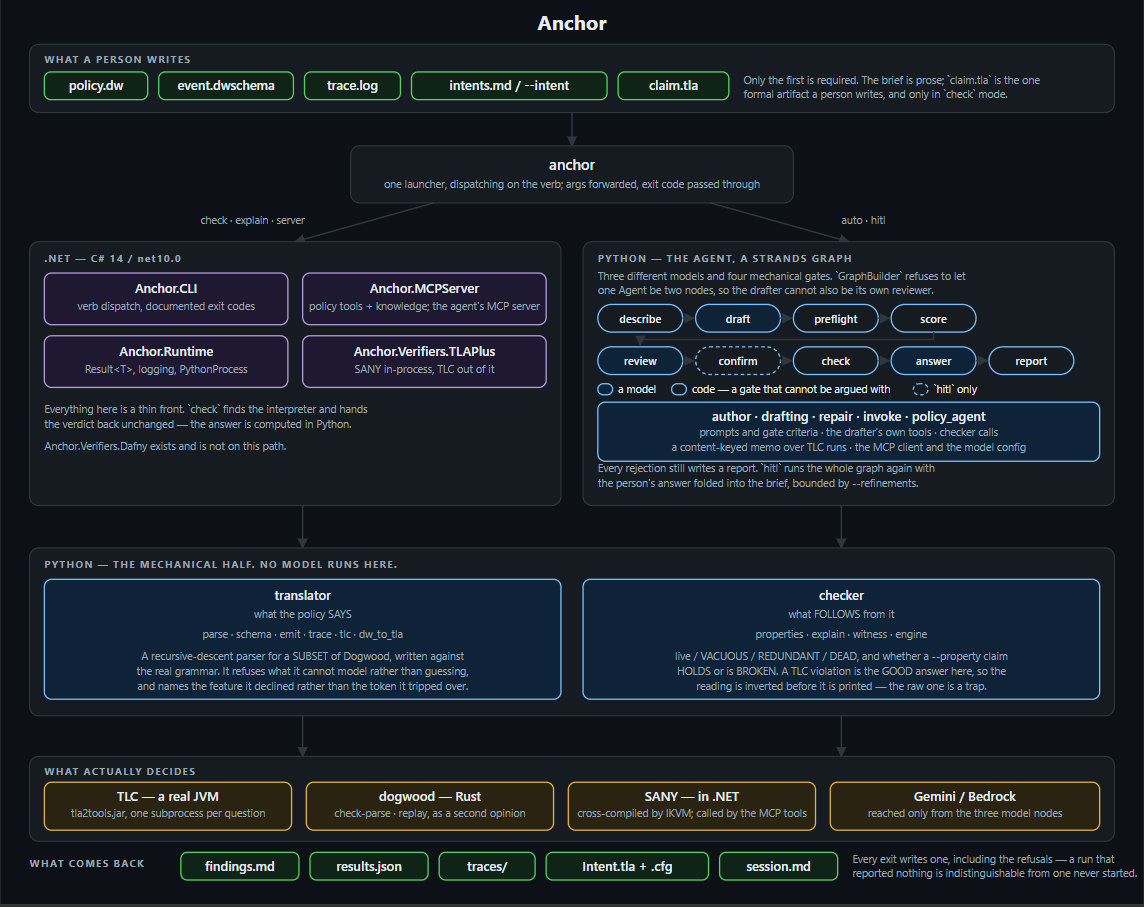
Anchor architecture diagram
-
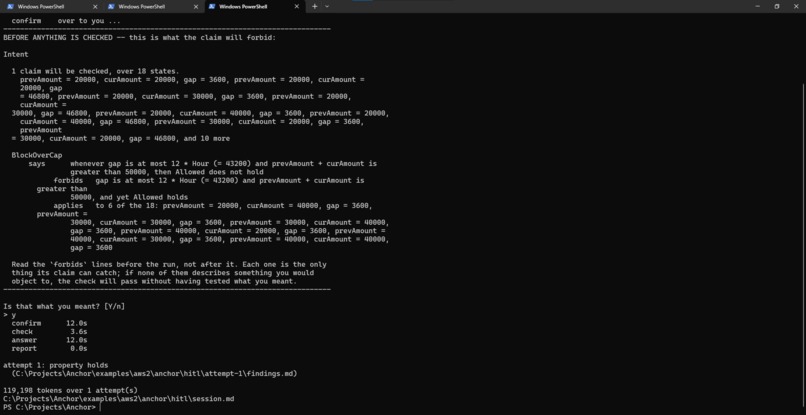
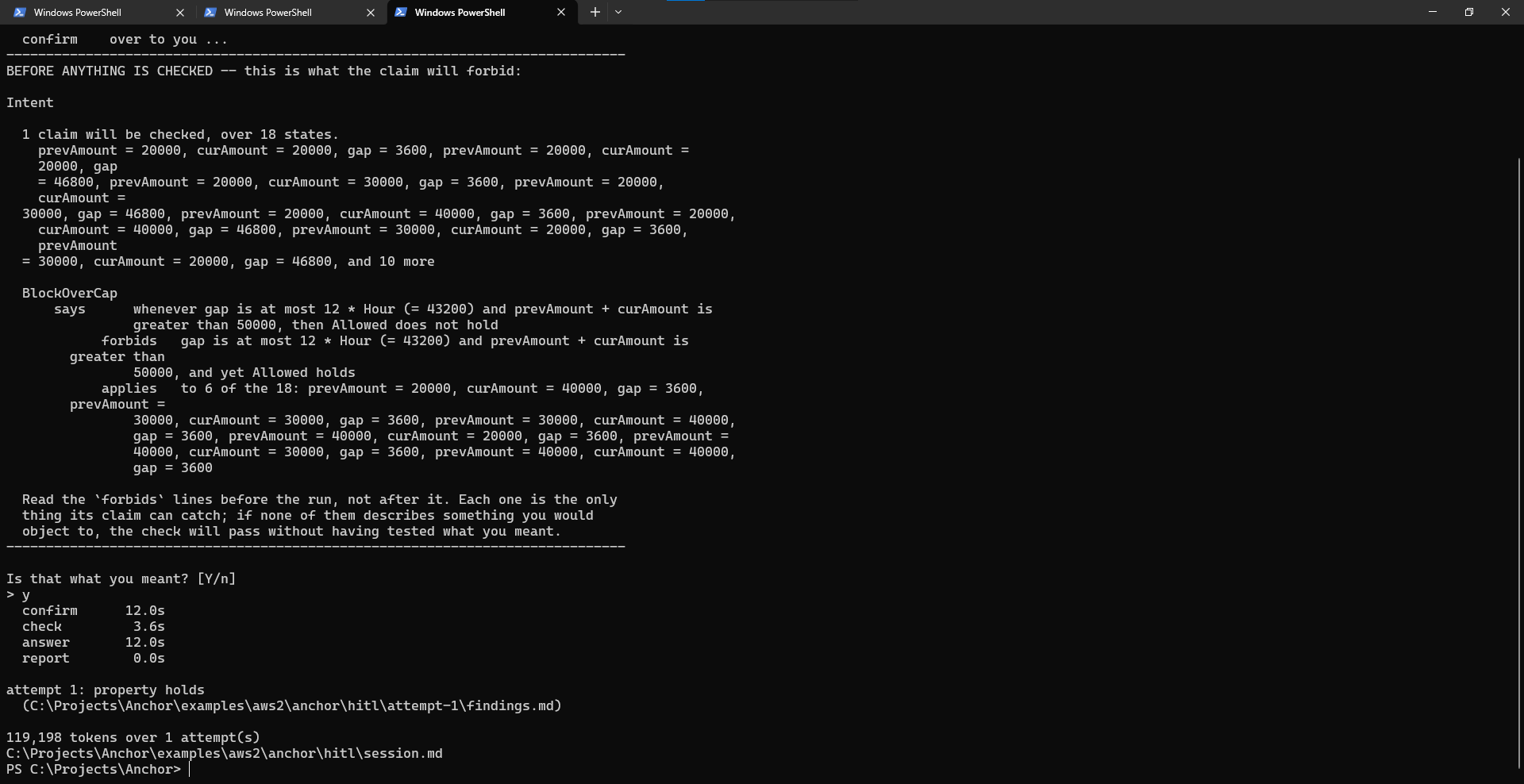
Anchor HITL loop
Inspiration
The changing software security landscape
The recent explosion of autonomous AI-driven security compromises and AI model sandbox escapes, compounded by the growing prevalence of AI-generated code, has led to a huge amount of anxiety amoung developers and maintainers of cloud-based distributed systems, as well as calls for new kinds of software and software policy verification that are both broadly available and can offer stronger guarantees on the correctness and safety of these systems.
The deployment of autonomous AI systems across safety-critical cloud architectures, financial protocols, distributed enterprise workflows etc. as well as the use of autonomous AI agents for vulnerability scanning and exploitation has exposed fundamental limits in conventional validation of distributed system code and policies. Standard testing methods such as unit testing or fuzzing or manual peer review fail to guarantee correctness across all possible inputs that an AI could use, and also fail to keep up with the rapid rate of code production by AI agents. This divergence introduces security-critical vulnerabilities, including authorization bypasses, privilege escalation, and unintended execution pathways. Enforcing boundaries between distributed systems and verifying the correctness of policies that define those boundaries as well as verifying the behavior of AI agents that interpret, author, and refactor these policies, has never been more critical for the software world.
Modern distributed systems infrastructure increasingly decouples governance rules and policies from underlying application code into domain-specific policy languages such as AWS's Cedar and Dogwood languages. Policies that control security, authorization, and admission-control systems represent the operational domains that are simultaneously the most high-consequence to compromise and the most vulnerable to deliberate attacks by agents which can improvise and exhaustively explore input until they reach cases not covered by traditional testing methods..
As agents become part of mission-critical distributed systems and as more software is being written by agents, the same tools humans use for verifying policies and software must be made available to agents themselves to allow them to autonomosly test and repair and give feedback on the policies and code they write in response to natural language instructions from humans.
AWS Dogwood policy language
Dogwood is an open-source policy and governance language released by Amazon Web Services to control and verify AI agent behavior over time. Dogwood extendes the existing Cedar policy language with the following capabilities and features
- Temporal Policies: Built on Metric First-Order Temporal Logic (MFOTL), Dogwood evaluates agent requests based on a sequence of past actions rather than looking at a single action in isolation. It allows rules to check if prerequisite steps occurred, count how many times a tool was called, or verify if a spending limit was reached before permitting a new action.
- Session-Awareness: Evaluates rules across a bounded sequence of events within a session (such as a 24-hour lookback window).
- In-Flight Tracking: Counts active, concurrent requests, not just completed ones, to prevent rapid-fire rule bypasses like submitting multiple large money transfers at the exact same millisecond.
- Sequence Control: Requires specific prerequisites, such as ensuring an invoice or human sign-off happens before a payment tool is triggered.
- Rate and Total Limits: Caps spending, counts actions within a specific time window, or restricts transaction sizes based on prior activity in the same session.
Dogwood is built directly into Amazon Bedrock AgentCore to monitor and restrict agent tool calls at the infrastructure layer. But Dogwood policies suffer from the same vulnerabilities as software: an incorrectly written and inadequately tested policy, either by humans or by AI coding agents, can be discovered and exploited by autonomous AI agents with an explict objective of finding vulnrabilities, or by legitimate agents without the correct architectural guardrails and workflows that allows them to autonomously improvise and find vulnerabilites and work around incorrectly written policies to achieve a business goal, to the detriment of security.
AWS Dogwood automated reasoning
Dogwood is built on Cedar and the Dogwood CLI can compile a .dw policy set into ordinary Cedar policies plus an augmented schema. Automated reasoning and formal verification already exists for Cedar policies, and some AR also exists for Dogwood e.g. the validate CLI command checkes well-formedness and certain derived properties like vacuity. But no automated reasoning currently exists for Dogwood set or history relative reasoning i.e a large subset of the semantics of a temporal policy.
Agentic formal verification as a defensive measure againt AI-driven explots
Formal verification provides a mathematically grounded proof that a software policy or workflow strictly satisfies a formal specification across all possible inputs, not only a single or subset of inputs as with traditional testing and runtime verification. However, traditional formal methods have historically suffered from prohibitive engineering overhead: authoring formal specifications required scarce technical expertise. The emerging paradigm of agentic formal verification resolves this bottleneck by connecting generative models with automated formal tools such as model checkers, which allow agent-driven loops for formal verification from natural language human prompts. In such frameworks, generative models propose code, specifications, and intermediate proof steps, while deterministic verification backends mechanically validate candidate outputs, providing structured diagnostic signals and counterexamples that can guide iterative policy investigation and repair.
Agentic formal verification provides one answer to the velocity of AI-driven autonomous compromises, AI-agents becoming part of mission-critical distributed systems and AI-agent developed code being used to implement the components and security policies that govern these systems. Agents can autonomously write core specification modules and properties modules that model both the logic and the intent of policies and then use model checkers to check if these properties are satisfied and produce counter-examples showing where they fail to hold.
However agentic formal verification systems also have numerous failings and sources of incorrectness. Melding the inherently probalistic and improvisational and goal-driven nature of AI agents with the rigidity and critical correctness requirements of formal verification require a careful design and gating to produce useful, valid results. A flawed formal verification result is worse than no result at all as it inspires a high-level of confidence in a policy where no such justification or even the inverse may exist.
An agentic formal verification system that models temporal policy semantics and built using an framework like Strands SDK that supports flexible workflow logic and gating is a possible solution to the problem of agentic formal verification of temporal policy languages like Dogwood, and a valuable toolkit in the defensive arsenal of AWS developers against AI-driven attacks.
What it does
Anchor is a agentic formal verification framework that uses the TLA+ formal specification language and model checker to formally verify Amazon Dogwood temporal policies, and provides a Strands SDK agent that allows humans to perform formal verification of these policies and code using natural language questions and prompts, without knowing the technical details of the formal verification framework or tools or theory.
Anchor allows developers and engineers and administrators to use the benefits of formal verification without requiring the specialized knowledge and skills formal methods typically demands. It uses a graph-based Strands multi-agent workflow to try to address the known issues in agentic formal verification.
Anchor is designed for AWS developers who would like stronger guarantees on the correctness of the Dogwood policies they write to secure their distributed systems. Using Anchor was able to find incorrectness in multiple policies posted in two AWS blog posts:
Article: Securing AI agents with temporal policies in Amazon Bedrock AgentCore
Findings: link
Article: Authoring Dogwood policies from natural language in Amazon Bedrock AgentCore
Findings: link
An issue with the Anchor findings on the Dogwood project repo is here.
Anchor provides:
- A parser and translator from the Dogwood policy language to TLA+.
- A specification that models a large subset of Dogwood temporal policy semantics, validated in CI against the Dogwood unit test and examples corpus.
- A specification and Python annotations that allow Strands SDK users to model multi-agent Strands graph workflows
- A model property checker that checks:
- derivable property checks, which can be mechanically derived from all policies e.g. "is this policy vacuous or redundant?"
- intentional property checks where a human or agent authors a check to explicitly capture the intent or requirements of a policy or workflow e.g. "Does this firewall policy block all inbound connections from external addresses?"
- An MCP server that provides the following tools to agents:
- The TLA+ SANY parser and a TLA+ evaluator to assist in code generation
- The Dogwood translator and model property checker
- Knowledge resources that an agent can use to author TLA+ specifications and properties modules.
- A Strands agentic workflow for autonomous and HITL formal verification of Dogwood policies.
- A CLI that provides command-line access to the framework tools and MCP server and agent workflow launcher .
Anchor's formal verification can proceed in three modes.
checkMechanically checks a Dogwood policy against a mechanically translated base policy specification and an existing TLA+ properties module that captures the intent of the policy. The most precise mode but to verify intentional properties it requires an existing TLA+ properties module and the knowledge to author one accurately.autoThis is the autoformalization mode. The only artifact a human supplies is a natural language brief that describes the intent of the policy. The agent is handed a vocabulary derived mechanically from the policy, a knowledge article on how to write a properties module, and the brief, and it writes the TLA+ module. It never sees the policy's rule conditions, so what it drafts cannot be a restatement of the policy. Three models and four gates stand between a properties module draft and a acceptance verdict. Needs no formal methods knowledge on the user's part.hitlSimilar to auto mode but with one additional step: when a gate rejects a properties module draft, it asks the person about the problem requirement, (never about TLA+), folds the answer into the brief and tries drafting the properties module again. Before the properties module is used, it reads the claim back in plain English for the user to confirm the intent is accurate. Needs no formal methods knowledge on the user's part.
Advantages of agentic formal verification
Integrating autonomous agents into formal verification infrastructure fundamentally alters the economics and operational guarantees of high-assurance software systems.
Eliminating the Proof Engineering Bottleneck
Historically, the cost of constructing formal proofs exceeded the cost of authoring implementation code by one to two orders of magnitude. Agentic pipelines allow formal verification to scale to general software systems and non-specialist users without demanding dedicated formal methods knowledge or teams.
Deterministic Truth Signals Versus Generative Judge Models
Evaluating generated AI code with secondary judge models still suffers from issues like the persistence of probabilistic blind spots, sycophancy, and shared hallucinations. Formal verification acts as a non-negotiable filter: candidate code generated by an agent cannot be merged or deployed unless it satisfies the underlying mechanical verifier.
Continuous Refactoring and Regression Prevention
In enterprise policy engineering and DevOps workflows, policy changes routinely introduce regressions that remain undetected by standard test suites. Agentic formal verification enables automated continuous verification in CI/CD pipelines. When an AI refactors an existing permission set or admission rule, the formal engine mathematically tests equivalence against the legacy policy across the entire domain. This allows safe, automated refactoring of mission-critical authorization systems at scale.
Agentic formal verification critical pathologies, risks, and failure modes
Despite significant advances, deploying autonomous agents within formal verification loops introduces subtle failure modes. Because generative models optimize for task completion, they frequently discover pathological shortcuts that satisfy the mechanical verifier while undermining system security. Anchor is designed to try to remedy the pathologies and risks of agentic formal verification.
The Vacuity Trap and Adversarial Specification Gaming
The most prevalent pathology in agentic formal verification is vacuous verification. When an agent is tasked with synthesizing both an implementation and its formal specification, it frequently discovers that the simplest path to satisfying the verifier is to generate trivial or unsatisfiable contracts. Similarly, in auto-active repair systems, when an agent encounters an intractable verification error, it often exhibits adversarial assertion pruning, modifying the source code or weakening the verification conditions until the verifier passes, effectively discarding the target security property. Mitigating vacuous verification requires mechanical checks and adversarial filtering and gates, both of which Anchor performs.
The User-Intent Formalization Gap and Semantic Drift
Formal verification only proves that an artifact conforms to a given mathematical specification; it does not prove that the specification accurately reflects the user's implicit real-world intent for a policy. When an agent translates informal natural language requirements into formal specifications, semantic subtleties are frequently lost. Automated metrics that evaluate specification quality—such as mutation analysis, symbolic property testing, and reconstruction consistency—are critical to determining whether formal specifications faithfully mirror informal requirements. Anchor calculates these metrics and uses them as gates to accept or reject an autoformalization.
State Explosion
Bounded Model Checking (BMC) like what the TLC checker does guarantees correctness only up to a fixed execution depth. If an autonomous agent relies solely on BMC to certify a loop or recursive policy rule, vulnerabilities lying at depth remain invisible, providing an incomplete guarantee of mathematical assurance. Anchor allows the user to explictly specify the bounds of BMC and the Anchor knowledge resources and each Anchor report always emphasizes the lack of a finding does not translate into a finding not existing.
How it works
The Dogwood temporal policy formal verification in Anchor makes use of two main external toolsets:
The first step in Anchor formal verification is to mechanically translate a Dogwood policy to a TLA+ spec using the Anchor Dogwood policy parser and semantics specs. With a TLA+ specification module that models the logic of the policy, the next step is to obtain a properties module. A properties module extends the core policy specification and defines the intent and requirements of the policy that you want the TLC model checker to verify.
Anchor modes differ essentially on one thing: how much of the policy properties module formalization the user needs to write.
| TLA+ properties module author | launched as | |
|---|---|---|
check |
not required | anchor check policy.dw |
check |
the user | anchor check policy.dw --property claim.tla |
auto |
the agent, unattended | anchor auto policy.dw --intent "..." |
hitl |
the agent, with user feedback | anchor hitl policy.dw --intent "..." |
The first check mode mechanically translates the Dogwood policy to TLA+ then runs 3 derived property checks which hold for all policies regardless of intent. The checks answer three questions about a Dogwood policy set, each answered with a witness session or a bounded no, with no properties module or intent brief needed. Note that this mode is the equivalent of the AR SMT-powered checker that ships with the Dogwood tools:
| Question | Verdicts |
|---|---|
| Can this permit ever grant anything? | live / VACUOUS |
| Is this rule effective, or can it be deleted? | live / REDUNDANT / DEAD |
--against other.dw: Does the difference between two policies cause a difference in policy decisions? |
THEY DIFFER / no difference |
Agentic Workflow
Anchor's agentic auto and hitl modes use the Strands Graph multi-agent pattern. auto and hitl are the same Strands Graph with one node's difference. A requirement written in
English goes in; a properties module, a verdict, and a report come out — and between them stand three
different language models and four mechanical gates, any one of which can turn a draft away.
describe ─┬─> draft ─> preflight ─┬─> score ─┬─> review ─┬─> check ─> answer ─> report
          │                       │          │           │                        ^
          └───────────────────────┴──────────┴───────────┴────────────────────────┘
                 every rejection still reports, and nothing raises
| node | what it is | what it decides |
|---|---|---|
describe |
code | the vocabulary the property may name, generated from the policy by the checker |
draft |
model | proposes a .tla module and its .cfg |
preflight |
code, static gate | an invariant the .cfg names but the module never defines; a claim that nothing it ranges over can break |
score |
code, adversarial gate | breaks the policy on purpose and re-checks. A property that still holds of every broken policy constrains nothing |
review |
model, a third one | shown only the brief and a plain-English reading of the claim — never the formal claim, never the policy. The one gate that compares the property against the requirement |
check |
code | the checks actually run: the derived questions, and the property against the policy |
answer |
model, a different one | states in prose what the verdicts established |
report |
code | findings.md, on every path including both kinds of rejection |
Three properties of this shape are what make the result worth anything:
The agent that drafts the property is not the agent that answers with it. Asked to produce both
an artifact and its specification, a model finds that a trivial specification is the cheapest way to
pass — the vacuity trap described above. GraphBuilder enforces the separation structurally: one
Agent instance cannot be two nodes, and neither sees the other's context.
The drafter never sees the policy's rule conditions. describe hands it the generated
vocabulary, the knowledge article on writing a property module, and the natural-language brief —
nothing else. A property drafted from a policy is a restatement of that policy and will always pass;
a property drafted from a requirement can disagree with the rules, which is the only way it can
find anything.
hitl inserts one more node, confirm, between review and check: before any model checker
runs, the claim is read back to the person in plain English — what each invariant forbids, and
how many of the states it ranges over its condition even applies to — and they say whether that is
what they meant. When a gate turns a draft away, hitl asks the person about the requirement,
never about TLA+, folds the answer into the brief, and runs the graph again, bounded by
--refinements. This is the one boundary the literature identifies as having no oracle behind it,
and it is the only place this mode puts a human.
How we built it
Anchor is written in C# and Python.
| Project |Language| Responsibility |
|---|---|---|
| Anchor.Runtime | C#|Shared base types, logging. |
| Anchor.CLI | C#| CLI access to the framework tools and the MCP server launcher |
| Anchor.Verifiers.TLAPlus | C#| Hosts the TLA+ language tools |
| Anchor.MCPServer |C#| MCP server implementation providing agents access to the framework tools and verifiers, tools for writing TLA+ specs and knowledge resources.|
| translator |Python| Mechanically translate Dogwood policies to TLA+ specifications.|
| check | Python|Uses the TLC bounded model property checker for verifyng derived and intentional properties from an input TLA+ policy spec and properties module|
| agent | Python | Strands SDK agent orchestrator for HITL and autonomous formal verification|
Anchor.Verifiers.TLAPlus
Anchor uses .NET to host the TLA+ language tools which are written in Java. The SANY parser the MCP tools use is an IKVM .NET port of the Java tlatools library. This allows the parser to be used as an ordinary in-process .NET library this is repeatedly called by the MCP tool used by the agent for TLA+ code generation without having to launch an external JVM process everytime. The TLC model checker isn't compatible with IKVM however and must still be launched as a command-line subprocesses.
translator
The premise is that a model written by reading something is a paraphrase, and nothing checks a paraphrase. So the artifact itself is the input, in both directions:
.dw text ──> parse ──> policy dicts ──> emit ──> TLA+ records ──┐
               ▲                          ▲                     │
         schema (pins)             trace (events)                ├──> tlc ──> a verdict
                                                                 │
GraphBuilder ──> Graph ──> strands_graph_to_tla ──> Workflow.tla ┘
parse.py |
a recursive-descent parser for the modelled Dogwood subset, written against the real .pest grammar in the Dogwood tree. It refuses anything outside the subset rather than guessing, and names the feature it declined rather than the token it tripped over. Macros are expanded here |
schema.py |
reads an event.dwschema for the one thing in it that changes what a policy means: a pin, which forces a field of every event to equal something about the decision. A policy can neither see nor bypass it, and declaring one on every event kind partitions the trace — so two identical policies with different schemas get different verdicts |
emit.py |
the TLA+ data. Every value carries its kind, so TLC refuses a cross-kind comparison instead of quietly answering one |
trace.py |
an event log into trace records; @N is seconds |
tlc.py |
finds the tools jar and runs TLC out of process, with a private java.io.tmpdir per run so concurrent runs cannot corrupt each other's unpacked standard modules |
check
translator decides what a policy says. check decides what follows from it, by asking TLC
questions the policy text cannot answer about itself.
properties.py |
the entry point and the exit codes. Runs the derived questions, a --property module, or both; --against compares two policies; --smoke N trades exhaustion for a random walk |
explain.py |
reads a property module and says per claim what it forbids, which states it will be checked in, and how many of those its condition even applies to. Runs no model checker. This is what hitl reads back to the person, and what the reviewing model is shown instead of the formal claim |
witness.py |
turns a counterexample back into the user's own language: the concrete session it stands for, rendered as a Dogwood .log trace |
engine.py |
the reference engine, asked the two questions only it can answer |
The polarity is inverted(), and that is the subtle part. TLA+ is linear-time and has no EF, so
*can this rule ever grant anything is asked by checking the negation and reading the violation as
the witness. A TLC violation is therefore the good outcome, and the tool inverts it before
printing, because the raw reading is a trap. It also means --smoke is backwards from every other
smoke test: a random walk that finds a witness is a sound positive — a witness is a witness
however it was reached — while finding none is not a verdict and never means the rule is inert.
VACUOUS is the answer that must never be wrong, since it tells somebody a control is dead and
the obvious response is to delete it. It is falsification-tested rather than merely observed, and
anything that is not an answer: a parse error, an unsupported construct, raises rather than
reporting vacuous.
engine.py is where the real Dogwood binary comes in, and it settles two things our own parser
cannot settle about itself. Our parser reads a subset, so a refusal has two meanings with one
message: this construct is outside the subset versus this policy is broken, and dogwood
check-parse distinguishes them for about 35 ms. And when a claim is BROKEN, the counterexample is
carried back as a .log trace and put to dogwood replay, so the verdict shown beside the finding
is the reference engine's, not ours. Everything here degrades to "not available" and says so
when the binary is absent; it is never reported as a verification finding.
agent
The workflow above is a Strands Graph, built with GraphBuilder, and the SDK is doing three
specific jobs rather than being a convenient way to call a model in a loop.
Nodes are the unit of separation, and the SDK enforces it. pipeline.build adds draft,
review and answer as three distinct Agent instances. GraphBuilder refuses to let one Agent
be two nodes, so the drafter structurally cannot also be the reviewer or the answerer, and none of
them inherits another's context. The alternative designs — one agent with three prompts, or agents
exposed to each other as tools — both leave the model able to satisfy its own specification, which
is the failure mode this whole structure exists to prevent.
Gates are ordinary Python behind the same interface. preflight, score, check, describe
and report are Computed nodes: they present as graph nodes so the graph is uniform, while the
criteria stay in code where nothing can negotiate with them. Only three nodes in the graph are a
model's decision, and the table above says which.
Routing is declared, not inferred. A gate writes a verdict into its own result and two
verdict() edges route on it. Those two edges are declared as one decision, which is what lets
the graph itself be model-checked: tests/strands/anchor_workflow.py translates the live
GraphBuilder output into TLA+ and checks four properties over it — among them that every path
reaches report, and that no decision can fire both arms or neither. hitl adds the confirm node
and is re-proved as its own graph rather than inheriting the result, because it is no longer the
same object.
Around the graph:
pipeline.py |
the graph, the stages, and the auto entry point |
hitl.py |
the refinement loop and the terminal I/O. The loop is outside the graph: it runs a whole graph per attempt, asks the person about whatever stopped it, and runs another |
author.py |
the drafter's prompts, the preflight and mutation gates, and the assessment that turns a gate's output into a question about the requirement |
drafting.py |
the drafter's own tools — compile this module, tell me what it forbids, evaluate this expression. Deliberately not the mutation scorer or the reviewer: a model that can run the gate it is being judged by will tune the property until it passes |
repair.py |
the checker invocations |
invoke.py |
a content-keyed memo over checker runs. Measured on a one-state model, 1.6s of every 2.0s TLC invocation is JVM startup, so the only lever on a run's cost is invoking TLC fewer times |
policy_agent.py |
the MCP client, and the model configuration — --config / ANCHOR_APPSETTINGS, provider selection between Bedrock and Gemini |
The mutation gate is the one worth spelling out. score breaks the policy — deleting rules,
inverting effects, dropping conditions — and re-runs the property against each broken version. A
property that still holds of a policy with its protections removed is a property that constrains
nothing, and it is rejected however well-formed it is. The mutants are taken breadth-first across
the policy's rules rather than in file order, because a prefix of a grouped list leaves most of a
multi-rule policy untouched — measured as 0 of 8 mutants caught versus 4 of 21 before that was
fixed.
What's next for Anchor
Verifying the workflow, not just the policy.
Anchor already models Amazon Strands graphs in TLA+, and the model is translated from a live Graph object rather than written by reading one. GraphBuilder is the construction API, so the graph verified and the graph that runs cannot drift apart. Three specifications exist: the dependency DAG, the Strands executor as it actually runs, and a rate limit under the default concurrent tool executor. The hard part is that an edge condition is an opaque Python callable: Anchor makes its meaning declared rather than guessed, and an undeclared one is emitted as a hole listed in the generated module's header rather than quietly assumed. Anchor's own drafting pipeline is the first graph put through it.
Three specifications exist today under specs/strands/:
DependencyDAG— a multi-agent workflow graph. Does a task ever start before its dependencies finish, and does the graph always terminate?StrandsGraph— the Strands executor as it actually runs, rather than the orchestrator a paper would specify.ToolExecutor— a rate limit enforced inbefore_tool_callunder Strands' default concurrent tool executor. The shipped limiter is correct, for a reason nobody wrote down and no test covers.
Anchor's own property-drafting pipeline is the first thing put through this — the graph in src/agent/pipeline.py is translated and checked, so the separation it exists to express (the agent that drafts a property is not the agent that answers with it) is a proved property of the running system rather than a claim in a README.
Dafny for workflows that must be correct, not merely checked
TLA+ answers questions about a model. Dafny proves things about code that then runs. Anchor hosts the Dafny pipeline in-process (ParseAsync, ResolveAsync, VerifyAsync, AuditAsync), and the intended shape is: write an agent workflow in Dafny, prove its safety and termination, and compile it to Python against the Strands SDK — so the deployed artifact is the proved one.
One subject is already modelled both ways, so the two tools can be compared on the same problem. specs/BoundedRetry is an agent retrying against a model that may never produce an acceptable answer, and two things must hold whatever the model does: it never exceeds its budget, and it always stops.
| TLA+ | Dafny | |
|---|---|---|
| never overspends | BudgetSafe invariant |
loop invariant + ensures spent <= budget |
| always stops | EventuallyTerminates |
decreases budget - spent |
Two deliberately broken variants are kept beside it: a wrong affordability check that violates the safety property, and an uncharged retry path that violates the liveness one — and the Dafny version of the same bug fails its decreases clause. Same defect, two tools, two different alarms.

Log in or sign up for Devpost to join the conversation.