-
-
The ultimate inventory command center for Amazon sellers
Inspiration
Amazon sellers lose money in two opposite ways: stockouts (lost sales, lower ranking, unhappy customers) and overstock (cash frozen in storage fees). Most tools show a spreadsheet of numbers but never say what is wrong, why it matters, or what to do next. We wanted a tool that acts like a calm, friendly business partner: it tells you what needs attention first, explains it in simple language, and helps you act.
What it does
Anchor AI is an inventory intelligence web app:
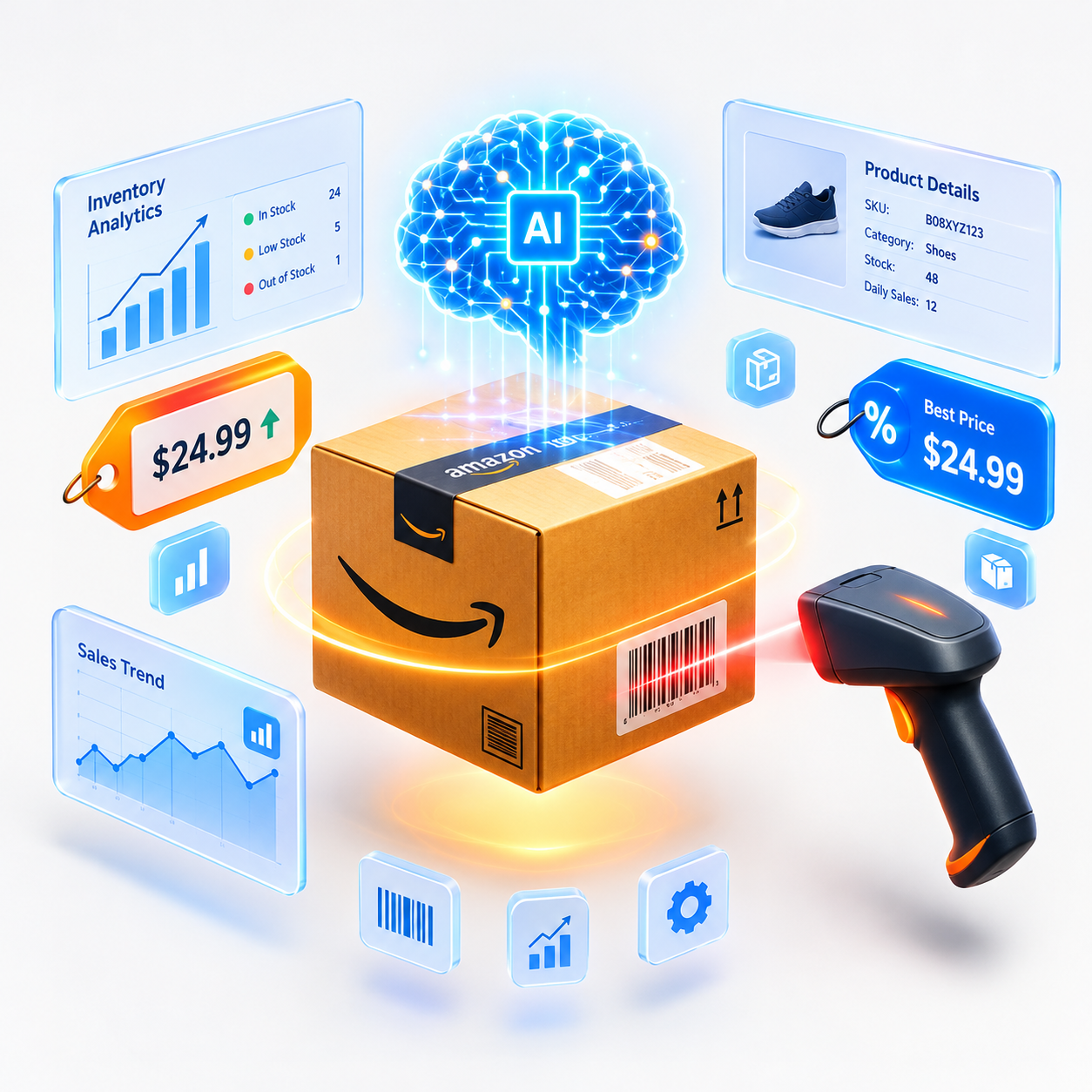
- Inventory dashboard:total SKUs, inventory value, low-stock and overstock counts, inbound units and a health score, with filters and charts (stock by category, days of cover, sales velocity, forecasted stockout dates).
- SKU management: create, edit, delete, search, filter, sort, CSV import and export.
- Risk engine: for every SKU it calculates sales velocity, days of cover, reorder point, recommended reorder quantity and date, and classifies it as Healthy, Low Stock, Critical Stockout Risk, Overstock, Slow Moving or Stranded, with a plain-language explanation.
- Scan & Count: scan a product barcode with a phone camera (or a USB scanner), then receive a shipment, do a cycle count or mark damaged units. Discrepancies are flagged, every change is audited, and the risk rating updates instantly.
- AI Business Partner: a chat assistant for stock levels, reorders, overstock, profit margins and pricing strategy. Every number comes from the user's own data.
- Orders & Deliveries: orders received, parcels delivered, in transit, returns and repeat customers (anonymous IDs), plus a CSV import.
- Accounts and security: sign up with email or Google, with admin, manager and viewer roles.
- Voice (in progress): an Alexa skill that adds and queries inventory by voice, with spoken confirmation before any change. All demo data is synthetic and labelled as such.
How we built it
- Frontend: Next.js, React and Tailwind CSS, in plain JavaScript, with a dark, responsive, accessible design.
- Backend: a Fastify (Node.js) REST API in layers: routes, services, repositories and pure domain logic. Every input is validated with Zod, requests are rate limited, and each user can only see their own data.
- Auth: Supabase Auth (email and Google). The backend verifies every token server-side and enforces roles.
- Risk engine: transparent formulas, not a black box. Velocity is 60% of the 30-day average plus 40% of the 90-day average; reorder point is velocity times lead time plus safety stock; every result is labelled an estimate.
- AI partner:a grounded design. A calculation layer produces the answer from real numbers, and an optional model (Amazon Bedrock) can only rewrite it in a friendlier voice. It has no tools and no write access, and it falls back to the built-in analyst if the model fails.
- Barcodes: browser camera scanning with the BarcodeDetector API, and EAN-13 barcode labels drawn in SVG so the demo can be scanned from a screen.
- Demo data: 30 SKUs across five categories, 90 days of sales, and thousands of synthetic orders generated so that units ordered match units sold.
- Quality: 51 automated tests (risk rules, RBAC, CSV import, injection-style input, order analytics, assistant answers). Deployed on Vercel.
Challenges we ran into
- Making the AI trustworthy. Models invent numbers, so the assistant's numbers come only from the calculation layer, and it says what it does not know (no competitor prices, no demand data).
- Buyer privacy.Amazon restricts buyer details, so customers are anonymous IDs and the importer rejects names and emails.
- Honest demo data on a serverless host.An in-memory store does not survive across Vercel instances, so we made the demo data deterministic and labelled it clearly.
- Auth and deployment. Supabase redirects, CORS and auth modes took careful debugging to get working on Vercel and on phones.
- Time. We built and shipped it in a very short deadline window.
Accomplishments that we're proud of
- A complete loop: scan a barcode, change stock, and watch a risk badge flip from critical to healthy in real time.
- Every recommendation comes with a reason in plain words.
- Security basics done properly: server-side verification, roles, validation, audit log and tests.
- An AI partner that is useful without ever making up a number.
What we learned
- Grounding beats prompting: calculate first, then let AI explain.
- Trust comes from showing evidence and labelling estimates.
- Privacy by design is easier than fixing it later.
- Serverless hosting changes how you think about state.
What's next for Anchor AI
Alexa voice assistant (our track, in progress). Sellers are often in the warehouse with their hands full, so we are adding Alexa as a hands-free way to manage inventory. For example, a seller says: "Alexa, tell Anchor to add 20 body lotions to my inventory." Alexa turns the voice into a request, our backend reads it, asks "Add 20 body lotion?" and, after a spoken "yes", adds it and Alexa replies out loud. They could also ask "What is running low?", "How many yoga mats do I have?" or *"What should I reorder today?", answered by the same engine as our AI Business Partner.
How we are building it:
- A custom Alexa skill that understands the intent and the product and quantity from speech.
- Account linking, so Alexa knows which seller's inventory to use.
- A secure endpoint that calls our existing API, with the same server-side checks as the web app: validation, roles and an audit log. -Confirmation before any change. Alexa never changes stock without a spoken "yes".
- Voice-added items are saved as drafts. A voice command carries only a name and a quantity, so the item appears in the dashboard marked "needs details" (price, cost, supplier) to finish in the app.
Status: designed and in development. It is not yet tested on a real Alexa device.
Also planned:
- Persistent storage (Supabase Postgres; the schema is already designed).
- Amazon Selling Partner API sync for FBA inventory.
- 7, 30 and 60-day demand forecasting with seasonality, and manual adjustments.
- Auto-generated tasks, supplier and purchase-order tracking.
- Chat that can propose stock changes, with user confirmation.
- Wider barcode support on iPhone and push notifications.
Anchor AI is an independent project and is not affiliated with Amazon. All inventory, order and customer data in the demo is synthetic.
Built With
- fastify
- google-oauth
- javascript
- next.js
- node.js
- react
- supabase
- svg
- tailwindcss
- vercel
- vitest
- web-apis
- zod

Log in or sign up for Devpost to join the conversation.