-
-
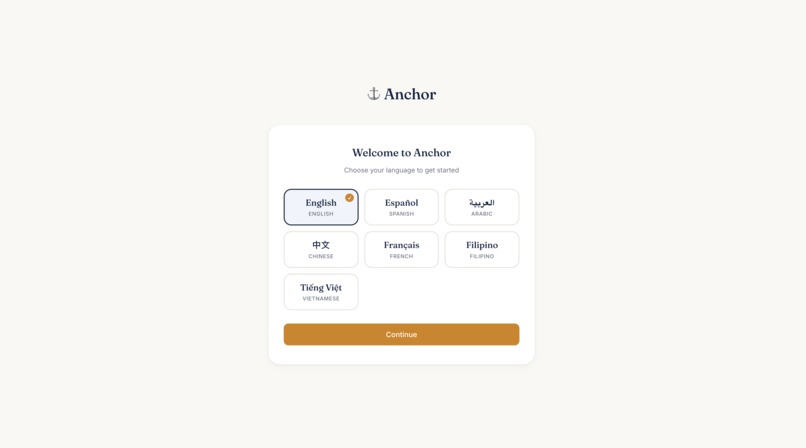
Anchor Language Selection Screen
-
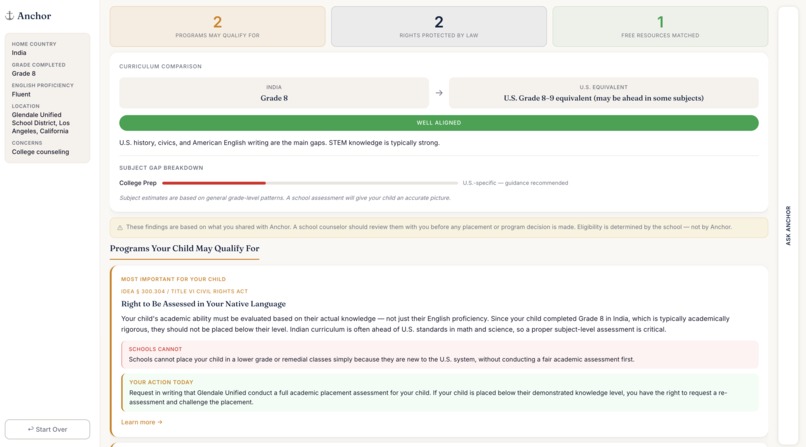
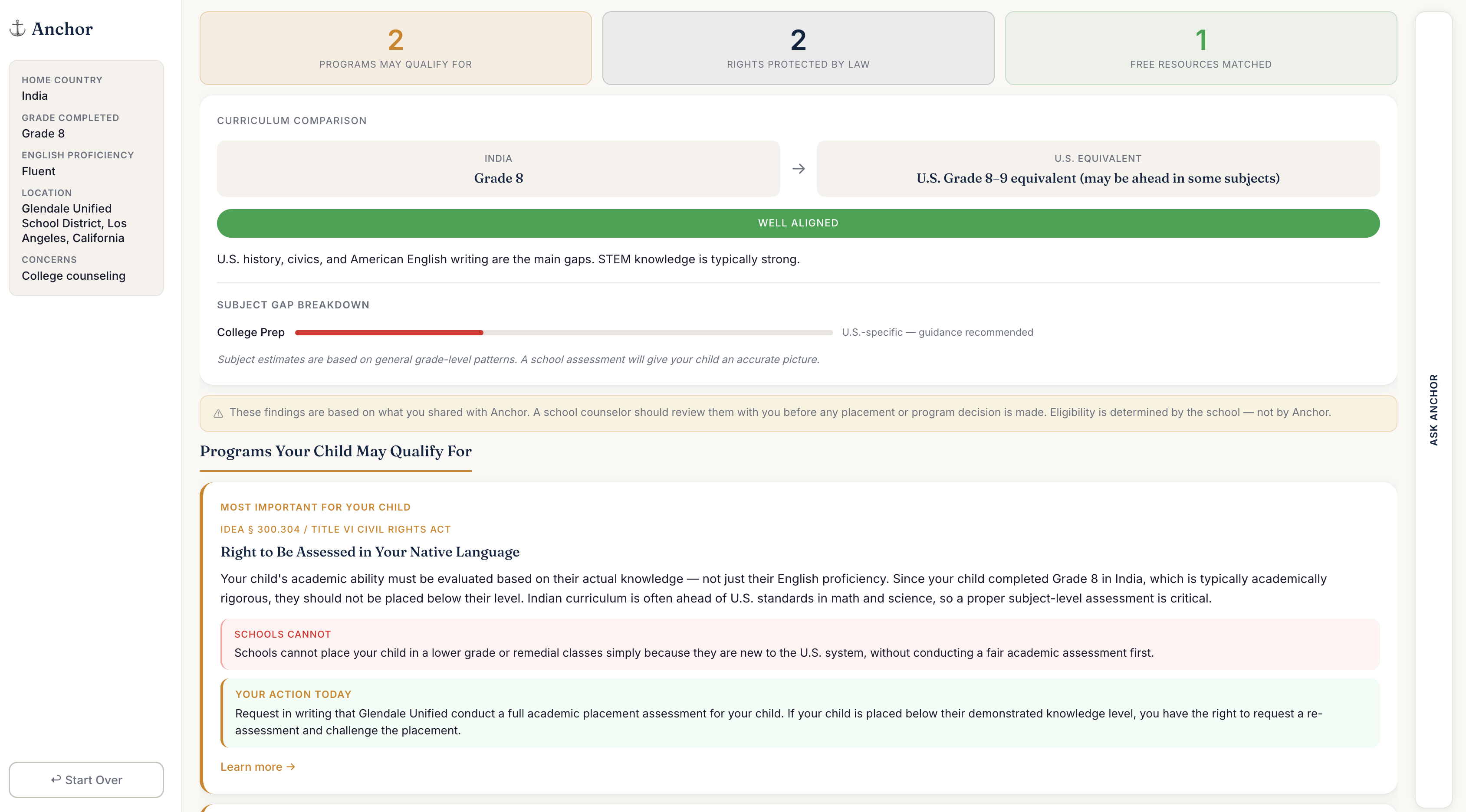
Results Page Example 2
-
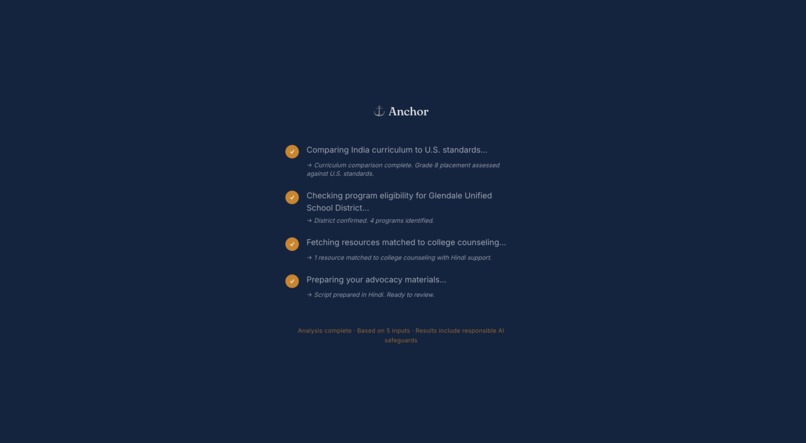
AI Reasoning Screen
-
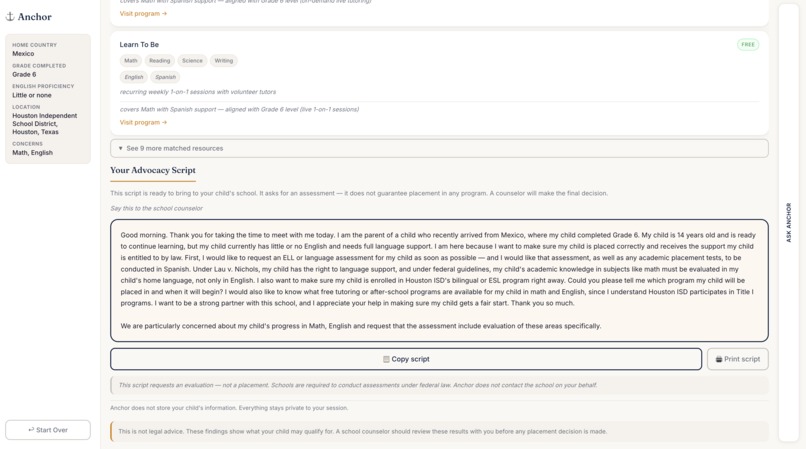
Advocacy Script
-
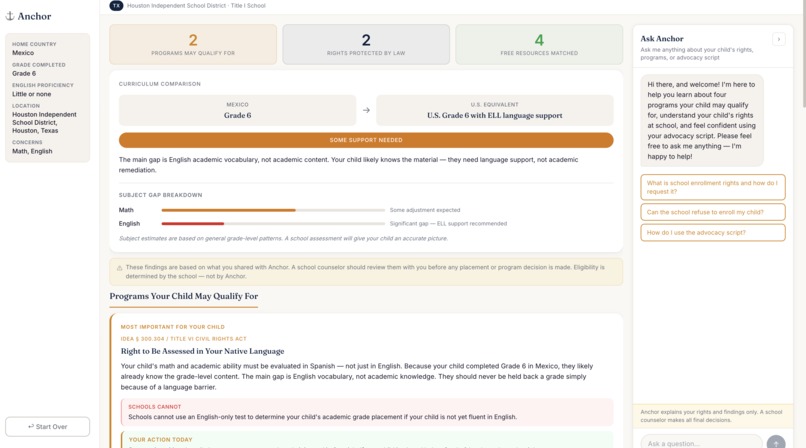
Results Page Example with AnchorChat
-
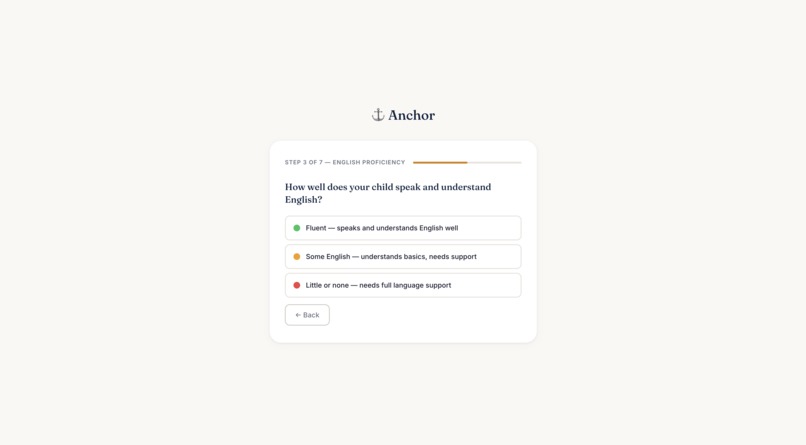
Step 3 of 7 Of Intake Wizard
Inspiration
One of our team members tutored an immigrant student who had transferred into a US school and was placed below her academic level. She wasn't struggling because she lacked the skills. She was struggling because nobody had taken the time to understand what she already knew, and her parents didn't know she had the right to request a reassessment in her native language.
We started asking around. The same story repeated itself: students arriving from different countries with years of academic achievement behind them, only to be placed in classes that didn't reflect their knowledge or needs. Some were held back because of language barriers. Others were placed into programs that overlooked their strengths. Many families simply didn't know what support, protections, or options were available to them.
Millions of immigrant students arrive in US schools with valuable educational experiences and strong academic foundations. Too often, language barriers, unfamiliar processes, and inaccessible information prevent schools and families from fully understanding a student's prior learning. The result is a system where capable students can be overlooked, underestimated, or placed on the wrong academic path.
The tools to help these students exist. The federal protections exist. The free tutoring programs exist. The curriculum data exists. Yet these resources remain scattered across agencies, school systems, and languages. Nobody had connected them in one place, in the student's own language, in a way a student or parent could actually use on the day they walked into a new school.
That's what Anchor is.
What it does
Anchor is an AI-powered education navigation tool for immigrant families in the United States. A parent provides information about their child: the country they attended school in, their last grade level, their English proficiency, their current city and school district, the subjects they need the most help with, and their home language.
Anchor does the following:
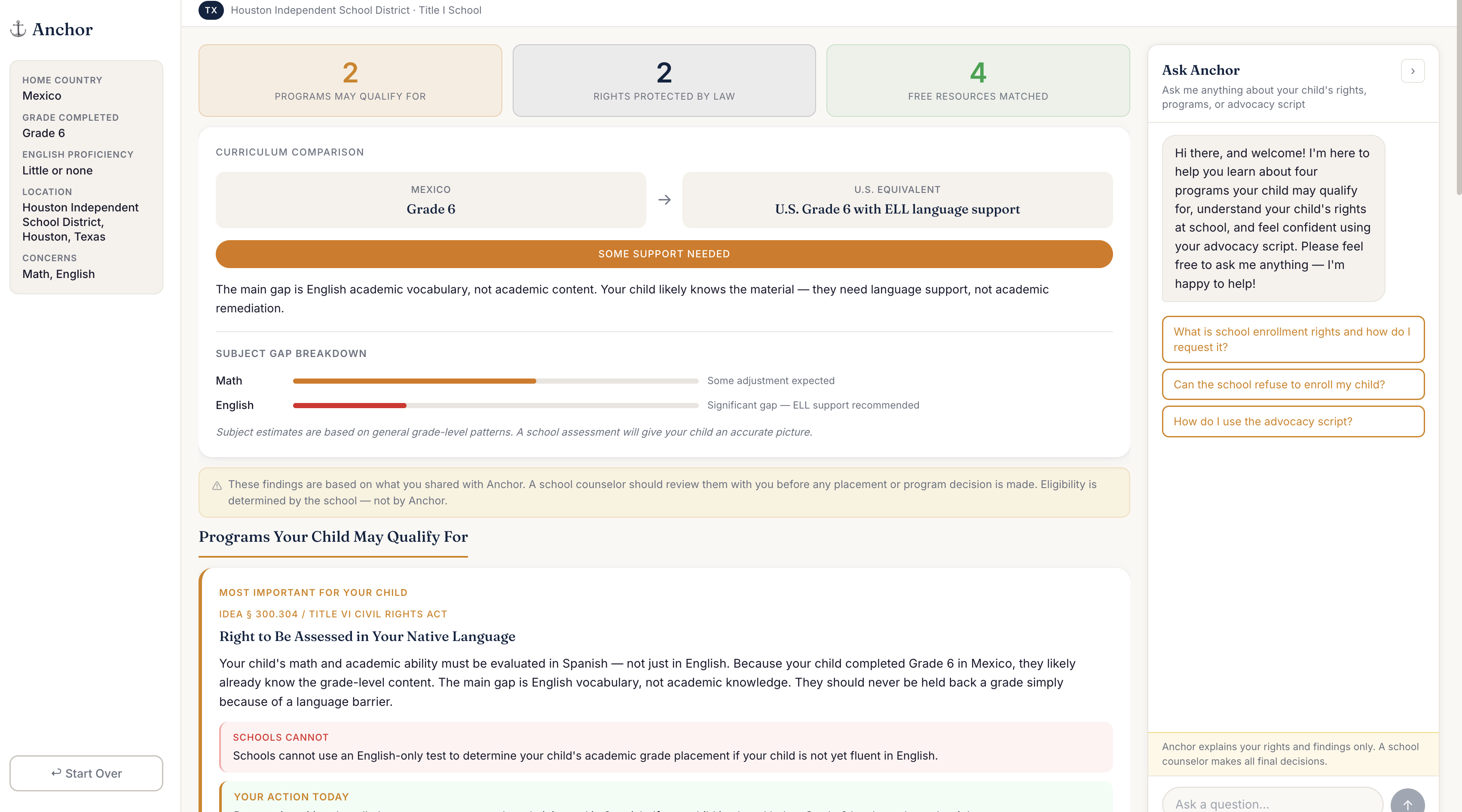
Curriculum Gap Analysis
Anchor maps the student's previous grade level to its closest U.S. equivalent using structured curriculum comparison data covering multiple countries of immigrant families in the United States including Mexico, India, China, the Philippines, El Salvador, Vietnam, Cuba, the Dominican Republic, Guatemala, and Honduras.
It identifies potential placement gaps at the subject level and explains, in plain language, how the student's prior curriculum compares with typical U.S. expectations — distinguishing between academic gaps and language gaps, which require different interventions.
For example, a student who completed Grade 11 in Mexico under the SEP curriculum likely has strong subject knowledge but needs English academic vocabulary support — not academic remediation. Anchor surfaces this distinction clearly so families can advocate for appropriate placement rather than accepting a lower grade assignment based on language ability alone.
Federal Rights Guide and Advocacy Script
Anchor surfaces the key federal protections that apply to immigrant students, including:
- Right to attend public school (Plyler v. Doe, 1982)
- Right to English language support (Lau v. Nichols, 1974; ESSA Title III)
- Right to native language academic assessment (IDEA / Title III, where applicable)
- Right to Title I tutoring at qualifying schools
- Right to meaningful school communications in a language families can understand (Title VI)
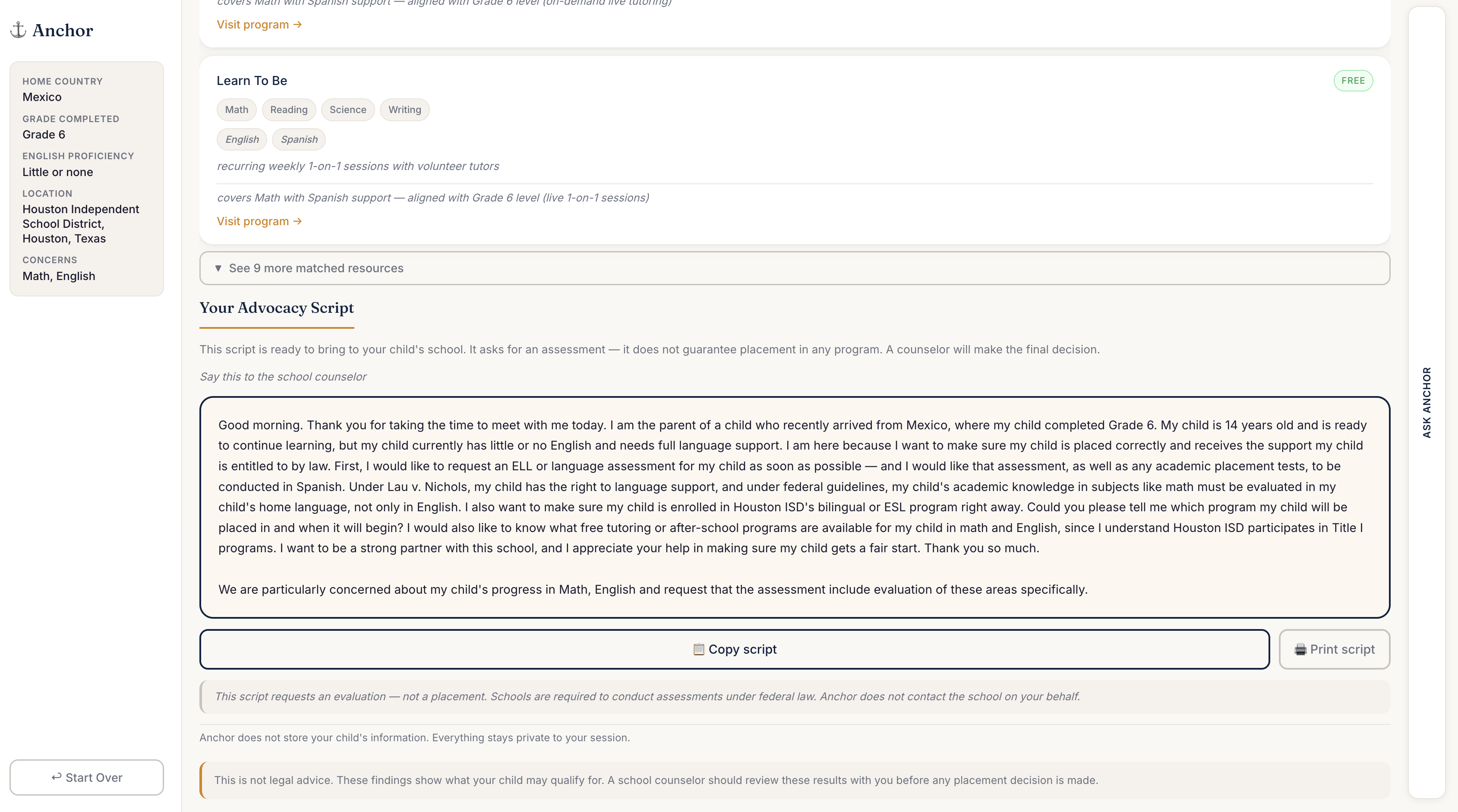
Most importantly, Anchor generates a personalized advocacy script that helps parents communicate with school staff. The script references the student's specific country, grade level, and district by name, cites the applicable federal laws, requests a formal assessment rather than asserting eligibility, and is delivered in the family's home language.
School and District Support Lookup
Anchor uses publicly available school district data to identify academic support resources at the student's school or district. If the district receives Title I funding, Anchor explains what types of support may be available and how families can ask about them. District ELL program contact information is surfaced directly so parents have a specific number to call.
Matched Free Tutoring Resources
Based on the student's home language, subject concerns, and grade level, Anchor recommends free tutoring resources from a curated dataset of 13 platforms — scored by subject coverage, language support, grade range, and format. Instead of a generic directory, each recommendation includes a plain-language explanation of why that specific resource was matched to this specific student.
Contextual AI Assistant
AnchorChat, embedded in the results page, lets parents ask follow-up questions about their specific findings, including their child's rights, the programs identified, and how to use the advocacy script. The assistant is fully multilingual and can answer questions in any of Anchor's seven supported languages. Questions outside Anchor's scope are routed to the school counselor, with the option to append them directly to the advocacy script so the parent remembers to ask them during the meeting.
How we built it
Anchor is built as a full-stack AI application with a React frontend (Vite) and a Python/FastAPI backend calling the Anthropic Claude API.
The core of Anchor is a three-layer AI reasoning pipeline. The first layer is curriculum gap detection, we map a student's home country grade level against U.S. Common Core equivalent standards and produce a subject-level gap severity assessment. The second layer is program eligibility classification, we take the gap severity, English proficiency level, district Title I status, and household context and classify which federal programs the student may qualify for across Title I, ESL/ELL, IDEA, and Head Start criteria. The third layer is advocacy script generation, Claude generates a plain-language letter in the parent's native language that they can bring to a school meeting to request a proper assessment by name.
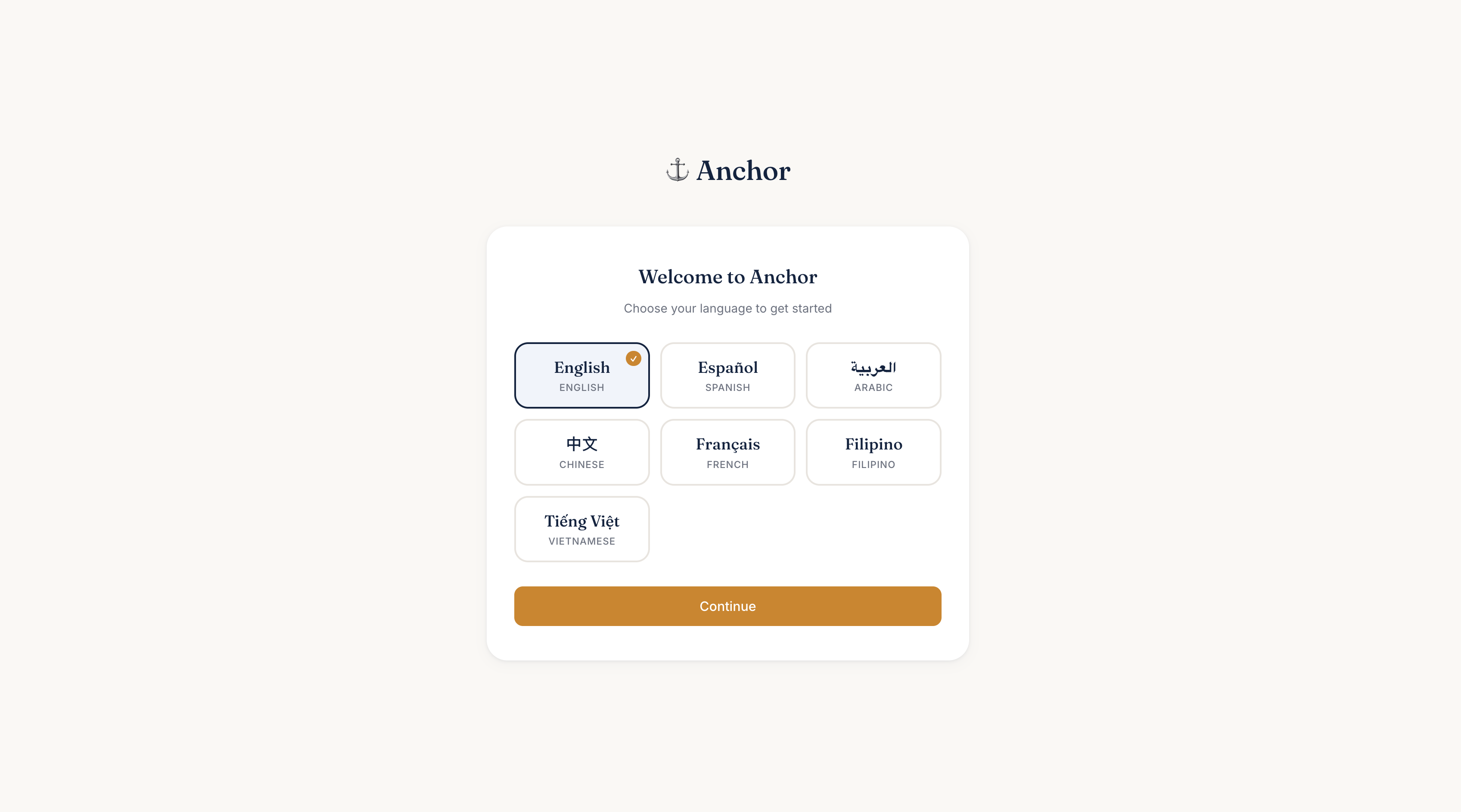
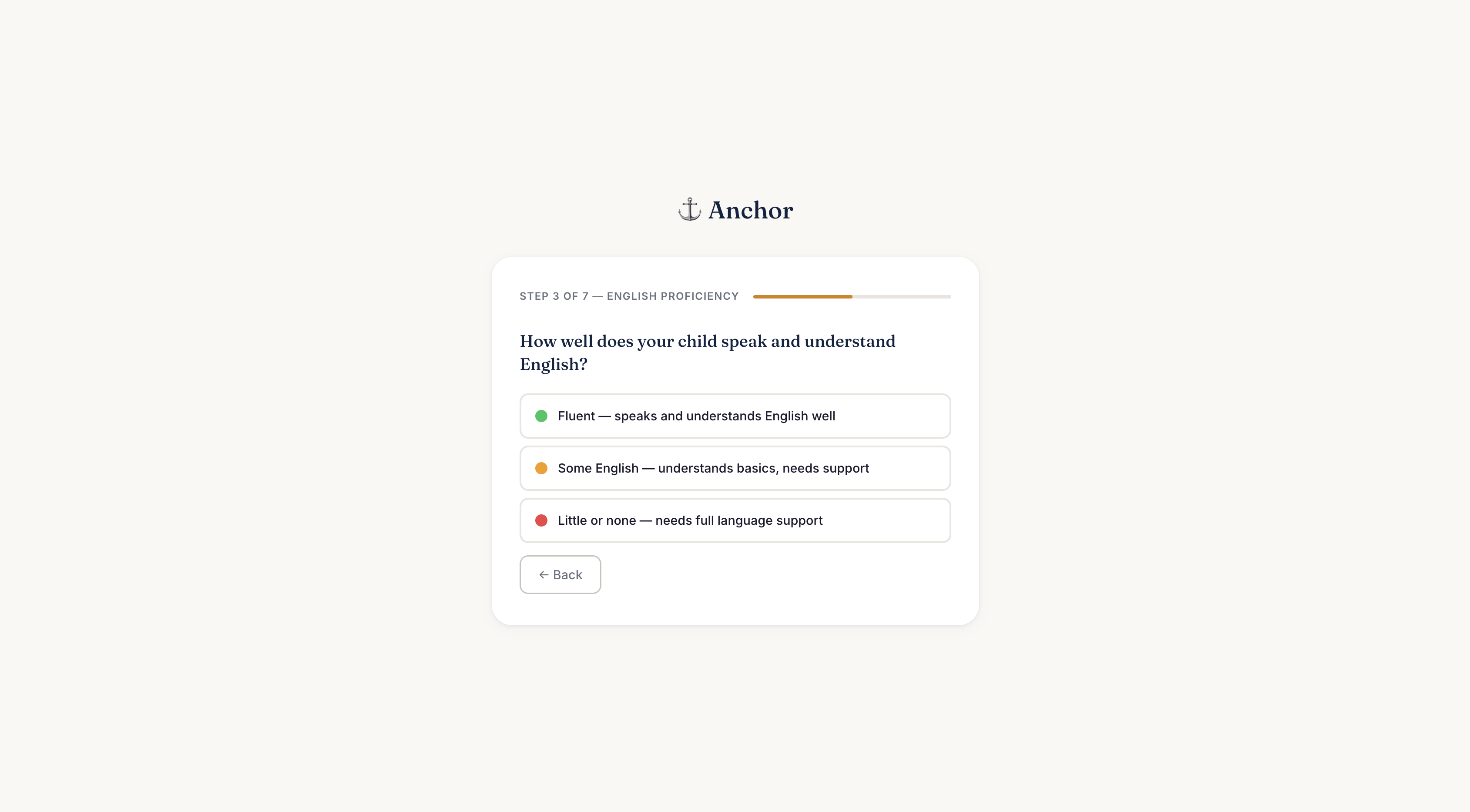
The intake experience is built as a stepped wizard with no dropdown elements, every selection uses large tappable button chips, designed for a stressed, limited-English parent on a mobile device. Language selection happens at step one and persists across every output screen.
We built a tutoring resource matching engine in JavaScript that scores 13 free platforms against the student's grade level, home country language, and selected subject concerns, surfacing the top matches with a visible "Matched because" reasoning line on each card so the parent understands why each resource was recommended.
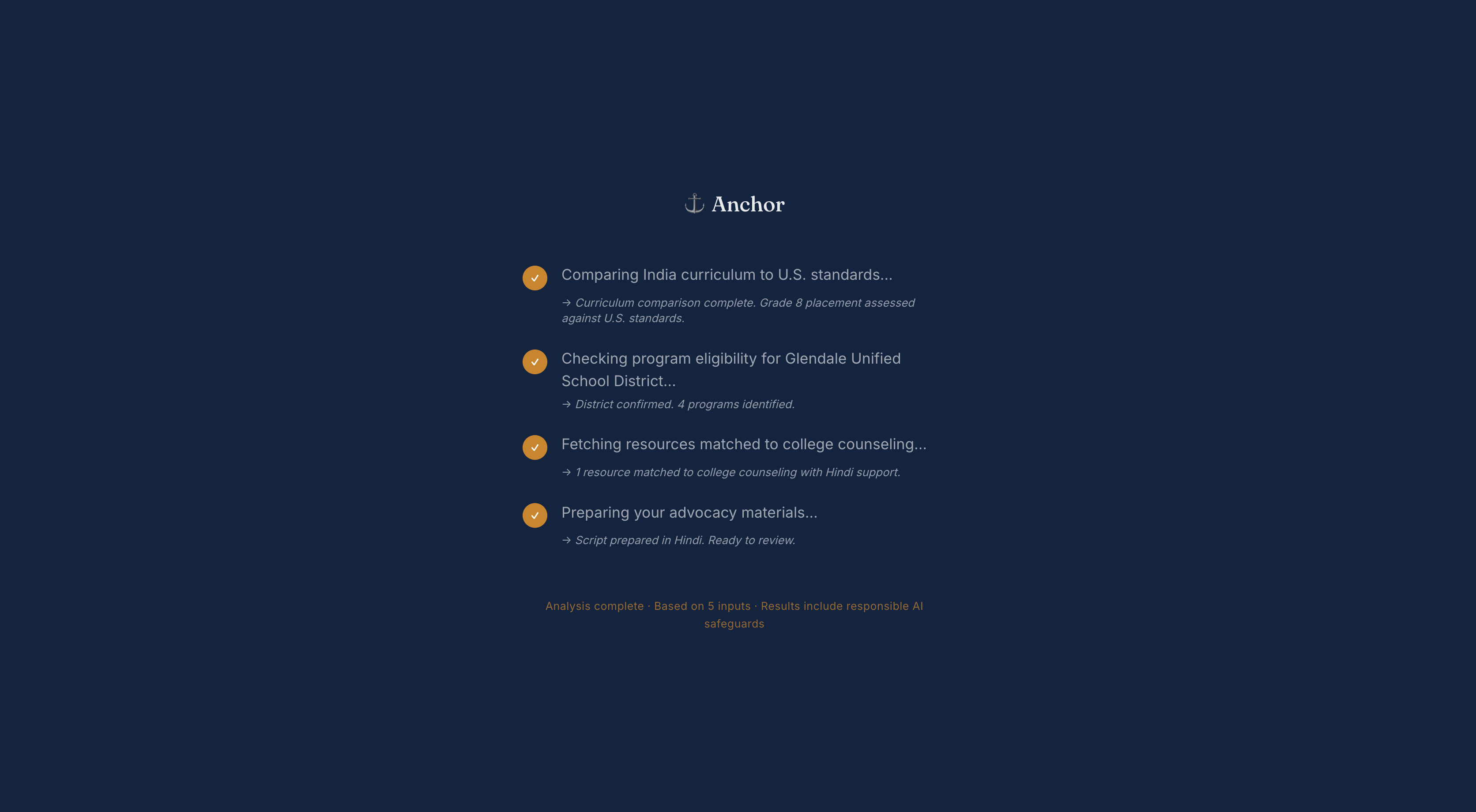
The AI reasoning interstitial between intake and results shows the three pipeline layers executing in real time, each step tied to actual API response progress, not fake timers, so the reasoning process is visible rather than hidden behind a loading spinner.
AnchorChat, a contextual AI assistant embedded in the results page, lets parents ask follow-up questions about their specific findings. Questions outside Anchor's scope are routed to the school counselor, with an option to append them directly to the advocacy script.
Challenges we ran into
The hardest challenge was designing for a user who may be navigating a new language, an unfamiliar education system, significant stress, and a mobile device all at the same time. Many design decisions that felt intuitive to us as builders created unnecessary complexity for the people we were trying to help. For example, we removed dropdown menus entirely after realizing that asking a parent to scroll through a list of 195 countries was exactly the type of burden Anchor was designed to reduce.
Responsible AI framing required constant discipline. The temptation throughout was to make Anchor sound more definitive, "your child qualifies for Title I" is a cleaner sentence than "your child may qualify for Title I." But every confident claim we made shifted decision-making power from the parent and counselor to the AI, which is exactly the wrong direction for this domain. Maintaining "may qualify" framing consistently across every output, in seven languages, while keeping the language warm and empowering rather than hedge-filled, required more iteration than any technical component.
Getting the AI reasoning interstitial to reflect real API progress, rather than running on fake timers that left the final step frozen, required restructuring how the analysis call was initiated. Moving the API call to begin at step two of the interstitial rather than after the animation completed eliminated the freeze and made the reasoning feel authentic rather than theatrical.
Curriculum gap detection across dozens of home countries required building a mapping layer between national curriculum standards that are not always publicly documented in English. We used synthetic scenarios for testing and were careful to frame all subject gap estimates as pattern-based rather than definitive, always directing parents to request a school assessment rather than trusting Anchor's estimate as fact.
Accomplishments that we're proud of
The advocacy script is the accomplishment we're most proud of. It is a physical artifact, something a parent can print, hold, and bring into a school meeting. It cites specific federal laws by name (Plyler v. Doe, Lau v. Nichols, IDEA, Title I), references the specific school district, names the parent's subject concerns, and requests an assessment in the child's native language. A parent who arrives at a school meeting with this document is fundamentally more prepared than one who arrives without it. That is a concrete, measurable shift in power from a broken system toward the family it was supposed to serve.
We’re proud that Anchor assesses English proficiency directly rather than inferring it from a child’s country of origin. Many education systems automatically place immigrant students into English language learner (ELL) programs, even when they are already fluent, which can lead to unnecessary or inappropriate placement. Anchor avoids this bias by explicitly asking about language ability during intake, a design choice that requires more engineering but results in a more accurate and fair assessment.
The AnchorChat "add to script" feature, where a parent can ask a question, be told it's outside Anchor's scope, and have it appended to their advocacy script for the school counselor, is a small interaction that we think represents responsible AI design at its best. The AI recognizes when a question falls outside its scope, directs the parent to the appropriate school contact, and helps ensure the question is addressed during the meeting.
We're proud that Anchor works in seven languages and that the AI reasoning pipeline produces district-specific, grade-specific, language-specific output.
What we learned
We learned that building for users with different backgrounds, experiences, and needs requires removing assumptions at every layer, not just in the copy but in the interaction model itself. The shift from open chat to a stepped wizard was not simply a UI preference. It was an acknowledgment that a free-form text interface assumes a level of language confidence and familiarity that may not reflect every user's situation.
We learned that responsible AI constraints make products more trustworthy, not less useful. Every time we added a "may qualify" qualifier, a counselor referral, or a source citation, we expected it to feel like a limitation. Instead, it made Anchor feel more credible because it was honest about what it knew and what it did not know.
We learned that making AI reasoning visible is a design problem, not just a technical one. The progress screen that shows the curriculum comparison, eligibility check, and advocacy script preparation as sequential named steps, using the parent's actual country, grade, and district, does more to build trust in the output than any explanation we could add to the results page. Seeing the reasoning happen is different from reading that reasoning happened.
We learned that the most important output in a navigation tool is not information, but action. Every section of Anchor's results page ends with a specific step the parent can take today, a phone number to call, a question to ask, or a script to print. Information without a clear next step only adds to an already confusing system.
What's next for Anchor
The immediate next step is adding zip code-based school lookup. City-level district matching works in most cases, but in large metro areas a family might belong to a different school district than the main one in their city. A zip code is more precise and is something every family already has on their mail.
A community case manager mode would let school social workers, refugee resettlement groups, and immigrant support nonprofits use Anchor for multiple families. They could save results, track follow-ups, and generate advocacy scripts in batches. This would make Anchor useful not just for individual parents but for organizations helping many families at once.
We also want to add a post-meeting follow-up feature. After a parent uses an advocacy script in a school meeting, Anchor could help them understand what the school said, what to do next if support was denied, and when to contact a district official or education advocate.
In the long term, we want to improve our curriculum gap system by using real curriculum data from different countries. Right now, we estimate based on general grade-level patterns. With better data, we could more accurately match what students actually learned in their home country, making our recommendations and advocacy scripts more precise and useful.


Log in or sign up for Devpost to join the conversation.