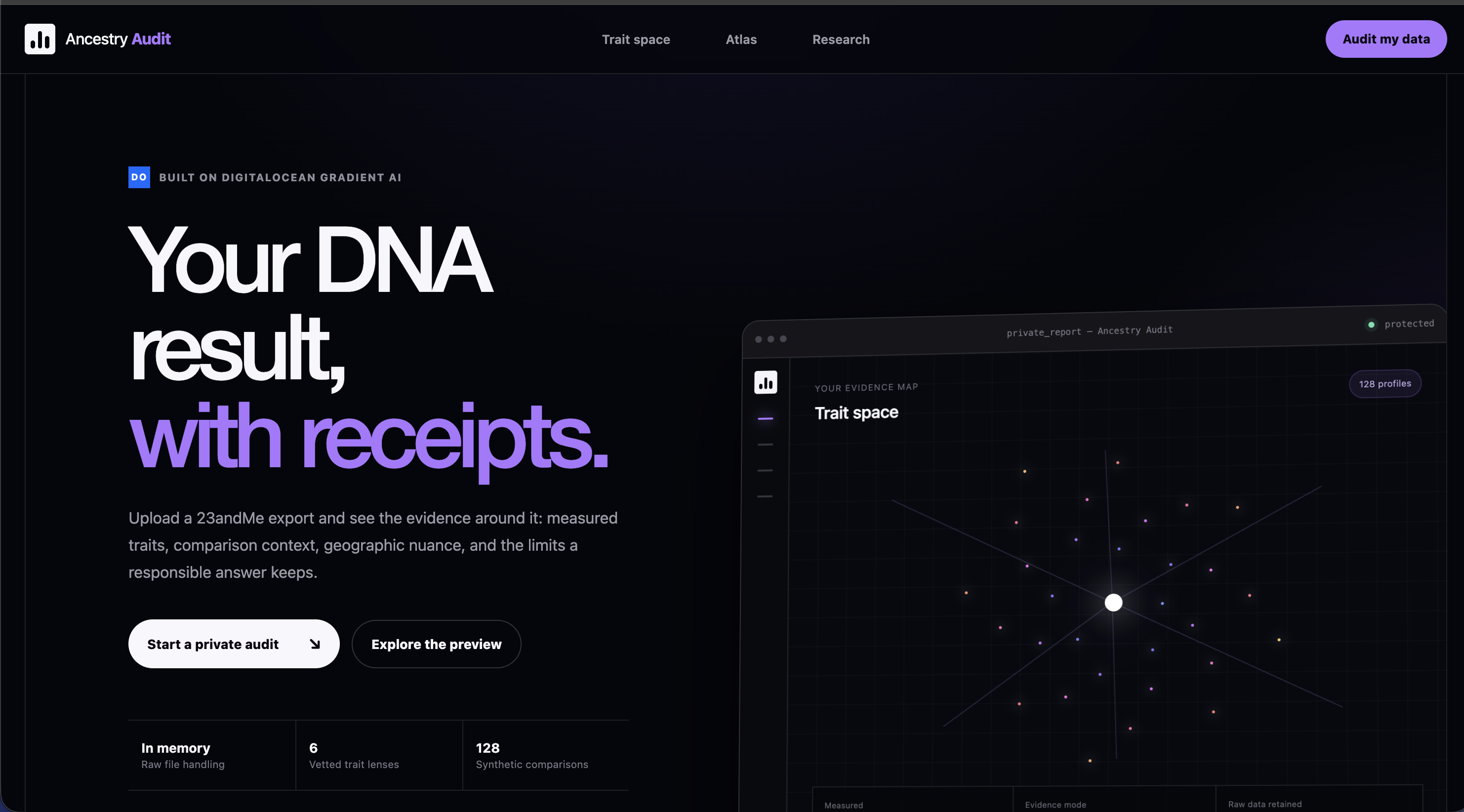
🧬 Ancestry Audit Layer — An Honesty Layer for Consumer DNA Results
🌍 Inspiration
Consumer DNA reports look scientific and precise — but that precision is not evenly earned. Reference panels and genome-wide association studies have historically over-represented European-ancestry populations, which means the same test can give a confident, specific answer for one person and a vague, low-confidence one for another, with no explanation of why. That gap is usually invisible to the person reading the report.
We built for AI for Social Good — Hack with MLH & DigitalOcean (San Francisco, Jul 10–11 2026) because this is exactly the kind of quiet, structural unfairness AI can help surface rather than hide. We didn't want to build another ancestry predictor — we wanted to build the tool that audits one: something that tells people where their result's certainty actually ends, and why.
🧠 What We Built
Ancestry Audit Layer takes a real, exported 23andMe raw-data file and returns a deterministic, plain-language guided report that explains what the data can and cannot responsibly support — plus a Gradient-AI-powered research layer for going deeper.
- Upload your exported 23andMe
.txtfile (or use one of our open-consent Harvard Personal Genome Project demo files). - The backend validates the file, retains only an explicitly reviewed, non-medical trait allowlist, and assembles a complete, reproducible report: measured/withheld/missing traits with citations, a reference-panel representation chart, honesty boundaries, and a dated bridge to real inclusive genomics research programs.
- Ask Gradient AI one of six vetted questions (interpretation, reference-panel bias, history, traits, research, limits) and get a grounded, cited answer — never a free-form prompt injection surface.
- Explore two visualization surfaces built on top of the same report: a 3D force-graph comparing your measured traits against an illustrative, clearly-labeled synthetic cohort, and a 3D globe of real, named 1000 Genomes Project / Human Genome Diversity Project reference populations with an expected genetic similarity to your own data.
Every one of those surfaces is built so that the AI never infers who you are or where you're "from" from your DNA — it only ever explains the evidence that already exists.
⚙️ How We Built It
- Backend (Flask + Gunicorn, DigitalOcean App Platform):
- A strict 23andMe parser that validates vendor signature, canonical columns, chromosomes, positions, genotypes, and build, and rejects or counts malformed rows without ever echoing raw data back.
- An in-memory upload path (no disk-spooled temp files, no request caching) so a raw genome is never persisted by application code.
- A default-deny interpretation boundary (
backend/boundaries.py): only an explicitly reviewed, non-medical, well-replicated SNP allowlist (lactase persistence, earwax type, ACTN3, TAS2R38 bitter-tasting, and others) is ever interpreted; everything else — health risk, exact ethnicity, ancestry re-inference — gets a deterministic, honest refusal. - A Gradient AI narrative layer (
backend/gradient_client.py): a deployed Gradient AI agent (OpenAI GPT-5) answers the six vetted question categories against the user's already-boundary-checked report, with automatic fallback to serverless Claude 4.6 Sonnet inference if the agent path is slow or unavailable. - Two new synthetic/real-data endpoints for the visualization layer:
backend/comparison.py(procedurally generates a cited, labeled synthetic cohort from published population allele-frequency literature) andbackend/population_map.py(returns real 1000 Genomes/HGDP reference populations at their real sampling coordinates, each scored against the user's own measured traits).
- Frontend (React + Vite): a restrained, accessible report view plus three interactive surfaces — the trait network, the 3D globe, and a research/chat workspace — all consuming the same-origin Flask API over relative URLs, with loading/empty/error states, keyboard operability, and reduced-motion/high-contrast support.
- Data honesty layer: every generated or aggregate data point is either (a) the user's own measured genotype, (b) a real, cited, named reference population, or (c) an explicitly labeled synthetic profile — never presented as a real other person's uploaded genome.
🔍 Key Features
- Deterministic guided report — same file in, same report out, every time.
- Default-deny safety architecture — only allowlisted, non-medical traits are interpreted; every other request gets a transparent refusal.
- User-supplied, never DNA-inferred population context — a broad label
the user types in themselves, always tagged
inferred_from_dna: false. - Reference-panel representation chart — a real TOPMed r2 sample-count breakdown showing exactly which populations are under-represented.
- Gradient AI research workspace — six fixed, vetted question categories, answered with retrieval citations when available and a clean serverless fallback when not.
- 3D trait-comparison network — your measured traits against a procedurally generated, clearly labeled synthetic cohort drawn from published allele-frequency literature (not real other users' data).
- 3D reference-population globe — real, named, citable 1000 Genomes/HGDP populations at their real sampling locations, each with an expected-similarity score computed from the same cited literature.
- Dated research bridge — links to real, currently active genomics programs recruiting under-represented populations, with consent/privacy context.
🧩 Architecture Overview
┌──────────────┐   same-origin HTTPS   ┌───────────────────────────┐
│   React /    │ ─────────────────────►│  Flask + Gunicorn          │
│   Vite app   │◄───────────────────── │  (DigitalOcean App Platform)│
└──────────────┘                       └───────────────┬─────────────┘
                                                         │
                        ┌────────────────────────────────┼─────────────────────────┐
                        ▼                                ▼                         ▼
              /api/analyze                      /api/narrative           /api/comparison-cohort
        (deterministic local report)      (Gradient AI agent, GPT-5)     /api/population-map
        strict parser + allowlist          + serverless Claude 4.6       (synthetic cited cohort +
        + default-deny boundaries          Sonnet fallback               real 1000G/HGDP populations)
💡 What We Learned
- Safety architecture is easier to trust when it's structural, not just policy. A default-deny allowlist means "we don't interpret that" is enforced in code, not just documented.
- Deployed AI agents have real, undocumented constraints. DigitalOcean's
Gradient AI agent endpoint hard-rejects
system/developerrole messages once agent instructions are configured server-side — we only found this by live-tailingdoctl apps logsin production. - "Compare yourself to 100+ people" is a data-honesty problem, not just an engineering one. With no real consented cohort, the honest path was procedurally generating a clearly labeled synthetic cohort from real, cited published literature — rather than either refusing the feature or quietly faking real user data.
- Latency needs a UI story, not just a timeout. A live Gradient AI agent call can take 60–90 seconds; that has to be a visible, designed state, not a spinner and a prayer.
🧠 Challenges We Faced
- Root-causing a silent Gradient AI agent failure in production: the
agent endpoint returned a generic 5xx until we live-tailed logs, fixed the
?agent=truerouting form, patched anopenai/httpxclient incompatibility, and discovered the system/developer-message rejection — four distinct bugs stacked on top of each other. - No real "100+ person" dataset existed to power the requested cohort-comparison visualization — we solved this by grounding every synthetic profile in real, cited population allele-frequency papers instead of inventing numbers or fabricating other people's data.
- Balancing an ambitious product ask against a hard-won safety boundary: the map/comparison features ask to show "where you stand," which is in tension with our own no-DNA-geolocation rule. We resolved it by keeping every fact the API returns literally true — real populations at real coordinates, an aggregate similarity score, a "you" marker that only ever echoes what the user typed — and never letting the backend infer a location or ancestry from DNA.
- Coordinating a fast-moving two-agent build (frontend and backend developed concurrently) without one side's changes silently overwriting the other's, using a shared README as the single source of truth.
🚀 Impact
Millions of people get a consumer DNA report every year with no way to know whether their result is precise because the science is solid, or vague because the reference data simply didn't include people like them. Ancestry Audit Layer makes that distinction visible, explains it in plain language, and points people toward real research programs working to close the gap — without ever making a new inference from their DNA itself.
🧰 Tech Stack
| Layer | Technology |
|---|---|
| Backend | Flask, Gunicorn, Python |
| Frontend | React, Vite |
| Deployment | DigitalOcean App Platform (Docker, auto-deploy on push) |
| AI Agent | DigitalOcean Gradient AI Agent (OpenAI GPT-5) |
| AI Fallback | DigitalOcean Gradient AI Serverless Inference (Claude 4.6 Sonnet) |
| 3D Visualization | 3d-force-graph, Three.js |
| Reference Data | TOPMed r2, 1000 Genomes Project, Human Genome Diversity Project |
| Testing | pytest, Vitest |
🧪 Future Enhancements
- Attach a DigitalOcean-managed Knowledge Base (corpus already curated and
staged in
data/kb_sources/) so Gradient AI answers carry real retrieval citations instead of an empty citations array. - Pair the globe view with
globe.glfor a dedicated basemap-aware rendering layer. - Expand the non-medical trait allowlist as new well-replicated, population-inclusive studies are published.
- Verify and document deployed-agent guardrail configuration once DigitalOcean exposes it via API/CLI, not just the console.
🤝 Team
(add teammates and roles here)
❤️ Closing Thoughts
We are not an ancestry tool. We are an audit layer for ancestry tools — one that tells people where certainty ends, why the gap exists, and what a responsible next step looks like.
"A precise-looking result can hide an unequal evidence base. Our job is to make that visible."
Built With
- css
- digitalocean
- dockerfile
- html
- javascript
- jupyter
- notebook
- python
- shell

Log in or sign up for Devpost to join the conversation.