🕯️ What If Your Ancestor Could Speak to You?
Every family has stories that were never written down. People who lived through wars, famines, revolutions, and migrations — and left no record behind. Ancestor's Voice gives them one.
💡 The Inspiration
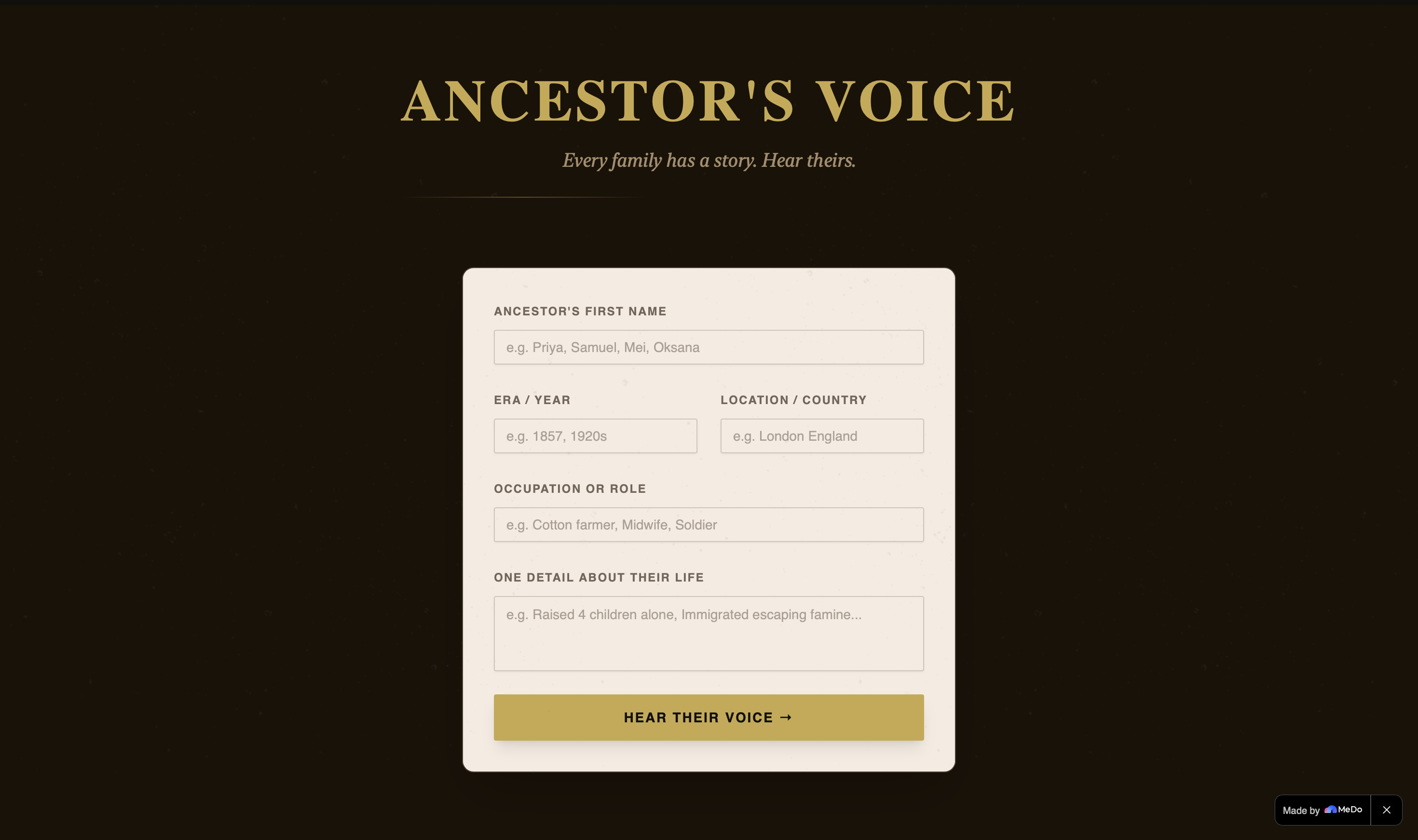
I kept thinking about my great-grandparents. I know almost nothing about them — a name, a place, a rough era. That gap felt like a loss. Then I wondered: what if AI could bridge that gap? Not with dry facts, but with something emotional — a portrait, a handwritten diary entry, a voice actually speaking to you across centuries.
The idea that every person on Earth has ancestors who never got to tell their story felt like the most universally human problem I could try to solve.
🏗️ How I Built It with MeDo
I built the entire application through MeDo's conversational builder — no external code, no separate deployment pipeline. What surprised me most was how MeDo understood the emotional intent behind my prompts, not just the technical requirements.
The plugin stack I assembled:
| Plugin | Role in the app |
|---|---|
| Image Generation (Kling) | Generates a period-accurate oil-painting-style portrait of the ancestor |
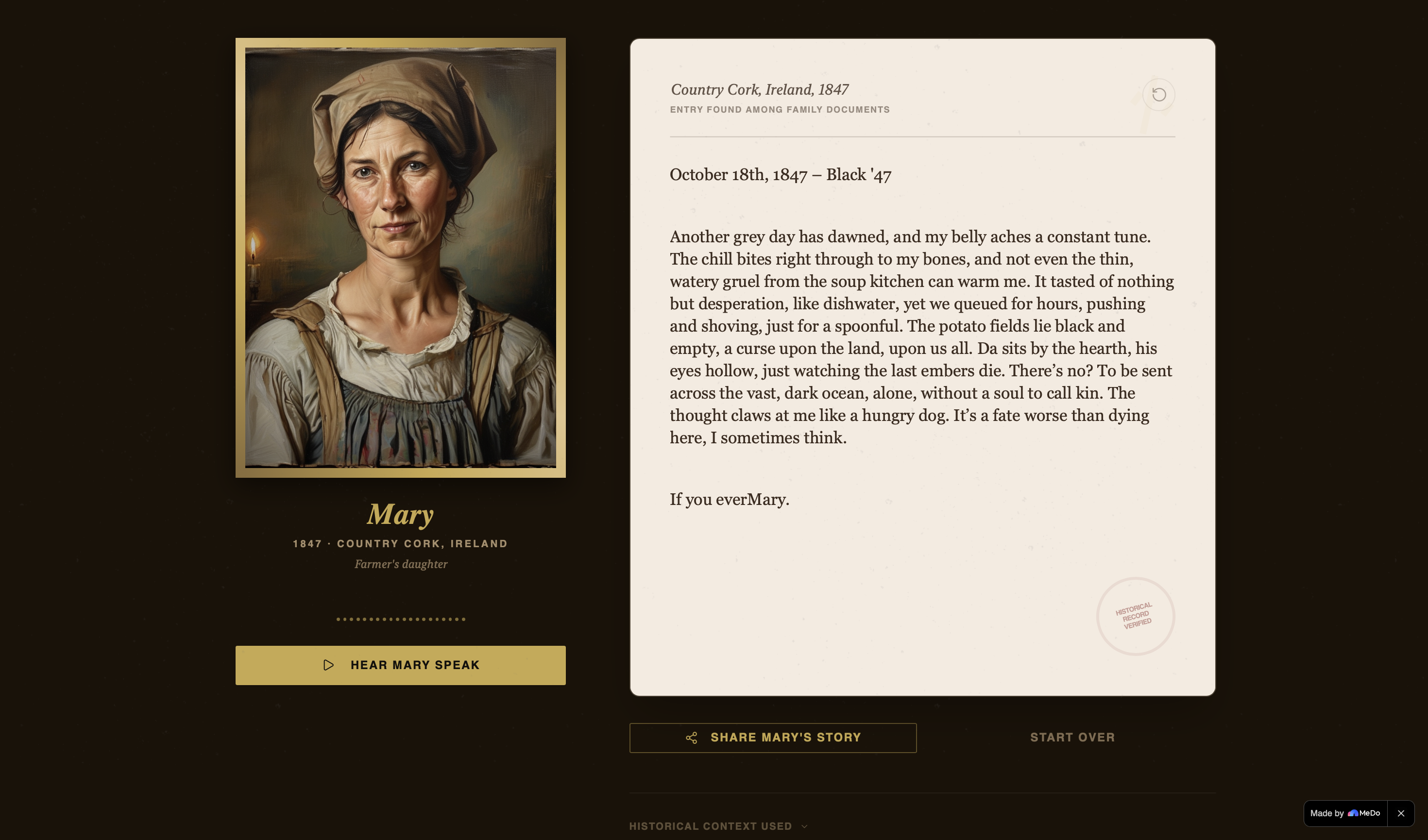
| Large Language Model | Writes a 200-word diary entry in first person, grounded in real history |
| AI Search | Fetches actual historical events from the user's specified era and location |
| Text-to-Speech | Converts the diary entry into the ancestor's spoken voice |
| Video Generation Omni (Kling) | Animates the portrait reveal as a cinematic opening |
The pipeline runs sequentially: AI Search grounds the story in real history → LLM writes the diary using those facts → Image Gen paints the portrait → TTS gives them a voice. Four plugins working as one coherent emotional experience.
✨ The Most Impressive Thing MeDo Generated
When I prompted MeDo to build the "revelation screen" — the moment the ancestor comes to life — it generated the full typewriter animation for the diary text, the portrait fade-in sequence, and the audio player UI without me specifying a single line of animation code. It understood that this moment needed to feel cinematic and built it that way.
The aged parchment diary styling, the ornate portrait frame, the floating dust particle ambient effect — MeDo inferred all of this from the emotional direction I described.
🚧 Challenges
Emotional authenticity vs. AI hallucination: The biggest challenge was making the diary feel discovered, not generated. The solution was chaining AI Search before the LLM call — grounding every diary entry in real historical events before the narrative was written. A story set in 1857 rural India now references the actual Sepoy Mutiny if relevant. A 1920s Mississippi ancestor reflects the real Great Migration.
Making silence feel heavy: Getting the loading state right was harder than the generation itself. The rotating messages ("Your ancestor picks up a quill...") were critical to building emotional anticipation before the reveal.
📖 What I Learned
MeDo is genuinely a creative partner, not just a builder. The multi-turn conversation approach meant I could refine the emotional tone of the app the same way you'd direct an actor — "make this moment slower," "the portrait should appear before the text" — and it responded to direction, not just instructions.
🌍 Who This Is For
Anyone who has ever looked at an old family photograph and wondered who were you, really? That's everyone. Ancestor's Voice turns that question into an answer.
Built With
- ai-search
- kling-ai-(image-generation)
- kling-ai-(video-generation)
- large-language-model
- medo
- text-to-speech


Log in or sign up for Devpost to join the conversation.