Inspiration
Anatomy is difficult to learn when most of the material is presented through static diagrams and textbooks. I wanted to create something that lets students actually explore the human body instead of just memorizing it.
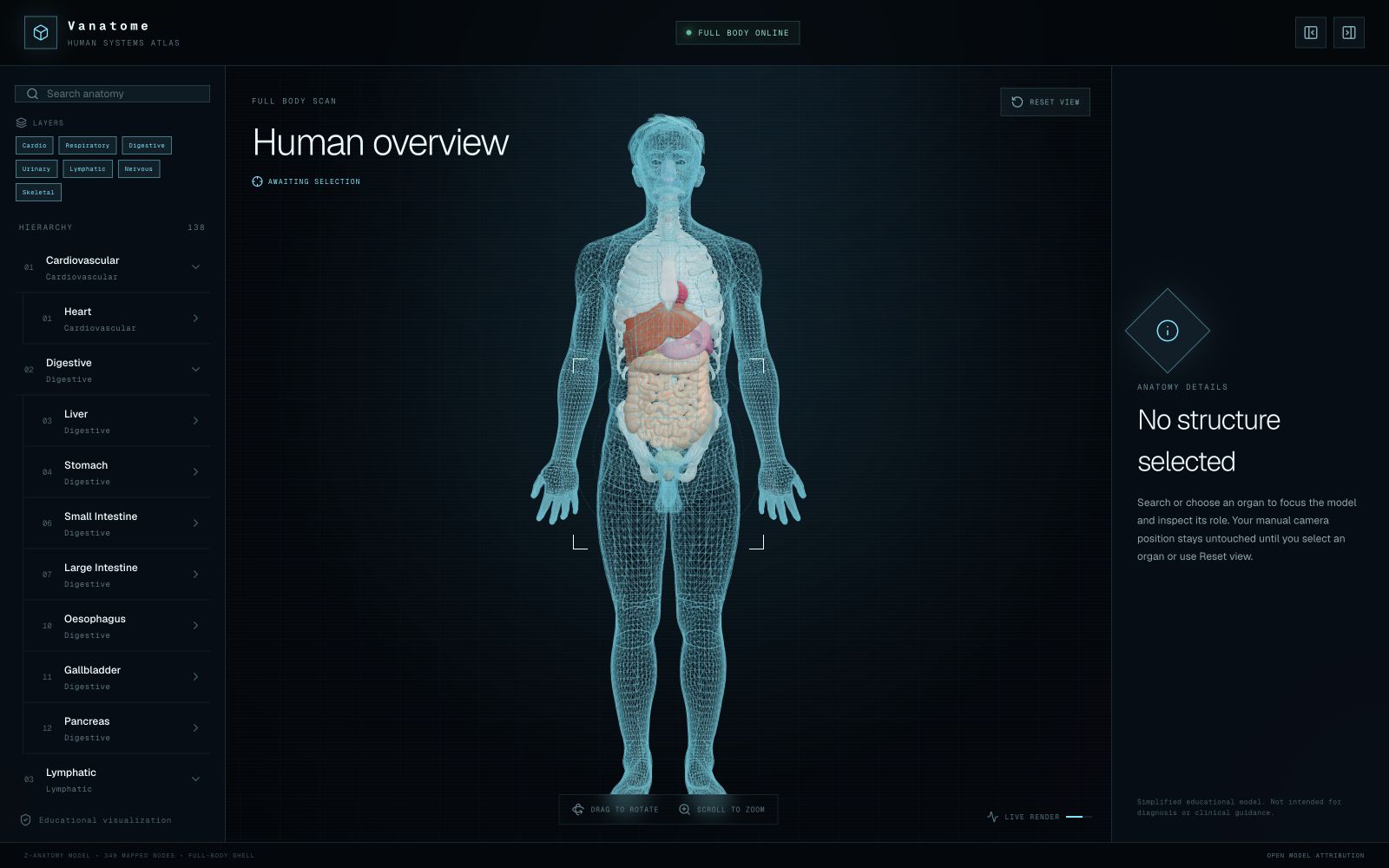
That idea became AnatoLens — an interactive 3D anatomy learning platform that combines visualization, virtual dissection, AI assistance, and clinical learning in one place.
Don’t just study anatomy — step inside it.
What it does
AnatoLens turns anatomy learning into an interactive experience.
Users can explore a 3D human body, rotate and zoom the model, select individual structures, hide or isolate anatomy, and explore different tissue and anatomical layers.
I also added several learning features around the 3D model:
- 🔪 Virtual Dissection — remove structures to explore deeper anatomy.
- 🤖 AI Anatomy Assistant — ask questions and get anatomy explanations while exploring.
- 🧬 Anatomical Layers — toggle different systems and layers on and off.
- 🩺 Clinical Challenges — connect anatomy to real clinical scenarios, such as wrist drop.
- 🧠 Revision Mode — practice identifying structures using active recall.
- ❓ Quizzes — test anatomy knowledge directly in the platform.
- 📌 Notes — save important information while studying.
Instead of switching between a textbook, chatbot, flashcards, and a 3D viewer, AnatoLens brings those experiences together.
How we built it
I built AnatoLens as a web application using React and TypeScript, with Three.js and React Three Fiber powering the interactive 3D anatomy environment.
I created interactions that allow users to select, focus on, hide, and isolate anatomical structures. I then built the learning features around that environment, including virtual dissection, layer controls, revision mode, quizzes, notes, and clinical challenges.
I also integrated the Gemini API to power the AI anatomy assistant, allowing users to ask questions and receive explanations without leaving the 3D learning environment.
GitHub was used for version control and managing the project throughout development.
Challenges we ran into
The biggest challenge was getting multiple features to interact correctly with the same 3D scene.
Dissection, layer visibility, hiding structures, camera focusing, and structure isolation all modify the anatomy model in different ways. I ran into React hook-order errors, visibility conflicts, camera synchronization problems, and UI interactions that sometimes interfered with the clinical challenge controls.
Debugging these issues while continuing to add features during a hackathon was challenging, but it also helped me understand React state management and interactive 3D development much better.
Another challenge was making sure the platform didn't become overwhelming. There are many possible anatomy-learning features, so I had to think carefully about how to keep the interface understandable while still making it powerful.
Accomplishments that we're proud of
I'm proud that AnatoLens became much more than a basic 3D anatomy viewer.
I was able to combine 3D exploration, virtual dissection, AI assistance, clinical challenges, revision, quizzes, and notes into one learning environment.
I'm especially proud of connecting anatomy with clinical reasoning. Instead of only showing users where a structure is, AnatoLens encourages them to understand what it does, how it connects to surrounding anatomy, and why it matters clinically.
Seeing all of these different pieces come together into a working project during the hackathon was one of my biggest accomplishments.
What we learned
I learned a lot about building interactive 3D applications with React, TypeScript, Three.js, and React Three Fiber, especially when multiple components need to control the same 3D scene.
I also learned more about integrating generative AI through Gemini and designing AI as part of an educational experience rather than simply adding a chatbot.
Most importantly, I learned that good educational technology isn't just about displaying information. It should encourage users to explore, question, practice, and apply what they're learning.
What's next for AnatoLens
I want to continue expanding AnatoLens with more detailed anatomical models, additional clinical cases, better virtual dissection, personalized AI tutoring, adaptive quizzes, progress tracking, and instructor tools.
I would also like to bring AnatoLens into AR and VR, allowing students to interact with anatomy at life-size scale instead of only viewing it on a screen.
Ultimately, I want AnatoLens to bridge the gap between seeing anatomy, understanding anatomy, and applying anatomy.
Built With
- css
- eact
- gemini
- gemini-api
- github
- html
- javascript
- react-three-fiber
- three.js
- typescript


Log in or sign up for Devpost to join the conversation.