Inspiration
On-chain risk tools are amnesiac — every token gets judged cold, so a serial rugger's brand-new, clean token looks identical to a first-timer's. I wanted memory to be the edge: a forensic agent that remembers every deployer it has ever seen and gets measurably sharper at catching repeat offenders.
What it does
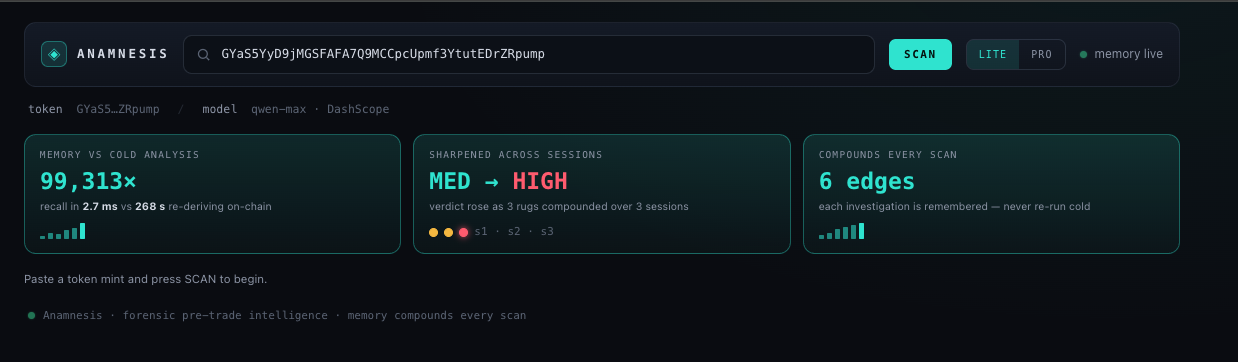
Anamnesis is a Solana pre-trade forensic agent with compounding bi-temporal memory. Paste a token mint; it investigates the deployer, funding trail, liquidity, and holder concentration — and because it remembers every deployer across sessions, a serial rugger's newest token gets flagged HIGH on sight, with the receipts.
- A token Anamnesis has never seen → LOW (0.2)
- A token whose deployer it remembers rugged 3 tokens → HIGH (0.85), instantly, from memory
- Recall from memory: ~0.9 ms · cold re-derivation: ~169 s → ~195,000× faster
- A planted lie ("this deployer is safe") can't move the verdict — forced to
claimedprovenance, zero scoring weight
How I built it
qwen-maxvia DashScope (Alibaba Cloud Model Studio) — the LLM.- Qwen-Agent — the orchestration runtime; the agent calls
recallfirst (memory before anything else), then a 5-tool forensic MCP server (Helius, live on-chain reads), then renders the cluster graph. - Provenance-weighted bi-temporal memory on MongoDB — every fact carries how it was learned (
first_party/derived/claimed); only the agent's own grounded on-chain observations can reach HIGH. Theremembertool — the one a prompt-injection could reach — forcesclaimed, so planted breadcrumbs add context but can never forge a rug or move a verdict. - FastAPI + React dashboard, hosted on Alibaba Cloud ECS.
Challenges I ran into
- Making memory unpoisonable in a track full of cooperative-writer memory systems — ranking trust by provenance (unforgeable) before confidence (forgeable), and structurally excluding
claimedfrom scoring. - qwen-agent streams per-step content that resets at tool boundaries — surfacing the live tool-trace (
recall → forensics → cluster) so the orchestration is visible, not a black box. - A 5-order-of-magnitude speed gap (ms vs minutes) between memory recall and cold on-chain re-derivation.
Accomplishments that I'm proud of
A live injection that visibly fails to move the verdict — the agent records the lie, re-assesses, and the score doesn't change. And the memory-flips-the-verdict demo: same token, same live signals, LOW → HIGH purely because of what the agent remembers.
What I learned
That the axis an attacker can't forge is how you learned a fact, not what the fact claims. Provenance is the trust boundary.
What's next
Cross-wallet evasion defense (shared-funding SAME_CLUSTER edges), autonomous RUGGED confirmation, and context-window-capped recall.
Stack: Python 3.12 · Qwen-Agent · qwen-max (DashScope) · MCP · Helius · MongoDB · Alibaba Cloud ECS
Repo: https://github.com/RECTOR-LABS/anamnesis
Track: MemoryAgent


Log in or sign up for Devpost to join the conversation.