Project Inspiration Computer-Based Testing (CBT) is increasingly becoming the standard for assessments across Africa. However, most AI-based proctoring tools are developed for high-resource environments. Solutions like ProctorU and HonorLock are expensive, rely on constant internet connectivity, and are tailored to Western infrastructure, making them largely inaccessible for educational institutions in West Africa.
This project was inspired by the need for an AI-powered, offline proctoring system that functions on low-end hardware using only a webcam. The goal was to develop a system that can detect malpractice in real-time using gaze and object recognition while ensuring student privacy and system efficiency.
Project Description The Intelligent Malpractice Detection System (IMDS) is a real-time monitoring solution designed specifically for CBT environments in resource-constrained settings. It:
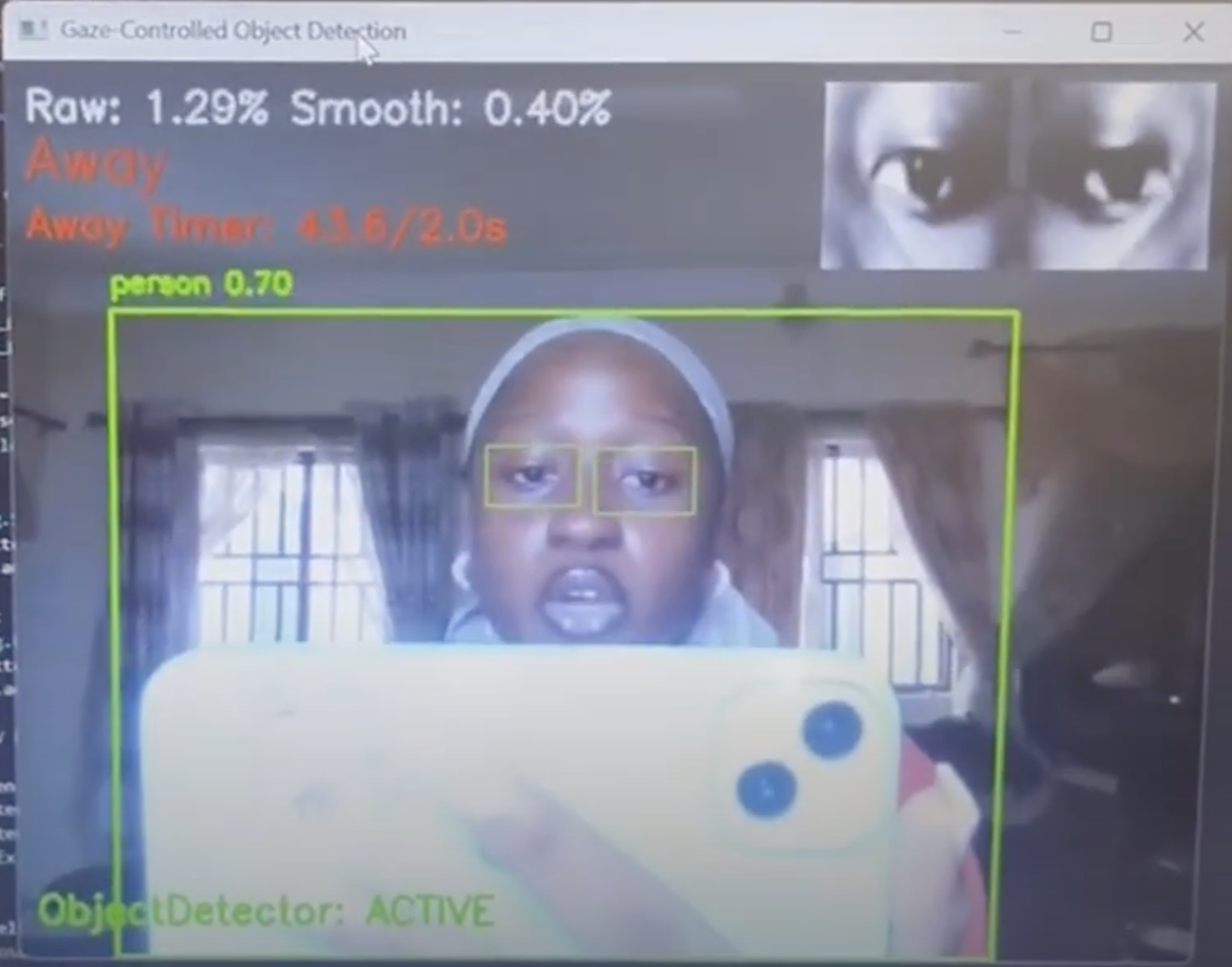
Tracks a student’s eye gaze using a TensorFlow-based convolutional neural network and MediaPipe FaceMesh.
Activates a lightweight object detection model (YOLOv8n) only when the user’s gaze is off-screen for more than two seconds.
Detects objects commonly associated with malpractice such as mobile phones, books, or the presence of another individual.
Annotates the live video feed with gaze and object detection indicators.
Operates completely offline on CPU-only systems with a minimum of 4GB RAM.
Technical Implementation Gaze Tracking: Utilizes MediaPipe FaceMesh to extract eye landmarks and preprocesses them for classification using a fine-tuned TensorFlow CNN.
Object Detection: Implements YOLOv8n through the Ultralytics interface to detect high-risk objects during periods of sustained off-screen gaze.
Logic Module: Coordinates gaze tracking and object detection to minimize false positives and reduce computational load.
Tech Stack: Python 3.9, TensorFlow, OpenCV, MediaPipe, Ultralytics, NumPy.
Platform Compatibility: Designed for deployment on Windows, macOS (including M1), and Linux without the need for GPU acceleration.
Challenges Encountered Achieving real-time performance without GPU support.
Managing inconsistent eye image quality due to varying webcam specifications and lighting conditions.
Reducing false positives through logic-based decision thresholds.
Ensuring compatibility and performance on older systems with limited RAM.
Key Accomplishments Developed a functional, real-time malpractice detection tool that runs efficiently on devices with as little as 4GB RAM.
Designed a modular and open-source architecture that facilitates deployment in a wide range of environments.
Successfully integrated gaze classification and object detection into a unified intelligent monitoring pipeline.
Addressed real-world constraints specific to West African institutions, including offline operation and hardware limitations.
Insights and Lessons Learned
Logic-based thresholds are effective in balancing detection sensitivity and reducing false alerts.
Building accessible AI solutions can promote educational equity in under-resourced regions.
Effective deployment strategies are essential for real-time applications without access to specialized hardware.
Future Development Port the system to Android tablets to accommodate exam centers without laptops.
Improve gaze detection accuracy by training on larger datasets such as GazeCapture and ETH-XGaze.
Implement logging and timestamping to analyze cheating patterns.
Develop a LAN-based synchronization mechanism for large examination halls.
Create a web-based monitoring dashboard for invigilators.
Localize the user interface and setup instructions into West African languages including Yoruba, Hausa, and Swahili.
Built With
- mediapipe
- opencv
- tensorflow
- ultralytics-(yolov8)


Log in or sign up for Devpost to join the conversation.