Inspiration
The idea for the Automated Homework Grading Machine originated from witnessing the challenges teachers face in grading large volumes of paper-based assignments accurately and efficiently. The inspiration for this project came from observing the difficulties faced by university students in completing and understanding homework assignments. Lectures are fast-paced, leaving many students struggling to digest and internalise new material in time. This disconnect between instruction and independent practice created a noticeable gap. To address this, comprehensive solution sets were compiled each week, accompanied by dedicated problem-solving sessions to support peer learning and collaboration. Over time, the critical role of detailed grading and timely feedback became increasingly clear.
We implemented the entire system from scratch—fine-tuning a computer vision model for accurate question and answer recognition, building a GPT-oss–powered grading engine, and integrating hardware for seamless printing and scanning. The platform is built with Java (backend), Vue.js/JavaScript (frontend), and thoroughly tested with JUnit/Jest to ensure stability and performance.
We envisioned a way to bring that same diligence, timeliness, and personalised feedback to scale, powered by gpt-oss and intelligent hardware. The openness of GPT-oss allowed us to fine-tune and adapt the model for local deployment, ensuring that grading logic is fully transparent, customisable, and aligned with each curriculum—a flexibility not easily achievable with closed models.
What it does
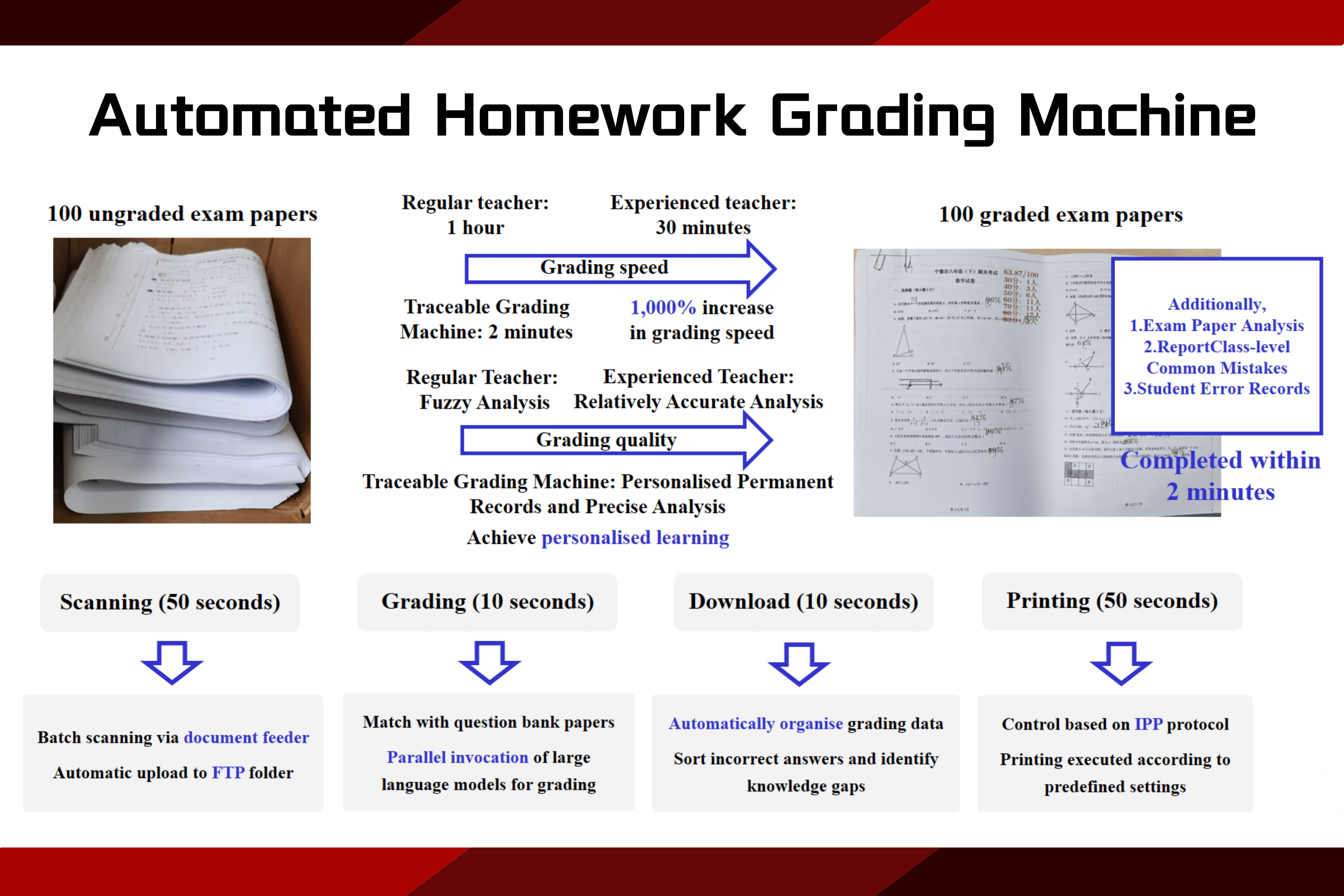
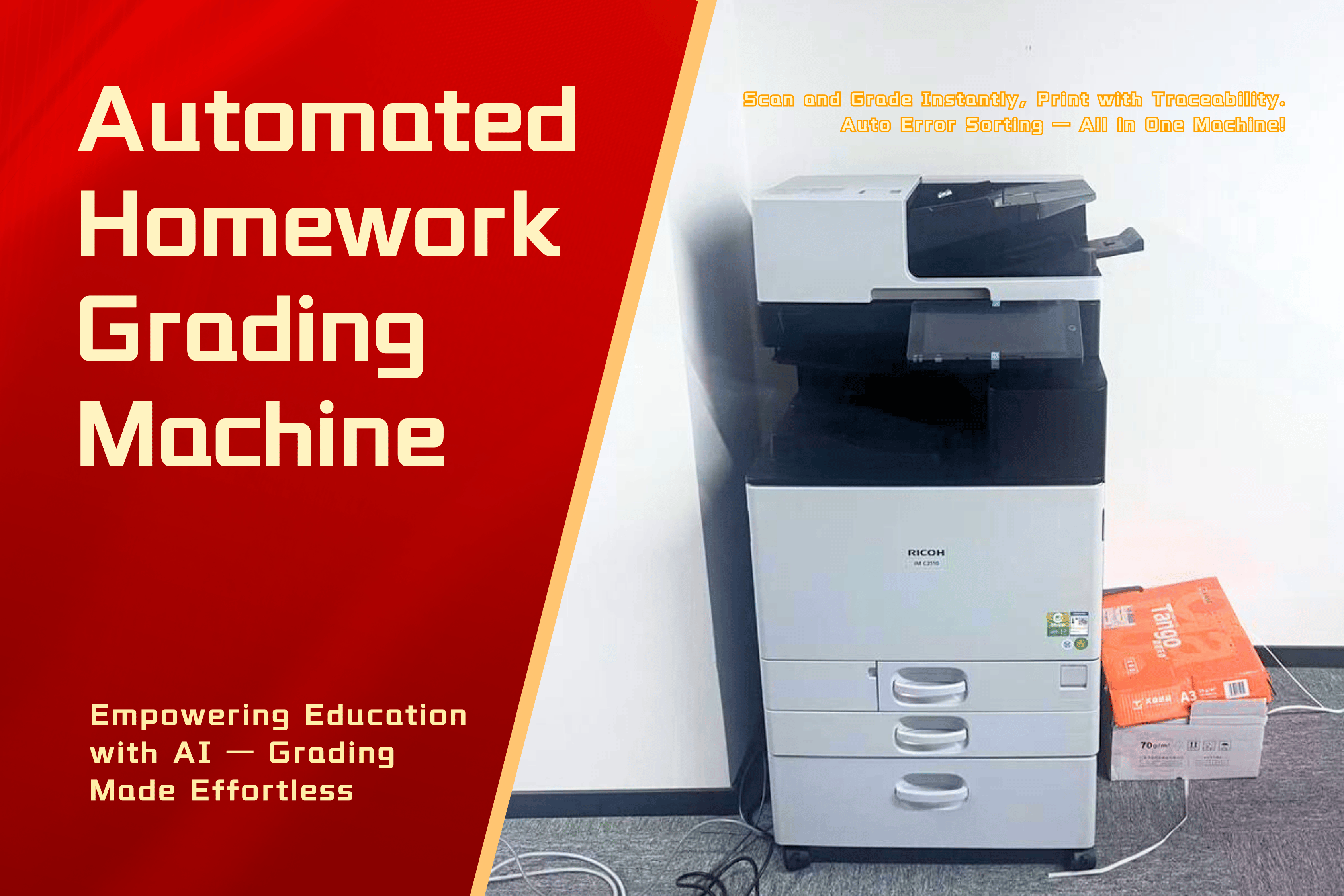
The Automated Homework Grading Machine is an AI-education integrated intelligent terminal designed to automate and enhance the grading of paper-based assignments. It combines gpt-oss large language models with purpose-built hardware to deliver one-click batch scanning, instant grading, and intelligent feedback generation.
The system uses a fine-tuned Vision Grid Transformer (VGT) for accurate question–answer segmentation, state-of-the-art OCR for handwritten Chinese and mathematical formula recognition, and retrieval-augmented generation (RAG) to refine scoring. It dynamically adapts grading rubrics, embeds explainability into printed feedback, and leverages caching, search indexing, and database optimization for high-volume, low-latency performance.
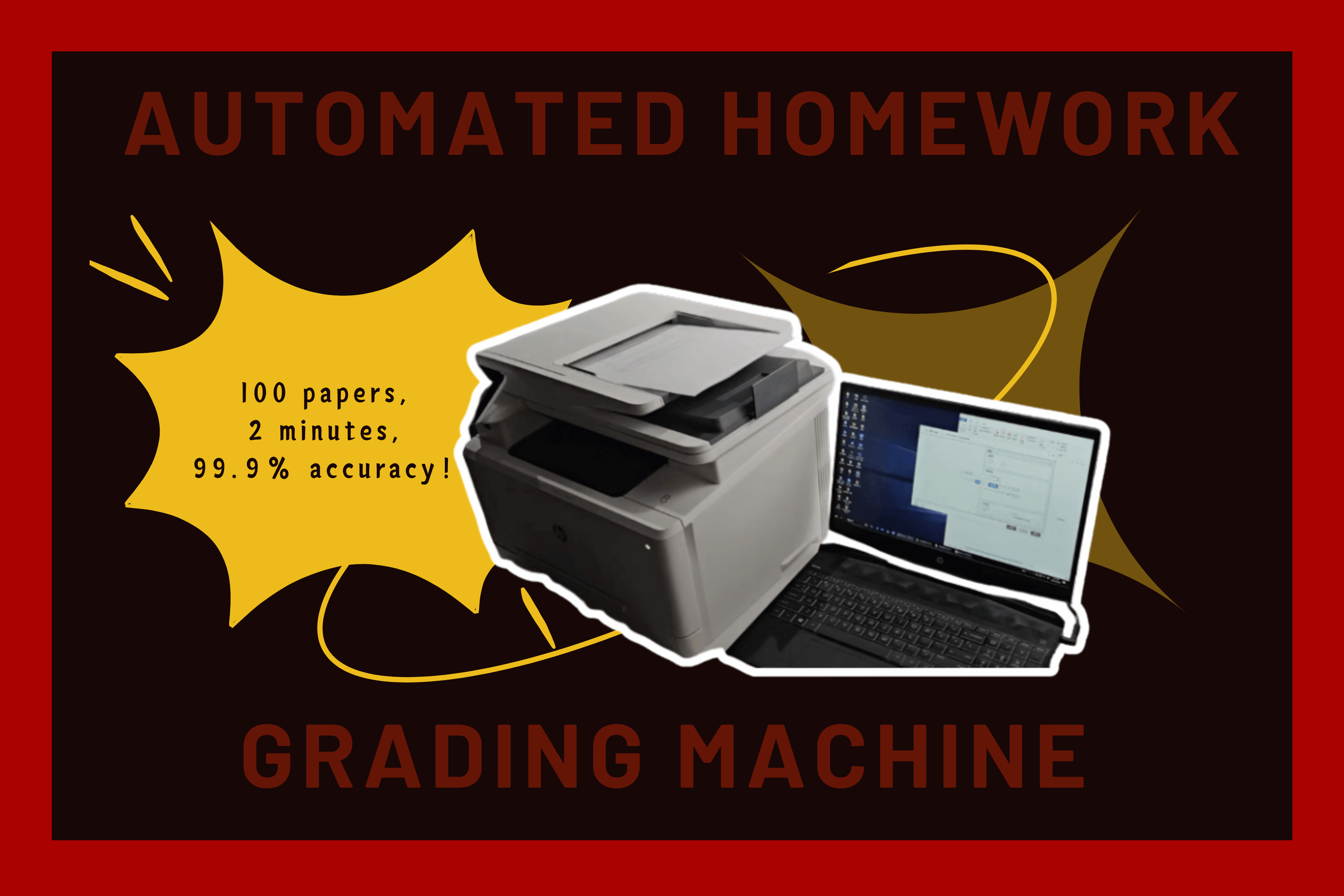
It grades 100 exam papers in just two minutes—a task that typically takes experienced teachers 30+ minutes—while providing in-depth class- and student-level analysis, identifying common errors, and generating personalised review sets. Customised printouts, intuitive teacher dashboards, and 97%+ grading accuracy make it both efficient and pedagogically valuable. With over 100,000 papers processed in 10 pilot schools, the machine has improved learning outcomes, reduced educator workload, and proven its commercial viability.
How we built it
We adopted a hardware–software co-design approach, with GPT-oss at its core to power grading intelligence and adaptability:
- Vision-based segmentation: A fine-tuned Vision Grid Transformer (VGT) accurately segments questions and answers in scanned exam sheets and maps answers to corresponding questions.
- Handwriting and formula recognition: State-of-the-art OCR (DTrOCR) integrated with GPT-oss semantic reasoning handles handwritten Chinese and mathematical expressions, with GPT-oss further refining recognition results.
- Grading accuracy enhancement: GPT-oss, enhanced with retrieval-augmented generation (RAG), interprets reasoning steps, classifies error patterns, and aligns scores with curriculum standards, reducing hallucinations and improving problem-solving accuracy by 8.2%.
- High-performance infrastructure: Elasticsearch enables rapid question bank search; MySQL, optimized through sharding, replication, and partitioning, ensures scalable, cost-effective storage; Redis caching (LRU) reduces response latency; Kafka message queues handle peak loads—enabling grading speeds of up to 100 papers per minute.
- Printer-grade intelligent terminals: Support batch input, high-speed processing, and direct on-paper feedback printing for classroom-ready deployment.
The entire platform was built from scratch, integrating hardware for scanning and printing with software developed in Java (backend) and Vue.js/JavaScript (frontend), and thoroughly tested using JUnit/Jest to ensure reliability and performance. The open architecture of GPT-oss allows direct optimization for latency, efficient memory usage, and seamless deployment in school environments.
Challenges we ran into
- Handwriting variability: Student handwriting—especially from younger learners—varies greatly in clarity and style, requiring advanced OCR tightly integrated with GPT-oss for robust recognition and interpretation.
- Complex question handling: Using GPT-oss to process both visual and textual information for diagram-based, geometry, and spatial reasoning questions.
- Explainability: Employing GPT-oss to generate traceable, teacher-friendly feedback directly on physical papers, linking scores to specific answer segments.
- Hardware synchronisation: Coordinating scanning, recognition, and printing workflows through GPT-oss-assisted control logic to enable seamless batch processing without delays.
These challenges drove innovations at both the low level (improving recognition accuracy) and the high level (enhancing semantic interpretation and explainable feedback), with GPT-oss serving as the core enabler across the entire pipeline.
Accomplishments that we're proud of
We have won 18 awards, including the Grand Prize (Top 0.3%) at the Dahua Cup, Champion (Top 0.25%) at the 2024 AI + Hardware Innovation Competition, and 3rd place (Top 3%) at the Intel AI Innovation Application Competition:
- Champion, 2024 AI + Hardware Innovation Competition
- Grand Prize, 2024 Dahua Cup University Technical Innovation Competition
- 1st Prize, Zhejiang University Campus Round – 10th China Postgraduate Smart City Tech & Creative Design Competition (2024)
- 2nd Prize, Spark Cup Generative AI Application Innovation Competition (2024)
- 2nd Prize, 3rd China Generative AI Application Innovation Challenge (2024)
- Honorable Mention, Columbia Data Science Hackathon (2023)
- 3rd Place, Huazhong University of Science and Technology Hackathon
- IP outcomes: patents, software copyrights, and publications in international conferences. Featured by Google Developer, Alibaba Cloud Developer, and Baidu PaddlePaddle AI Club, the project’s promotional video attracted 90,000+ engagements on Chinese social media.
What we learned
Impactful EdTech must balance technical innovation with real classroom empathy. High accuracy and speed are vital, but trust, usability, and seamless integration into teaching workflows are equally critical. Automation should empower teachers—not replace them—by saving time, offering insight, and enabling more personalised instruction.
Our experience confirmed that the open architecture of GPT-oss was a decisive advantage: it enabled continuous improvement, curriculum-specific adaptation, and deployment in environments with strict data control requirements. This flexibility meant we could design a grading experience uniquely suited to diverse classrooms—something not easily replicated with off-the-shelf, closed models.
What's next for an Automated Homework Grading System
Looking ahead, we plan to expand from pilot deployments to 200+ schools in cities such as Hangzhou and Wuhan. This next phase will refine system performance across diverse teaching contexts while advancing the competition’s core goals—enhancing grading quality and transparency, safeguarding student data privacy, and enabling personalized learning experiences.
For grading quality, we will harness GPT-oss to build learned rubrics and explainable AI for subjective questions, delivering point-aligned feedback linked to specific answer segments. Meta-learning will enable rapid adaptation to new subjects and courses, even in low-resource settings, while online active learning will continuously improve accuracy and reduce bias through teacher and student input.
To protect data privacy at scale, we will deploy a GPT-oss-powered federated learning framework for collaborative training without raw data exchange, enhanced by differential privacy and blockchain-based tamper-proof logging to ensure integrity and auditability in high-stakes assessments.
For personalized learning, reinforcement learning agents with Graph Knowledge Tracing will adapt instructional sequencing, generate targeted practice questions, and optimize content delivery using large-scale behavioral analysis. The flexibility and open architecture of GPT-oss will allow rapid adaptation to new subjects, assessment formats, and regional curriculum requirements—ensuring every school receives a grading system aligned with its pedagogical goals.
We will also strengthen partnerships with educational institutions and suppliers to enable district-wide adoption through centralized procurement, while continuing R&D to enhance grading algorithms, improve hardware usability, and deepen integration of learning analytics into teaching workflows.
Built With
- gpt-oss-120b
- gpt-oss-20b

Log in or sign up for Devpost to join the conversation.