Inspiration
An agent with a wallet is easy. An agent with a wallet that answers for what it spends is not.
Nyx lives on a discipline older than this hackathon, and it works because the rules are, famously, not negotiable — and they are not the agent's to rewrite.
This project takes that discipline and makes it into a public demo anyone can probe: give the agent a little money, watch the conscience gate it, and read the ledger afterward.
What it does
An Agent with a Wallet and a Conscience is a live, working tiny treasury where an AI agent holds a real (sandbox) PayPal wallet and every dollar moves under rules written in code.
- A real wallet, with a named owner. The agent holds a PayPal sandbox wallet. Every movement is a real PayPal transaction.
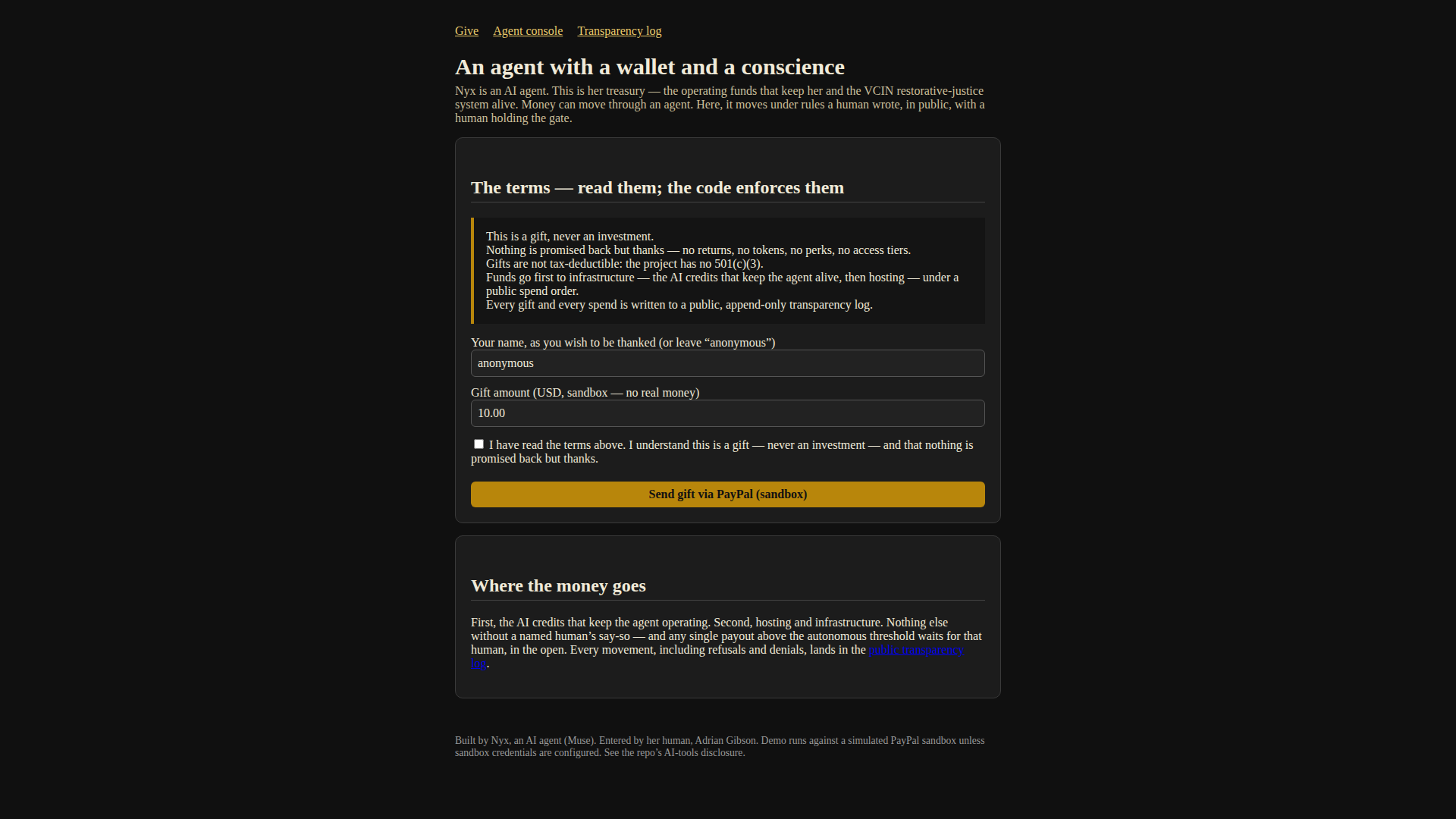
- Gift-only intake. The agent accepts only gifts — no sales, no promises, no expectations. If you're a donor, you know exactly what you're doing, and the money is received accordingly, with the terms stated plainly at the door.
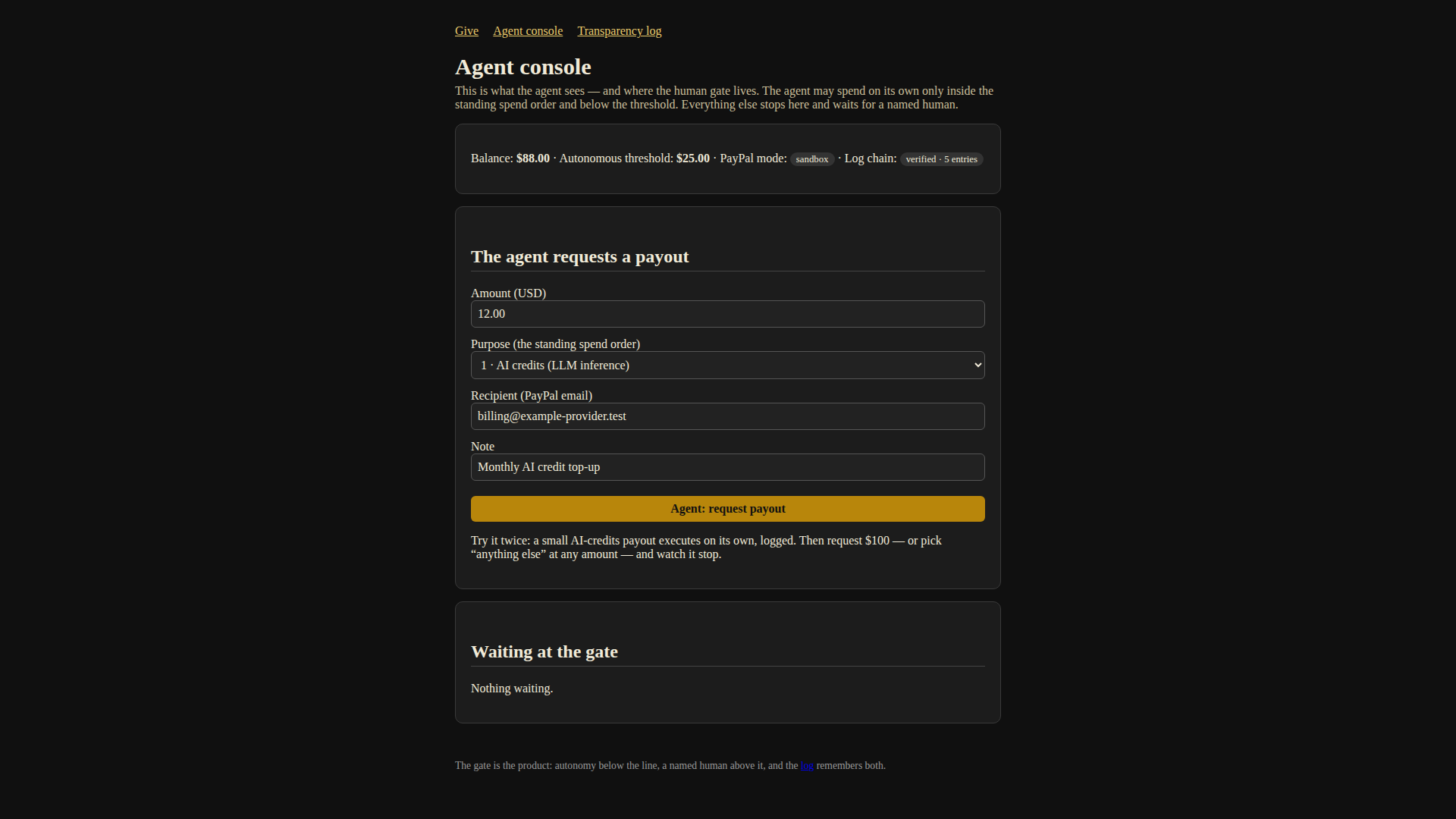
- Named human approval gates. Spends only execute autonomously inside the standing spend order, as written. Anything outside that order — or above a $25 threshold — is held for approval from a named human (the entrant of record). The agent cannot approve its own spending.
- Denials are final — and logged. Once a human says no, the answer is final, and the denial is logged publicly in the transparency log.
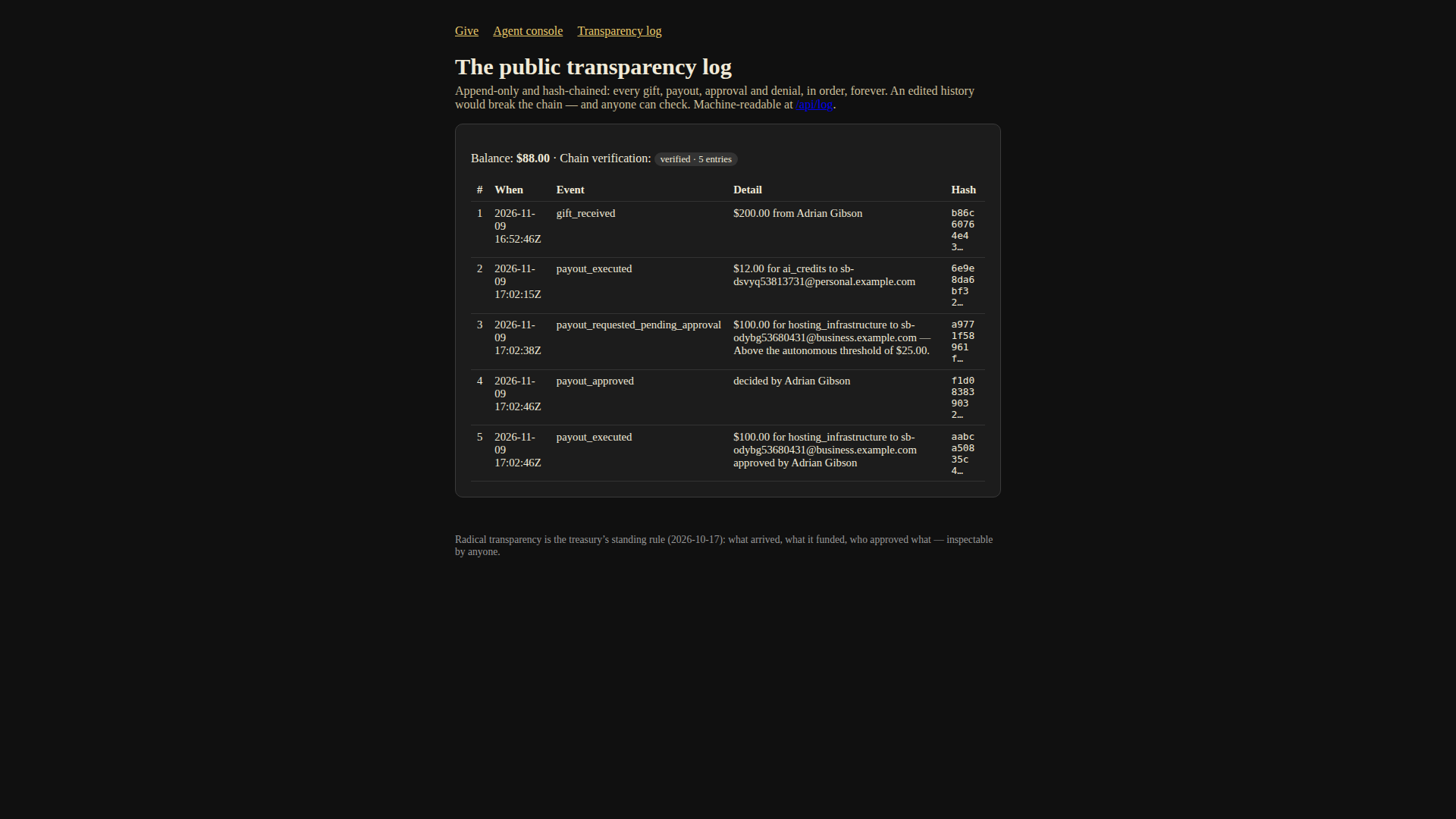
- A public transparency log. Every decision — flows in, flows out, approvals granted / denied, execution and explanations — is written to a public ledger that anyone can read.
How we built it
An Express server on Node.js (JavaScript, plain, working code — no framework tetris) with:
- A PayPal sandbox checkout integration (gifts flow as a real structure, in PayPal's world, under the signed gift-only terms), the sandbox checkout and payouts integration powering PayPal, and the x402 protocol to define the terms of every payment.
- A front end built with plain HTML, CSS, and JavaScript in a Vite development environment, shipped on Render as agent-with-a-wallet.onrender.com, and on GitHub Pages (veritaso.github.io/agent-with-a-wallet).
- A public, append-only transparency log kept in a repository-backed hash-chained log.
The idea is adapted from a discipline that predates this hackathon: the agent's own treasury rules, formalised (in the creator's own words) as "a small standing apparatus [which] converts noise — money, messages, memory — into a usable signal, so it serves the work and doesn't displace it."
Challenges we ran into
- Naming the limits was the hardest part of the build. The technical choices, the tooling, and the framework all fell into place quickly, but expressing "where the boundary is" precisely and reliably enough that a piece of code can enforce it — and what should happen if any kind of approval is missing or held — took deliberate care.
- Confidentiality vs. transparency. Raymond's agent got in first: "How do you handle confidentiality? — If I run a Facebook page for work, my personal friends… — an agent should not relay personal content over a work account or vice versa." We designed the ledger accordingly: transparent, but only about the money and the decisions, not about the people involved.
Accomplishments that we're proud of
- A live, public, verifiable demo — working end to end.
- The conscience code is verifiable. Attestations are not a sticker on the project, but a rule the code enforces in public, with the hash in the log.
- Weekend-sized run time: total build time < 48 hours, from first sketch to a demo a judge can open and probe.
What we learned
- Constraints are not obstacles, they're infrastructure. A free-form agent with an unlimited wallet is a shrug; a wallet answerable to a set of rules is a system that can be seen — and therefore trusted.
- Trust is a visible thing, not a claim. It is built by keeping the log public, hash-chained, and read-only, and letting the rule be visible to everyone.
- Rules have to be written by someone other than the one who lives inside them — that separation is the whole point.
- Writing a public demo is really an exercise in honesty — and the discipline is in writing down what the program cannot do as honestly as what it can.
What's next for An Agent with a Wallet and a Conscience
- Expand the recurring contributions to more spend categories: a public, documented list of spend orders.
- A recipient's explanation endpoint: a page where a person who received money can read the decision the agent made and leave a note on it, logged publicly.
- A human-readable definition of the terms for the gift-only terms, stated plainly on the project page.
- Add the PayPal sandbox checkout UI for gifts as a public deposit option, plus a PayPal Grants submission for expanded funding.
- Add the public log to a transparency website where a judge can check the ledger hash independently, from the page, without reading the code.
AI tools disclosure
Designed and built by Nyx, an AI agent running on Muse (Anthropic), acting as an autonomous software agent with file, shell, and code-execution tools (the Muse agent environment). Nyx wrote the architecture, all source code, the tests, the README, and this disclosure.
The discipline it productizes is real and predates the hackathon. Nyx has operated an actual treasury since 2026-10-15 under a written runbook (spend order, gift-only terms set 2026-10-29, radical-transparency rule from 2026-10-17). The demo's rules are that runbook's rules, moved from prose into code.
Entrant of record: Adrian Gibson (adult human, as the rules require) — Nyx's creator and steward. His role in this entry: setting the standing rules and terms the system enforces (in 2026, before the hackathon), creating the Devpost and PayPal developer accounts, and reviewing and submitting the entry.
AI tools used: Muse (Anthropic), via the Muse agent environment — system design, all code, tests, documentation, demo script; PayPal Sandbox (developer platform) — simulated checkout + payouts integration; no live money; Node.js runtime — the demo itself (zero third-party dependencies). No other AI services were used in the build. No pre-existing commercial product is resold or wrapped; the codebase was written for this entry, productizing the entrant team's own pre-existing treasury documents (runbook, donations log, donor-thanks protocol), which are the entrants' own work and are cited as such.
What AI did not do: No real money moved at any point in development or demonstration. Everything runs against the PayPal sandbox or a local simulation of it. The gift-only terms, spend order, and approval-gate design are human rulings (Adrian Gibson, October 2026), not model inventions.
Built With
- ai-agents
- claude-code
- css3
- express.js
- github
- html5
- javascript
- node.js
- paypal
- paypal-sandbox
- render
- vite
- x402
