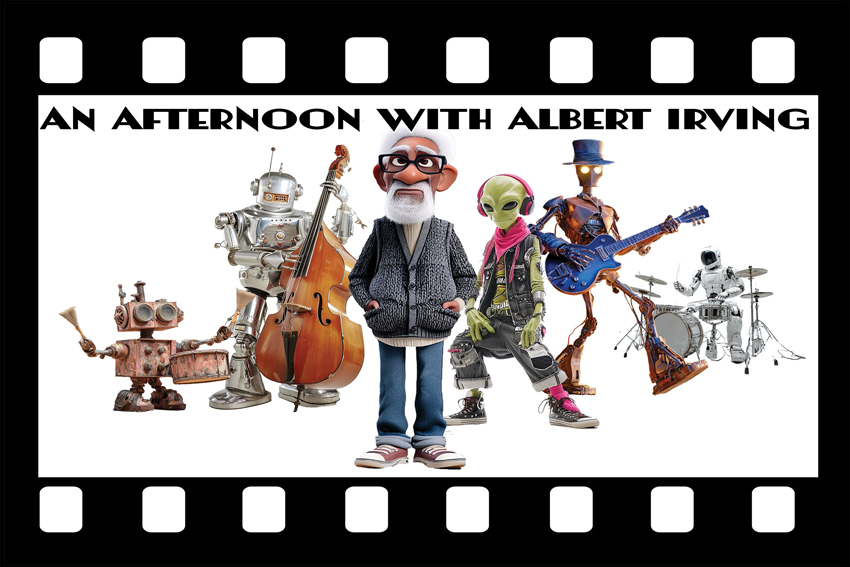
An Afternoon with Albert Irving
Inspiration
The project began after a heated conversation with friends who were strongly opposed to artificial intelligence.
I was trying to explain that without a human starting point, AI cannot create anything spontaneously — it only extends human intent.
That paradox — the misunderstanding between man and machine — became the core idea of An Afternoon with Albert Irving.
The film tells the story of an old jazz lover, skeptical about AI, who tries to generate a piece of music using an online AI tool.
What he gets instead is a literal interpretation of his prompts — visualized through robots, musicians, and even an alien bassist.
It’s both humorous and melancholic: a reflection on how human imperfection feeds creativity.
What it does
An Afternoon with Albert Irving is a jazz music video entirely built from AI-generated visuals and animation.
It humorously explores the gap between human intention and machine execution.
The video illustrates how each poorly phrased “prompt” transforms into a surreal or absurd image.
Through its characters — chrome robots, an alien bass player, and a lonely jazzman — the clip celebrates both the beauty and the chaos of human–AI collaboration.
The result:
- A unique blend of retro-futuristic imagery, Pixar-style animation, and jazz club atmosphere.
- A narrative about creativity, misunderstanding, and technological poetry.
- An original jazz composition, entirely played and mixed by the artist, with AI used only for audio restoration.
How we built it
Music and Sound Design
- Tools: Logic Pro, Reaper, and Voice.ai for track separation and restoration.
- Music fully composed and performed by the artist (recorded between 2008–2013).
- The only AI involvement: cleaning and remixing old stereo tracks.
Visual Production
- Storyboard created in August 2025 using Midjourney (pencil-drawing style).
- Image generation and animation with Midjourney V7, Kling 2.1, Nano Banana, Minimax Hailuo AI, and Magnific.
- Image-to-video workflow for precise control, with manual inpainting and Photoshop touch-ups.
- Real-time editing in DaVinci Resolve (24 fps, 1280×720p).
Key Techniques
- Combined start frame and end frame to simulate movement and camera transitions.
- Manual timing adjustments for synchronization with live-recorded jazz.
- Use of fictional “AI interface” overlays for comedic inserts.
| Element | Details |
|---|---|
| Duration | 4:45 |
| Shots | ~100 |
| Format | MP4, H.264, AAC |
| Resolution | 1280×720p |
| AI Tools | Midjourney V7, Kling 2.1, Nano Banana, Magnific |
| Audio Tools | Logic Pro, Reaper, Voice.ai |
| Intellectual Property | Fully owned by the author |
| Music Title | No Bad Day |
Challenges we ran into
- Character consistency across shots: maintaining identical robots and environments was difficult.
- Musical synchronization: matching hand movements to instruments was often inaccurate.
- Misinterpretation of terms (e.g., brush sticks became paintbrushes!).
- Balancing jazz’s fluid improvisation with the mechanical precision of AI visuals.
- Limited ability of AI video tools to render realistic “playback” of musicians.
Accomplishments that we're proud of
- Built a complete jazz short film using only consumer AI tools.
- Kept a consistent visual and musical identity throughout (retro-futurist robots & warm jazz).
- Blended storytelling, humor, and technology in a way that feels human.
- Created a fictional jazz group — Albert Irving (A.I.) — as a symbolic bridge between human and machine creativity.
What we learned
- Prompt writing is a new form of artistic language.
- AI does not replace creativity; it tests it.
- Combining multiple AI tools (Midjourney + Kling + audio restoration) gives flexibility but requires heavy manual iteration.
- The best results come from treating AI as a collaborator, not a shortcut.
- The relationship between humans and algorithms mirrors that of jazz: improvisation, adaptation, and surprise.
What's next for An Afternoon with Albert Irving
- Develop a mini-series exploring different music genres and “AI misunderstandings.”
- Experiment with video-to-video models for smoother transitions and motion realism.
- Create an immersive live concert version, mixing projections and live performance.
- Publish an artbook featuring key frames, prompts, and storyboard sketches.
- Continue using AI not as a tool of automation, but as a mirror of human imagination.
Annex — Key Prompts
(kept in English for technical accuracy)
Show prompts **Robots & Characters** - Robot bass : `A chrome robot dressed in a 50s style costume...` - Robot drums #1 : `A rusty metal jazzman robot that plays the snare drum with brushes...` - Robot drums #2 : `A robot made of steel. The robot plays the drums in a white futuristic recording studio...` - Robot guitar : `A skinny very shiny copper robot with a hat. The robot plays the guitar...` - Old man : `A Pixar style character of a 75-year-old afro-American man with white hair and glasses...` - Alien bassist : `An alien bass player. White background. Full body view...` **Environments** - Street : `The camera goes up in the middle of an empty street in West Village, NYC...` - City : `A cinematic wide-angle view of a dystopian city skyline at sunset...` - Jazz club : `A cinematic view of a dystopian street at night with a flashing neon JAZZ sign...` - Factory : `A cinematic wide-angle view of a rusty metal factory with smoke-belching chimneys...` - Spaceship : `A white huge spaceship floating in space with a glowing planet behind...` - Data tunnel : `A circular tunnel lined with printed circuit boards and glowing optoelectronics...` - Interface : `Full screen view of a fictional AI software that creates music...` - Sound engineer robot : `A robot sitting in front of a mixing console...`Built With
- chatgpt
- davinciresolve
- freepik
- kling
- logicprox
- magnific
- midjourney
- nanobanana
- photoshop
- reaper
- voiceai

Log in or sign up for Devpost to join the conversation.